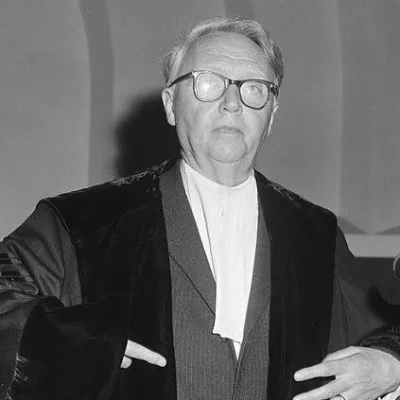
Hendrik Andriessen
Human Design Chart
Biography
He died 12 April 1981 in Haarlem.
What does Manifestor 3/5 mean for Hendrik Andriessen?
Manifestor 3/5 — Design at a Glance
Hendrik Andriessen was seen as a pioneer and visionary whose task it was to lead the world into a new future. His design corresponds to that of an Manifestor, comparable to a Roman emperor: He had the great vision of an empire but did not wage the necessary wars himself; instead, he sent others to conquer lands for him. This superior way of thinking led to misunderstandings and polarization; some loved his dreams and followed him, while others rejected or even hated him because of these grand visions. To find the right followers, it was crucial that he informed his environment in a timely and precise manner about his plans. This strategy of informing served to minimize misunderstandings and attract suitable supporters. If Hendrik Andriessen lived according to this guideline, he was rewarded with inner peace. However, if he violated his design by failing to inform others, he felt a persistent deep anger. His life energy thus focused on creating resonance through clear communication and reducing resistance through transparency rather than fighting against the current.
Ego Authority
Hendrik Andriessen revealed himself as someone whose inner truth lay in the will of the defined Ego Center. This authority was only possible because his Emotional, Sacral, and Spleen centers were open, leading to great influenceability. His authenticity did not come from thinking but rather by listening to himself while speaking. What came spontaneously and unfiltered from his throat represented his truth; the mind often served other interests or his open centers.
Consistently following this will could appear selfish to others, yet it was necessary for him to achieve his goals and keep promises. For him, every action had to yield some form of reward, whether through material success experiences or the urge to surpass limits and be first. However, there was a risk of distraction due to his openness. A central mechanism for him was the need for a pause after each goal achievement. Continuous work did not lead to the desired result but rather to unhealthy exhaustion and illness. His design thus required a balance between the powerful expression of will and necessary recovery to preserve his energy.
The 3/5 Profile — Martyr / Heretic
Hendrik Andriessen revealed himself as someone who did not accept knowledge theoretically but only through personal, often painful experimentation. His design tended towards skepticism towards prefabricated solutions and instead favored experiencing everything firsthand. This attitude stemmed from his Line 3 of the Experimenter: He believed nothing until he had experienced it. Through this phase of personal tests and failures, he accumulated a rich treasure of practical life experience.
This self-acquired knowledge became the foundation for his role as a Hero, shaped by Line 5. While Line 3 drove him to solve problems through trial and error, Line 5 used these insights to offer pragmatic help to others in crisis moments. Hendrik Andriessen thus appeared attractive to those around him; others sought his proximity because they wanted to learn from his experiences. This dynamic flattered him but also carried the risk of public disappointment: If he failed at an experiment in front of others, the pain was great.
Line 5 also gave him a certain caution and distance. He learned that people often projected onto him, which led him to avoid or withdraw from certain interactions to prevent emotional overload. His path involved combining the loyalty and adaptability of Line 3 with the pragmatic withdrawal of Line 5. Thus, he transformed personal mistakes into valuable lessons without suffering under the pressure of a constant hero role.
Single Definition — Defined & Open Centers
Hendrik Andriessen revealed himself through a pronounced inner strength and authority resulting from the definition of his G Center, Heart Center, and Throat Center. His design gave him a clear sense of self-identity and a consistent direction in life (G Center), paired with the willpower to keep promises and use resources autonomously (Heart Center). This energy flowed directly into his voice and manifestation; he spoke from a reliable 'I want', which endowed him with a precise, authentic expression.
However, this closed system of identity and action power was in tension with his high sensitivity towards external fields. His Head Center, Ajna Center, Sacral Center, Solar Plexus Center, Spleen Center, and Root Center were open. Without a constant generative energy source in the open Sacral Center, he was vulnerable to exhaustion when taking on others' work energy or trying to keep up with their pace. His open Solar Plexus absorbed emotional waves from the environment, which could lead him to experience foreign moods as his own instability or avoid confrontation out of fear of rejection.
Furthermore, his open Spleen Center carried a fundamental survival anxiety; he unconsciously sought security through others and risked unhealthy dependencies to maintain a sense of well-being. The open Root Center made him take on external stress, which could lead to a cycle of adrenalized pressure that he did not generate himself. His open Head and Ajna Centers made him receptive to mental inspiration but also vulnerable to the confusion and questions of others, which he might interpret as his own problems. The challenge lay in using his strong inner voice without being overwhelmed by borrowed energies and emotions from his environment.
Channels for inner reflection and selfless pioneering spirit.
Hendrik Andriessen oscillated between deep reflection and active initiation. His design marked a duality: on one hand, the need for withdrawal to internal processing; on the other, a competitive impulse to enforce change through challenge. This tension defined how he interacted with the world – not as a steady flow but as a rhythmic alternation between listening and acting.
Channel of the Lost Son 13-33 connected his G Center with his Throat Center. Through Gate 13, the Listener, he gathered information and secrets from the environment. He did not merely passively store this data; Gate 33, the Withdrawal, challenged him to withdraw to reflect on these experiences patiently. He sought the deeper truth hidden beneath the surface before sharing it. This process brought continuity and stability to his development as he learned to draw from the past rather than blindly look towards the future.
Simultaneously, Channel of Initiation 51-25 operated in his Heart Center. Here, Gate 51 of Shock drove a competitive ego-energy that always wanted to be first. However, this competitiveness was connected with Gate 25, the Spirit of Self, which saw beauty and universal love. Hendrik Andriessen used this channel to promote individuation – both within himself and in others. He prepared the ground for growth through 'shock' or challenge, often meaning breaking normal boundaries. This impulse contrasted with the patience of the first channel: while 13-33 waited until the truth was ripe, 51-25 actively called forth the courage to transform.
The combination of these forces created a person who drew wisdom from the past (13-33) but had a strong urge to provocatively carry this insight into the present (51-25). The challenge lay in timing: when was it time to listen and gather, and when to initiate and compete? Hendrik Andriessen lived this internal tension by navigating between the protection of what he heard and the necessity for growth through conflict. His mechanics showed that true maturity required both the patience of an observer and the courage of a fighter.
Individual Circuitry — Circuit Signature
Hendrik Andriessen revealed himself through a strong, individualistic basic attitude. His design connected his Identity Center and Heart Center via the Centering Circuit (Channel 25-51). This connection created inner certainty and courage without needing to verbally articulate these convictions; instead, this power worked through presence.
Parallel to this, he processed emotional waves from the past. The Meaning-Finding Circuit linked his Throat with his Identity Center (Channel 33-13), enabling him to find felt insights and the meaning behind past experiences and share them with the collective.
These two circuits formed a contrast: while inner centering was firm and individual, emotional processing followed a cyclical pattern of highs and lows. Hendrik Andriessen lived this tension between strong internal conviction and the necessity to process past emotions and pass them on. The connection to his Throat Center in the Meaning-Finding Circuit offered an outlet for the verbal expression missing from the Centering Circuit by verbally sharing insights from emotional history.
Right Angle Cross of Eden 3
Hendrik Andriessen was marked by the energetic signature of the right cross of Eden 3, which determined his fundamental life dynamics and destiny theme. This design set an archetypal framework in which his energy operated – independent of specific gates or channels. It represented a deeper, often unconscious motivation as well as the evolutionary purpose that became active through this configuration in Human Design. The essence of the Eden archetype in its right expression drove structure, creation, or transformation on an individual level. Hendrik Andriessen lived within this framework, which significantly influenced his actions and reactions. Thus, the right cross of Eden 3 defined the core of his existence by setting a specific direction for his personal growth and development. This energetic foundation created the conditions under which he realized himself and interacted with the world. His design showed a tendency to live out these archetypal patterns, shaping his entire life path. The mechanics of the cross not only described his nature but also provided context for his actions and experiences. Hendrik Andriessen followed this inner compass set by the right cross of Eden 3, forming his unique perspective on life.
Saturn Return · Uranus Opposition · Chiron Return · 2nd Saturn Return — Life Cycles
Hendrik Andriessen established himself as a recognized authority towards the end of the 1940s, carrying his internal structure outwardly. This was concretely evident in 1949: at age 57, he became director of the Royal Conservatory in The Hague. For his design, this marked the second Saturn return, a phase that heralds the transition to full responsibility and collective anchoring. In this cycle, years of groundwork solidified into a stable position within the public sphere. Internal order became visible and recognized, allowing Hendrik Andriessen to clearly define his role in the community. The Saturn return here acts as a catalyst for stability and authority by connecting personal development with societal expectations. Hendrik Andriessen used this moment to institutionalize his expertise. His appointment was no coincidence but the result of long-term maturation reaching its peak during this life phase. Through this position, he not only took on administrative tasks but also represented the values and structures of his field. The second Saturn return often confirms a person's true nature in the collective context. Hendrik Andriessen lived this confirmation through assuming a leading role at the conservatory. His authority was thus effective both individually and publicly.
Manifestor · Ego Authority — Synthesis
Hendrik Andriessen led a life guided by deep inner direction and the desire to gather experiences and pass them on. As a Manifestor with defined authority in the ego, his design points to someone who had visions and was willing to express them – provided they arose from spontaneous, unfiltered internal impulses (Throat Center). The connection between G-Center and Throat (Channel 13/33) strengthens this tendency towards reflection on experiences before passing them on as wisdom. The openness of many centers, particularly the Head, Sacral, and Root Centers, indicated a high sensitivity to other people's energies, making him a mirror for his environment while also making him susceptible to conditioning.
A central paradox in Andriessen's design lies in the tension between the need for individuality and the ability to be swayed by external influences. As a Manifestor, he was destined to walk his own path (defined G-Center), yet open centers made him receptive to other people's energies. This dynamic manifested in a tendency towards spontaneous action and ego-driven decision-making while being influenced by the environment. The right cross points to a life task of mastering this tension and gaining wisdom through experience.
2 Defined Channels
Incarnation Cross - Right Angle Cross of Eden 3
Solar Return
The Solar Return shows the moment when the sun returns to its exact birth position - your personal solar year.
Life Cycles
Discover the life cycles with a detailed triple view (birth chart, cycle chart, composite).
Human Design Profile
- Type
- Manifestor
- Strategy
- To inform others before acting
- Authority
- Ego Authority
- Profile
- 3/5 - Martyr / Heretic
- Definition
- Single Definition
- Incarnation Cross
- Right Angle Cross of Eden 3
- Date of Birth
- 17.09.1892 19:00
- Place of Birth
- Haarlem, Netherlands
Frequently Asked Questions
What is Hendrik Andriessen's Human Design type?
What profile did Hendrik Andriessen have?
What authority did Hendrik Andriessen have?
What incarnation cross did Hendrik Andriessen have?
When was Hendrik Andriessen born?
Discover your own Human Design
Are you also a Manifestor? Find out in a personal reading how to use your initiation power peacefully and dissolve resistance.
More Personalities
Back to overviewAaliyah

Alexia

Alizée

Angèle

Anne-Marie

Arcángel