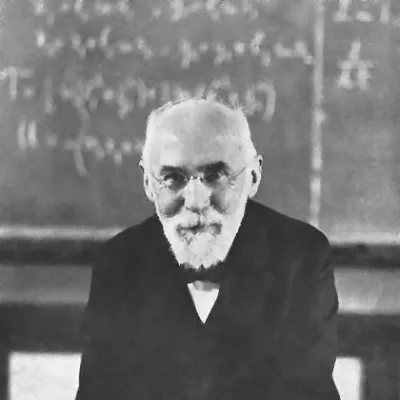
Hendrik Lorentz
Human Design Chart
Biography
Lorentz died on 4 February 1928 in Haarlem, Netherlands.
The Human Design of Hendrik Lorentz: Manifesting Generator 6/2
Manifesting Generator 6/2 — Design at a Glance
Hendrik Lorentz revealed himself as someone who acted with unique speed and propelled various areas of his life in parallel. His design as an expressing generator combined the constant energy source of a generator with the ability to skip steps. This allowed him to quickly draw things into his life, unlike pure generators who often had to proceed step-by-step.
This rapidity brought specific challenges. Hendrik Lorentz tended to miss important stages or start multiple projects simultaneously, driven by different impulses. If he did not wait for the inner signal of his sacral center – that clear 'yes' which confirmed – this swift activity could quickly turn into frustration. The risk was that he would become overwhelmed or have to correct results because he had rushed ahead too quickly.
The solution for his design lay not in linear task completion but in consciously responding to life impulses. Only when he ensured that his inner authority and sacral center supported each endeavor did potential frustration transform into deep satisfaction. In this state, Hendrik Lorentz found his true creative power: not through strict focus on a single thing, but through playful switching between various interests as long as they brought him joy and energetic confirmation.
Sacral Authority
Hendrik Lorentz demonstrated a direct, physically anchored way of decision-making. As a generator, he possessed sacral authority, meaning that his strategy and inner guidance were identical: He responded to external stimuli from the gut. This configuration greatly simplified his process since no discursive weighing was necessary; an immediate physical response sufficed.
Prerequisite for this clarity was his open emotional center. Thus, he could not act impulsively but had to wait for internal confirmation – a surge of energy or a vital reaction in the lower abdomen. When Hendrik Lorentz felt alive and energized about something, he knew he was on the right path. This energy was inexhaustible and allowed him to dive into his activities with great enthusiasm without an external goal or purpose being paramount. The joy of doing itself drove him forward.
This sacral guidance was supported by his activated spleen center. This gave him the ability to react particularly quickly and spontaneously. He had direct access to his instinctive perception and physical well-being. Hendrik Lorentz could therefore rely not only on the slow, deeper signal from the sacrum but also on quick intuitive impulses from the spleen. Both sources together enabled a reliable, physically grounded orientation in life that protected him from falling into excessive contemplation.
The 6/2 Profile — Role Model / Hermit
Hendrik Lorentz revealed himself as someone who carried out his life mission in two clearly distinct phases. In the first three decades of his life, his path was marked by experimentation and the principle 'trial and error'. As a 6/2 profile, he acted like a pure line three before Saturn's return: He gathered experiences, hit boundaries, and retreated after setbacks to start anew. This period was characterized by inner instability and a certain immaturity that he often did not recognize himself; he had to wait for external circumstances to call him out of confusion.
After the age of 30, his dynamics fundamentally changed. The sixth line became active, initiating a phase of intense reflection and self-awareness. Hendrik Lorentz metaphorically withdrew into a 'cave' to look back at earlier experiments with distance. This time of healing was essential for his development into a true role model. Through strict self-discipline and precise, correct communication in detail work, he transformed from an exploring beginner to an authoritative voice. Finally, he emerged from this isolation as a wise person, ready to share the accumulated wisdom and ability for deep introspection with others who now came to him to learn from his authenticity.
Triple Split Definition — Defined & Open Centers
Hendrik Lorentz revealed himself as someone who constantly struggled with mental pressure to question and understand connections. His defined Head and Ajna centers created a trustworthy, specific form of conceptual thinking; he was perpetually engaged in a mental process that lacked the direct energy for implementation. Instead, his mind served to create concepts and inspire others to think through inspiration. This mental activity flowed through his defined Throat into the world, allowing him to consistently express his thoughts.
Parallel to this, Hendrik Lorentz possessed immense vital force. His defined Sacral center generated daily energy that was only correctly available in response to external stimuli. Initiatives from the mind would have interrupted this source and led to frustration; his design required waiting for life to ask before responding with full power. His defined Spleen supported this through spontaneous intuition in the present moment, helping him make healthy decisions for his well-being without rational justification.
In contrast, Hendrik Lorentz was open in other areas, making him conditionable. His open G Center lacked a fixed identity or direction; he tended to blend with his environment and often sought a “borrowed” identity through reflection of others. This could lead him to question who he really was or where his true love and direction lay, rather than trusting external initiations. His open Solar Plexus absorbed the emotions of his surroundings, making him vulnerable to emotional waves that were not his own; he had to learn not to personalize these to maintain stability. Additionally, his open Root Center took on external stress, causing him to suffer under adrenalized pressure that was not his and which he often tried to compensate for through overactivity rather than simply letting go.
Channels for logic, awareness, values and material security.
Hendrik Lorentz showed himself as someone whose thinking was characterized by a constant healthy skepticism. His design inclined towards questioning patterns rigorously instead of accepting them blindly. This attitude resulted from the Logic Channel 63-4, embodying the doubting mind: Here, the Gate of Doubt (63) continuously filters information until a consistent, verifiable pattern emerges, which is then translated into clear answers through the Gate of Formulation (4). For Hendrik Lorentz, an answer was only valid if it was logically impeccable and practically functional; unfounded belief had no place here.
Parallel to this, he possessed the ability for sudden, mutative knowledge. The Awareness Channel 61-24 connected the Gate of Secrets (61) with the Gate of Rationalizing (24). This allowed him to take inspiration from the unconscious and transform it into rational insights – a process that was uncontrollable but led to realization in its own time. While logic sought proof, this channel offered intuitive breakthroughs, breaking old cycles.
In the material world, Hendrik Lorentz acted with strong will and awareness of responsibility. The Money Line Channel 21-45 connected the Gate of the Hunter (21) with the Gate of the Collector (45). This created a dynamic between the need for control over one’s work and the authority to protect and distribute resources. He was designed to achieve material success through his will, where the balance between hard work and necessary rest was crucial for his well-being.
Additionally, he worked as a natural provider and custodian of values. The Preservation Channel 27-50 connected Care (27) with Traditional Values (50). This gave him an aura that attracted trust and drove him to take responsibility for the survival and stability of his community – whether through direct support or by defending fundamental principles.
Tribal Circuitry — Circuit Signature
Hendrik Lorentz was marked by three separate, parallel functioning energy blocks. His Triple Definition meant no cohesive overall energy but isolated functional areas. In Head and Ajna Centers, the Knowledge Circuit connected innovative flashes of insight with the Mind Circuit’s Logic Channel (4-63) through Awareness Channels (24-61). This promoted focused, rational thinking and sharing clear insights. Unconnected to this, Heart and Throat Centers operated: The Ego Circuit used the Money Line (21-45) to secure resources through cooperation – a process without direct connection to the intellectual sphere. Thirdly, the Protector Circuit connected Sacral Center with Spleen through Preservation Channel (27-50), giving instinctive care and preservation ability, also isolated from mind and social exchange. Hendrik Lorentz thus moved in discrete fields: analytical clarity in Head, resource-oriented action capability in Heart as well as primal protective instincts in Body. This separation prevented energetic overload from conflicting impulses; instead, it enabled specialized efficiency in each area for itself.
Left Angle Cross of Obscuration 1
Hendrik Lorentz carried the design of the left cross of veiling, a configuration that significantly shaped his inner orientation. This structure laid a deep inclination towards spiritual or metaphysical questions, coupled with the constant struggle between the desire for absolute truth and the fear of deception. For Hendrik Lorentz, this meant he often found himself in tension: On one hand, he strove to reveal hidden connections and create clarity; on the other hand, he had to live with the fact that these insights were not always understood or even rejected from outside. The left cross of veiling arises through the interaction of specific channels within the emotional and mental centers, thereby creating a strong impulse towards self-presentation as a teacher or enlightener. Hendrik Lorentz thus showed himself to be someone who was eager to make complex ideas accessible, yet simultaneously confronted with the pressure that his message might be misunderstood or ignored. This dynamic demanded from him great inner patience and the ability to hold fast to his conviction despite external resistance. The challenge lay in recognizing the difference between true insight and mere illusion while still having the courage to share his truths without being discouraged by possible rejection. Hendrik Lorentz navigated this tension field through a continuous search for authenticity in his communication.
Saturn Return · Uranus Opposition · Chiron Return · 2nd Saturn Return — Life Cycles
Hendrik Lorentz was someone whose life phases were marked by clear cyclical turning points. His design laid a tendency towards making fundamental decisions or gaining insights at certain age stages, structuring further development.
In 1881, at the age of 28, he married Aletta Catharina Kaiser. For his chart, this was the first Saturn return, a time when years of inner maturation often condensed into a stable life structure. This union marked the transition from individual search to carried responsibility in the private sphere.
Ten years later, in 1892 at age 39, Lorentz introduced the assumption that moving matter is shortened in ether. This fell during the phase of Uranus opposition, a time of conscious break with established patterns. Here his ability to question conventional physical notions and adopt radically new perspectives was shown, breaking through scientific stagnation.
In 1902 at age 49, he received the Nobel Prize for Physics together with Pieter Zeeman. This Chiron return signaled the blossoming of his incarnation purpose. Not as healing but as fulfillment: His long-term work found its visible confirmation and meaning in recognition by the scientific community.
Manifesting Generator · Sacral Authority — Synthesis
Hendrik Lorentz lived a life path marked by a profound inner drive to explore and formulate principles. The connection between sacral energy (generator) and the ability to skip steps (manifesting component) points to someone who, while reacting to external stimuli, transformed these into concrete results at an unusual speed. This process was intensified by a constant mental pressure towards analysis and questioning (defined Head Center), making him an indefatigable researcher. The 6/2 profile line underscored this path: A phase of intensive experiments followed by a time of reflection and finally sharing deep insights with others – a pattern that showed itself in various life phases (documented event at Saturn return).
A central paradox lay in the tension between the need for logical rigor (Channel 63-4) and the ability to reach results quickly through intuition and sacral reaction. While the defined Head Center demanded an unceasing search for consistency and proof, the manifesting component allowed a direct access to insight that did not always follow conventional means. This might have led to an internal conflict between the desire for rational explanation and acceptance of insights beyond pure logic – a dynamic that showed itself in defining moments of his career (Uranus opposition) and successes (Nobel Prize).
4 Defined Channels
Incarnation Cross - Left Angle Cross of Obscuration 1
Solar Return
The Solar Return shows the moment when the sun returns to its exact birth position - your personal solar year.
Life Cycles
Discover the life cycles with a detailed triple view (birth chart, cycle chart, composite).
Human Design Profile
- Strategy
- To respond - wait for something to respond to
- Authority
- Sacral Authority
- Profile
- 6/2 - Role Model / Hermit
- Definition
- Triple Split
- Incarnation Cross
- Left Angle Cross of Obscuration 1
- Date of Birth
- 18.07.1853 13:00
- Place of Birth
- Arnhem, Netherlands
Frequently Asked Questions
What is Hendrik Lorentz's Human Design type?
What Profile did Hendrik Lorentz have in Human Design?
Which Authority guided Hendrik Lorentz?
Which incarnation cross was active for Hendrik Lorentz?
When was Hendrik Lorentz born?
Discover your own Human Design
Are you also a Manifesting Generator? Find out in a personal reading how to unfold your multi-talents and direct your energy wisely.
More Personalities
Back to overviewAldair

Alizée

Angeli

Arletty
Artus

Balthus