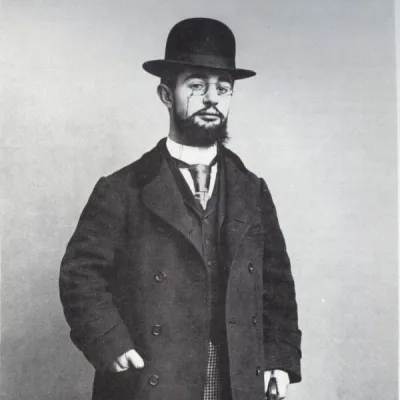
Henri de Toulouse
Human Design Chart
Biography
Born into the aristocracy, Toulouse-Lautrec broke both his legs during adolescence, leaving him with a stunted appearance. In later life, he developed an affinity for brothels and prostitutes that directed the subject matter for many of his works, which record details of the late-19th-century bohemian lifestyle in Paris. He is among the painters described as Post-Impressionists, with Paul Cézanne, Vincent van Gogh, Paul Gauguin, and Georges Seurat also commonly considered as belonging in this loose group.
In a 2005 auction at Christie's auction house, La Blanchisseuse, Toulouse-Lautrec's early painting of a young laundress, sold for US$22.4 million, setting a new record for the artist for a price at auction.
What does Manifesting Generator 3/5 mean for Henri de Toulouse?
Manifesting Generator 3/5 — Design at a Glance
Henri de Toulouse revealed himself as someone who possessed hybrid energy: the constant power of a Generator paired with the lightning-fast impact of a Manifestor. His design suggested that he could draw things into his life by skipping steps and pursuing multiple projects simultaneously. However, this speed was a double-edged sword. If Henri did not wait for his inner impulse – the 'yes' from his sacral center – he tended to overlook important stages. This often led him to backtrack and make up missing parts, causing frustration as his non-self theme precisely lay in this dissatisfaction.
The mechanics of his type, the Manifesting Generator, demanded a clear strategy: react first, then act. Only when his inner authority and sacral center supported a project could he effectively utilize his creative power. In this state, he fell into a 'play mode' where variety was not a distraction but fuel. Then it did not bother him to do many things at once; on the contrary, the demand to focus solely on one thing would have slowed down his energy. Henri de Toulouse found deep satisfaction in his work as soon as he learned to channel his speed through conscious reactions to impulses rather than blindly rushing forward. Thus, potential frustration transformed into productive, playful creativity.
Emotional Authority
Henri de Toulouse revealed himself as someone who never made decisions immediately but subjected them to an inner maturation period. His design carried Emotional Authority, meaning that his defined emotional center held the control function – regardless of which other centers were also defined. This priority rule is central: The emotional wave always had precedence over all other internal impulses.
Henri de Toulouse was subject to a constant up and down of his feelings. The world appeared colored by his current mood; a moment of enthusiasm could quickly turn into a negative outlook. His immediate feeling, however, was only a snapshot, not a final judgment. Quick, spontaneous decisions based on such emotion often had negative consequences as they ignored the yet unresolved truth.
Instead, his path required patience and multiple reconsiderations of important questions. The longer Henri de Toulouse waited, the deeper he could see. Over time, intense feelings subsided, emotional gain set in, and clarity replaced unrest. This process was particularly crucial for long-term life decisions. Only when the emotional wave had died down and calmness settled did he know that he had traversed his inner path and a well-founded answer lay ahead.
The 3/5 Profile — Martyr / Heretic
Henri de Toulouse revealed himself through his 3/5 profile as someone who primarily gained knowledge through personal experimentation. As an experimenter, he initially believed little in preordained truths and instead learned from direct experiences along with the associated failures. This practical foundation formed the basis for his later role as a Hero: He used his acquired reservoir of experience to solve other people's problems and thus presented himself as a rescuer or authority figure.
This dynamic was reinforced by specific energetic lines. The third line promoted a process of trial and error in dealing with power. Henri de Toulouse developed his role not through theoretical study but through becoming aware in practice, learning how he could authentically unleash power. Simultaneously, the fifth line acted as an alluring force, especially during crisis times. It drew attention and admiration, similar to a charismatic leader or Casanova type. This allure often served to influence or subordinate others, which increased his attractiveness but also raised the risk of public failure if experimental attempts in front of the community failed. His design marked him as someone who gained authority through personal action and then used it to lead or seduce others.
Single Definition — Defined & Open Centers
Henri de Toulouse was characterized by a consistent and reliable way of communication and manifestation. His defined Throat Center acted as a focal point, transforming information from the body into clear messages. This voice did not speak arbitrarily but derived from his inner sources: He acted based on his vital energy (Sacral), intuitive insights (Spleen) and the physical pressure to maintain his life impulse (Root). His design shaped a person who easily and honestly expressed their truth, as long as they followed their strategy.
At the same time, Henri de Toulouse had an enormous power source through his defined Sacral Center. This energy was generated daily and required reaction rather than initiation. His inner authority lay in his defined Solar Plexus Center; he was designed to wait for the emotional wave before making decisions. Emotional clarity emerged only over time, not in impulsive moments. His defined Spleen Instinct protected him through spontaneous, momentary perceptions of health and well-being, while the defined Root Center provided the necessary pressure to move forward in the material world.
In contrast, Head, Ajna, G, and Heart Centers were open. Henri de Toulouse tended to absorb mental confusion or doubt from his environment without interpreting it as his own truth. He did not actively seek answers in the mind (open Ajna/Head), but let himself be guided. His open G Center meant that he did not carry a fixed identity but reflected in correct environments and relationships; at the wrong place, he felt lost. The open Heart Center made him vulnerable to the pressure of proving his worth through promises – a trap he had to avoid by not promising what he could not keep with willpower. His strength lay in using these open fields as mirrors for others rather than getting entangled in their problems.
Channels for logical clarity, intuitive power and emotional depth.
Henri de Toulouse was characterized by an insatiable logic that constantly questioned and corrected patterns. This attitude stemmed from the Judgment Channel 58-18, which connected Root energy with Spleen intuition: A drive towards perfection that only worked peacefully when invited to solve societal problems – otherwise inner restlessness ensued.
At the same time, Henri de Toulouse possessed immense immediate action power. The Charisma Channel 34-20 linked his sacral life energy directly to expression in the Throat Center. This generated an impulsive urge towards manifestation; he could hardly sit still and acted charismatically as long as he reacted on inner resonance rather than mental 'shoulds'. This raw power was sharpened by the Power Channel 34-57: Here, sacral energy met the intuitive survival intelligence of the Spleen. Henri de Toulouse was highly sensitive to dangers and environmental energies, reacted lightning-fast and protected his vitality through selective listening.
His communication was shaped by the Flash of Insight Channel 57-20. Intuitive insights from the Spleen resulted in spontaneous, true statements in the present moment. Henri de Toulouse often spoke directly to the point faster than others could think, which made him appear intuitive when he sensed his environment's receptiveness.
Emotionally, he went through a pulsating wave of joy and melancholy via the Emotions Release Channel 39-55. This moodiness was not a weakness but a creative motor: He provoked other people's minds to reveal their true nature and sought moods that resonated with his own.
Additionally, further energies were at work in his design: Gate 59 drove a genetic strategy of attachment independent of personal preferences. Gate 9 promoted meticulous taming and perfection through repetition. Gate 35 searched for meaning through new experiences and interaction, while Gate 32 secured continuity and material success for the collective. Gate 44 supported this through alert transformation in relationships. Henri de Toulouse lived these mechanisms as a complex web of intuitive sharpness, impulsive action, and emotional depth.
Individual Circuitry — Circuit Signature
Henri de Toulouse was someone whose actions were based on a deep connection between intuition, emotion, and physical strength. His simple definition connected Spleen, Root, Solar Plexus, Throat, and Sacral centers into a coherent flow. This created a pulsating energy that translated intuitive knowledge (Spleen) through emotional waves (Solar Plexus) into concrete expression (Throat), supported by the endurance of the Sacrum.
In the Knowledge Circuit, two separate segments were at work: The Flash of Insight Channel connected Spleen and Throat for creative impulses, while Emotions Release linked Solar Plexus and Root Center to transform feelings into endurance. Parallel to this, the Understanding Circuit through the Judgment Channel promoted a logical structuring between Spleen and Root, strategically placing intuitive insights.
The Integration Circuit completed this picture with two channels: Charisma connected Throat and Sacral Center for charismatic presence, while Power directly linked Sacral and Spleen Centers. Thus, Henri de Toulouse channeled power from the reaction to life (Gate 34) through intuitive knowledge (Gate 57) into immediate presence (Gate 20). This configuration strengthened his unique individuality by uniting emotional authenticity with strategic clarity and physical action capability.
Right Angle Cross of the Sleeping Phoenix 4
Henri de Toulouse carried the right Phoenix at Rest 4 incarnation cross. This configuration characterized an attitude marked by a deep, almost unconscious connection to collective rhythms and a certain reticence in direct action. In Human Design, this cross often describes energy that does not push outward but rather works internally, similar to a resting Phoenix preparing for renewal. Henri de Toulouse was less someone who actively shaped the world than one who radiated from within and exerted influence through his mere presence. The term 'at rest' indicates that this power wasn't always evident; it needed time to awaken and manifest in his lifestyle. It was a subtle dynamic more connected with silent, yet persistent inner strength rather than loud actions. Henri de Toulouse lived this energy not through aggressive assertiveness but by a kind of resonance that subtly touched others. His design suggested that his true power lay in embodying calmness and stability even when the world around him was turbulent. This internal orientation significantly shaped how he dealt with challenges: not through confrontation, but through deep, almost meditative composure which helped him remain a steady point during turbulent times.
Saturn Return — Life Cycles
Henri de Toulouse revealed himself in his midlife as someone seeking and finding profound personal connections. This became clear in 1893 when at the age of 29 he met Yvette Guilbert. For his design, this marked his first Saturn Return. This cycle signifies the condensation of long-term inner work into a stable life structure. What was often experimental or uncertain before now gained substance and durability. Henri de Toulouse used this phase not only to solidify his career but also to clarify his most intimate relationships. Meeting Guilbert wasn't coincidental, but an expression of how his chart worked during this period: through the search for reliability and emotional depth. The Saturn Return often demands a confrontation with responsibility and limits. For Henri de Toulouse, it showed in entering into a connection that questioned and reordered his previous life path. It was not about fleeting romance but establishing a foundation upon which future developments could rest. This phase profoundly shaped him as it marked the transition from youth to mature manhood with its duties and joys. The mechanics of the Saturn Return support choosing what is truly important and letting go of everything else. Henri de Toulouse did precisely this in his relationship with Guilbert.
Manifesting Generator · Emotional Authority — Synthesis
Henri de Toulouse was a Manifesting Generator whose life was characterized by a steady flow of sacral energy (defined Sacral Center). This energy fueled his ability to quickly initiate things and transform them (Manifestor aspect), yet always under the condition of responding to an inner impulse rather than initiating on his own. His profile as Explorer/Hero/Rescuer (3/5) indicates that he learned through experimentation and made this knowledge accessible to others – a process enhanced by defined Throat and Judgment (Channel 58-18). The constant search for correction and improvement drove him to question patterns and explore new paths, aligning with the Knowledge Circuit.
A central paradox in his design lay in the combination of emotional authority and the quick energy of the Manifesting Generator. While the emotional wave required a maturing decision (defined Emotional Center), his sacral definition demanded an immediate response to impulses. This led to internal tension between the need to quickly push things forward and the necessity to emotionally digest decisions over time – a dynamic evident in experiences where steps were skipped and corrections became necessary.
5 Defined Channels
Incarnation Cross - Right Angle Cross of the Sleeping Phoenix 4
Solar Return
The Solar Return shows the moment when the sun returns to its exact birth position - your personal solar year.
Life Cycles
Discover the life cycles with a detailed triple view (birth chart, cycle chart, composite).
Human Design Profile
- Strategy
- To respond - wait for something to respond to
- Authority
- Emotional Authority
- Profile
- 3/5 - Martyr / Heretic
- Definition
- Single Definition
- Incarnation Cross
- Right Angle Cross of the Sleeping Phoenix 4
- Date of Birth
- 24.11.1864 06:00
- Place of Birth
- Albi, France
Frequently Asked Questions
What was Henri de Toulouse's Human Design type?
What Profile did Henri de Toulouse have in Human Design?
Which Authority determined Henri de Toulouse?
What incarnation cross did Henri de Toulouse have?
When was Henri de Toulouse born?
Discover your own Human Design
Are you also a Manifesting Generator? Find out in a personal reading how to unfold your multi-talents and direct your energy wisely.
More Personalities
Back to overviewAldair

Alizée

Angeli

Arletty

Artus

Baekhyun