
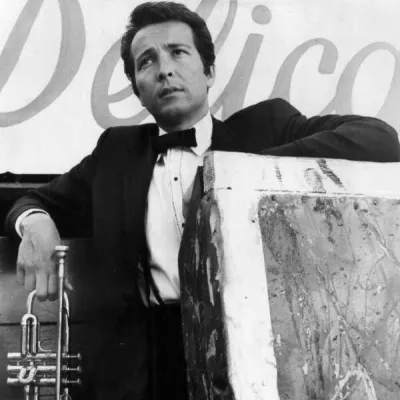
Herb Alpert
Human Design Chart
Biography
He founded A&M Records in 1962, along with Jerry Moss, with a $200 investment in his garage in suburban Los Angeles. By 1988, A&M had sales of $300 million annually and a stable of recording stars. They were bought out by the Dutch firm, Polygram Records, in 10/1989 for some $500 million; Alpert continued to help run the company. A hugely successful recording artist and businessman, he can notch five number one hits on his trumpet, along with 72 million copies of 21 albums. Alpert has received seven Grammy awards.
He put out "Second Wind," his first album in four years in 1996 through his new label, Almo Sounds, which was started in 1994 with longtime pal Moss. They set up their first road tour in eight years.
Privately a fine painter, he had a first formal exhibition of his colorful acrylics in 1989.
Human Design Analysis: Herb Alpert as Generator 1/3
Generator 1/3 — Design at a Glance
Herb Alpert's design shows a tendency towards immense endurance, which is not fueled by constant initiative. His energetic core as a Generator consisted of waiting for and responding to internal impulses. The strategy was clear: don't take the first step yourself but wait until life sends a signal. Only then, when an inner confirmation – a 'yes' from the gut – became palpable, did he give his powerful response.
This configuration describes an energy flow that arises through reaction. Herb Alpert had much sacral energy, comparable to a strong workhorse that only effectively uses its power when reacting to a task. If he followed this strategy and authentically responded to impulses, projects experienced deep materialization and he himself felt a sense of full fulfillment.
However, if he deviated from it – by initiating or suppressing impulses – frustration and energy loss resulted. The danger lay in doing things that did not find an inner resonance, which could lead to burnout. Equally problematic was when external circumstances hindered him from continuing work on his heart projects despite his energy still being present. The decisive lever for satisfaction was thus the authenticity of the response to what came from outside, not inventing new paths from within.
Emotional Authority
Herb Alpert showed an inner decision-making structure that required patience and time: His clarity did not set in with the first impulse but only after going through emotional waves. This results from his emotional authority, which is always present when the Emotional Center is defined – independent of other configurations in the chart.
This mechanism means that Herb Alpert was subject to a natural fluctuation between enthusiasm and doubt. The current mood was always just a snapshot colored by the momentary emotional state. An immediate reaction to this first impression could have been risky, as it did not yet reflect his deeper truth. Instead, his design required strategic waiting: Quick decisions were avoided in favor of a process of maturation.
Through multiple nights and enduring emotional detachment, intense feelings gradually subsided. Only then, when calmness set in and the initial intensity waned, true clarity emerged. This mechanism served to not leave long-term life decisions to passing moods but to make them on a stable foundation cleansed by the emotional wave. Herb Alpert thus had to consciously let himself be delayed and wait for the process of cooling down to recognize his inner truth.
The 1/3 Profile — Investigator / Martyr
Herb Alpert's design shows a tendency towards a dual approach to life: he appeared as someone who combined theoretical knowledge with practical experience. His Profile 1/3, the Researcher and Experimenter, shaped this attitude. Line 1 brought a drive for control and respect along with the necessity of thorough preparation. This could however lead to hesitation when the feeling arose that not enough was known yet to move into implementation. At the same time, Line 3 demanded the process of trial and error. Here it was about maintaining vitality through alliances and learning from mistakes. The tension between the need for complete information and the urge simply to try things out was characteristic of him. His judgment was based on having tested things both intellectually and practically down to his gut. When Herb Alpert evaluated something as good, he had previously worked on and validated it himself. This created an authority that rested on vetted insights. The synthesis of theoretical foundation and practical struggle for vitality allowed him to gain insights one could trust because they were confirmed through personal experience.
Split Definition — Defined & Open Centers
Herb Alpert's design clearly distinguished between constant inner energy and situational adaptation. His defined Head and Ajna centers created a permanent mental pressure to ask questions and form concepts. Since these centers are not connected to the motors, there was no direct energy available to immediately turn thoughts into action; this required patience and waiting for the right moment instead of hasty initiation.
The constant vital source supplied his defined Sacral center. This energy was only accessible through reaction – not through independent action. Every yes or no had to come from the gut to unleash full power and avoid frustration. The defined Solar Plexus center served as inner authority: decisions could only be made after going through the emotional wave, ensuring clarity rather than impulsiveness. His defined Root Center provided a steady pressure for survival and progress.
At the same time, his open centers shaped situational flexibility. His open Throat Center attracted attention without actively seeking it; trying to be in the spotlight would have been energetically counterproductive. The open G Center meant that identity and direction were not fixed but depended on the right place and environment. Herb Alpert tended to crystallize in stable relationships rather than pursuing a rigid self-definition. His open Heart Center warned against proving worth through competition or promises, as there was no energy for this. Finally, his open Spleen Center cautioned against spontaneous decisions and unhealthy dependencies due to its vulnerability to external conditioning. This architecture created a profile designed for reaction, emotional maturity, and situational adaptation rather than constant self-assertion.
Channels for transformation, clarity and emotional release.
Herb Alpert's basic attitude was based on evolutionary change and spontaneous insight. His energy followed not linear plans but pulsing cycles of creative power and withdrawal. This dynamic resulted from the combination of three central channels in his design.
The Channel of Mutation 60-3 connected his Root Center to the Sacral. Through the Gate of Limitation (60), he learned to accept boundaries as necessary frameworks for innovation, while the Gate of Order (3) helped him create structure out of the confusion of new beginnings. This connection generated a powerful but melancholic energy that worked in unpredictable pulses. Change did not come through constant pressure on Herb Alpert but unexpectedly during pauses between these impulses.
Mentally, he was shaped by the Channel of Awareness 61-24. Here, inspiration from the Gate of Secrets (61) connected with the rational mind at Gate 24. This led to sudden moments of insight, a Satori that did not come through logical pondering but appeared as spontaneous truth. Herb Alpert could not control his thinking; he had to wait for inner clarity to reveal itself.
Emotionally, the Channel of Emotional Release 39-55, connecting Root and Solar Plexus centers, came into play. Through provocation (Gate 39) and mind (Gate 55), he generated an emotional wave that swung between joy and melancholy. His impact on others depended heavily on his current mood. Authenticity in this emotional alchemy was the key to creating deep resonance. Herb Alpert did not use this capriciousness as a weakness but as a driving force for his individual expression and influence.
Individual Circuitry — Circuit Signature
Herb Alpert's design inclined towards a pulsing, acoustic form of expression deeply rooted in the emotional wave. His Human Design shows a Split Definition with two parallel power centers: In the first area, he directly connected Head to Ajna center. This connection generated creative flashes and innovative ideas that did not automatically turn into action but existed as mental impulses.
The second, energetically separate center united Sacral, Root, and Solar Plexus centers. Here, the Channels of Mutation (3-60) and Emotional Release (55-39) were at work. This configuration described a process where deviations from the known were transformed through emotional resonance. The Knowledge Circuit did not connect these elements into one flow but as two parallel systems: mental inspiration in the Head-Ajna area and emotional, impulse-driven energy in the lower centers.
The mechanics suggested that Herb Alpert generated new insights through mutation and inspiration, which he could only transform into a pulsing, acoustic expression via the emotional wave of Solar Plexus. Identity was shaped by reinforcing his individuality, with emotional depth carrying melancholic undertones. It was about his unique path to initiate change through this specific mix of mental spark and emotional transformation without these two energies directly merging.
Right Angle Cross of Tension 1
Herb Alpert was marked by a deeply rooted existential fundamental tension that significantly shaped his life path. This internal dynamic often worked unconsciously as a central motivational pattern, driving him to grapple with fundamental questions. In Human Design, this is described through the right cross of Tension 1. It defines not just a superficial inclination but the archetypal structure of how inner tension is transformed into outer action or insight. For Herb Alpert, this configuration meant that his actions always stemmed from this deepest drive, even if he could not always clearly articulate it himself. The mechanics of this cross imply a specific kind of processing: tension is not simply reduced but directed in a way that shapes the life path. Without delving into further details about specific Gates or Channels, the focus remains on this fundamental archetypal structure. It shows that Herb Alpert's development and decisions were driven by an inner necessity to resolve or endure this tension. This pattern requires constancy and depth as it forms the basis for all subsequent experiences. So, Herb Alpert lived in a constant dialogue with this fundamental tension, which both challenged him and pointed out the direction of his path.
Saturn Return · Uranus Opposition · Chiron Return · 2nd Saturn Return — Life Cycles
In this phase of life, Herb Alpert emerged from his experimental youth to establish a clear, self-determined identity. In 1962, at age 27, he celebrated his first major success with „The Lonely Bull“ by The Tijuana Brass – a concrete sign that the inner vision was now transitioning into external reality.
This moment marks the first Saturn Return cycle. In Human Design mechanics, this is not just aging but the decisive transition to an established adult structure. Years of groundwork condense into a solid foundation for long-term life design. What had previously been fluid now solidifies; personal strategy shows its effectiveness in tangible results. Herb Alpert's design laid the groundwork for a stable basis upon which future developments could build. The success was not random but the result of maturation, where inner clarity aligned with the external world. This cycle shapes how one sees oneself as competent and reliable in life. It is the moment when the foundation is laid – not for short-term impulses but for an enduring structure that determines the further course of life.
Generator · Emotional Authority — Synthesis
Herb Alpert's design reveals a central thread of dynamic reaction. As a Generator with emotional authority and a Profile of Researcher/Experimentor, he is not meant to initiate but to respond to life – a process fueled by sacral energy. However, this responsiveness is modulated by the emotional wave that demands time for clarity before decisions can be made. The combination of the need for stimulation (sacral) and the necessity of emotional maturation leads to a lifestyle marked by experiments, trials, and constant searching for authentic resonance. He finds fulfillment in embracing impulses while ensuring they align with his inner truth.
A central paradox lies in the tension between his desire for spontaneity and the necessary waiting for emotional clarity. As a Generator, he wants to act, but emotional authority demands patience and experiencing the full range of emotions. This dynamic is amplified by open centers – particularly in the G Center, which signals an undefined identity – making him vulnerable to external influences while simultaneously opening up his ability to adapt and absorb new experiences. He is thus both a powerful responder and a seeker after inner compass.
3 Defined Channels
Incarnation Cross - Right Angle Cross of Tension 1
Solar Return
The Solar Return shows the moment when the sun returns to its exact birth position - your personal solar year.
Life Cycles
Discover the life cycles with a detailed triple view (birth chart, cycle chart, composite).
Human Design Profile
- Type
- Generator
- Strategy
- To respond - wait for something to respond to
- Authority
- Emotional Authority
- Profile
- 1/3 - Investigator / Martyr
- Definition
- Split Definition
- Incarnation Cross
- Right Angle Cross of Tension 1
- Date of Birth
- 31.03.1935 14:46
- Place of Birth
- Los Angeles, CA, United States
Frequently Asked Questions
What is Herb Alpert's Human Design type?
What Profile does Herb Alpert have?
What Authority Does Herb Alpert Have?
What is Herb Alpert's incarnation cross?
When was Herb Alpert born?
Discover your own Human Design
Are you also a Generator? Find out in a personal reading how to use your sacral energy correctly and discover deep satisfaction.
More Personalities
Back to overviewAaliyah

Alexia

Angèle

Anne-Marie

Arcángel

Arno
