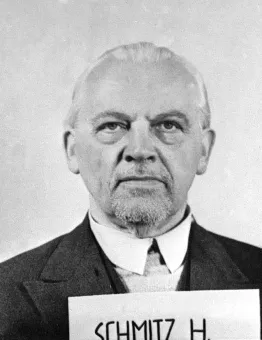
Hermann Schmitz
Human Design Chart
Biography
After completing his studies, he was hired by Metallurgische Gesellschaft (metallurgy company), where after some time he became consultant of Wilhelm Merton, member of the superivosors' council of the company, who helped Schmitz promote his career.
In 1914 he was required to serve in the army. He was injured during the First World War and, after recovering from his injuries, he was made Reich's supervisor for chemical products production in the matériel department (1915).
In 1919, as an expert in fertilizers and nitric salts, he took part in the assembly that negotiated the Treaty of Versailles. There he met Carl Bosch, a chemist of worldwide fame. In July 1919 Schmitz was hired at BASF by Bosch as his financial advisor. He was promoted to administrator of BASF's exterior department, a position he maintained after the company became part of IG Farben. As per his job requirements he maintained contacts with large businesses, such as Standard Oil, with which he took part in negotiations, always having the support of that era's governments in the interests of IG Farben.
In 1933 he was elected to the Reichstag under the banner of the National Socialist Party, and after two years he succeeded Carl Duisberg as IG Farben's CEO when he died. In 1938 he became war economy administrator (Wehrwirtschaftsführer). In 1941 Hitler gave him a portrait of him with his autograph as a gift for his dedication to the aims of Nazi Germany. Schmitz led IG Farben until the end of the Second World War. He was arrested and tried at the IG Farben Trial, during which he was sentenced to four years imprisonment. He was freed in the end of 1950s and he went on to become member of the administrators' council of Deutsche Bank in Berlin, while he took the honorary president of "Rheinische Stahlwerke AG".
Schmitz died in Heidelberg on 8 October 1960.
What does Generator 3/5 mean for Hermann Schmitz?
Generator 3/5 — Design at a Glance
Hermann Schmitz was known for his remarkable endurance and inner strength. His Human Design type is the Generator, characterized by an active Sacral Center which acts as his power station, providing him with continuous energy as long as he engages in activities that resonate deeply within him.
His life strategy did not involve initiating or taking the first step independently but rather waiting for a signal from life to act. Only when this external offer met his inner 'yes' - a spontaneous physical confirmation from his gut - would he deploy his considerable resources. This response to impulses was key to his effectiveness and satisfaction.
When Hermann Schmitz acted against this mechanism, such as by doing things that did not bring him internal joy or being hindered in his heart projects, he quickly lost energy. Such actions led to frustration and exhaustion because he then worked against his natural design. However, when aligned with his strategy, responding to real incentives allowed him to handle tasks with great consistency and find a deep sense of fulfillment. His strength lay in the ability to generate energy not through constant pushing but by consistently responding to what truly moved him.
Sacral Authority
Hermann Schmitz was a Generator whose decision-making process was shaped by Sacral Authority. This inner guiding function is unique as it represents both his life strategy: waiting for external stimuli and then reacting from within. His process simplified significantly; he did not need to think or plan but could directly respond to impulses.
The prerequisite for this clear guidance was his open Emotional Center, manifesting through physical signals such as a gut feeling, an energy surge, or loud responses like grunts and hums in reaction to the outside world. When his sacral motor engaged, he felt vital and alive. He had inexhaustible energy and tackled tasks with great enthusiasm. His life was designed to flow joyfully into activities without being bound by strict purpose.
Additionally, his activated Spleen Center acted as a supporting authority, giving him the ability to react quickly and spontaneously. He had direct access to his physical well-being and instinctive perception. This combination of sacral energy and spleen-supported intuition enabled Hermann Schmitz to make decisive decisions in harmony with his inner rhythm.
The 3/5 Profile — Martyr / Heretic
Hermann Schmitz was someone who learned through personal experimentation and later provided this practical knowledge to others. His Profile 3/5, that of the experimenter and hero, shaped this approach: Line 3 demanded he first explore everything himself as he did not accept anything blindly. He gathered experiences through trial and error, with failures serving as necessary learning moments. This phase of learning culminated in the role of Line 5, the rescuer or hero. Here, Hermann Schmitz used his acquired insights to solve others' problems. His appeal to those around him stemmed from offering concrete solutions based on personal practice, which bound others to him and granted him a certain authority. This status flattered his ego but could also be vulnerable if public experiments failed. Additionally, mechanisms like the need to 'woo' resources to implement solutions in crisis times were at play. He had to deal with uncertainty about his own depth; fear of inadequacy could temporarily block his actions. Alliances he formed often served short-term goals or the maintenance of his own vitality and dissolved once these objectives were met. His path was thus marked by a constant cycle of personal experimentation, learning from it, and then presenting these results as help for others.
Single Definition — Defined & Open Centers
Hermann Schmitz revealed himself through a fixed self-identity and a clear sense of direction. His defined G Center gave him a reliable inner orientation that allowed him to lead others without needing their consent. This magnetic presence was supported by his defined Heart Center, which endowed him with willpower and the ability to keep promises as well as to use resources autonomously. He had his own power source: The defined Sacral Center generated continuous vital energy, but it could only be correctly activated in response to external requests. Initiatives from the mind often led to resistance and exhaustion because they overstretched this sacred resource.
His actions were also shaped by a defined Spleen Center, which provided him with intuitive warning signals in the here and now. This spontaneous body intelligence served as a protective mechanism for his well-being and health. A further defined Root Center ensured a constant inner pressure that propelled him forward and helped him cope with stress in the material world.
In contrast, Head, Ajna, and Throat Centers were open. This meant that Hermann Schmitz did not have a constant mental structure. He tended to identify with the thoughts and concepts of his environment, making him vulnerable to confusion and doubt. Often he sought answers to questions that weren't his own or tried to force attention through targeted speech, although his open Throat Center actually waited to be invited. His open Solar Plexus absorbed foreign emotions, which could lead him to feel emotionally unstable if he didn’t separate the moods of others from his own feelings. This openness challenged him not to fall into conditioned reactions but to trust in his inner authority and strategy.
Channels for change, intuition, devotion and life's meaning.
Hermann Schmitz was someone who worked deep underground, often characterized by a melancholic, pulsating energy. This basic attitude resulted from Channel Mutation 60-3, which connected the Root Center with the Sacral. Here, the power of Gate Restriction (60) worked together with Gate Order (3). Hermann Schmitz had to learn to accept limitations and patiently wait for the right pulse rather than trying to fill inner emptiness through rational argumentation. This channel brought about evolutionary change that unexpectedly occurred — like music in the pauses between notes.
Parallel to this, Hermann Schmitz possessed a rare ability for intuitive adaptation to his environment, carried by Channel Perfect Form 57-10. Through Gate Intuitive Insight (57) and Gate Self Behavior (10), he acted spontaneously and appropriately, guided by a deep appreciation of himself. This enabled him to survive through skillfulness in the moment, far from future anxieties. His behavior projected a quality based on instinctive love for his own existence.
Additionally, Channel Devotion 44-26 worked in his design, connecting the Spleen Center with the Heart. Through Gate Awareness (44) and Gate Egoists (26), Hermann Schmitz had an intuitive sense of what his environment needed — often before others knew it. He could convincingly convey his gifts not out of altruism, but from a spontaneous will to manipulate the tribe for his own benefit and the preservation of viability.
Channel Life Struggle 38-28 finally connected the Root Center with the Spleen. Through Gate Fighter (38) and Gate Players (28), Hermann Schmitz actively sought meaning in his conflicts. He possessed a stubborn determination to fight for his individual integrity and resist distractions from his true self. This struggle was not only personally significant but served as an example that encouraged others to follow their own process of individuation.
Individual Circuitry — Circuit Signature
Hermann Schmitz revealed himself as someone whose inner structure was characterized by a simple, coherent definition. His defined centers — Sacral, Root, Spleen, G and Heart Centers — formed a single energetic stream that combined action capability with emotional intuition.
This flow manifested in three specific circuits. In the Knowledge Circuit, he connected the Sacral, Root, and Spleen Centers through Channels 'Mutation' (Gates 3-60) and 'Life Struggle' (28-38). This promoted a pulsating energy aimed at walking one's own path and transforming new knowledge through deviation from tradition as well as endurance in life struggle.
The Ego Circuit connected his Heart and Spleen Centers via Channel 'Devotion' (26-44). Here, it was about cooperation and the distribution of resources within a community, supported by traditional values and mutual support without directly participating in the constant life force of the Sacral Center.
In the realm of Integration, he connected Identity and Spleen Centers through Channel 'Perfect Form' (10-57). This allowed him to intuitively guide energy from reactions to life into an appropriate outer form in the present moment. This configuration supported his ability to unite individual identity with communal utility and intuitive adaptability.
Right Angle Cross of Tension 4
Hermann Schmitz exhibited a fundamental attitude based on inner clarity and the desire for spiritual orientation. His design was characterized by the right cross of tension 4, a configuration often associated with a profound spiritual quest. This structure fostered a need to look beyond everyday life and engage with higher values or transcendent themes. It wasn't superficial interest but rather a serious dedication to questions about life's meaning and personal development.
For Hermann Schmitz, this meant that he likely always strived to align his actions with his inner compass. He sought ways to shape his life so it not only functioned practically but also had deeper significance. This pursuit of authenticity and spiritual integrity influenced many of his decisions and interactions.
Without specific events in the raw content, the description remains limited to this general tendency. Nevertheless, it is clear that Hermann Schmitz was a person who valued consciously leading his life and continually searching for new perspectives and insights. His energy focused on resolving inner tensions through reflection and spiritual growth.
Saturn Return · Uranus Opposition · Chiron Return · 2nd Saturn Return — Life Cycles
Hermann Schmitz's professional development was closely linked with the major astrological cycles of his design. His first Saturn return occurred in 1910; at age 29, he became deputy board member of a global corporation. This marked period often signified the consolidation of earlier efforts into a stable position. The Uranus opposition shaped his career phase around 1919: At 38 years old, he switched to Carl Bosch as a financial advisor and thus joined BASF, later I.G. Farben – a step typically associated with sudden changes or new perspectives in this configuration.
The Chiron return, a cycle of fulfillment and blooming purpose, fell on his 52nd year in 1933. During this period, Hermann Schmitz was elected to the Reichstag. This aligned with the pattern of this cycle where inner orientation increasingly unfolds and becomes visible in external life. His second Saturn return occurred in 1938; at 57 years old, he was appointed as an economic leader during wartime. This later Saturn cycle often concerned long-term responsibility and structuring in advanced adulthood. Thus, his career moves followed the rhythmic phases of his individual design.
Generator · Sacral Authority — Synthesis
Hermann Schmitz lived deeply within his sacral authority (Sakral Center defined), always reacting to external stimuli with an inner surge of power. This fundamental principle of reaction shaped his path, especially as a Generator destined to generate energy and through experimentation (Line 3) accumulate experiences which he then passed on heroically (Line 5). The repeated professional turns – from deputy board member to economic leader during wartime (Saturn returns, Uranus opposition, Chiron return document career trajectory) – manifested this energy and the need to effect change through action.
A central paradox in his design lay in the combination of a defined G-Center, which stands for firm identity and direction, with the Channel of Mutation (3-60). While the G-Center suggested stability, the Mutation channel demanded constant change and deviation from conventions. This tension between the need for inner security and the inclination to experiment led to a life full of transformations, marked by melancholy and the pulsating format of his individual energy (Knowledge Circuit).
4 Defined Channels
Incarnation Cross - Right Angle Cross of Tension 4
Solar Return
The Solar Return shows the moment when the sun returns to its exact birth position - your personal solar year.
Life Cycles
Discover the life cycles with a detailed triple view (birth chart, cycle chart, composite).
Human Design Profile
- Type
- Generator
- Strategy
- To respond - wait for something to respond to
- Authority
- Sacral Authority
- Profile
- 3/5 - Martyr / Heretic
- Definition
- Single Definition
- Incarnation Cross
- Right Angle Cross of Tension 4
- Date of Birth
- 01.01.1881 16:30
- Place of Birth
- Essen, GER
Frequently Asked Questions
What is Hermann Schmitz's Human Design type?
What Profile did Hermann Schmitz have in Human Design?
What Authority did Hermann Schmitz possess?
What incarnation cross was assigned to Hermann Schmitz?
Discover your own Human Design
Are you also a Generator? Find out in a personal reading how to use your sacral energy correctly and discover deep satisfaction.
More Personalities
Back to overviewAaliyah

Alexia

Angèle

Anne-Marie

Arcángel

Arno