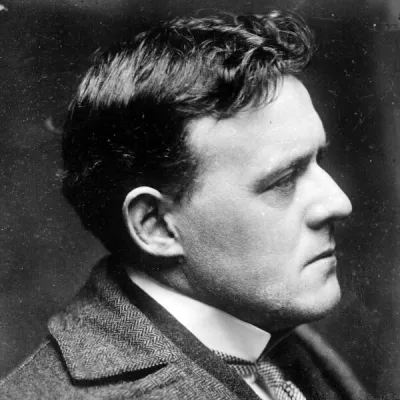
Hilaire Belloc
Human Design Chart
Biography
His writing tended to be melancholy while showing a zest for the physical life. He published an eclectic variety, everything from nonsense children's verse to historical biographies, travel books, satirical novels and a four-volume "History of England."
Belloc married an American, Elodie Hogan, in 1896, and he died on 16 July 1953 in Guilford, England.
Human Design Analysis: Hilaire Belloc as Generator 3/5
Generator 3/5 — Design at a Glance
Hilaire Belloc revealed himself as someone with immense endurance and great energy capacity. His design established a foundational stance that did not rely on self-initiation but rather waited for life to send impulses. He was a Generator – a type comparable to an extremely strong workhorse, provided he had the energy for his task. This power only became effective when he reacted instead of initiated.
His strategy involved waiting for signals from the environment and then acting upon them, guided by the inner impulse of the Sacral Center. When this center gave a clear “yes,” he could respond with full force. Living in harmony with this rhythm rewarded him with a deep sense of satisfaction and fulfillment.
At the same time, his chart carried two specific risks. Persistently acting against his will or on things that did not interest him wasted his energy and led to burnout. Conversely, frustration arose when he was prevented from working on his heart project despite still being full of power. The danger of energy depletion or persistent frustration occurred whenever he initiated against this nature instead of listening to the gut impulse. His strength lay in the ability to react from the gut and thus deploy his immense endurance purposefully.
Sacral Authority
Hilaire Belloc's decision-making was oriented towards a direct physical resonance as a reaction to external stimuli. As a Generator, he possessed sacral authority, where strategy and inner guidance were identical. This simplified his process: instead of mental analysis, it involved waiting for the response from the defined Sacral Center.
This mechanism manifested in a noticeable “gut feeling” or surge of energy. His internal signals materialized as grunting, humming, or an affirming hmm. When this physical confirmation occurred, it was followed by immediate vitality and inexhaustible energy. Hilaire Belloc could then immerse himself enthusiastically in tasks driven by joy and satisfaction without the need for purpose-driven compulsion.
A prerequisite for this clear guidance was his open Emotional Center. This protected the sacral response from distortion through fleeting mood swings. Through this configuration, he lived best when reacting to external offers and completing his work from this inner drive, which allowed him to fully engage in his tasks.
The 3/5 Profile — Martyr / Heretic
Hilaire Belloc emerged as someone who generated practical knowledge through personal experimentation and even failure, subsequently providing it to others. His design, Profile 3/5 (Explorer/Hero), established a foundational stance: thanks to Line 3 at Gate 31, he initially believed nothing given but had to experience everything himself. This process of trial and error served to develop leadership competence and test the quality of his followership, where discernment was crucial.
The accumulated experiences formed a rich treasure that attracted others. Belloc used this knowledge to offer solutions in crisis situations – an ability stemming from Line 5 at Gate 27. Here it was about managing other people's resources effectively and addressing emergencies. The tension in his design lay between the necessary public vulnerability during experimentation (Line 3) and the expectation of being a competent savior for others (Line 5). While his practical know-how made him attractive and flattered him with the role of hero, failing in front of an audience could also be painful. Nevertheless, he transformed these personal mistakes into collective solutions by addressing other people's problems with self-acquired knowledge.
Single Definition — Defined & Open Centers
Hilaire Belloc was characterized by a life driven by constant inner vitality. His defined Sacral Center generated an enormous daily energy source that he could not channel through his own initiatives. Instead, this power was only available when he responded to external requests and felt an affirmative 'yes' from within. When asked, his Sacral Center mechanically decided on the use of energy; if he ignored these reactions in favor of mental considerations, he encountered resistance and frustration. This reactive strategy was essential for avoiding exhaustion and productively utilizing his enduring strength.
At the same time, Hilaire Belloc carried a defined pressure in his Root Center, which propelled him existentially forward. This stress served as a motor for his survival and material handling of the world. To avoid becoming obsessive or projecting this pressure onto others, he had to learn to guide this inner drive through strategy rather than blindly following it.
In contrast, six of his centers were open: Head, Ajna, Throat, G, Heart, and Solar Plexus. This openness made him vulnerable to conditioning from the environment. His open Head tended to engage with foreign questions and doubts, while his open Ajna Center absorbed ideas that may not have been his own truth. Without a fixed identity in his open G Center, he often sought direction through others rather than determining it himself. The open Heart Center drove him to prove his worth through promises and competition, leading to a cycle of self-doubt as he lacked consistent willpower. Additionally, his open Solar Plexus absorbed the emotions of his environment, resulting in emotional instability when he personalized these foreign feelings. Finally, his open Spleen Center was marked by fear of not being adequately equipped for survival, tending to cling to unhealthy situations just to feel a sense of security. These open windows reflected the world rather than offering him an independent, stable truth.
Channels for the natural process of growth and maturity.
Hilaire Belloc exhibited a fundamental approach based on fully traversing life cycles. His design suggested that he did not superficially consume experiences but pursued them to their end to extract wisdom and share it collectively. This structure was primarily determined by the Maturity Channel 53-42. This channel connects the Root Center with the Sacral Center through Gate of Beginnings (53) and Gate of Growth (42). It forces one to enter a new cycle, complete it fully, and only then reflect on it. As a result, a deep connection to history is formed; Belloc learned from empirical experience not to repeat mistakes but to prepare knowledge for future generations. Without this completion, energy remained unused, making him dependent on finishing cycles before starting new ones.
This cyclical maturation was complemented by specific energetic qualities. Gate 31 shaped his identity as a leadership figure. It involved the pure transmission of power to others; Belloc did not lead through command but by passing on energy and thus creating impact in the collective. Simultaneously, Gate 41 carried the impulse for evolutionary development within him. As a source of feeling, it propelled him from one experience to another, often accompanied by crises or deep desires for change. This emotional intensity helped him maintain a certain coolness despite fluctuations and integrate specific lessons.
Additionally, care and risk-taking were at play. Gate 27 brought altruistic warmth into his activities, aimed at self-preservation and the welfare of the tribe. This caring component softened the harshness of evolutionary crises. Parallel to this, Gate 28 stood for making decisions in the here and now about whether or not to take risks. It involved persistent listening in the present moment to recognize personal meaning and take brave steps without losing sight of one's strategy. Through this combination of cyclical depth, energetic leadership, and risk-taking care, a personality was formed that reflected lessons and passed them on as stabilizing forces.
Collective Circuitry — Circuit Signature
Hilaire Belloc's design inclined him towards emotionally processing past experiences and drawing meaning from them. This energy flows in wave-like patterns: each cycle has a clear beginning, middle, and end. Rather than relying on cool logic or rational future planning, his process focused on reflecting on the past.
This trait stemmed from the Meaning Circuit (Perception). In him, this circuit was activated by the Maturity Channel connecting the Sacral Center with the Root Center. Since both centers lie in the same group, energy flowed directly between them. This meant that his emotional waves – often inexplicable or illogical – had a direct connection to his most fundamental survival impulses and endurance.
The right side of his chart emphasized themes from the past. His goal was not only to privately experience these feelings but also to share the insights gained with the collective. Through this sharing, joint learning should be enabled. The cyclical nature of this energy shaped how he conveyed knowledge: visually-emotionally and deeply rooted in personal experiences rather than abstract or purely intellectual.
Right Angle Cross of the Unexpected 2
Hilaire Belloc's design revealed a tendency towards unpredictable turns that fundamentally shaped his life. He was someone who encountered unexpected events that determined his existential dynamics. This structure was not merely random but formed the deeper pattern of his experiential world.
The right cross of the Unexpected describes an archetypal configuration where unpredictability is at the center. It revolves around constant reactions to turns that cannot be planned for. For Hilaire Belloc, this meant that his path was marked by sudden changes that he had to take on and process. This mechanism demanded a certain kind of adaptability as life continually presented him with new, unexpected situations.
His attitude towards the unexpected was thus not a minor trait but a central element of his inner disposition. The design conveyed the necessity of dealing with surprises and accepting them as part of one's own development. Hilaire Belloc lived in a context where the unforeseen was a driving force. This dynamic significantly influenced his decisions and reactions, without him being able to control it beforehand. The structure of his design underscored the importance of flexibility and letting go of rigid plans.
Saturn Return · Uranus Opposition · Chiron Return · 2nd Saturn Return — Life Cycles
Hilaire Belloc's design carried the signature of sudden, unexpected breaks in long-term patterns. This configuration described shock moments that destroyed old structures and forced a new beginning. The Uranus opposition acted as a mechanism of liberation through destruction of the known.
In 1910, at age 40, Hilaire Belloc's wife Elodie passed away. This event marked the concrete trigger of this dynamic force. The sudden loss of his life partner tore apart the existing relationship framework and forced a radical reorientation. It was not a gradual change but an abrupt cut that irrevocably ended the previous life order. For his design, this moment was characteristic: Uranus energy broke through established routines and required rapid adaptation to the new reality. The death of Elodie served as a catalytic point where old bonds were dissolved to make room for a changed way of existence. This experience underscored the nature of his Uranus configuration – it brought no gentle evolution but disruptive events that initiated profound changes in the private and personal realm. Belloc had to face this sudden emptiness without the possibility of a slow farewell. The mechanism here showed its sharp side: through the shock of loss, the path was cleared for a new life phase, even though this came with considerable pain.
Generator · Sacral Authority — Synthesis
Hilaire Belloc lived a life deeply marked by the necessity to react to external impulses rather than initiate them himself. His Sacral Center generated a constant energy source that only became active upon stimulation – a principle that determined his decision-making and path in life. This responsiveness was linked to an intense cyclical process of experimenting and gaining insights from it (Channel 26). He gathered experiences, processed them deeply, and shared his knowledge willingly, becoming a kind of guide for others. This pattern shaped his interactions and the impact he had on his environment.
Belloc seemed to always struggle with an internal tension between the need for authenticity and conditioning by external expectations. His open Heart Center (and other undefined centers) made him susceptible to influences from others while simultaneously feeling the urge to find his own direction and not be led by foreign ideas. This dynamic led him into situations where he had to react spontaneously to preserve his inner truth – a balancing act between adaptability and holding onto his own values.
1 Defined Channel
Incarnation Cross - Right Angle Cross of the Unexpected 2
Solar Return
The Solar Return shows the moment when the sun returns to its exact birth position - your personal solar year.
Life Cycles
Discover the life cycles with a detailed triple view (birth chart, cycle chart, composite).
Human Design Profile
- Type
- Generator
- Strategy
- To respond - wait for something to respond to
- Authority
- Sacral Authority
- Profile
- 3/5 - Martyr / Heretic
- Definition
- Single Definition
- Incarnation Cross
- Right Angle Cross of the Unexpected 2
- Date of Birth
- 27.07.1870 16:00
- Place of Birth
- St.Cloud, France
Frequently Asked Questions
What is Hilaire Belloc's Human Design type?
Which Profile did Hilaire Belloc have?
What Authority did Hilaire Belloc have?
What incarnation cross did Hilaire Belloc have?
When was Hilaire Belloc born?
Discover your own Human Design
Are you also a Generator? Find out in a personal reading how to use your sacral energy correctly and discover deep satisfaction.
More Personalities
Back to overviewAaliyah

Alain-Fournier

Alexia

Angèle

Angeli

Anne-Marie