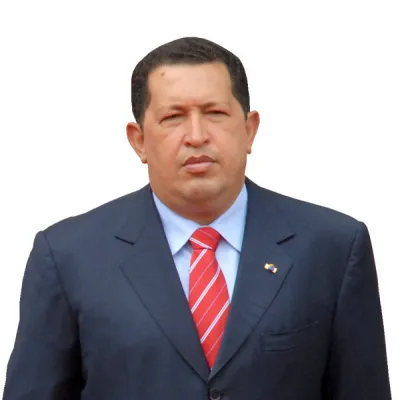
Hugo Chávez
Human Design Chart
Biography
The next night, several Venezuelan generals were killed in a helicopter accident. By mid-June, huge rallies for and against the leftist president jammed Caracas and other Venezuelan cities. Citizens were quoted that "that crazy man has dragged us into political anarchy and economic disaster," emphasizing the bitter divisions in a nation that has the largest oil reserves outside the Middle East but where 80% of the people live below the poverty line.
On 1 July 2011, he announced that on 10 June he had undergone surgery in Cuba for a pelvic abscess. He added that during his recuperation, cancerous cells had been identified and stated that he intended to remain in power, fully capable of the job even while undergoing treatment for cancer. He died on 5 March 2013 at 4:25 PM in Caracas at age 58.
Hugo Chávez as a Generator 3/5 in Human Design
Generator 3/5 — Design at a Glance
Hugo Chávez had as a Generator immense sacral endurance. His design suggested a high resistance power comparable to that of a workhorse generating energy as long as it burns for its task. This architecture allowed him to materialize things, but not through sheer willpower alone, rather through the proper handling of his inner drive.
The central mechanics of his type consisted in reacting to impulses from the environment instead of initiating independently. His energy was primarily released when he responded to an external signal and his sacral center gave the clear sign "Yes! Let's get started!" Acting in accordance with this gut feeling led to deep satisfaction and a sense of fulfillment.
Conversely, his design carried two specific risks. If he initiated out of sheer will without this inner resonance impulse, he tended to waste his strength, which could lead to long-term frustration or burnout over time. Equally problematic was when external circumstances prevented him from continuing work on his heart project, even though his inner self still brimmed with power. His strength thus lay not in pushing forward but in the ability to listen to life and then respond fully to it with all his might.
Sacral Authority
Hugo Chávez lived as a Generator, whose decision-making was marked by sacral authority. His design determined that he did not initiate but responded to external stimuli. This strategy of responding simplified his process since type and authority were identical. A prerequisite for this was an open emotional center.
His inner truth manifested physically: as gut feeling or surge of energy, audible in grunts, hums, or a simple "Mhm." When he resonated with an impulse, he felt vital aliveness and inexhaustible energy. He tackled his tasks with great enthusiasm, fully immersed in the activity itself, without external goals driving him. Joy and satisfaction naturally accompanied his work.
Furthermore, his activated spleen center served as a supportive instance to his sacral authority. This allowed him particularly quick and spontaneous reactions and decisions. He had direct access to his physical well-being and instinctive perception. He could reliably follow this inner voice, which strengthened his ability to intuitively act correctly in the moment of occurrence, supported by the physical resonance of his system.
The 3/5 Profile — Martyr / Heretic
Hugo Chávez's Design established an identity defined by practical experience in the public sphere. He emerged as someone who did not accept knowledge theoretically but instead tested it himself and developed solutions for others from his experiences. This dynamic of "trial and error" formed the foundation of his approach: only through personal experimentation could he gain credibility to solve problems for other groups.
This pattern arose from Profile 3/5, the combination of Explorer and Hero. Line 3 drove him to test everything himself; mistakes were inevitable but instructive. Line 5 used these accumulated experiences to serve as a role model for others. This attractiveness drew people who wanted to learn from his life experiences. At the same time, this profile carried the risk of painful public failure if experiments failed.
Additionally, Gate 27 on Line 5 addressed themes such as resource management and crisis resolution. It described the ability to effectively manage foreign resources but also the danger of losing power or damaging one's reputation through misconduct. The third line of Gate 31 underscored the process of trial and error in leadership. Here, discernment was crucial: the quality of followership weighed more heavily than its quantity, and choosing the right influences determined the success or failure of his leadership role.
Single Definition — Defined & Open Centers
Hugo Chávez was characterized by a design marked by constant vitality and a strong dependence on external stimuli to activate his energy. His defined Sacral Center served as the engine that generated an enormous power source, which could only be effectively utilized through reactions to questions or situations. This meant that initiation from the mind often led to frustration, while waiting for the right inquiry released his full capacity. This dynamic was supported by his defined Spleen Center, which gave him a reliable momentary instinct and deep bodily awareness. He had spontaneous intuition allowing him to act in the present and make health-promoting decisions without awaiting rational analysis. Additionally, his defined Root Center contained physical pressure and stress management, helping him master existential challenges and the urge for material survival.
In contrast, Head, Ajna, Throat, G, Heart, and Solar Plexus Centers were open. These undefined areas made him vulnerable to reflecting environmental impulses without personal constancy. Thus, he tended to absorb mental confusion or doubt from his environment rather than generating it himself. His open G Center led to his identity and direction being strongly influenced by the people and places around him; he often sought external validation for his life path. The open Heart Center made him sensitive to questions of self-worth and willpower, risking proving himself through promises he could not keep. Similarly, his open Solar Plexus absorbed others' emotions, leading him to experience foreign feelings as his own and feeling emotionally overwhelmed when unable to let go of these waves. This configuration underscored the need to trust inner authority rather than being guided by external conditioning.
Channels for life purpose, ambition and mature growth.
Hugo Chávez's design was marked by a driving, mutative force that combined stubborn resistance against the status quo with an ambitious social ascent. This configuration defined a profile characterized by individual integrity and experience-based maturation.
The Life Struggle Channel 38-28 endowed him with the stubborn determination to follow his own path even against poor odds. Through Gate 38 (the Fighter) there was pressure to defend personal integrity against external distractions, while Gate 28 (the Player) created awareness of which struggles had value and were worth it. This allowed him to find meaning in these conflicts and inspire others through his example.
Parallel to this, the Transformation Channel 54-32 drove ambition motivated by a desire for recognition and social improvement. Gate 54 (Ambition) sought to elevate one's position in life while Gate 32 (Continuity) instinctively recognized talents and fostered tribal loyalty. This channel linked personal ascent with tribal support; success depended on efforts being recognized and mutual dependence arising.
The framework was set by the Maturation Channel 42-53, which steered cyclical experiences. Gate 53 (Beginnings) initiated new cycles that had to be fully traversed and reflected upon through Gate 42 (Growth). This process required learning from the past for future wisdom. Hugo Chávez lived this mechanism by carrying experiences to completion and generating information for others.
Additionally, Gates like 31 (Transfer of Power), 41 (evolutionary development through crisis) and 27 (caring role in the tribe) complemented this picture with analytical sharpness and a drive to correct patterns. The combination of combative individualization, ambitious transformation, and cyclical learning shaped his unique expression.
Individual Circuitry — Circuit Signature
Hugo Chávez's design presented itself through three separate energetic strands that existed parallel without directly flowing into each other. The Knowledge Circuit connected his Spleen and Root Centers. This created an intuitive, survival-oriented identity rooted in the Life Struggle Channel 28-38 – a strong impulse towards individual transformation through hard experiences.
Completely independently, the Purpose Circuit worked, connecting Sacral and Root Centers. Here, the constant life force of the Sacral flowed together with the emotional wave dynamics in the Maturation Channel 42-53. This generated a cyclical process of past processing where emotional insights from earlier experiences had to mature and repeat.
Parallel to this was the Ego Circuit as a connection between Spleen and Root Centers. While belonging to the tribe, this configuration focused through the Transformation Channel 32-54 on transformation within resource building. It involved an instinctive tactical adaptability in dealing with collective material or social goods.
Although all three circuits touched the Root Center, they did not form a single continuous energy path. The intuitive survival strategy (Knowledge/Ego) and emotional maturation (Purpose) were energetically isolated. Hugo Chávez thus moved within a tension field: on one hand, the pressing individual struggle for identity and resources; on the other, the slow cyclical emotional digestion of the past – two worlds running parallel but not merging.
Right Angle Cross of the Unexpected 2
Hugo Chávez's design carried the archetypal imprint of the 'Right Cross of the Unexpected 2'. This configuration established a fundamental dynamic where life was experienced not as linear planning but as a series of sudden turns and surprising events. For Hugo Chávez, this meant that his path often defined itself through unforeseen upheavals that challenged him to remain flexible and respond to what came in rather than trying to predetermine it.
The 'Right Cross of the Unexpected 2' describes a life task where the individual learns to deal with the uncontrollable. It is not about creating chaos but developing the ability to maintain clarity during moments of surprise and find new paths where none were previously visible. This mechanism shaped Hugo Chávez's existence as an ongoing confrontation with the unexpected, which both challenged him and catalyzed change. The energy of this cross demanded that he not cling to rigid structures but embrace life's dynamics when they pushed him in unforeseen directions. This created an inner attitude of vigilance and adaptability towards his ever-changing fate.
Saturn Return · Uranus Opposition · Chiron Return · 2nd Saturn Return — Life Cycles
Hugo Chávez's life path showed marked structural phase changes, influenced by cyclical astrological turning points. In 1994, at the age of 40, he was pardoned and released from the army after two years in prison. This coincided with his Uranus opposition, a point of rupture and liberation where old structures often break to create new opportunities.
Ten years later, in 2003 when he was 49, Chávez ended an opposition against a strike; a referendum was planned. This fell during his Chiron return. This cycle marks not a crisis of healing through resistance but a phase of fulfillment and bloom. Here, the individual's incarnation cross unfolds increasingly in life if one has lived according to strategy and authority; meaning and purpose become experiential. The political developments that year reflected this deepening sense of destiny.
In 2011, at age 57, Chávez announced he had cancer and was undergoing surgery. This correlated with his second Saturn return. This cycle brings confrontation with finite mortality and the seriousness of time. The diagnosis was no coincidence but an expression of this structural phase where the limits of physical existence become consciously known and life's path turns towards its end. These three points – liberation, fulfillment, and confrontation with finiteness – framed his later years.
Generator · Sacral Authority — Synthesis
He was a Generator whose life was marked by an unstoppable flow of sacral energy seeking constant expression and satisfaction through work on themes that truly attracted him (Sakral Center defined). His profile as an Experimenter/Hero/Rescuer (3/5) points to someone who learned through personal experiences and then made this knowledge available to others. The Channel of Life Struggle (38-28) revealed a deep need to find meaning in action and stand for one's own integrity, which was shown in constant confrontation with external forces. Recurring crisis phases (cycles), such as pardon after imprisonment or the cancer diagnosis, revealed a life style that was marked by energy and initiative but also constantly hit limits.
A central paradox lay in the combination of his sacral authority – an immediate 'yes' or 'no' to external stimuli – with the drive of the Experimenter (Line 3) to try everything himself and experience it. So, on one hand, he lived in the present moment guided by gut feeling, while on the other hand, he was constantly seeking new experiences and insights. This tension between immediate reaction and exploratory curiosity shaped his path and led him repeatedly into situations where his energy and courage were called for.
3 Defined Channels
Incarnation Cross - Right Angle Cross of the Unexpected 2
Solar Return
The Solar Return shows the moment when the sun returns to its exact birth position - your personal solar year.
Life Cycles
Discover the life cycles with a detailed triple view (birth chart, cycle chart, composite).
Human Design Profile
- Type
- Generator
- Strategy
- To respond - wait for something to respond to
- Authority
- Sacral Authority
- Profile
- 3/5 - Martyr / Heretic
- Definition
- Single Definition
- Incarnation Cross
- Right Angle Cross of the Unexpected 2
- Date of Birth
- 28.07.1954 02:00
- Place of Birth
- Sabaneta, Venezuela
Frequently Asked Questions
What is Hugo Chávez's Human Design type?
What Profile did Hugo Chávez have?
What Authority guided Hugo Chávez?
What incarnation cross did Hugo Chávez have?
When was Hugo Chávez born?
Discover your own Human Design
Are you also a Generator? Find out in a personal reading how to use your sacral energy correctly and discover deep satisfaction.
More Personalities
Back to overviewAaliyah

Alexia

Angèle

Anne-Marie

Arcángel

Arno