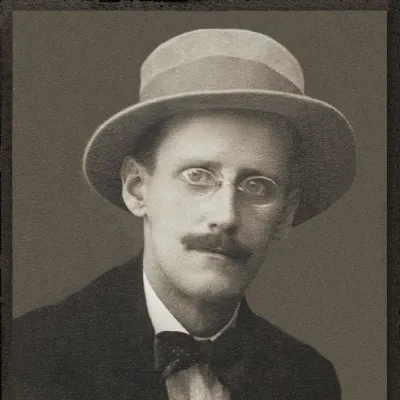
James Joyce
Human Design Chart
Biography
As a young man, Joyce's genius was recognized by Dublin literary circles. He mastered an encyclopedic knowledge of world literature, music, art and philosophy. As Joyce achieved literary notoriety, he and his family became the toast of the Parisian artistic community with the publication of his masterwork, "Ulysses" in 1922. Originally the stream of consciousness account of a day in the lives of Dubliner Leopold Bloom and his wife Molly was turned down by reputable publishers. The scandalous content, language, and unorthodox "stream of consciousness" literary style was too strong for the sensibilities of the day. Today, "Ulysses" is considered the greatest work of fiction of the twentieth century.
Joyce grew up in Dublin as one of 13 children, ten of whom survived. Originally born into wealth, his dad had an annual income and a good job as a tax collector. Drinking too much, spending too much and too many mortgages led to his dad loosing his job at 42 to never work again. Moving to 16 houses in the Dublin area clearly led to his articulate knowledge of every house, store and park.) He was educated at the Jesuit school and from a very early age displayed his precocious intellect. With a talent for languages, Joyce taught himself Dano-Norwegian in his teen years. In 1902, he went to Paris to study medicine. Blessed with a beautiful tenor voice, he began lessons for a concert career but when he returned to Dublin, he concentrated on his writing career.
On 16 June 1904, Joyce walked with Nora Barnacle, the daughter of a Galway baker, around the streets of Dublin. He had met her in a chance encounter six days earlier along Nassau Street near Trinity College. Four months later, Joyce and Barnacle left Dublin and moved to Trieste to start a new life.
Human Design Analysis: James Joyce as Projector 1/3
Projector 1/3 — Design at a Glance
James Joyce revealed himself as someone with a dense, focused aura that appeared like a bright flashlight. His design suggested that he immediately recognized flaws in the systems around him – places that were "still in the dark." This ability to bring light into darkness for others and illuminate their path was central to his nature as a Projector.
The challenge lay in how these insights were communicated. When James Joyce addressed systemic flaws right away, it was often perceived by those around him as aggressive or unpleasant – like shining a bright light directly into someone's face. The optimal strategy for him was not to instruct but to attract through his own harmony and radiance. By setting an example of harmony himself, others were automatically drawn to him and actively sought out his advice.
Therefore, it was crucial for him to wait for respectful and sincerely meant invitations before he acted as a guide or illuminator. This prevented the feeling of bitterness that arises as a Non-Self theme in Projectors when they live against their design. Instead, this patience led to successful rewards.
Moreover, James Joyce had to carefully manage his energy. Since Projectors do not have a defined Sacral Center, they lack constant intrinsic life force energy. Instead, his rhythm moved through phases of high activity and necessary rest periods. Rest phases were essential to prevent burnout, as the conventional system of continuous productivity did not meet this natural need.
Emotional Authority
James Joyce exhibited an internal decision-making structure that required time and emotional distance. His design featured Emotional Authority, meaning the Solar Plexus Center was defined and thus became the source of his inner guidance. In Human Design mechanics, this authority is considered primary: once the Emotional Center is active, it takes over as the guiding force regardless of other defined centers in the chart.
This configuration marked him by a constant emotional wave, an ongoing up-and-down of his feelings. The world appeared to him always colored by his current mood; what was inspiring at one moment could turn negative the next. His immediate feeling, however, was only a snapshot, not a guaranteed truth. Quick, spontaneous decisions made in this emotional heat carried potential for negative consequences.
The mechanics required patience and the process of ripening. By taking time and reconsidering decisions multiple times, his intense feelings gradually subsided. This distance allowed him to gain clarity and calmness. Only after this emotional cycle had run its course did the true inner truth emerge. This process of emotional clarification was particularly relevant for long-term directional settings that significantly influenced his life path. James Joyce thus lived in a dynamic that made impulsivity difficult and instead emphasized the depth of emotional breathing.
The 1/3 Profile — Investigator / Martyr
James Joyce revealed himself as someone who inseparably linked theoretical study and practical validation. His design indicated a tendency to form identity only through the synthesis of knowledge and experience; a judgment was valid only if it had been intellectually understood and practically tested. This aligned with Profile 1/3, the Researcher and Experimenter. Here, the tension between Line-1's tendency towards endless preparation – often accompanied by fear of implementation due to feeling there is not enough knowledge yet – and the urgent need in Line-3 for direct experimentation was at play. This dynamic created a figure who was both scientist and adventurer, comparable to Indiana Jones.
Line 1 promoted empathy and listening, enabling him to approach others without discrimination and absorb secrets from various sources. This formed the foundation for openness, although this willingness to exchange could be felt as a burden. At the same time, Line 3 learned through trial and error to develop adaptability and authentic self-expression. While material forces could interrupt creativity or lead to excessive ambition, self-earned insights remained the central theme. When James Joyce deemed something to be truly good, he had previously examined it both theoretically and practically down to his heart and gut; thus, one could absolutely trust his judgment.
Split Definition — Defined & Open Centers
James Joyce's design inclined towards a consistent identity and emotional depth, paired with reliable communication skills. His defined G Center gave him an inner compass for direction and self-love; he knew who he was without being dependent on others. This solid foundation allowed him to speak from his personal truth, supported by the also defined Throat Center. His voice served as a pivot point that transmuted messages from his inner world into the world – not as impulsive chatter but as a clear expression of his identity.
Crucial for his life approach was the defined Solar Plexus Center, which gave him emotional authority. James Joyce showed himself to be someone who practiced patience: He waited out the waves of his feelings before acting or judging. This time-based clarity protected him from impulsive mistakes and enabled deep insights as he could explore the full palette of his emotions until calm set in. This was complemented by defined Spleen and Root Centers: His intuitive intelligence in the present moment, along with his physical pressure for survival and correction, gave him a strong existential presence.
In contrast, mental and will-related areas revealed themselves as mirrors, not as personal drivers. His open Head Center made him vulnerable to the pressure of finding inspiring answers; he tended to question whether he was thinking correctly instead of trusting his inner compass. The open Ajna Center allowed him to take in concepts without identifying them as personal truth – a flexible mind that, however, risked getting stuck in the illusion of security through knowledge. His open Heart Center freed him from the compulsion for willpower; he did not need to prove himself or make promises to be valuable. Instead, it reflected others' egos, giving him wisdom about their reliability. Similarly, his open Sacral Center meant no constant energy flow; he absorbed foreign vitality and had to learn to set boundaries and rest rather than driving himself through borrowed energy until exhaustion. This configuration marked him as someone who acted from deep emotional and intuitive clarity while observing mental and will-related conditioning as passing waves.
Channels for logical leadership, inspiration, intuition and emotion.
James Joyce's design inclined towards a tension-filled synthesis between individual inspiration and collective, logical leadership. This configuration signaled a strong presence in the realm of identity and expression, with two defined channels connecting the G Center to the Throat Center.
The Channel of Inspiration 1-8 represented individual, mutative leadership through being an example. Through Gate 1 (Self-expression) and Gate 8 (Contributing), he acted as a public outlet for creative potential. James Joyce was designed to draw attention by simply “being” – showcasing his unique identity authentically without social adaptation or explanatory words. His impact relied on inspiring others through his authentic presence, encouraging them to adopt new perspectives and express their own uniqueness. This required patience with timing and the ability to communicate his individuality effectively.
Simultaneously, the Alpha Animal Channel 7-31 embodied logical, collective leadership. Linked by Gate 7 (Role of Self) and Gate 31 (Leading), this mechanism was based on tested patterns and trends. Unlike the spontaneous inspiration of Channel 1-8, leadership through Channel 7-31 required an invitation from the majority to be effective. It aimed for the future and sought a “pack” it could lead by highlighting essential qualities for societal progress.
The dynamics between these two channels created a unique tension: On one hand, the urge to act as an individual example (Inspiration), on the other, the necessity of being recognized and chosen by a group to logically lead (Alpha Animal). Both channels were Personality or Juxta-Channels, suggesting that these leadership qualities often worked in the background or as internal stances before manifesting outwardly. James Joyce thus balanced between wanting to inspire through his own creativity and the ability to recognize and guide collective patterns when circumstances allowed.
Individual Circuitry — Circuit Signature
James Joyce carried two separate, not directly connected energetic poles within him. On one side, he was marked by pulsating, acoustic energy: The Knowledge Circuit linked his Throat, Identity, and Spleen Centers as well as separately the Solar Plexus and Root Centers. This generated intuitive flashes of insight (Channel 20-57) and inspiration (Channel 1-8), transformed through emotional waves (Channel 55-39) – a search for the unique new path.
Parallel to this, another completely different mechanism operated: The Mind Circuit only linked his Throat and Identity Centers via Channel 31-7 (
Right Angle Cross of the Sphinx 1
James Joyce's Human Design profile featured the 'Right Cross of the Sphinx' as his deepest, archetypal core. This configuration did not define an active behavior or a task to be fulfilled in everyday life but formed the static, fundamental identity of his existence. It was the unchanging keynote of his essence, that silent background against which all other mechanisms played out. The Cross stood for existential constancy, something that could not be altered by external circumstances or conscious decisions. It was the foundation upon which James Joyce stood, regardless of which strategies he employed or which channels were active. This structure shaped his existence as a given and unmovable fact, a deep layer of identity that was always present, even if it did not always take center stage in action. It conveyed a sense of ancient continuity and inner firmness that underpinned his entire life course without being directly controllable.
Saturn Return · Uranus Opposition · Chiron Return · 2nd Saturn Return — Life Cycles
James Joyce's life followed a clear cyclical structure with four phases reaching their peak. In 1907, at the age of 25 during his first Saturn Return, he met the writer Italo Svevo and began a long-lasting friendship. This cycle often established the first sturdy bonds and structural foundations.
The zenith of creative power was evident in 1922 during the Uranus Opposition. On his 40th birthday, Joyce completed Ulysses. This phase typically marks a turning point where years of work mature into a decisive success and personal creativity reaches its peak.
The Chiron Return around age 50 is a fulfillment cycle in which one's personal meaning deepens. In 1931, Joyce married Nora Barnacle in London; at the same time, his father died. This union of new binding and the end of an old generation underscores the intensity of this life phase, during which one increasingly experiences their own incarnation cross.
Finally, the second Saturn Return in 1939 sealed his life's work. At the age of 57, Finnegans Wake was published. This cycle often condenses all previous development into a final, lasting result and concludes creative activity.
Projector · Emotional Authority — Synthesis
James Joyce lived a path deeply marked by a drive for self-discovery and the expression of individual truth. As a Projector with emotional authority and the Profile of Researcher/Experimenter (1/3), he constantly sought patterns and hidden mechanisms – both in others and within himself (Gate 1). His ability to recognize the unsaid and express it through his voice (Channel 1-8) was central to his work. The emotional wave required time for decision-making, yet Line 3 urged him to validate insights through experience and courageously tread new paths. He was an observer who recognized the potential in others and transformed it through his art.
A central paradox in Joyce's design lay in the interplay between self-discovery and the need for recognition. The Knowledge Circuit challenged him to walk his own path and develop new perspectives, while Channel of Inspiration (1-8) simultaneously brought him into public light. The cycles showed that significant successes (Uranus Opposition) often coincided with profound personal changes (Chiron Return, Saturn Returns) – a constant swing between the desire for inner freedom and the necessity to define oneself through relationships and work.
4 Defined Channels
Incarnation Cross - Right Angle Cross of the Sphinx 1
Solar Return
The Solar Return shows the moment when the sun returns to its exact birth position - your personal solar year.
Life Cycles
Discover the life cycles with a detailed triple view (birth chart, cycle chart, composite).
Human Design Profile
- Type
- Projector
- Strategy
- Wait for the respectful invitation
- Authority
- Emotional Authority
- Profile
- 1/3 - Investigator / Martyr
- Definition
- Split Definition
- Incarnation Cross
- Right Angle Cross of the Sphinx 1
- Date of Birth
- 02.02.1882 06:00
- Place of Birth
- Dublin, Ireland
Frequently Asked Questions
What was James Joyce's Human Design type?
Which Profile did James Joyce have in Human Design?
Which Authority guided James Joyce?
What incarnation cross did James Joyce have?
When was James Joyce born?
Discover your own Human Design
Are you also a Projector? Find out in a personal reading how to unfold your leadership qualities and recognize the right invitations.
More Personalities
Back to overviewSissy Spacek
Alain-Fournier

Anémone

Angeli

Ann-Margret

Bourvil