
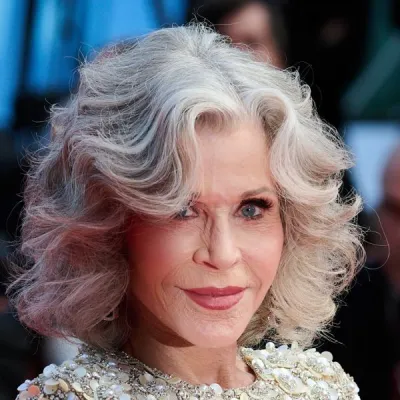
Jane Fonda
Human Design Chart
Biography
Born to socialite Frances Ford Seymour and actor Henry Fonda, she made her acting debut with the 1960 Broadway play There Was a Little Girl, for which she was nominated for a Tony Award for Best Featured Actress in a Play, and made her screen debut the same year in the romantic comedy Tall Story (1960). She rose to prominence with the comedies Period of Adjustment (1962), Sunday in New York (1963), Cat Ballou (1965), Barefoot in the Park (1967), and Barbarella (1968). Her first husband was Barbarella director Roger Vadim.
Human Design Analysis: Jane Fonda as Generator 2/4
Generator 2/4 — Design at a Glance
Jane Fonda's design points to a tendency towards great endurance and inner drive. As a Generator, she had plenty of sacral energy, which made her strong and steady like a workhorse – provided she had the right task in front of her. Her life force was not unleashed by self-willed initiative but responded to environmental signals. The strategy of her design was to wait until life presented a question or opportunity, then respond from the gut. If her sacral core signaled a clear 'yes', she could act with full power; ignoring this inner feedback or forcing herself into tasks without resonance threatened frustration or energy loss.
This mechanism created two central pitfalls: either spending her strength on things that did not bring joy, leading to exhaustion, or being prevented from continuing work on her heart project despite a still high internal drive. Living in harmony with this reactive strategy rewarded the design with a deep sense of fulfillment. The energy was available to materialize things but only through the correct response to external impulses, not by constantly pushing against the current.
Sacral Authority
Jane Fonda's design points towards intuitive, body-based decision-making. She showed herself as someone who responded to inner signals rather than acting through analytical deliberation. This stance results from her sacral authority, which is available only for the Generator type and whose strategy aligns with inner authority. This simplifies the decision process significantly since there is no separation between 'How' and 'What'.
A prerequisite was an open emotional center that ensures decisions are not dictated by passing moods. Sacral authority expressed itself as a direct physical reaction to external stimuli: a gut feeling or surge of energy. Jane Fonda learned to pay attention to these bodily sounds – such as grunts, hums, or simple noises like 'Hmm'. When her sacral motor kicked in, she felt vital and alive. She then had seemingly inexhaustible energy and tackled tasks with great enthusiasm. Her design predisposed her to go through life joyfully and lose herself in activities without needing an external purpose. The activity of her spleen center further supported this sacral authority by enabling quick, spontaneous reactions and a reliable access to instinctive perception as well as physical wellbeing, allowing her to be guided safely by these impulses.
The 2/4 Profile — Hermit / Opportunist
Jane Fonda's design points towards a pendulum rhythm: between the deep need for withdrawal and the strong pull of social networking. She showed herself as someone who did not draw strength from constant availability but in strategic shifts between isolation and community.
This dynamic stems from her 2/4 profile. Line 2, 'Solitude', demands protective spaces to remain independent and reduce conditioning by other influences. Here she finds the necessary distance to gain clarity and deepen mental processes without external pressure. Without this phase of demarcation, her independence would suffer.
Simultaneously, line 4, 'Community', acts as a driving force towards recognition and influence within her closer circle. She does not use the network for superficial contacts but to gather knowledge that she later reflects on in her alone time. The key lies in clearly communicating these two poles: when she withdraws to develop ideas and when she is ready to spend time with her favorite people. Only if both needs are respected can she effectively utilize insights from her network and transform them into brilliant concepts.
Split Definition — Defined & Open Centers
Jane Fonda's Human Design profile indicated a tendency towards persistent mental pressure and clear inner direction. With defined Head and Ajna centers, she was constantly exposed to inspiration that asked questions but did not provide direct energy for implementation. This created a reliable mental function: She understood connections and could inspire others through her concepts. Her defined Throat center allowed her to articulate these thoughts reliably, while the defined G Center provided a firm sense of self-identity and purpose. The defined Sacral center generated daily vital energy that was only correctly available in response to external impulses – not through mental initiatives.
At the same time, her chart revealed specific vulnerabilities. Her open Heart center lacked consistent willpower; she tended to move in cycles where she wanted to prove her worth by making promises she couldn't keep, leading to self-doubt. Her open Solar Plexus absorbed and amplified the emotions of others, putting her at risk of personalizing foreign moods and making emotional decisions that she later distanced herself from. The open Spleen center brought a fundamental survival anxiety that led her to cling to unhealthy situations just to avoid losing feelings of security and well-being. Finally, her open Root center took on external stress, which could lead to cycles of restlessness as she tried to rid herself of this foreign pressure through overactivity. The challenge was to use mental clarity and sacral energy without falling into the traps of conditioned emotional and willful reactions.
Channels for insatiable search, inner endurance and mental filters.
Jane Fonda's Human Design profile indicated a tendency towards narrative discovery: She showed herself as someone who influenced the collective by telling stories from personal experiences. This attitude was particularly shaped by Channel Curiosity 11-56, which connects idea formation with a constant desire for stimulation. Thus, she did not seek fixed truths but continuously explored new perspectives and passed them on as a 'storyteller'. Her creativity lay in transforming abstract concepts into compelling parables that prompted others to think – less through dry facts than emotional resonance and imagination.
Parallel to this, Channel Discovery 29-46 worked, which conveyed deep persistence in the process of experience. Here it was not about control or planned goals but losing oneself completely in the moment and trusting the natural rhythm of life. By positively responding to opportunities, she could make discoveries that only showed their full significance at the end of a long journey. This channel demanded patience and dedication to the process itself without expecting immediate results.
Additionally, Channel Abstraction 47-64 contributed by promoting an active associative mind constantly searching for patterns and connections. This mental flow could be confusing but often led to surprising insights shared as inspiring stories. Jane Fonda used this ability to make complex topics accessible and encourage others to question their own perspectives.
Individual Gates like Gate 10 (Integration), Gate 25 (Innocence) and Gate 4 (Formulation) supported this process through a mix of intuitive perception, mystical depth, and logical thinking, enabling her to communicate both emotionally and intellectually.
Collective Circuitry — Circuit Signature
Jane Fonda's Human Design profile indicated a tendency towards emotional wave movements that developed not linearly but cyclically. This structure shaped how she took in experiences from the past and grasped their meaning. The Meaning-Finding Circuit connected two separate energetic segments for her: On one hand, energy flowed between Head, Ajna, and Throat centers; on the other hand, there was a separate connection between Identity and Sacral centers. These groups were not directly linked but existed as parallel forces.
The channels Abstraction (64-47), Curiosity (11-56) and Discovery (46-29) activated this circuit. They promoted a visual, feeling-based understanding that often seemed illogical but was deeply rooted in personal history. Emotions played a central role; they followed a natural rhythm with beginning, peak, and end. Jane Fonda showed herself as someone who wanted to share these inner insights to learn together from past events. The Ajna Center's consciousness stream of meaning-finding underscored this collective aspect: It was not just about individual experience but connecting emotional truths with others to create broader understanding of human experiences.
Right Angle Cross of the Vessel of Love 4
Jane Fonda's Design reveals a tendency towards deep, almost fated dedication to interpersonal bonds. She showed herself as someone who possessed the ability to touch others through pure presence and emotional openness without it being externally forced or strategically planned.
This attitude stems from the configuration of the right cross of Love Vessel 4 in Human Design. It is a specific energy combination that connects the center of emotions with the Solar Plexus Center, extending down into the lower body via the Root Channel. Practically speaking: Jane Fonda carried an inner warmth within her that appeared like an open vessel. Other people felt drawn to this radiance and could safely deposit or share their own feelings with her. She was not actively seeking validation but offered a space where love and emotional resonance could naturally flow.
This cross acts as a magnet for deep connection. It signals the environment: "Here you are seen and accepted." Jane Fonda's Design allowed her to authentically radiate this quality. She did not need to do anything to be loved; her mere presence often sufficed to awaken feelings of safety and belonging in others. This energy is not consciously controllable but arises in waves when the inner emotional flow can freely move. In moments of clarity, she worked as a central point of human warmth that defused conflicts through simple understanding and empathy.
Saturn Return · Uranus Opposition · Chiron Return · 2nd Saturn Return — Life Cycles
Jane Fonda's Design indicates a tendency to use personal connections and public recognition as central axes of her life development. This was evident in her relationship endings: In 1965, she married Roger Vadim at the age of 28, marking her first Saturn return – a time when inner structures are often anchored through firm commitments. Later, in 1991, she married Ted Turner at her second Saturn return (age 54), reflecting a renewed consolidation of her personal identity within a partnership.
Parallel to this, external forces influenced her professional position. In 1978, Jane Fonda won the Oscar for Best Actress for "Coming Home." At age 41, she was in the Uranus opposition cycle, which often brings unexpected breaks or sudden status upgrades. This success was not a gradual ascent but a momentary leap of public affirmation that redefined her role.
Her chart suggests that she experienced fluctuations between private anchoring (Saturn) and public fame (Uranus). The marriages served stability during phases of change, while the award marked the peak of a transformative period. Jane Fonda did not passively react to these astrological pressures but actively shaped her life stages through partnerships and career successes, with each cycle revealing new facets of her public and private identity.
Generator · Sacral Authority — Synthesis
Jane Fonda seems to be driven by a deep inner impulse that arises from the interplay of sacral energy and mental pressure. As a Generator, she possesses tremendous endurance and the ability to find joy in activities when they align with her inner voice (sacral authority). At the same time, the defined Head Center creates a constant urge to question things and understand them, which inspires but also causes mental worry. This combination points to a personality that can get lost in engaged work as long as it is guided by gut feelings, while her mind constantly seeks new insights.
A central paradox lies in the tension between the need for withdrawal and social interaction. Her Profile as a Natural Talent/Networker shows an inner rhythm of phases of solitude for self-discovery (Line 2) followed by a desire to share experiences with others (Line 4). This is reflected in recurring examples of relationships that seem marked both by closeness and distance. The cyclical patterns – both successes and connections – suggest that navigating between these poles is a defining element of her life.
3 Defined Channels
Incarnation Cross - Right Angle Cross of the Vessel of Love 4
Solar Return
The Solar Return shows the moment when the sun returns to its exact birth position - your personal solar year.
Life Cycles
Discover the life cycles with a detailed triple view (birth chart, cycle chart, composite).
Human Design Profile
- Type
- Generator
- Strategy
- To respond - wait for something to respond to
- Authority
- Sacral Authority
- Profile
- 2/4 - Hermit / Opportunist
- Definition
- Split Definition
- Incarnation Cross
- Right Angle Cross of the Vessel of Love 4
- Date of Birth
- 21.12.1937 09:14
- Place of Birth
- Manhatten, United States
Frequently Asked Questions
What is Jane Fonda's Human Design type?
What profile does Jane Fonda have in Human Design?
Which authority guides Jane Fonda?
What is Jane Fonda's incarnation cross?
When was Jane Fonda born?
Discover your own Human Design
Are you also a Generator? Find out in a personal reading how to use your sacral energy correctly and discover deep satisfaction.
More Personalities
Back to overviewSissy Spacek

Aaliyah

Alexia

Anémone

Angèle

Ann-Margret
