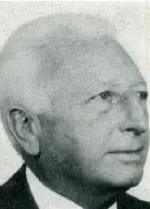
Jean-Paul de Rocca Serra
Human Design Chart
Biography
From 1984 to 1998 he was president of the Assembly of Corsica. He was also mayor of Porto-Vecchio for 47 years, from 1950 to 1997.
He died on 6 April 1998 in Paris.
What does Generator 3/5 mean for Jean-Paul de Rocca Serra?
Generator 3/5 — Design at a Glance
Jean-Paul de Rocca Serra had the immense sacral endurance of a Generator. His design suggested that he functioned like a strong workhorse: extremely resilient and energetic, provided the task aligned with his inner motivation. However, this energy was not freely available for spontaneous initiatives; it only became effective when he responded to external impulses. Therefore, the clear motto of his design was: do not initiate but wait and respond.
This mechanism carried two specific risks. If Jean-Paul de Rocca Serra engaged in tasks that did not internally motivate him over a long period, he would waste his energy and tend towards exhaustion. Conversely, he suffered from frustration when prevented from pursuing his heart project despite still being full of drive. His path to deep satisfaction led exclusively through reacting to signals from life. Once his sacral center gave a clear “yes,” he could respond with consistent action and thus experience profound fulfillment. Acting against this inner signal or attempting to start things on his own would eventually lead him to persistent frustration and a noticeable lack of energy. Therefore, his success depended on unleashing his enormous power only when he responded from the gut to an invitation.
Sacral Authority
Jean-Paul de Rocca Serra based his decisions on sacral authority. This inner guidance was for him as a Generator the primary source of action capability and greatly simplified his decision-making process since strategy and authority were unified in one person. His reactions to external stimuli manifested physically: through a gut feeling or sudden surge of energy. He learned to pay attention to these internal signals, which could manifest as grunts, hums, or simple utterances like “Mhm.” When his sacral motor kicked in, he felt vital and alive. Then, almost inexhaustible energy was at his disposal with which he accomplished tasks with great enthusiasm. This allowed him to move through life joyfully and fully immersed in his activities without the need for external purposefulness. The prerequisite for this clear sacral guidance was his open emotional center. Additionally, his activated spleen center acted as a supportive authority. This connection endowed him with the ability to react particularly quickly and spontaneously. He had an immediate access to his physical well-being and instinctive perception, which he relied on reliably. This configuration shaped his way of acting impulsively yet firmly rooted in himself.
The 3/5 Profile — Martyr / Heretic
Jean-Paul de Rocca Serra lived as an experimenter and hero. His design laid a foundation characterized by the constant testing of new paths and sharing these experiences with others. He learned primarily through personal action and failure, which provided him with a rich treasure trove of practical knowledge. This profile marked him as someone who initially accepted few predefined beliefs but had to test everything himself. Through this process of adaptability and intuition, he developed his own clarity, which he then used to solve problems for others.
Line 3 in his design drove him to adapt through trial and error. This was a self-referential process of survival and learning from mistakes. At the same time, Line 5 acted on him as a hero line, connecting assertiveness with the need to venture new beginnings often under high expectations. This aspect gave his initiatives a certain mystical quality but also came with the risk of failure if he did not properly root himself. Jean-Paul de Rocca Serra thus emerged as someone who made his own mistakes the foundation for leading and inspiring others. The attractiveness of his experiences drew people who wanted to learn from his practical knowledge, giving him a central role in his environment.
Single Definition — Defined & Open Centers
Jean-Paul de Rocca Serra revealed himself as someone who drew his strength from an inner, vital source. His defined Sacral Center provided him with constant energy that he used by reacting to life – not through initiatives of the mind. This mechanism protected him from exhaustion as long as he listened to his immediate “yes” or “no” response. This was complemented by his defined Spleen Center, which gave him a sharp instinctive feeling for health and well-being in the present moment. His defined Root Center also provided the necessary pressure to move forward in the material world and transform stress into productive action.
At the same time, Jean-Paul de Rocca Serra was vulnerable to external influences through several open centers. His open Head and Ajna Centers meant that he did not possess a fixed mental truth; he tended to identify with foreign questions or theoretical concepts rather than trusting his inner authority. This could lead to confusion when he tried to solve everything intellectually. His open G Center left him without a fixed identity, absorbing the directions and roles of his environment, leading him often to question who he was or where his true love lay instead of simply being in the right place. Additionally, his open Heart Center made him not consistently willful; he tended to want to prove his worth through promises or competition, which could plunge him into spirals of self-doubt if he failed to meet these expectations. His open Solar Plexus absorbed the emotions of others, making him emotionally restless when he personalized these foreign feelings as his own. Finally, his open Throat Center attracted attention without him actively seeking it; attempting to control his communication often led to stress rather than clarity.
Channels for evolutionary change, care and traditional values.
Jean-Paul de Rocca Serra displayed a fundamental attitude that oscillated between the urge for evolutionary change and the responsibility of maintaining what exists. His design was characterized by two central channels that determined this dynamic. The Channel of Mutation 60-3 connected his Root Center with his Sacral Center. This connection brought forth pulsating energy of transformation, steered by Gate 60 (Limitation) and Gate 3 (Order). Jean-Paul de Rocca Serra had to learn to accept limitations and move beyond the confusion of new beginnings in order for this mutative process to be effective. This energy often felt melancholic and unpredictable as it waited for something new to emerge, which could only be patiently awaited rather than controlled.
Simultaneously, the Channel of Preservation 27-50, connecting his Sacral Center with his Spleen Center, created a strong need to nourish the clan and preserve traditional structures. Jean-Paul de Rocca Serra naturally attracted trust and felt compelled to take responsibility for others – whether through direct care or defending shared values. This combination of revolutionary impulse (mutation) and conservative maintenance (preservation) created an inner tension: on one hand, the energy pushed towards change and innovation; on the other hand, there was a desire to secure stability and order.
Additional gates like Gate 57 (intuitive clarity), Gate 51 (willpower), as well as Gates of freedom (53) and spiritual development (54) rounded out his profile. They promoted intuitive perception in the present moment paired with strong adaptability and a drive for individual unfolding. Jean-Paul de Rocca Serra lived this mechanism by navigating between creating new paths and nurturing existing bonds, always driven by the necessity to enable change as well as secure the foundation of life.
Individual Circuitry — Circuit Signature
Jean-Paul de Rocca Serra exhibited a penetrating, pulsating life force that was grounded in his unique path and the preservation of what is essential. His design was simply defined, meaning his energy centers were directly connected to each other forming a coherent flow.
The Knowledge Circuit worked through him via the Channel of Mutation (3-60). This connected his Sacral Center with his Root Center. It was about the power to create new things and initiate changes. The energy was pulsating and acoustic, driven by a deep inner motivation to express personal identity and bring innovations into the world.
Parallel to this, the Archer Circuit worked through the Channel of Preservation (27-50). This connected his Sacral Center with his Spleen Center. Here lay instinctive energies of protection, care, and preservation. These were ancient forces aimed at nourishing and defending family and genetics. The energy was timeless and oriented towards the senses of taste and smell.
As Jean-Paul de Rocca Serra had a simple definition, these energies – creativity from the Knowledge Circuit and protective instinct from the Archer Circuit – flowed together in one single connected system. His Sacral Center served as a common source for both aspects: it propelled both the creative mutation forward and the instinctive preservation of what exists. This connection created a person who not only generated unique knowledge but also preserved and passed it on with deep, maternal-filial devotion.
Right Angle Cross of Penetration 3
Jean-Paul de Rocca Serra demonstrated a fundamental disposition aimed at profound and often unconscious transformations. His design was marked by the right cross of penetration 3, describing a specific life dynamics: the drive to unite seemingly incompatible or contradictory elements into a new coherent whole. This did not happen through superficial adaptation but rather through intensive inner work where old structures were dismantled and redefined.
This configuration points towards an alchemical transformation process. Jean-Paul de Rocca Serra lived in tension between the known and unknown, using these polarities as raw material for a higher synthesis instead of avoiding them. It was a pattern of breaking through boundaries – whether it be between mind and matter, individual and collective or tradition and innovation.
The mechanics of this cross imply that true insight arises only from direct confrontation with opposition. Jean-Paul de Rocca Serra did not seek harmonious tranquility but rather the power lying in friction between opposing forces. His path involved enduring these tensions until they were integrated into a new form of understanding, transcending original contradictions. It was a process of breaking and reassembling where the result was always more complex and profound than the sum of its parts.
Saturn Return · Uranus Opposition · Chiron Return · 2nd Saturn Return — Life Cycles
Jean-Paul de Rocca Serra's life was marked by clear phases of structural change followed by later confirmation. At age 39 in 1950, he was elected mayor of Porto-Vecchio. This event occurred during his Uranus opposition period, often associated with unexpected turns or breaking away from established structures. For his design, this moment signified a point where external circumstances pushed him towards new responsibilities, possibly against the resistance of old habits or expectations.
Later at age 51 (1962), Jean-Paul de Rocca Serra was elected to the National Assembly. This happened during his Chiron Return cycle. In Human Design mechanics, this is not a time for healing past wounds but rather a phase of blooming and fulfilling one's incarnation purpose. Here it became evident that his life increasingly took on meaning and direction aligned with his inner design. The election into national parliament was less a struggle than the natural outcome of long-term development where his true life mission became clearer and recognized by the outside world. These two events illustrate the transition from a phase of upheaval to a time of stable realization of his potential.
Generator · Sacral Authority — Synthesis
Jean-Paul de Rocca Serra lived deeply rooted in his sacral energy (Sacral Center defined, Generator type) and followed an inner call manifesting as physical reactions to external stimuli (sacral authority). This combination of powerful, available life force and intuitive 'yes' or 'no' shaped his path. His profile as an experimenter and hero (3/5-Profile) indicates that he learned through personal experimentation and shared this knowledge with others – a pattern evident in professional successes (events documented during Uranus cycle and Chiron Return).
A central paradox lay in the connection between his capacity for deep engagement and sustained work (Sacral Motor) with the channel of mutation (3-60). This channel brought constant change and some melancholy, as it continually sought new paths while questioning existing structures. Thus, through his energy, he created both stability and an unceasing drive towards innovation that propelled him forward but also caused internal tension.
2 Defined Channels
Incarnation Cross - Right Angle Cross of Penetration 3
Solar Return
The Solar Return shows the moment when the sun returns to its exact birth position - your personal solar year.
Life Cycles
Discover the life cycles with a detailed triple view (birth chart, cycle chart, composite).
Human Design Profile
- Type
- Generator
- Strategy
- To respond - wait for something to respond to
- Authority
- Sacral Authority
- Profile
- 3/5 - Martyr / Heretic
- Definition
- Single Definition
- Incarnation Cross
- Right Angle Cross of Penetration 3
- Date of Birth
- 11.10.1911 23:00
- Place of Birth
- Bonifacio, France
Frequently Asked Questions
What was Jean-Paul de Rocca Serra's Human Design type?
Which Profile did Jean-Paul de Rocca Serra have?
What Authority did Jean-Paul de Rocca Serra have?
Which incarnation cross was active for Jean-Paul de Rocca Serra?
When was Jean-Paul de Rocca Serra born?
Discover your own Human Design
Are you also a Generator? Find out in a personal reading how to use your sacral energy correctly and discover deep satisfaction.
More Personalities
Back to overviewAaliyah

Alexia

Angèle

Anne-Marie

Arcángel
Arno