
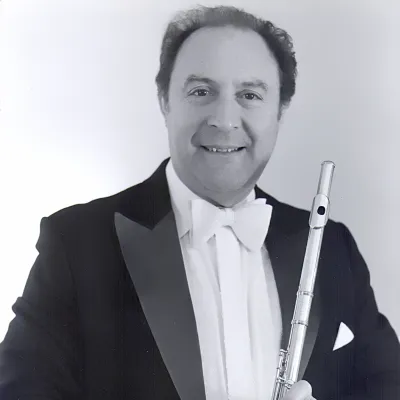
Jean-Pierre Rampal
Human Design Chart
Biography
Despite being the son of a flute teacher, Rampal was encouraged to study medicine. While attending Marseille Medical School during World War II, he was drafted into a labor camp in Germany. He abandoned his studies and fled underground in Paris. He began taking flute lessons at the Paris Conservatory and won first prize in their competition. In 1945, he founded the French Wind Quintet, and from 1947-51, he worked with the Vichy Opéra orchestra. He founded the Baroque Ensemble of Paris in 1953 and held the position of first flute at the Paris Opéra from 1956–62. In 1968, he joined the faculty of the Conservatory.
Seemingly filled with boundless energy throughout his life, he made numerous international tours, appeared with all the major orchestras in Europe and the United Sates and appeared in recital in many of the world’s great halls. Additionally, he edited music and taught, and during his later years, he took up conducting. He gained a worldwide reputation for authentically interpreting 18th century music.
Rampal suffered a fatal heart attack on May 20, 2000 in Paris.
Jean-Pierre Rampal — Projector with Profile 2/4
Projector 2/4 — Design at a Glance
Jean-Pierre Rampal appeared as someone who interacted with his environment through a dense, focused aura. His design indicated a tendency to immediately identify weaknesses in systems or others – similar to a bright light beam shining directly into the dark. This ability to quickly spot errors could be perceived as unpleasant when addressed directly. Instead of appearing confrontational, his strategy was designed to attract through his own harmony. He waited for appreciative and honest invitations from others before sharing his knowledge or leadership. As a Projector, he did not have a defined Sacral Center, meaning that he lacked a constant intrinsic source of life energy. Instead, he experienced phases of high activity and fast work speed followed by necessary rest periods to prevent burnout. This rhythmic distribution of energy fundamentally differed from the demands of standardized school or professional systems. If Jean-Pierre Rampal lived according to this design and respected his invitation dynamics as well as his energy balance, he was rewarded with success. Ignoring these mechanisms led sooner or later to the non-self theme of bitterness. His impact therefore did not rely on permanent self-activity but rather on serving as a shining example, prompting others to seek out his insider tips.
Splenic Authority
Jean-Pierre Rampal demonstrated decision-making based on an immediate inner signal. His internal authority lay in the defined Spleen Center while the Emotional and Sacral Centers were open – a configuration only Projectors or Manifestors can carry. The Spleen Center served as his health and alarm system, equipped with pronounced survival intelligence. This intuition signaled spontaneously whether a situation, environment, or society was right for him. The first impulse directly served his health; it enabled him to rigorously distance himself from harmful influences and take good care of himself.
This spleen impulse was very subtle and appeared only once at each moment. It could easily be drowned out or ignored by other voices, requiring high vigilance. Sometimes a brief retreat helped to perceive this fine voice again. Since Jean-Pierre Rampal knew what was right for him only in the moment, his plans often changed last-minute. Long-term commitments were difficult; he needed much freedom and flexibility. Spontaneous decisions suited his nature better than rigid guidelines. His strategy consisted of listening to these immediate impulses that helped him stay in the right environment and protect himself from stress.
The 2/4 Profile — Hermit / Opportunist
Jean-Pierre Rampal appeared as someone who oscillated between a deep need for withdrawal and the urge towards community. His design created tension: on one hand, he sought solitude to clarify inner processes; on the other hand, it drew him into the circle of his trusted companions. This dynamic matched his Profile 2/4, known as 'Natural Talent / Networker'. Line 2 demanded a safe cave where he could reflect undisturbed. Only when this inner peace was achieved did line 4 open up and allow exchange with his network.
Specific line influences were particularly defining. The second line of Gate 54 promoted discretion and restraint. Here, a wise strategy emerged: He avoided exploiting previous advantages, which strengthened his ambition through moderation. At the same time, this energy could weaken loyalty if it remained immature. On the other hand, the fourth line of Gate 57 determined his relationship life. It anchored his survival in social bonds and enabled masterful handling of harmony. However, when his own existence was threatened, he tended to make authoritarian decisions to secure his position.
For Jean-Pierre Rampal, it was therefore essential to clearly communicate when he sought company and when he wanted to be left alone. Only then could he process the knowledge from his network in solitude and develop brilliant ideas without causing conflicts through contradictory signals. His life consisted of this rhythmic alternation between isolated immersion and connecting exchange.
Split Definition — Defined & Open Centers
Jean-Pierre Rampal was characterized by a persistent mental pressure that drove constant questioning and understanding. His defined Head and Ajna Centers created a trustworthy mental function; he processed data conceptually, yet lacked the energy to directly translate these thoughts into physical reality. This inner drive required patience, as hasty action would only have led to frustration. Instead, his inspiration manifested through stimulating thought impulses in others.
Parallel to this, Jean-Pierre Rampal had a defined Spleen Center, which endowed him with spontaneous and intuitive bodily intelligence. He perceived warning signals in the moment and acted from an existential awareness, providing him with well-being and protection. His defined Root Center also provided a steady adrenergic pressure that propelled him forward and helped him cope with stress by nourishing his survival consciousness.
These stable inner resources contrasted with his open centers. His open Throat Center made him vulnerable to the desire for attention; he tended to wonder if others noticed him, and could suffer under the pressure of needing to speak to be recognized. The open G Center meant that Jean-Pierre Rampal lacked a fixed identity. He relied on being initiated by his environment and often felt uncertain when he did not find the right place or direction.
Additionally, in his open Heart Center, he lacked consistent willpower; he could easily get caught up in spirals of promises and disappointment to prove his worth. His open Sacral Center caused him to absorb foreign energies, leading to exhaustion if he did not pause. Finally, his open Solar Plexus absorbed the emotions of his surroundings, putting him at risk of personalizing other people's moods and feeling emotionally overwhelmed rather than observing them objectively.
Channels for logical clarity and abstract patterns.
Jean-Pierre Rampal was characterized by an insatiable drive for perfection and a deep need to understand complex patterns. His design was marked by the tension between logical correction and abstract insight.
The Judgment Channel 58-18 connected his Root Center with his Spleen Center. This channel drove him to examine every structure for its functionality and correct it. It was an insatiable impulse to filter out the best – Gate 58 demanded 'better and more', while Gate 18 ensured only healthy and balanced elements remained. This mechanism nourished the art of mastery; he sought solutions applicable to the collective rather than merely criticizing.
Parallel to this, the Abstraction Channel 64-47 between Head and Ajna Centers filtered every experience through a kaleidoscope of mental images. He was under pressure to find a story or perspective that made sense. Although this process often began with confusion – like a 'drunken monkey' – patience led to a clear, inspiring sequence crystallizing from the many possibilities. This ability to weave a comprehensible narrative from the chaos of experience was central to how he conveyed insights.
Additionally, specific Gates shaped his profile: Gate 54 linked worldly success with mystical insight, while Gate 53 represented the pioneer spirit and the start of new cycles. Gate 51 brought strong willpower and shock adaptability. In his design, Gates 44 (awareness) and 39 (selective analysis) sharpened his intuitive responsiveness. Thus, his chart united the discipline of correction with the freedom of abstract thinking, always seeking a truth that was both logically sound and deeply inspiring.
Collective Circuitry — Circuit Signature
Jean-Pierre Rampal was characterized by two parallel, energetically separate focal points. On one side, his design connected Spleen to Root Center through the Judgment Channel (Gates 18 and 58). This connection within the Understanding Circuit fostered an intuitive, rapid evaluation capability that translated directly into action impulses. It was a 'dispassionate ratio' aimed at improving things through focus and structure, conveying logical insights free from conditioning.
Simultaneously, there existed a completely independent current between Head and Ajna Centers, carried by the Abstraction Channel (Gates 64 and 47). This part of the Meaning Circuit did not engage in direct exchange with the Spleen-Root connection. Instead, it produced a cyclical, wave-like form of thinking that dealt with emotions and experiences from the past. Here, it was about finding meaning behind past events and emotionally processing these felt insights.
As Jean-Pierre Rampal had a split definition, these two systems – the intuitive, future-oriented logic on one hand and the emotional, past-focused reflection on the other – operated alongside each other. They did not form a continuous unit but rather two separate fields of power: one for quick, rational judgment and action, the other for deep, often inexplicable contemplation over past experiences. This separation meant that rational strategies were not automatically supported by emotional waves and vice versa.
Right Angle Cross of Penetration 4
Jean-Pierre Rampal exhibited a fundamental disposition rooted in profound inner clarity and an almost penetrating perception. His design bore the signature of the right cross of penetration four, which was not mere intuition but a specific ability to grasp the essence directly. This configuration enabled him to look beyond facades and superficial appearances to recognize the core of a matter or person abruptly. It did not involve long analytical thought but rather an immediate clear access to the truth of the situation. This gift significantly shaped his way of interacting and creating: he sought not complex detours but aimed directly at the heart of a situation. The energy of this cross acted like a sharp focus, pushing aside fog and making space for authentic encounters or artistic expressions based on unadorned insight. For Jean-Pierre Rampal, this meant that his deepest impulses often originated from this place of immediate penetration, allowing him to act with special directness and authenticity in his fields without being distracted by external expectations or illusions.
Saturn Return · Uranus Opposition · Chiron Return · 2nd Saturn Return — Life Cycles
Jean-Pierre Rampal showed himself as someone whose professional authority and recognition reached their full extent in later life stages. His design indicated a tendency to receive the highest formal confirmation only after years of groundwork and maturation, typical for the effect of the second Saturn return. This cycle often marks the point where years of discipline and structuring culminate in a socially visible honor. In 1978, at age 56, he was awarded the Léonie Sonning Music Prize – an event that concretely illustrates this mechanical dynamic: condensing long-term work into a sustainable public success.
Earlier, the Chiron return had already shown its effectiveness, a fulfillment cycle in which one's incarnation cross unfolds and meaning becomes tangible. In 1968, at age 46, Jean-Pierre Rampal received a professorship at the Paris Conservatory. This step was not merely a career change but the concrete manifestation of his inner calling in an institutional role. The design promoted the transition from pure action to mediation and anchoring of knowledge. Both cycles together underscore a life path where external recognition did not happen by chance, but as a logical consequence of alignment with strategy and authority. His chart's mechanics clearly show: recognition came where he consistently applied his specific energy over time.
Projector · Splenic Authority — Synthesis
Jean-Pierre Rampal lived a path marked by a deep need for authenticity and the ability to recognize potential in others (Projector type with defined Head Center). He constantly sought clarity through inner reflection (Line 2 in Profile) before sharing his insights within a network of relationships (Line 4). This alternation between withdrawal and connection shaped his interaction with the world, where Spleen authority helped him instinctively know when it was time for both. The Channel of Judgment (58-18) points to a natural talent for recognizing patterns and improving things – an urge that drove him to extract the best from every situation.
A central paradox in his design lay in the interplay between inspiration and correction. The defined Head Center generated constant mental pressure to question and understand, while the Channel of Judgment led him to recognize and correct errors. This resulted in internal tension between a desire for perfection and acceptance of imperfection, manifesting in recurring themes of his work and relationships. Recognition for his achievements (Saturn return) and reaching a career milieu (Chiron Return) thus expressed this inner dynamic.
2 Defined Channels
Incarnation Cross - Right Angle Cross of Penetration 4
Solar Return
The Solar Return shows the moment when the sun returns to its exact birth position - your personal solar year.
Life Cycles
Discover the life cycles with a detailed triple view (birth chart, cycle chart, composite).
Human Design Profile
- Type
- Projector
- Strategy
- Wait for the respectful invitation
- Authority
- Splenic Authority
- Profile
- 2/4 - Hermit / Opportunist
- Definition
- Split Definition
- Incarnation Cross
- Right Angle Cross of Penetration 4
- Date of Birth
- 07.01.1922 09:00
- Place of Birth
- Marseille, France
Frequently Asked Questions
What is Jean-Pierre Rampal's Human Design type?
What Profile did Jean-Pierre Rampal have?
What Authority did Jean-Pierre Rampal have?
What incarnation cross did Jean-Pierre Rampal have?
When was Jean-Pierre Rampal born?
Discover your own Human Design
Are you also a Projector? Find out in a personal reading how to unfold your leadership qualities and recognize the right invitations.
More Personalities
Back to overviewSissy Spacek

Aaliyah

Alain-Fournier

Alexia

Alizée

Anémone
