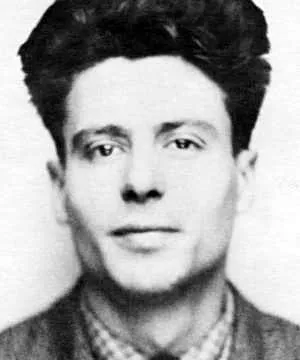
Jean Vigo
Human Design Chart
Biography
He married and had a daughter, Luce Vigo (a film critic) in 1931.
Vigo died of complications from tuberculosis at age 29, on 5 October 1934, Paris.
Jean Vigo as a Generator 4/6 in Human Design
Generator 4/6 — Design at a Glance
Jean Vigo's Design inclined towards high endurance as long as he responded to impulses. As a Generator, he had plenty of sacral energy that made him extremely strong and resilient like a workhorse – provided this power was used for tasks that resonated with him internally. His life force did not unleash itself through spontaneous initiatives but only when responding to signals from his environment. The strategy 'react rather than initiate' was central: When his sacral center gave a clear 'yes', he could act with full power and experience deep satisfaction.
However, this system contained two specific risks. First, burnout threatened if Vigo continuously handled tasks that did not interest him and wasted his energy. Second, it led to frustration when he was prevented from pursuing his heart project despite still being full of drive. If he did not live according to his design – for example by constantly initiating actions against his inner compass – sooner or later he would encounter a feeling of persistent frustration and lack of energy. In harmony with his nature, however, he was unstoppable as his energy came directly from the gut and responded to real life impulses.
Emotional Authority
Jean Vigo's Design inclined towards emotional wave movement where inner truth only became visible after acute feelings subsided. He possessed emotional authority carried by his defined Solar Plexus Center. In Human-Design mechanics, this authority is prioritized: It always takes precedence over all other defined centers regardless of further configurations in the chart. This meant for Jean Vigo that spontaneous decisions from the moment were often deceptive as they only reflected a temporary mood – sometimes euphorically enthusiastic, sometimes deeply negative colored. His true clarity set in only after he took time to go through these emotional waves and let decisions ripen overnight. This process of 'pondering' and multiple reconsiderations was not a sign of weakness or indecision but a necessary mechanical function of his design. Only by exercising patience and gaining distance from the current emotion could he find calmness and recognize the deeper truth of a situation. The necessity to take time particularly shaped long-term life decisions, as quick reactions from emotional snapshots had potential for negative consequences. Jean Vigo's path towards inner security thus led not through immediate action but through consciously enduring in emotional turbulence until clarity set in.
The 4/6 Profile — Opportunist / Role Model
Jean Vigo's Design inclined strongly with the years changing. In his first thirty years, he appeared experimental and intensely sought connection in relationships and friendships driven by the dynamics of his Profile Line 4. This phase was characterized by a need to show generosity and build a network, where the challenge lay in learning whom to open up to so as not to lose strength or get hurt through blind sharing.
With Saturn's return, his focus fundamentally shifted. The Line 6 became active and brought an inner conflict between the desire for community belonging (Heart) and the drive towards distant, wisdom-oriented reflection (Head). Jean Vigo now faced expectations to function as a role model. His task was to develop new superiority or insight and transfer this onto others, thereby becoming part of the second generation setting trends. He had to weigh which advantages needed protection through secrecy so their impact would not be lost. Thus, his life revolved around integrating these two poles: generous sharing in the network on one hand and the transcendent, often reserved position of a mentor for others.
Split Definition — Defined & Open Centers
Jean Vigo's Human Design profile emphasized a tendency towards self-determined action power, supported by a defined Heart Center. He had permanent access to willpower and could keep promises and control resources, which helped him recognize his own worth and be successful. This energy was connected with a defined Sacral Center, acting as the motor: His vitality required reactions to external impulses to be used satisfyingly; initiating would have led to resistance.
His emotional system was characterized by a defined Solar Plexus Center. Here, the mechanics of emotional authority applied: Jean Vigo had to wait out waves of feelings and moods until clarity emerged instead of making impulsive decisions. This created deep sensitivity but required patience as truth revealed itself over time. Additionally, a defined Spleen Center supported his intuitive survival awareness in the moment of "now," while a defined Root Center provided constant pressure to materialize and manage stress.
In contrast, his vulnerability was evident in open centers. His open Head Center left him without consistent mental inspiration; he tended to engage with others' questions or be overwhelmed by doubts rather than generating his own answers. Similarly, his open Ajna Center meant that his conceptual thinking was flexible and receptive to ideas from the environment, yet he could not hold stable concepts of his own, leading him to interpret opinions as his truth.
His open Throat Center indicated that he could not communicate consistently. He naturally drew attention when waiting rather than trying to be the center or forcing it through talking. Finally, an open G Center meant a lack of firm identity and direction. Jean Vigo relied on others to initiate finding the right places and relationships; attempting to determine his own direction left him confused about his "who." His strength lay in using this openness as a mirror for the environment rather than seeking a fixed self-image.
Channels for change, life purpose and community.
Jean Vigo's Human Design indicated a tendency towards deep, often melancholic transformation. The Channel 60-3 connected the Root Center with the Sacral Center and created a pulsing rhythm of chaos and order. This energy demanded acceptance of limitation (Gate 60) to move beyond the confusion of new beginnings (Gate 3). The inner pressure was felt as melancholy when the pulse stopped; Jean Vigo learned not to resist this moodiness but to patiently wait for the next mutation.
Simultaneously, the Channel of Life Struggle 38-28 shaped his attitude. It connected the Root Center with the Spleen Center and pushed him to find meaning in struggles. Gate 38 provided the pressure to defend individual integrity against external forces, while Gate 28 sharpened awareness of which battles were truly worth fighting. This combination gave him a stubborn determination to walk his own path and inspire others towards individuation.
In interpersonal relationships, the Channel of Community 37-40, connecting the Solar Plexus Center with the Heart Center, was influential. It sought recognition (Gate 37) and a place in the whole but also needed pauses for regeneration (Gate 40). This channel emphasized the need for carefully negotiated agreements to build stable relationships based on mutual benefit and loyalty rather than hierarchy.
Additional Gates like Gate 27 (Care) and Gate 58 (Experimental Spirit in the Root Center) supported these dynamics. Gate 41 promoted evolutionary development through crises, while Gate 36 released emotional energy cyclically during downturns. Thus, Jean Vigo's design emerged as a complex web of mutative change, combative integrity, and the need for binding community, always navigating between inner pressure and the search for meaning.
Individual Circuitry — Circuit Signature
Jean Vigo's Human Design shows a tendency towards separate, parallel energetic fields. His system exhibited a "Split Definition," meaning that his defined centers did not act as a continuous flow but rather existed as two independent power centers. This shaped his experience: He had to learn to view these different energies separately and not as one continuous experience.
The Knowledge Circuit formed the first of these fields. Here, Sacral, Root, and Spleen Centers were directly connected. This connection created a pulsing energy aimed at mutation and deviation from the known (Channel 3-60), paired with the intensity of life's struggle (Channel 28-38). It was about expressing a unique identity through new knowledge.
The second field was formed by the Ego Circuit, where Heart and Solar Plexus Centers were connected. This circuit focused on cooperation and the relationship between giving and taking (Channel 37-40). Since there was no connection to the Sacral Center here, this energy was timeless and required pauses for resource building for the community.
Jean Vigo lived with these two separate systems: An impulsive, innovative field of body and intuition alongside an emotional, cooperative field of heart and feeling. They operated side by side without directly overlapping, requiring a clear distinction between his individual creative power and social interaction.
Right Angle Cross of the Unexpected 1
Jean Vigo's Human Design profile bore the signature of the right cross of the Unexpected. This configuration shaped a life characterized by spontaneous turns and unpredictable developments. In Human Design terms, this cross describes a pattern where life does not follow a linear path but is instead guided by sudden insights or external circumstances that abruptly change one’s course. For Jean Vigo, it meant his development was often marked by moments when situations unexpectedly unraveled or took new directions without much warning.
The mechanics of this design suggest that stability was not achieved through rigid planning but rather through the ability to respond to the unforeseen. Jean Vigo worked with surprises in his energy flow. What initially appeared as an obstacle or distraction often turned out to be a necessary impulse for the next step. This dynamic required inner flexibility, as focus was not on achieving fixed goals but navigating the current, often surprising events. The right cross of the Unexpected 1 underscores the importance of these sudden shifts as driving forces in his individual journey rather than viewing them as disruptions.
Saturn Return — Life Cycles
Jean Vigo's design featured an intense yet time-limited lifespan that reached its peak during a short but formative creative phase. His first Saturn return occurred at age 29 – a cycle often seen in Human Design as a moment of condensing long-term inner work and confronting personal limits. In this year, 1934, he completed his second feature film “L’Atalante”. This work symbolized the maturation of his creative vision before his physical existence ended due to tuberculosis. The Saturn return here marks not just biological aging but the point where a person’s essence is revealed in its purest form, often tied to a final confirmation or abrupt end of their earthly path. For Jean Vigo, this was the pinnacle of his artistic unfolding and simultaneously the end of his life. The mechanics of the Saturn return act like a test of substance: what has been built over years is put to the test for its durability. In his case, this condensation led to a masterpiece before physical condition gave way. His design thus showed an extreme concentration of energy and expression in a very short period, with the Saturn return serving as the decisive moment of completion and conclusion. It was not a gradual process but an intense focal point that released all his potential at once and then left the material plane with his death.
Generator · Emotional Authority — Synthesis
Jean Vigo lived his energy as a Generator deeply immersed in creative creation, driven by a strong Sacral Center. This endurance allowed him to take on and pursue projects as long as inner passion burned – a central aspect of his actions that showed a tendency towards focusing on heart projects (and potentially protecting them from external influences). Emotional authority shaped his perception and decision-making, requiring time for feelings to mature and reveal deeper truths.
A fundamental paradox in his design lay in the interplay between individual expression and the desire for community. The Profile as Networker/Role Model points to the ability to form connections and inspire others, while Channel of Mutation (3-60) released an unpredictable energy that pushed him to explore new paths and break conventions. This tension between the need for belonging and the drive for innovation created a dynamic field where creative transformations could occur – up to the final, unexpected conclusion of a life’s work at a young age.
3 Defined Channels
Incarnation Cross - Right Angle Cross of the Unexpected 1
Solar Return
The Solar Return shows the moment when the sun returns to its exact birth position - your personal solar year.
Life Cycles
Discover the life cycles with a detailed triple view (birth chart, cycle chart, composite).
Human Design Profile
- Type
- Generator
- Strategy
- To respond - wait for something to respond to
- Authority
- Emotional Authority
- Profile
- 4/6 - Opportunist / Role Model
- Definition
- Split Definition
- Incarnation Cross
- Right Angle Cross of the Unexpected 1
- Date of Birth
- 26.04.1905 03:00
- Place of Birth
- Paris, France
Frequently Asked Questions
What was Jean Vigo's Human Design type?
Which Profile did Jean Vigo have?
What authority guided Jean Vigo's decisions?
What incarnation cross did Jean Vigo have?
When was Jean Vigo born?
Discover your own Human Design
Are you also a Generator? Find out in a personal reading how to use your sacral energy correctly and discover deep satisfaction.
More Personalities
Back to overviewAaliyah

Alexia

Angèle

Anne-Marie

Arcángel

Arno