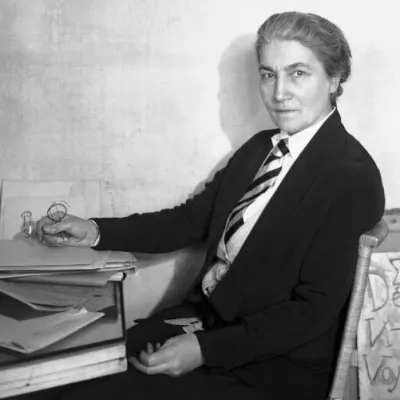
Jeanne Bucher
Human Design Chart
Biography
Jeanne Bucher was the sister of physician Pierre Bucher. She arrived in Paris in 1920 where she befriended Edmond Bernheim, Jean Lurçat, Jean Dalsace, Dollie and Pierre Chareau.
In 1895 she married the Swiss-born pianist Fridolin Blumer, with whom she had two daughters, Ève born in 1898, and Sybille born in 1901.
Between 1902 and 1922, she left Strasbourg for Switzerland, to study to be a librarian and then a nurse, becoming a volunteer nurse in Lyon during the Second World War. Following the annulment of her marriage to Fridolin Blumer, she moved to Paris in 1922.
She opened her first gallery-bookstore in 1925, in an annex to the Pierre Chareau showroom where she met the writer-publisher Georges Hugnet. Her first exhibitions were dedicated to cubism and especially to the sculptures of Jacques Lipchitz. When financial difficulties forced her to sell her art gallery, she participated in the exhibitions organized by Marie Cuttoli.
In 1936, Jeanne Bucher reopened a gallery in an upstairs apartment, at the end of a courtyard, at 9 boulevard du Montparnasse, still surrounded by the friendship of Jean Lurçat and Georges Hugnet, whom she exhibited in addition to Pablo Picasso, Joan Miró, Kandinsky, Henri Laurens, Georges Gimel, Jacques Lipchitz, Max Ernst, André Masson, Jean-Michel Coulon, Paul Cognasse, Nicolas Eekman, Robert Lotiron, Jean-Francis Laglenne, and Jean Signovert. She also published art books, such as Une semaine de bonté (A Week of Kindness) by Max Ernst in 1934.
During World War II she helped photographer Rogi André, first wife of André Kertész, hiding her in Paris after she had been forced to take refuge in Touraine because of her Jewish origins.
Jeanne Bucher died on 1 November 1946 in Paris at age 74.
Human Design Analysis: Jeanne Bucher as Generator 3/5
Generator 3/5 — Design at a Glance
Jeanne Bucher was a Generator. Her design endowed her with immense endurance and the ability to generate energy – comparable to a strong workhorse that moved powerfully forward as long as it burned for its task. However, this strength was only fully available to her when she responded to impulses from her environment rather than initiating independently. The motto of her design was: not start but answer.
Her most successful strategy involved listening to signals from life and waiting until her sacral center gave a clear “yes.” Only then did she release her energy through action. When Jeanne Bucher lived in harmony with this principle, she was rewarded with a deep sense of fulfillment; no one could stop her progress.
Deviation from this strategy led to two specific pitfalls. If she persistently engaged in activities that brought her no joy or wasted her energy, she tended towards exhaustion and burnout. Conversely, she also suffered when prevented from continuing work on her heart project while still full of power and wanting to continue. Initiating against her design eventually met with persistent frustration and a noticeable lack of energy. Her path to contentment thus did not lie in forcing results but in patiently reacting to inner confirmation.
Sacral Authority
Jeanne Bucher possessed sacral authority, which fundamentally shaped her decision-making process. As a Generator, this was her internal compass needle and strategy. Her design required her not to actively seek or plan but to wait for external stimuli and then listen to the immediate physical impulse. This manifested as gut feelings, a subtle grunting sound, or a noticeable surge of energy in the lower abdomen. When this motor started up, she felt vital and alive; her energy was inexhaustible, and her tasks were completed with great enthusiasm. She lived to immerse herself fully in what confirmed her inner resonance without having to follow a strict utilitarian purpose in her head.
A crucial mechanism of her design was the openness of the emotional center. This condition enabled the function of sacral authority as the primary decision-making instance. Additionally, her activated spleen center acted as a supportive instance. Through this connection, Jeanne Bucher had quick and instinctive access to her physical well-being. She could react spontaneously and quickly guided by a reliable perception of her state. This configuration simplified her process: instead of weighing things in her head, she trusted the direct physical response – the “yes” or “no” of her system – which allowed her to go through life with joy and satisfaction.
The 3/5 Profile — Martyr / Heretic
Jeanne Bucher was someone who did not accept knowledge theoretically but acquired it through direct experimentation. Her design as Profile 3/5 – Explorer and Heroine – shaped this attitude: she initially believed in nothing predetermined, but had to experience everything herself. This line of the adventurer drove her to learn from her own mistakes so that later on, she could solve others’ problems with practical know-how.
This process was marked by ambivalence. The experiential line (3) brought resignation in the sense of a fatalistic acceptance; life was perceived as a wave offering temporary relief but no lasting fulfillment. At the same time, her accumulated insights made her attractive to those around her. The Heroine line (5) gave her an innate dignity and power that drew others in. Yet this projection was fragile: failing publicly could be painful because it shattered the illusion of infallibility. Arrogance or overconfidence often served as protective mechanisms to maintain her public image, especially when she felt rejected by others. Jeanne Bucher thus lived in a tension field between necessary private experimentation and the public role as rescuer who knew solutions from personal experience.
Single Definition — Defined & Open Centers
Jeanne Bucher's Human Design profile points towards a tendency towards a fixed, reliable self-identity. Her defined G Center gave her a clear sense of direction and the ability to guide others into new life paths or love without being dependent on them. This inner security allowed her to offer comfort by explaining the nature of human evolution. At the same time, as a Generator, she had a defined Sacral Center, which meant an enormous source of vital energy. She was dependent on responding to requests to make her power available; initiatives without invitation led to exhaustion and frustration, while affirming responses guaranteed lasting satisfaction.
In contrast, several undefined centers revealed her vulnerability to conditioning. Her open Head Center tended to get lost in mental monologues or engage with others' questions, creating pressure and confusion. The open Ajna Center made her mind flexible but unstable; she could take on concepts without holding them as personal truth, risking the pretense of uncertainty. Her open Throat Center naturally attracted attention when she waited rather than actively seeking recognition or speaking under pressure. The open Heart Center relieved her from the compulsion to make promises or prove worth through willpower. Additionally, her open Solar Plexus absorbed emotions from the environment, leading to personalizing foreign moods and avoiding confrontation. Finally, her open Spleen Center was vulnerable to fears and a drive to cling to unhealthy situations to simulate a sense of security, while the open Root Center amplified external stress, promoting hyperactivity or burnout when she succumbed to this pressure.
Channels for the rhythm of material creation.
Jeanne Bucher demonstrated a profound ability to initiate new directions and substantiate them with material substance. This trait resulted from Channel 14-2, connecting her Sacral Center with her G Center. Gate 14 brought the competence to skillfully use power and resources to drive mutation, while Gate 2 acted as a driver directing movement through space and time. This connection enabled her to translate innovative impulses into concrete life designs. She was capable of guiding others towards new directions by trusting the responses from her Sacral Center, even if the goal remained unclear.
Additionally, Gate 30 shaped her essence through recognizing feelings and confronting the goddess of fate. Here it was about longing and accepting limitation as part of destiny, with illusions being revealed through experience. In terms of life energy, Gate 29, the Yes-Saying Gate, demanded persistence and promised reward for correct action if challenges were met in a life-affirming manner.
Her identity also formed through Gate 8, emphasizing contribution to the whole and promotion of group goals. By bringing her unique essence to life, she could act as a creative role model. On the level of detail work, Gate 9 stood for taming details and perfecting through repeated pattern correction, requiring a wealth of energy to prevent depression. Finally, Gate 42 contributed to development by seeing experience as key and enabling the completion of processes to take on new commitments; however, lack of decisions here led to blockages.
Individual Circuitry — Circuit Signature
Jeanne Bucher's design points towards rhythmic, pulsating expressive strength. She was someone who carried her unique identity into the world through a clear, acoustic 'beat' – an energy that worked in the present moment and triggered emotional waves.
This attitude stemmed from the Knowledge Circuit, whose core lay in taking new paths and bringing change. However, for Jeanne Bucher, this circuit was not fully active; it consisted of only one piece: Channel 2-14, 'The Beat'. This channel directly connected her Identity Center with her Sacral Center. Since Jeanne Bucher had a Simple Definition and these two centers were in the same group, energy flowed seamlessly between them.
The Sacral Center provided constant life force, while the Identity Center determined individual orientation. Through Channel 2-14, these forces merged into rhythmic creative expression power. It was not about intellectual analysis or inspired flashes of insight from other parts of this circuit – those were missing in her case – but rather about pure, pulsating quality of being. Jeanne Bucher lived this connection as a unity of Who-She-Was and What-She-Did. Her energy was acoustic and present, marked by the emotional wave often carried by the Solar Plexus (not directly in the channel but relevant in the context of the circuit), yet the focus was on the direct link between identity and life force. This shaped her way of expressing herself: authentically, rhythmically, and unmistakably.
Right Angle Cross of Contagion 1
Jeanne Bucher lived with a deep, often unconscious inclination towards identifying with suffering and the role of a victim. Her Human Design included what is known as the right infection cross, a configuration that does not describe a biological illness but rather a psychological pattern. This design shaped her way of behaving in relationships and social contexts: she tended to emotionally catch onto others' pain or unconsciously seek out situations where she herself became the victim.
This cross is not a sign of weakness in a moral sense, but a specific energetic structure. It means that Jeanne Bucher often could not clearly distinguish between her own suffering and that of others. The suffering of others became personal to her as if it were her own. At the same time, this pattern attracted situations where she was suppressed or misunderstood, reinforcing her inner belief that life is unfair.
For Jeanne Bucher, the challenge was not to be 'healthy' in a conventional sense but rather to see through this identification with victimhood. As long as she saw herself as the sufferer, she remained trapped in this cycle. The mechanics of her design showed that true freedom only became possible when she recognized that her pain often was a projection or taken on from outside. She had to learn to take responsibility for her own emotional health instead of losing herself in sympathy with others or in her own victim role. This process was central to her inner development and understanding of her nature.
Saturn Return · Uranus Opposition · Chiron Return · 2nd Saturn Return — Life Cycles
Jeanne Bucher went through the classical, structural phases of maturation as described by Human Design in life. Her chart showed no specific event dates but followed the universal rhythm of planetary cycles. The first Saturn return marked a transition into a phase of consolidation where early impulses were condensed into stable structures. This was not a single date but a process that promoted stability and responsibility.
Following this, the Uranus opposition occurred, a period often associated with the need for change and breaking free from outdated patterns. Jeanne Bucher faced the task of exploring new freedoms without losing her inner authority. This cycle fostered flexibility and growth through challenges.
The Chiron return followed as a fulfillment cycle. In this phase, typically between the ages of 49 to 51, the incarnation cross increasingly unfolded in everyday life. For Jeanne Bucher, this did not mean healing wounds but experiencing her purpose and the meaningfulness of her path if she had followed her strategy. It was a time of blooming and affirmation.
Finally, the second Saturn return led to further deepening of life structure. This cycle solidified achievements from previous phases and prepared the ground for the final stage of life. Jeanne Bucher's design thus manifested in this harmonious sequence of four major cycles that collectively shaped her personal development.
Generator · Sacral Authority — Synthesis
Jeanne Bucher lived deeply rooted in her sacral energy (Generator type, defined G Center) and an unstoppable necessity to gather experiences. Her profile as a experimenter/hero and savior points towards a life path characterized by active experimentation – constant testing of new paths (Line 3), from which knowledge was drawn and made accessible to others (Line 5). This process was reinforced by the channel of Beats (14/2), carrying a natural talent for innovation and transformation. The connection between Sacral Center and G Center enabled her to take new directions on her own power and bring others along.
A central paradox lay in the tension between her powerful, generative energy (sacral authority) and the melancholic undertone of the knowledge circuit. While she fueled life force through experimentation and experience, a deeper sense of uniqueness and mutation was always present – a longing for something new, connected with the realization that change often also means farewell. This interplay between vital energy and melancholic depth shaped her path and gave it a special authenticity.
1 Defined Channel
Incarnation Cross - Right Angle Cross of Contagion 1
Solar Return
The Solar Return shows the moment when the sun returns to its exact birth position - your personal solar year.
Life Cycles
Discover the life cycles with a detailed triple view (birth chart, cycle chart, composite).
Human Design Profile
- Type
- Generator
- Strategy
- To respond - wait for something to respond to
- Authority
- Sacral Authority
- Profile
- 3/5 - Martyr / Heretic
- Definition
- Single Definition
- Incarnation Cross
- Right Angle Cross of Contagion 1
- Date of Birth
- 16.02.1872 06:00
- Place of Birth
- Guebwiller, France
Frequently Asked Questions
What was Jeanne Bucher's Human Design type?
What Profile did Jeanne Bucher have in Human Design?
Which Authority guided Jeanne Bucher?
What incarnation cross did Jeanne Bucher have?
When was Jeanne Bucher born?
Discover your own Human Design
Are you also a Generator? Find out in a personal reading how to use your sacral energy correctly and discover deep satisfaction.
More Personalities
Back to overviewAaliyah

Alexia

Angèle

Anne-Marie

Arcángel

Arno