
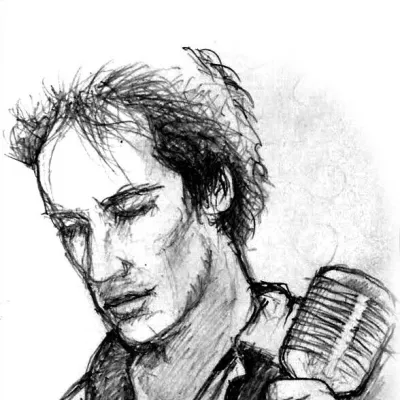
Jeff Buckley
Human Design Chart
Biography
Like his father, Jeff died young; on 29 May 1997, he drowned in a tragic accident in the Mississippi River near Memphis, Tennessee.
Born in 1966, Jeff never knew his father. He was raised by his mother, Mary Guibert, and his stepfather, Ron Moorhead, with a half-brother, Corey. He grew up as brother and sister to his stepfather’s children, Ann-Marie and Kevin.
As a child he was called Scotty Moorhead, although his birth certificate read "Jeffrey Scott Buckley." When he was about ten, he chose to use his legal name, in homage to his late father.
His childhood was full of music, and at 18, he moved to Los Angeles to study music for two years at the Musician’s Institute, an endeavor he later described as a ‘waste,’ although he made life-long friends there.
He participated in various jazz bands before relocating to New York City. Although not billed as a performer because he did not feel it was right to use the event as a career stepping-stone, his public debut occurred at a tribute performance for his father on 26 April 1991.
Signed by Columbia Records, he accompanied himself on electric guitar and released "Live at Sin-e" in November 1993. His 1994 release "Grace" received raves, and the artist with the ethereal voice and incredible four-octave vocal range began touring. Well-received in Europe, in 1995, he received France’s "Grand Prix International Du Disque" award.
A gifted composer, many of his fans describe his music as spiritual and moving; however, he stated he wasn’t allied with any organized religion. He added, "If you want divinity, the music in every human being and their love for music is pretty much it.
What does Manifesting Generator 2/4 mean for Jeff Buckley?
Manifesting Generator 2/4 — Design at a Glance
Jeff Buckley revealed himself as someone who quickly pulled things into his life and pursued multiple projects simultaneously. His design as a Manifesting Generator combined the constant energy of a Generator with the ability to skip steps in action. This hybrid nature allowed him to initiate quickly but carried the risk of overlooking important stages, forcing him to backtrack and fill in gaps. Such setbacks often led to frustration, his specific Non-Self theme.
To use this speed constructively, he responded to impulses rather than initiating himself. Only when his Sacral Center gave a clear “yes” did he apply his energy. This strategy protected him from exhaustion caused by too many simultaneous endeavors. When strategy and inner authority aligned, he found deep satisfaction in his work. For him, the advice to focus on one thing was counterproductive. Instead, he thrived in a play mode that required variety and parallel work. His creative power flourished when he had the freedom to follow various interests, as long as they were carried by his inner approval. This shaped his work style as dynamic and multi-layered, rather than linear and single-minded.
Emotional Authority
Jeff Buckley revealed himself as someone who never made decisions immediately but gave himself time for emotional waves to subside. His inner authority was emotional, carried by the defined Emotional Center. This center was subject to constant ups and downs of feelings; the world appeared to him always colored by his current mood. What seemed inspiring in one moment could appear negative in the next. His immediate feeling was, however, only a snapshot, not necessarily the truth. Quick, spontaneous decisions from this emotional excitement could have had negative consequences. Instead, his design required patience. He let decisions mature, slept on them multiple times. Over time, the intense feelings subsided, he gained emotional distance. Only then did clarity and calm set in. This process was of great importance for long-term decisions that shaped his life course. Emotional authority always took precedence over other defined centers, regardless of what else was defined in his graph. Jeff Buckley had to take his time, ask himself multiple times before acting. Only then could he gain the deeper, more comprehensive insight that lay beneath the surface of first impressions. His strategy was to trust the emotional wave but not to follow its first impulse. Through this delay, he found his true path, free from the distortions of passing moods.
The 2/4 Profile — Hermit / Opportunist
Jeff Buckley revealed himself as someone who oscillated between withdrawing into solitude and being connected to a close-knit community. His design as a 2/4 Profile created an inner tension: On one hand, he needed time alone to gather himself and gain clarity; on the other hand, he was drawn to his favorite people to share experiences. This duality required him to communicate his needs clearly – when he sought company and when he wanted to be left alone.
In his “Me-Time,” he immersed himself in internal processes to reflect on what he had learned. Only when this need for peace was satisfied did he return to his social sphere. The second line of his profile promoted a stance of delegation and trust in experts. He did not have to prove everything himself but could delegate responsibility, saving him energy. At the same time, the fourth line brought a direct, uncomplicated way of acting. It focused on the simplest path and saw things from a perspective that already brought experience.
This combination allowed him to evaluate the knowledge of his network in solitude and develop new ideas from it. The frustration that could arise if it was unclear who was responsible for which task was overcome by this structure. Jeff Buckley used the security of his environment to both maintain his expertise and live out the direct, transpersonal nature of the fourth line without losing his inner balance.
Split Definition — Defined & Open Centers
Jeff Buckley's Human Design profile indicated a tendency towards constant, conceptual thinking, paired with a profound emotional wave. His defined Ajna Center ensured consistent mental processes; he thought constantly and was hard to influence from the outside. These concepts flowed into his defined Throat Center, allowing him to reliably express what he thought. His identity was stabilized by the defined G Center, giving him a clear sense of direction.
His energy source was his defined Sacral Center. As a Generator, he possessed vital energy that, however, only flowed correctly through reaction, not through initiation. Simultaneously, his defined Solar Plexus Center shaped his emotional authority: decisions required time to wait out the emotional wave and gain clarity. The defined Root Center provided the constant pressure to move forward.
In contrast, his vulnerabilities were revealed in the undefined centers. His open Head Center made him susceptible to mental confusion and the pressure to find answers to non-personal questions. His open Heart Center lacked consistent willpower; he tended to prove himself through promises, often leading to frustration as the energy for this was not present. Additionally, his open Spleen Center made him sensitive to external signals of security and well-being. He risked clinging to unhealthy environments just to simulate a sense of security, rather than trusting his inner authority. This constellation created a person deeply rooted mentally and emotionally, but constantly learning to release from external expectations and spontaneous fears.
Channels for inspiration, rhythm, structure and emotional clarity.
Jeff Buckley revealed himself as someone who, through his mere presence and authentic expression, drew public attention to himself. His design indicated a tendency to act as a role model without the need for words. This was enabled by the Inspiration Channel 1-8, connecting the G Center with the Throat Center. Gate 1 promoted bold, creative self-expression, while Gate 8 fueled the need for contribution and leadership. Buckley lived his individual direction, inspiring others to live out their own uniqueness.
At the same time, he possessed a deep, generative power that created new directions. The Beat Channel 14-2 connected his Sacral Center with the G Center. Gate 14 ensured the availability of material resources for mutation, while Gate 2 directed higher knowledge and movement through space and time. This combination gave him a powerful aura that encouraged others in their creative direction simply by reacting to life.
His mind often worked ahead, however. The Structuring Channel 23-43 connected his Ajna Center with the Throat Center. Gate 43 received spontaneous insights, which Gate 23 assimilated and expressed. Buckley had to learn to cultivate patience so that his innovative perspectives would be accepted by the collective rather than being rejected as foreign.
Emotionally, he was marked by an intense drive for new experiences. The Recognition Channel 30-41 connected his Solar Plexus Center with the Root Center. Gate 41 generated restlessness and the expectation of possibilities, while Gate 30 emotionally charged this longing. Buckley sought the completion of cycles, with his emotional wave needing time to gain clarity before making decisions. Additional gates like the Reflecting Gate 33 and the Narrative Gate 56 colored his inner processing, while Gate 62 stood for logical detail work.
Individual Circuitry — Circuit Signature
Jeff Buckley revealed through his design as someone seeking the original path and transforming new knowledge. This tendency resulted from the Knowledge Circuit. In him, this circuit connected the Ajna, Throat, Identity, and Sacral Centers into a single, continuous flow. Through the channels Structuring, Inspiration, and The Beat, a pulsating, acoustic energy emerged. It promoted creative flashes of insight and the expressive ability of individual identity. Emotional waves from the Solar Plexus Center were transported through the Throat Center, enabling transformation for others.
Parallel to this, there existed a separate, non-connected area: the Meaning Circuit. As Jeff Buckley had a Split Definition, this second group of centers stood energetically isolated from the first. Here, the Recognition Channel connected the Solar Plexus with the Root Center. This configuration directed attention to emotions and experiences from the past. The energy flowed cyclically and wave-like, with a clear beginning, middle, and end. It served to reflect past events and grasp their meaning. These felt insights should be shared with the collective to learn together from history. While the first part of his design aimed at creative novelty and expression in the present, the second part anchored his experience in the emotional processing of the past. Both systems worked alongside each other without directly overlapping.
Right Angle Cross of Contagion 4
Jeff Buckley's Human Design shows a specific energetic configuration through the right infection cross four, which manifested in his way of being. This structure is not a simple characteristic but a complex pattern based on the interaction of certain energy centers. It describes a tendency to find oneself in situations where one can be strongly influenced by the energy of others without always being able to control it consciously.
In Human Design, this configuration means that personal energy sensitivity is heightened. Jeff Buckley was prone to absorbing and reflecting the moods, expectations, and energies of his environment. This happened not as a conscious decision but as an automatic reaction of his system. The energy of the people around him could change his own aura, leading to feelings of being controlled by others or overwhelmed when the surrounding energy was too intense or contradictory.
This mechanism required high awareness, as the boundary between one's own energy and that of others often blurred. Jeff Buckley had to learn to recognize these influences and not accept them as his own truth. The right infection cross four thus shaped a lifestyle characterized by constant navigation through foreign energies, with the challenge of maintaining his own center while moving through various social and creative fields.
Saturn Return — Life Cycles
Jeff Buckley's Human Design shows a tendency towards intense internal condensation, which often only formed into a viable result after years of groundwork. He was a Generator whose energy was directed by the authority of the Solar Plexus; this meant he had to wait for internal impulses to act authentically, rather than being externally driven. This structure promoted a deep, often painful commitment to his own form of expression, which could only unfold its full power through patience and waiting for the right response.
In 1994, at the age of 28, he released the album 'Grace'. For his design, this marked the first Saturn Return, a cycle in which earlier efforts and internal conflicts condensed into a clear, stable structure. This moment was no coincidence but a typical moment of maturation: the long phase of internal search and experimentation found its external confirmation. The album became the visible expression of his individual strategy to pour the energy of the Solar Plexus into a concrete, lasting form. It showed how his inner truth, long held in secret, now reached the public and thus profoundly shaped his life path.
Manifesting Generator · Emotional Authority — Synthesis
Jeff Buckley lived a dynamic driven by an inner urge for creative expression. His design as a Manifesting Generator (with defined Sacral Center) pointed to a constant energy source, which was not activated through initiation but through reaction to impulses. This sacral foundation, combined with the ability to skip steps and attract things quickly, created a rhythm marked by rapid creative bursts and a need for deep emotional processing. The defined Mental Center strengthened the tendency to develop and implement concepts, while the profile as a natural talent and networker lived a balance between the desire for inner reflection and the need for connection and exchange.
A central paradox in his design lay in the tension between the impulsive action of the Manifesting Generator and emotional authority. Although he was capable of quick action (Channel 1-8), his emotional wave required time to gain clarity. This led to an internal conflict between the desire for immediate implementation and the necessity of letting decisions mature, which manifested in a constant oscillation of his feelings. The right infection cross four underscored this dynamic by intensifying the tendency to influence others through his expression while simultaneously maintaining a strong need for autonomy.
4 Defined Channels
Incarnation Cross - Right Angle Cross of Contagion 4
Solar Return
The Solar Return shows the moment when the sun returns to its exact birth position - your personal solar year.
Life Cycles
Discover the life cycles with a detailed triple view (birth chart, cycle chart, composite).
Human Design Profile
- Strategy
- To respond - wait for something to respond to
- Authority
- Emotional Authority
- Profile
- 2/4 - Hermit / Opportunist
- Definition
- Split Definition
- Incarnation Cross
- Right Angle Cross of Contagion 4
- Date of Birth
- 17.11.1966 22:49
- Place of Birth
- Anaheim, CA, United States
Frequently Asked Questions
What was Jeff Buckley's Human Design type?
What Profile did Jeff Buckley have in Human Design?
What Authority guided Jeff Buckley's decisions?
Which incarnation cross characterized Jeff Buckley?
When was Jeff Buckley born?
Discover your own Human Design
Are you also a Manifesting Generator? Find out in a personal reading how to unfold your multi-talents and direct your energy wisely.
More Personalities
Back to overviewAaliyah

Aldair

Alexia

Alizée

Angèle

Angeli
