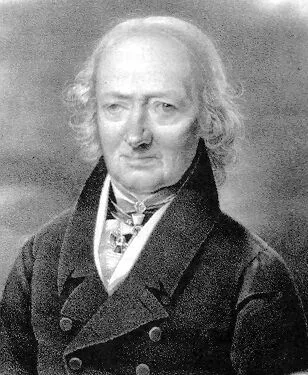
Johann Elert Bode
Human Design Chart
Biography
He died on 23 November 1826.(Annotation: at 17:00 LMT, Berlin)(mik)
Johann Elert Bode — Generator with Profile 3/6
Generator 3/6 — Design at a Glance
Johann Elert Bode was someone whose life force relied on endurance, which could only be unleashed through reaction. His Generator design had considerable sacral energy, comparable to that of a workhorse: strong and steady if used for the right task. This energy wasn't freely available for spontaneous initiatives but required an external impulse to become effective.
The basic operating principle was to react to signals from life. Instead of taking the first step himself, his design waited until an opportunity arose that his inner center responded to with a clear "yes". Only then could he materialize his full creative power. If he tried to initiate things independently or push through against his internal resistance, this inevitably led to frustration and a gradual energy loss up to burnout.
Conversely, the greatest danger for him was being prevented from doing his actual work while there was still inner power left. The strategy of reacting to gut feelings not only ensured efficiency but also a deep sense of fulfillment. Johann Elert Bode's energy management thus followed the principle: do not initiate, but respond from the gut. Only in this way could he utilize his high potential without exhausting himself or falling into persistent dissatisfaction.
Emotional Authority
Johann Elert Bode's design tended towards cautious waiting; spontaneous impulses were often misleading for him. His inner authority lay in the defined Emotional Center. This meant he was subject to a constant wave of ups and downs in his emotions. The world appeared colored by his current mood: A moment of enthusiasm could quickly be replaced by a negative outlook. However, his feeling at any given moment was only a snapshot, not necessarily his truth. Quick decisions based on emotion risked negative consequences.
Clarity emerged for Johann Elert Bode only through time. He needed the process of sleeping on it multiple times to let a decision mature. This patience allowed him to let intense emotions subside and gain emotional distance. Only then did calmness set in. It was important for him to be indecisive and ask himself repeatedly, to avoid emotional duels. This mechanism served to recognize his true inner truth rather than just a snapshot moment. Especially with long-term decisions that influenced the course of his life, this strategy of delay was crucial. By enduring through the emotional cycle, he gained the necessary overview to act without being driven by passing moods.
The 3/6 Profile — Martyr / Role Model
Johann Elert Bode showed a development line from an experimental "try and error" approach in the first half of his life towards reflective wisdom. Until the end of his Saturn return, around 29.5 years old, he primarily acted under the influence of Line 3. This phase was marked by individual melancholic depressions and the feeling of an insurmountable pressure if no mutation occurred. The third line knew only its own hexagram; it experienced a process with imposed limitations where bonds were dissolved without achieving transcendence. Mutation happened in the space between pulses, often during moments when one believed they felt nothing.
Only after his Saturn return, around age 30, did Johann Elert Bode find more contrast within himself. Line 6 became active and likely prompted him to withdraw to reflect on past experiences. This line oversaw the entire circuit and went beyond into the next hexagram. It emphasized the importance of consistent values over inconsistent risks. The decision for or against leadership roles was now based on these values and their demands.
Although it appeared externally like control, Johann Elert Bode often felt torn internally between a desire for playfulness and reflection. He carried both his eight-year-old and eighty-year-old selves within him. In his later years, around age 50, he became a great role model for others through charm and wisdom.
Quadruple Split Definition — Defined & Open Centers
Johann Elert Bode's Human Design presented a nearly complete internal structure characterized by constant energy in almost all areas of life. His system had defined centers for mental inspiration (Head/Ajna), identity and love (G-Center), willpower (Heart), vital energy (Sacral), emotional depth (Solar Plexus), intuitive health (Spleen) as well as stress management (Root). This configuration created a massive, unchangeable presence. Bode lived with a constant mental pressure to ask questions and form concepts, combined with a clear inner direction and the ability to keep promises. His decisions were guided by waiting for emotional waves and intuitive impulses in the here-and-now, while his Root Center maintained the necessary life impulse.
The only exception was his open Throat Center. This meant that Bode did not initiate to force attention or achieve results through direct speech. Instead, he waited for invitations and the right timing for communication. Attempts to take control of this would have led to frustration. The mechanics of his design required patience: the rich inner resources from defined centers had to unfold first before they could be expressed outwardly through the open Throat Center. This structure isolated him partially from the environment as he did not receive energy from open centers, but it also gave him extreme stability and self-sufficiency in his processes.
Channels for clarity, change, intuition and community.
Johann Elert Bode showed a fundamental attitude shaped by the paradoxical nature of change: waiting in apparent stillness was for him not emptiness, but the necessary prerequisite for a sudden impulse towards innovation. This dynamic taught his design to trust the inner rhythm rather than argue against the mood.
The Channel of Mutation 60-3 connected the Root Center with the Sacral Center through Gate of Limitation (60) and Gate of Order (3). This format-channel-potential depended on the ability to accept limitation and go beyond the confusion of a new beginning. The powerful, pulsating on/off energy of this channel came with melancholy – a physiological pressure from the Root Center during phases where the pulse stopped. This energy permeated his way of living and deeply conditioned anyone in his vicinity. Mutation occurred suddenly for him like music between the notes, forcing adaptation or change.
In addition to this driving force, the Channel of Awareness 61-24 connected Head with Ajna Centers through Gate of Secrets (61) and Gate of Rationalizing (24). It created the individual thinker. Here it was not about discovery in a traditional sense but how his acoustic mind processed inspiration. His thinking repeated patterns until the moment of mutation or satori arrived, and he simply knew. He did not control this knowledge; it happened at its own pace, often supported by silence or music that alleviated constant mental noise.
The Channel of Perfect Form 57-10 connected Spleen with G Centers via Gate of Intuitive Insight (57) and Gate of Self Behavior (10). This was his creative channel of integration – the art of survival. He projected behavior guided by intuitive consciousness based on self-love. His acute sensitivity to tones in the environment linked him to spontaneous wisdom beyond thoughts, giving him clarity to act spontaneously and appropriately when something in his surroundings did not fit, allowing him to move through the world existentially unburdened.
The Channel of Community 37-40 connected Solar Plexus with Heart Centers via Gate of Friendship (37) and Gate of Solitude (40). He sought his place within the whole and built bridges for individuals to live in a community. For him, good business was not spontaneous but had to be carefully considered so that it benefited everyone involved. His investment focused less on material gain than on group needs and the desire to be part of something greater than himself.
Additionally, he carried the energy of individual gates: Gate 56 allowed abstraction of mental processes into pictorial representations; Gate 50 acted as a conservative protective reflex for values and traditions; Gate 58 brought pressure and joy in perfecting patterns. Gate 19 connected him to community resources and spirituality while Gate 53 initiated new developmental cycles. Gate 14 helped him handle power with grace, and Gate 63 drove mental processes forward through doubt. Gate 64 interpreted past experiences for future clarity, Gate 32 ensured continuity and material success of the tribe. Gate 26 allowed ego to anchor innovations within a conservative framework, and Gate 5 represented the basic rhythm of life processes. Gate 41 propelled evolutionary development through specific experiences while Gate 43 enabled breakthroughs in individual insights clearly communicated to others.
Individual Circuitry — Circuit Signature
Johann Elert Bode's Human Design showed a fragmented energy structure without a central constant source. As a Fourfold Defined, he lacked an overarching drive like the Sacral Center and had to 'sign up' situationally in different contexts. His strength lay in separate, parallel acting blocks that were activated according to environment without forming one dominant identity.
The Knowledge Circuit formed two isolated segments: Head and Ajna Centers connected via the Channel of Awareness (Gates 24-61), promoting mental clarity. Separately, Sacral and Root Centers worked through Mutation Channel (3-60) for impulsive change. Both groups did not flow into each other.
In the Ego Circuit, the Community Channel (37-40) connected Heart with Solar Plexus Centers creating a give-and-take dynamic based on emotional support and cooperation rather than individual resource generation.
Finally, the Integration Circuit united Identity and Spleen Centers through the Channel of Perfect Form (10-57). Here inner values merged with intuitive essence in the present moment. These three separate circuits – Knowledge, Ego, Integration – acted as independent fields of power. Bode could not consolidate them into a single stream but had to use their specific energies sequentially or simultaneously to gain operational capability.
Right Angle Cross of Laws 4
Johann Elert Bode's design was characterized by a strategic alignment with the 'Right Cross of Laws 4'. This configuration formed the archetypal framework for his life task and determined the underlying dynamics of his essence. The Right Cross of Laws 4 points to a deeper order in which seemingly disparate elements coalesce into a coherent whole. It describes not individual actions but the overarching pattern within which Johann Elert Bode gathered and interpreted experiences.
This structure inclined him to view the world through the lens of specific laws often operating in the background, yet exerting decisive influence. For his design, this was no mere coincidence but rather the fundamental filter of his perception. The archetypal dynamics of this cross served as a constant reference point, helping him translate chaos into structure and reveal interconnected patterns. It was an inner logic guiding his actions without always needing explicit articulation. Johann Elert Bode operated within this framework, profoundly shaping how he approached problems and found solutions. Laws 4 represent principles aimed at creating stability and clarity in complex situations. Through this orientation, his path was marked by a striving for order and understanding of the forces that shape life.
Saturn Return · Uranus Opposition · Chiron Return · 2nd Saturn Return — Life Cycles
Johann Elert Bode's design inclined him towards structured life planning, with inner maturation and external authority taking over through astrological cycles. His first Saturn return occurred as a phase of condensation. In 1774, at age 27, Johann Elert Bode married Johanna Christina Lange. This was a typical moment for this cycle: years of groundwork condensed into a viable result in the relational sphere. The Saturn return signaled here the assumption of responsibility and stability in the private domain.
Later, the Uranus opposition acted as a catalyst for professional authority. In 1786, at age 39, Johann Elert Bode became director of the Berlin Observatory. This position corresponded to the mechanics of the opposition: an internal pressure towards independence and leadership culminated in a concrete external role. Taking up this direction was seen as fulfilling the need to establish his own structures and take responsibility for a larger whole. Both events illustrated the dynamics of his chart: cycles served not only as time markers but also as triggers for concrete steps toward greater self-determination and structural anchoring in Johann Elert Bode's life.
Generator · Emotional Authority — Synthesis
Johann Elert Bode lived a life marked by profound inner clarity and a strong drive towards self-realization. His defined emotional authority (Solar Plexus) required time to let decisions mature, while the constant energy of his generator propelled him to respond to impulses from life – a synergy of internal reflection and external action. The Channel of Mutation (Gate 60/3) indicates an ability to handle changes and embark on new paths, always driven by an unstoppable pulse of creative energy. This dynamic was reinforced by his defined root base, which provided the necessary pressure for him to bring his visions into the world.
A central paradox in Bode's design lies in the tension between his inner emotional wave and the need for spontaneous reaction. While the Solar Plexus Center required time for decision-making, the generator urged him to respond directly to external stimuli. This tension manifested as a dance of waiting and acting, of internal introspection and external expression – a dynamic balance between feeling and doing that shaped his life's path.
4 Defined Channels
Incarnation Cross - Right Angle Cross of Laws 4
Solar Return
The Solar Return shows the moment when the sun returns to its exact birth position - your personal solar year.
Life Cycles
Discover the life cycles with a detailed triple view (birth chart, cycle chart, composite).
Human Design Profile
- Type
- Generator
- Strategy
- To respond - wait for something to respond to
- Authority
- Emotional Authority
- Profile
- 3/6 - Martyr / Role Model
- Definition
- Quadruple Split
- Incarnation Cross
- Right Angle Cross of Laws 4
- Date of Birth
- 19.01.1747 13:15
- Place of Birth
- Hamburg, Germany
Frequently Asked Questions
What was Johann Elert Bode's Human Design type?
What profile did Johann Elert Bode have?
Which authority guided Johann Elert Bode?
What is Johann Elert Bode's incarnation cross?
When was Johann Elert Bode born?
Discover your own Human Design
Are you also a Generator? Find out in a personal reading how to use your sacral energy correctly and discover deep satisfaction.
More Personalities
Back to overviewAaliyah

Alexia

Angèle

Anne-Marie

Arcángel

Arno