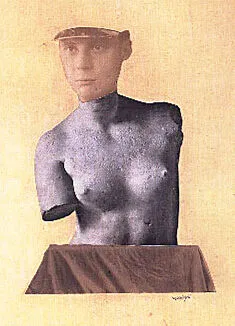
Johannes Theodor Baargeld
Human Design Chart
Biography
Baargeld studied jurisprudence at Oxford and Bonn. He was the editor of the periodical The Fan (Der Ventilator) which Ernst and Hans Arp started in 1919, and he collaborated on many other Dadaist publications such as Bulletin D and Dada W/3.
Baargeld gave up painting in 1921 and on 18 August 1927 died in an avalanche while climbing Aiguille de Bionnassay in the French Alps.
What does Generator 2/4 mean for Johannes Theodor Baargeld?
Generator 2/4 — Design at a Glance
Johannes Theodor Baargeld's design indicated a tendency towards great endurance and the ability to materialize ideas. His energetic foundation was that of a Generator, a configuration with ample sacral energy. This energy worked similarly to that of a workhorse: strong and steady, yet effective only when available for an appropriate task. The central mechanics of his design required him to react to impulses from the environment rather than initiating actions himself. His success depended on waiting for an inner signal from the sacral center – an instinctive “yes” from the gut – and then responding powerfully.
If Johannes Theodor Baargeld followed this reactive strategy, he experienced deep satisfaction and fulfillment. If he deviated by initiating things or suppressing his impulses, it inevitably led to frustration and energy loss. Two specific pitfalls shaped his potential: On one hand, there was the risk of burnout if he continually engaged in activities that he had no interest in, thereby wasting his resources. On the other hand, an energy deficit threatened when he was prevented from working on his heart project even though he still wanted to continue with full power. His design thus did not show itself through self-driven pushing forward but rather through the clever use of given moments to create sustainable results.
Emotional Authority
Johannes Theodor Baargeld revealed himself as someone who did not leave his decisions to the first impulse, but rather subjected them to a necessary maturation period. His design featured Emotional Authority, meaning that his defined Emotional Center always served as the internal compass – independent of other defined Centers in his chart. This configuration shaped a specific emotional wave: his feelings constantly fluctuated between enthusiasm and rejection, with the current mood strongly coloring his perception of the world. A momentary impression was not considered final truth; spontaneous reactions from this fleeting state often proved risky or misleading.
The mechanics of his authority required patience and conscious hesitation. Johannes Theodor Baargeld used time to repeatedly "sleep on" decisions and ask others for input until the initial emotional flood had subsided. Only after this process was complete did clarity and calmness set in. This waiting strategy served to gain deeper insights, especially regarding long-term steps with significant influence on his life course. By waiting out the emotional wave movement, he could distinguish between transient momentary moods and his true inner truth.
The 2/4 Profile — Hermit / Opportunist
Johannes Theodor Baargeld's design tended towards a pendulum-like balance: He oscillated between the deep need for withdrawal to clarify intuitive values (Line 2) and the urge to reappear in his familiar network to collect experiences (Line 4). This configuration required clear communication of his availability limits. Only through explicitly distinguishing "Now I want company" from "Now I need silence" could he protect his energy. During periods of retreat, he immersed himself in internal processes to find calm and clarity. This alone time served the purification and strengthening of his values through intuition, not as a moral judgment but as a survival instinct. Once this inner need was satisfied, he returned from his "cave" into the social fabric. There, he gathered experiences that gave him confidence during crises because he knew everything has an end and cycles repeat themselves. The network insights collected were then reflected upon again in solitude, evaluated, and brilliant ideas developed from them. This constant alternation between community and solitude shaped his way of processing knowledge: first distance for inner order, then connection for external validation.
Split Definition — Defined & Open Centers
Johannes Theodor Baargeld had a design with five defined centers, indicating a high level of inner consistency and clear expressive ability. His Root Center provided the constant life drive that propelled him forward, while his Sacral Center served as the motor: He possessed enormous vitality, which could only be sustainably utilized through correct reaction – not initiation. His G Center gave him a firm identity and direction; he knew intuitively where he belonged without having to control it. The Solar Plexus as emotional authority required patience: Decisions matured after running through the emotional wave. The defined Throat allowed him to reliably translate these inner states into the world.
In contrast, Spleen, Heart, Ajna and Head were open. This openness made him vulnerable to conditioning. The open Spleen Center tended towards survival anxiety and clinging to unhealthy situations out of a false sense of security. The missing Heart Center led to often feeling pressure to prove his worth, which could lead into cycles of promise and disappointment. The open mental centers (Ajna/Head) meant that inspiration and thoughts were not constant; he tended to identify with other people's problems or doubts rather than trusting his inner authority. His strength lay in playing the stability of his defined energy centers against these situational mental and emotional fluctuations.
Channels for inspiration, intimacy, reflection and maturation.
Johannes Theodor Baargeld's design inclined towards individual, inspiring radiance. His inner truth was not primarily expressed through words but through authentic presence and exemplary life. This dynamic came from Channel Inspiration 1-8, connecting the G Center with the Throat Center. Gate 1 brought in the mutative perspective of self-expression while Gate 8 represented a drive to contribute and lead. Baargeld was designed to draw attention through his uniqueness and inspire others to live out their own creativity.
This public impact was shaped by the dominant energy of Sun Gate 57. As the gate of intuitive clarity and the "Soft Wind", it offered an unshakable inner authority in the here and now. This intuitive security formed the foundation on which Baargeld pursued his individual direction, driven by a deep perception rather than external validation.
In interpersonal relationships, there was an intense search for intimacy through Channel Union 59-6. This channel connected sacral sexuality (Gate 59) with the emotional wave of pleasure and pain (Gate 6). Baargeld needed time to gain emotional clarity; his relationships were characterized by a deep, often unspoken connection that was released through physical closeness or shared silence.
At the same time, he gathered life experiences reflectively. Channel Lost Son 13-33 connected listening and storing information (Gate 13) with the need to withdraw to digest it (Gate 33). Baargeld acted as a witness of his own life cycle. He waited patiently until deeper truths of an experience revealed themselves before he processed or shared them. This combination of intuitive clarity, inspiring exemplarity, and reflective depth shaped him as someone who lived his inner truth to show others the way to their own uniqueness.
Collective Circuitry — Circuit Signature
Johannes Theodor Baargeld was marked by a split definition, highlighting two independent energetic focal points in his design. This separation meant that his powers did not work as a continuous flow but rather existed as parallel, independent areas.
In the first area, the Knowledge Circuit connected his Throat with his Identity Center. Here inspiration took center stage: The ability to generate new ideas and express them immediately. This channel promoted the expression of his unique individuality through creative impulses that were directly translated into words or actions without long delay.
The second, separate area included the Purpose and Archer Circuits, connecting Solar Plexus, Sacral, and Root Centers. Here two different dynamics worked side by side. On one hand, the Purpose Circuit drove emotional maturation: Experiences from the past were felt, processed, and used to share with others and draw common lessons. This process proceeded in waves and cycles. On the other hand, the Archer Circuit connected the life force of the Sacral through Channel Union to the emotions of Solar Plexus. This created a primordial energy aimed at protection, care, and preserving one's genetics.
While inspiration worked isolated in the upper chart, emotional, survival-relevant powers formed a cohesive lower block. Johannes Theodor Baargeld thus lived with a clear distance between his creative self-expression and his deep, instinctive as well as emotional needs for connection and security. This structure shaped how he experienced the world: creatively independent on one side, emotionally and instinctively strongly anchored on the other.
Right Angle Cross of Penetration 3
Johannes Theodor Baargeld's design carried the signature of the right cross of penetration 3. This configuration established a fundamental disposition characterized by a profound and often painful engagement with one's own existence. It was an energetic structure that did not allow for superficial observation but demanded radical honesty towards the inner self.
The right cross of penetration 3 is in Human Design a specific pattern associated with intense internal processes. It describes a path where external circumstances and inner conflicts are not seen as obstacles, but rather as necessary tools for self-discovery. Those who carried this configuration often lived in tension between the desire for connection and the necessity to detach from false identities.
For Johannes Theodor Baargeld, this meant that his life was not defined by outward fame or conventional success, but by the quality of his inner truths. The energy of this cross penetrated deeply into the psyche and brought everything to the surface that was authentic. It was about breaking through illusions, whether in one's self-image or perception of the world. This process was rarely easy; it demanded courage to face dark shadow places without judgment.
The effect of this structure manifested in a way that touched others with its immediacy and depth. It was not a soothing comfort but a sharp gaze that forced clarity. Johannes Theodor Baargeld lived this dynamic as an ongoing invitation to look behind the facade of daily life and grasp what is essential. His design challenged him to translate his personal struggles into a universal language that spoke to others in their own quests.
Saturn Return — Life Cycles
Johannes Theodor Baargeld appeared at age 28 in 1920, participating in the First International Dada Fair in Berlin. This marked a decisive step in his professional development and corresponded exactly with his first Saturn return. In Human Design mechanics, this cycle signals the transition from an experimental phase to structural consolidation. It is the time when inner values and external circumstances move towards a sustainable foundation. For Baargeld, this meant not only artistic presence but also taking concrete responsibility for his own path. The Saturn return often demands a re-evaluation of what truly stands. Through his participation in this international platform, he anchored his position within the cultural field. It was less a moment of mere appearance and more the beginning of a stabilized identity within his creative work. The mechanics of this cycle support the ability to recognize and utilize long-term structures. Baargeld used this energetic framework to place his artistic voice in a broader context. This laid the groundwork for future developments by establishing himself as a serious force in Dadaism.
Generator · Emotional Authority — Synthesis
Johannes Theodor Baargeld lived a life marked by deep internal dynamics: the interplay between creative inspiration and emotional depth. His design as a generator with emotional authority points to someone who draws energy from reaction, yet needs time to gain clarity about their feelings. This combination manifested in the ability to give new impulses through authentic expression (Channel 1-8), while simultaneously reflecting the cyclical nature of experience and maturation (Channel 53-42). The openness of his centers for mental consciousness and heart indicates that he did not force himself into rigid thought patterns or expectations, but rather an open field for receiving impressions.
A central paradox in Baargeld's design lies in the tension between the need for expression and the necessity of emotional maturation. His defined Throat and G Centers pointed to a strong inner voice and identity that was nevertheless subjected to the cyclical processing of the emotional center. This led to an internal rhythm between creative initiative and waiting for emotional clarity – an interplay that enabled him to convey authentic messages while simultaneously reflecting the depth of his own experiences.
4 Defined Channels
Incarnation Cross - Right Angle Cross of Penetration 3
Solar Return
The Solar Return shows the moment when the sun returns to its exact birth position - your personal solar year.
Life Cycles
Discover the life cycles with a detailed triple view (birth chart, cycle chart, composite).
Human Design Profile
- Type
- Generator
- Strategy
- To respond - wait for something to respond to
- Authority
- Emotional Authority
- Profile
- 2/4 - Hermit / Opportunist
- Definition
- Split Definition
- Incarnation Cross
- Right Angle Cross of Penetration 3
- Date of Birth
- 09.10.1892 03:45
- Place of Birth
- Stettin, Germany
Frequently Asked Questions
What was Johannes Theodor Baargeld's Human Design type?
What Profile did Johannes Theodor Baargeld have?
What Authority did Johannes Theodor Baargeld have?
What incarnation cross did Johannes Theodor Baargeld have?
When was Johannes Theodor Baargeld born?
Discover your own Human Design
Are you also a Generator? Find out in a personal reading how to use your sacral energy correctly and discover deep satisfaction.
More Personalities
Back to overviewAaliyah

Alain-Fournier

Alexia

Angèle

Angeli

Anne-Marie