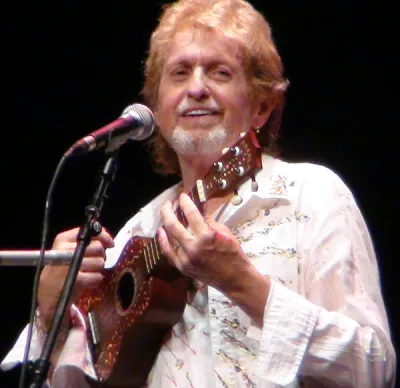
Photo: Wikimedia Commons
Jon Anderson
Human Design Chart
Biography
Anderson is also noted for his solo career and collaborations with other artists, including Vangelis as Jon and Vangelis, Roine Stolt as Anderson/Stolt, and Jean-Luc Ponty as AndersonPonty Band. He has also appeared on albums by King Crimson, Tangerine Dream, Iron Butterfly, Battles and Mike Oldfield.
Anderson released his first solo album, Olias of Sunhillow, in 1976, while still a member of Yes, and subsequently released 13 more albums as a solo artist. Anderson became an American citizen in 2009. In 2017, he was inducted into the Rock and Roll Hall of Fame as a member of Yes.
The Human Design of Jon Anderson: Generator 6/2
Generator 6/2 — Design at a Glance
Jon Anderson's design featured immense and enduring strength that was effective not through spontaneous initiatives but solely in response to external impulses. His path to deep satisfaction and fulfillment lay in waiting for life signals and then responding with full intensity. As a Generator, he had abundant sacral energy – comparable to a strong workhorse – which could only unfold when ready for its task. The central dynamic was 'Reacting instead of Initiating.' If he worked against this mechanism, whether by forcing action without inner desire or suppressing his urge to engage in heart projects, it inevitably led to frustration and energy loss. His strength showed only in harmony with the 'gut feeling,' that is, the sacral impulse. The most successful strategy was to react to a signal from life and then, when the inner center said 'Yes! Let's go!', to act upon it. If he did not live by this design – for example, by constantly initiating himself – he would eventually encounter persistent frustration or a lack of energy. Only in the flow of this reactive response could nothing stop him; then he was rewarded with the feeling of deep fulfillment.
Sacral Authority
Jon Anderson's decision-making was marked by clear physiological logic: His inner authority resided solely in his defined Sacral Center. As a Generator, strategy and authority were united within him, simplifying the process of orientation fundamentally. Decisions did not arise through analytical head processes but as direct physical resonance to external stimuli. This response often manifested subtly as grunts, hums, or a palpable surge of energy – a 'gut voice' that immediately signaled whether something was energizing or depleting.
When Jon Anderson waited for this inner confirmation, he was carried by vital aliveness and seemingly inexhaustible energy. In these moments, he performed his tasks with great enthusiasm, driven by the joy in the matter itself, free from any sense of obligation. His design suggested that he was born to dissolve into his tasks and find satisfaction there.
Additionally, his activated Spleen Center acted as a supportive force. It lent speed and instinctive spontaneity to his sacral reaction. Jon Anderson could thus respond particularly quickly to stimuli, supported by an immediate access to his physical well-being. This configuration allowed him to reliably guide himself from his inner perception without falling into excessive analysis or hesitation. The waiting time for the sacral response was key to efficiently and enthusiastically deploying his energy.
The 6/2 Profile — Role Model / Hermit
Jon Anderson's design outlined a clear developmental arc: Early years were marked by experimental learning through trial and error, while middle age led into an intense phase of reflection and withdrawal. This path ultimately culminated in remarkable wisdom that he made available as a role model for others.
This pattern arises from his Profile 6/2 (Role Model/Natural Talent). Before the age of 30, the energy of Line 2 dominated; here, collecting personal experiences was paramount; mistakes were not defeats but necessary steps in individual learning. The natural leadership ability of this phase had to be developed to avoid being misunderstood as arrogance or failing due to lack of experience.
Around the age of 30, Line 6 activated – metaphorically speaking, he withdrew into a 'cave' – a time of distancing from external activity. In this phase, he evaluated his past experiments with great clarity. The sixth line demands value consistency: It surveys the entire circuit and decides based on deep values whether leadership is to be taken or not. This intense introspection served healing and self-awareness.
The result was transformed authority. Emerging from withdrawal, Jon Anderson re-emerged as a wise person. His ability for deep self-reflection became visible to his surroundings. Others sought his counsel to partake in this life wisdom. He embodied the development from natural talent that must be discovered to collective role model guided by conscious value decisions.
Single Definition — Defined & Open Centers
Jon Anderson revealed himself through a deep, unshakeable inner security in his identity and direction. His defined G Center gave him the knowledge of where he belonged without needing to prove this truth to others. This self-love formed the basis for his interactions: He could love others without being dependent on their confirmation. However, when he tried to take others along on his path instead of waiting to see if they were invited, conflicts arose. His energy source lay in the defined Sacral Center, which generated a constant vital force. The strategy 'Wait and Respond' was essential here; only through an affirming sacral response to requests could he unleash his full energy. Initiated actions without this confirmation led to frustration and exhaustion as the energy was not available.
This structure was supported by the defined Spleen Center, which gave him a reliable instinct for health and well-being in the moment, as well as the defined Root Center, which provided the necessary pressure to move forward and survive materially. This combination created a robust foundation of intuition and endurance.
At the same time, Jon Anderson was vulnerable to external influences through his open centers. His open Head and Ajna Centers made him receptive to inspirations and concepts from the environment but also prone to getting stuck in mental stress or interpreting answers as personal truth. He had to learn not to seek endless proof. The open Heart Center led to a temptation to prove his worth through promises or competition, although he did not have consistent willpower for this. Additionally, his open Solar Plexus absorbed other people's emotions, leading him to personalize foreign moods and avoid confrontations out of fear of rejection. Deconditioning these patterns was crucial to prevent external noise from overshadowing his inner authority.
Channels for change, endurance and intuitive survival power.
Jon Anderson's design set a tendency towards cyclical phases of intense activity and necessary rest, driven by a pulsating, melancholic force of evolutionary change. This dynamic was significantly influenced by the Channel of Mutation 60-3, which connects the Root Center with the Sacral Center. Gate 60 functions as the pivot point for all evolutionary possibilities, while Gate 3 attempts to realize specific, novel options. This combination generates an on/off energy that requires patience: The inner melancholy during pauses should not be rationalized but endured patiently until the next mutation is revealed through a sacral response.
Parallel to this, the Channel of Discovery 29-46, which links the Sacral Center with the G Center, was at work. Here Gate 29 ('Saying Yes') requires a positive reaction to gain access to the depth of the Sacral, while Gate 46 establishes the connection to Higher Self and the right direction. For Jon Anderson, this meant letting go of all expectations for the process and fully relying on his sacral authority to follow experiences through to their end without prematurely evaluating them.
Additionally, the Channel of Power 34-57 ensured intuitive awareness. This channel connects the Spleen Center (Gate 57) with the Sacral Center (Gate 34). Gate 57 operates on an inner vibrational level and continuously checks the environment, while Gate 34 provides the generative force to engage in activities. This created instinctive survival intelligence that selectively responded to dangers and allowed him to navigate moments independently and vitally by spontaneously responding to vibrations from places or people – free of mental analysis. This mechanism shaped his generative life force as a blend of mutational change, persistent discovery, and instinctual self-preservation.
Individual Circuitry — Circuit Signature
Jon Anderson's design set a tendency towards individual deviation and re-creation, driven by a stable energetic foundation. His simple definition connected the Sacral, Root, G, and Spleen Centers in a continuous flow, combining ongoing power with intuitive clarity.
In the Knowledge Circuit, the Channel 3-60 'Mutation' was at work for Jon Anderson, connecting his Sacral Center with his Root Center. The energy promoted deviation from the known and creation of new identity, supported by the pulsating force of the Sacral.
The Integration Circuit showed the Channel 34-57 'Power', which connected the Sacral with the Spleen Center. This created intuitive power for self-affirmation in the present moment based on reacting to life and correct behavior.
In the Meaning Circuit, the Channel 46-29 'Discovery' was active, linking the Identity Center with the Sacral Center. This allowed emotional reflection of the past and sharing learned insights for individual transformation. The combination of these channels shaped a strong impulse towards unique expression through emotional learning and intuitive power.
Left Angle Cross of Wishes 2
Jon Anderson's design suggests a tendency towards internal orientation, where personal desires remain in the background. The left cross of Desires 2 describes a configuration where one's own wishes do not push outward but rather work as a quiet inner force. This structure means that Jon Anderson's motivations often remained invisible to others; he acted not out of the need to articulate or enforce his desires, but followed a subtler internal logic.
In Human Design, this cross marks a stance of restraint in the realm of personal will. It is not about suppression, but rather about directing the energy of wishes inward where it works without necessarily manifesting as visible demands. For Jon Anderson, this shaped a lifestyle where external recognition or talking about goals did not play a central role. Instead, there was a presence characterized by its non-imposition. The power lay in the hidden, silent certainty of what mattered, without needing to be loudly communicated. This mechanism fostered a kind of integrity that does not rely on affirmation but is nourished from one's own inner clarity. Jon Anderson's design thus carried the seed of deep yet unobtrusive self-determination, which was less evident in words than in quiet and steady actions.
Saturn Return · Uranus Opposition · Chiron Return · 2nd Saturn Return — Life Cycles
There are no specific Human Design data or documented events available for this chapter. Without concrete chart facts such as defined centers, channels, or gates, a person-specific characterization of Jon Anderson is not possible. A Human Design reading strictly relies on the individual configuration; general mechanism explanations without reference to actual individual data would be speculative and violate the requirement to describe only what actually applies. Therefore, no content text can be created that adheres to the hard rules. The lack of foundation prevents any meaningful analysis.
Generator · Sacral Authority — Synthesis
Jon Anderson's design is marked by a deeply rooted, sacral energy and a strong instinct for survival. This fundamental source of power, fueled by the defined Sacral and Root centers, manifests in the ability to respond to impulses from life and find fulfillment through action (Design). The connection to the G Center gives this response clear direction and strong self-confidence. However, due to the open design of various centers, he also intensely perceives the energies of his environment, making him a mirror for others and influencing his decisions by external stimuli (Centers). This process is reinforced by mutation energy, which demands constant adaptation and realignment.
The central paradox in Jon Anderson's design lies in the tension between this deep inner power and open receptivity to external influences. On one hand, he is equipped with a strong, enduring energy that drives him to react and manifest things (Channels). On the other hand, his open centers are vulnerable to conditioning and emotional confusion, which challenges him to remain authentic and not lose himself in the energies of others (Circuitry). This tension requires constant balancing between inner impulse and external perception.
3 Defined Channels
Incarnation Cross - Left Angle Cross of Wishes 2
Solar Return
The Solar Return shows the moment when the sun returns to its exact birth position - your personal solar year.
Life Cycles
Discover the life cycles with a detailed triple view (birth chart, cycle chart, composite).
Human Design Profile
- Type
- Generator
- Strategy
- To respond - wait for something to respond to
- Authority
- Sacral Authority
- Profile
- 6/2 - Role Model / Hermit
- Definition
- Single Definition
- Incarnation Cross
- Left Angle Cross of Wishes 2
- Date of Birth
- 25.10.1944 06:00
- Place of Birth
- Accrington, United Kingdom
Frequently Asked Questions
What is Jon Anderson's Human Design type?
What Profile does Jon Anderson have in Human Design?
What Authority does Jon Anderson possess?
What incarnation cross does Jon Anderson have?
When was Jon Anderson born?
Discover your own Human Design
Are you also a Generator? Find out in a personal reading how to use your sacral energy correctly and discover deep satisfaction.
More Personalities
Back to overviewAaliyah

Alexia

Alizée

Angèle

Anne-Marie

Arcángel