
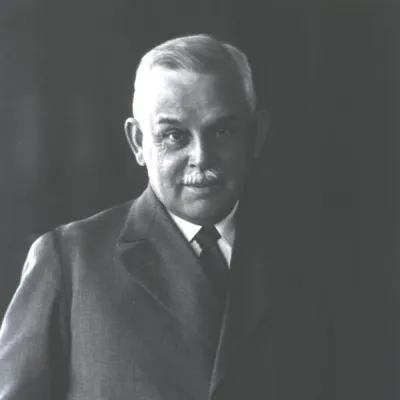
Karl Bonhoeffer
Human Design Chart
Biography
From 1887 to 1892 Bonhoeffer studied medicine at the University of Tübingen, in Berlin and in Munich. From 1904 to 1912 Bonhoeffer worked as professor at the University of Breslau. From 1912 to 1938 Bonhoeffer worked at the Charité in Berlin.
In 1898, he married Paula von Hase (1876–1951). Two of his children were Klaus Bonhoeffer and Dietrich Bonhoeffer, both of whom were executed by the Nazis. Bonhoeffer died in Berlin on 4 December 1948 at the age of 80.
Human Design Analysis: Karl Bonhoeffer as Generator 2/4
Generator 2/4 — Design at a Glance
Karl Bonhoeffer revealed himself as someone whose strength did not lie in initiating projects on his own initiative, but rather in the powerful reaction to external impulses. His Generator design endowed him with immense endurance and energy capacity, comparable to an workhorse that could only fully unleash its capabilities when intrinsically motivated for a given task. This energy source in the sacral center was primarily activated through responses to environmental signals, not by self-initiated action.
The successful life strategy consisted of waiting until a clear inner impulse – the palpable “yes” from his gut – demanded an action. When Karl Bonhoeffer responded this way, it led to deep fulfillment and sustained endurance. Conversely, ignoring this strategy, whether through forced initiatives or suppressing desire for unsuitable tasks, resulted in frustration and energy loss. Two specific pitfalls characterized this pattern: on one hand, the risk of burnout when energy was wasted on things that did not resonate internally. On the other hand, the blockage by external constraints that prevented him from working on his heart projects even though he still had plenty of power left. His essence lay in the ability to respond from the gut and thus sustainably channel his enormous creative force.
Emotional Authority
Karl Bonhoeffer exhibited a fundamental attitude where spontaneous reactions were considered unreliable; his decisions always required time and emotional clarity. This resulted from his emotional authority, carried by the defined Solar Plexus Center in his design. In this configuration, he was subject to a constant wave of emotions, an up-and-down of moods that colored perception of the world at any given moment. What appeared inspiring in one moment could turn negative in another. Since these feelings were only snapshots and not necessarily deeper truths, quick, spontaneous decisions based on emotion could have negative consequences.
The mechanics of his inner authority therefore demanded patience: The more time he took, the deeper he could see. This meant concretely that he had to “sleep over” important decisions multiple times in order to distinguish between momentary mood and true insight. Through hesitation and questioning himself, intense feelings gradually subsided. Only when emotional distance was gained did the necessary clarity and calm set in. This process was central for long-term, life-defining decisions. Only through this delay could he ensure that his choice was based on a stable inner truth, not on a passing emotional impulse.
The 2/4 Profile — Hermit / Opportunist
Karl Bonhoeffer revealed himself in a constant tension between a deep need for withdrawal and the simultaneous attraction to community. His design as Profile 2/4, the Natural Talent-Networker Profile, fundamentally shaped this dynamic. Line 2 conveyed an introverted tendency: Karl Bonhoeffer needed physical and mental distance to find inner clarity. Persistent interference into this space often led him to react with surprising harshness – a mechanism that was effective but later caused regret for himself. This extreme boundary setting served the protection of his individual processes.
At the same time, Line 4, the Networker Line, drew him into familiar circles. Here it was not about blind struggle, but strategic analysis and alliance building. Karl Bonhoeffer waited for the right opportunities and partners, with trust playing a central role. Aggressive resistance often hindered rather than helped; instead, a sober confrontation of facts promoted his effectiveness in the network.
The challenge lay in balance: First he had to withdraw to reflect and evaluate the knowledge of his network in peace. Only when this inner need was satisfied did he come out again to spend time with his favorite people. For Karl Bonhoeffer it was essential to clearly communicate availability – when he sought company and when he wanted to be undisturbed. Only then could he utilize the potential of his profile: developing brilliant ideas from the synthesis of isolated reflection and network-based experience.
Split Definition — Defined & Open Centers
Karl Bonhoeffer had a fully defined energy system, which endowed him with immense, constant inner strength. His design established a firm identity and direction; he knew who he was and where he stood without relying on others. This self-assurance was supported by his unwavering willpower in the Heart Center, enabling him to take responsibility for his life and keep promises. His generative vitality from the Sacral Center provided a constant motor that only responded to invitations – he acted most effectively when asked rather than initiating himself.
This massive energy had to be filtered through his emotional authority in the Solar Plexus Center. Karl Bonhoeffer appeared as someone who needed patience to gain clarity; immediate action was risky, as the truth revealed itself over time. His defined Root Center provided the necessary pressure and stress management mechanism to advance in the material world and show endurance.
In contrast, Head, Ajna, Throat, and Spleen were open. This meant no constant mental clarity or spontaneous physical intuition. Instead, he was vulnerable to mental overload from foreign questions and doubts as his mind responded flexibly to inspirations without needing to hold them as personal truth. The open Throat Center led him not to speak constantly; attention came to him when he waited rather than actively seeking it out. Particularly the open Spleen Center required vigilance: He tended to look for external security and well-being, which brought the risk of unhealthy dependencies or absorbing others' health conditions. His strength lay in seeing these open areas as opportunities for openness while channeling his defined energy through reaction and emotional waiting.
Channels for self-acceptance, community and emotional release.
Karl Bonhoeffer demonstrated his authenticity and self-love (Channel of Exploration 34-10) by serving communities based on fair agreements (Channel of Community 37-40), yet was often marked by a deep, frequently provocative emotional depth (Channel of Emotional Release 39-55). The Channel of Exploration 34-10 connected his Sacral Center with the G Center and drove an individual reaction that promoted self-acceptance. He lived according to inner convictions without imposing them but rather through authentic actions.
The Channel of Community 7-40 linked Solar Plexus and Heart Centers, fostering group formation through clear agreements and willpower. He sought recognition as a whole but also needed breaks and rewards. His relationships were based on respectful agreements that required time to mature for all sides' benefit. Here it was not about hierarchy but loyal contribution to the common good.
The Channel of Emotional Release 39-55 connected Root and Solar Plexus Centers, bringing a mutative emotional wave. Through provocation, it sharpened mental perception and oscillated between joy and melancholy. This moodiness was no weakness but a creative force for spiritual passion. He used his mood to awaken the right spirit in others rather than rationalizing or manipulatively using emotions.
Together these channels formed a design that combined individual truth with social engagement. Karl Bonhoeffer acted from deep inner authority, demanded respect and clear rules in communities, and accepted his emotional nature as a source of depth and creativity. His challenge lay in living the emotional wave authentically while maintaining pauses and correct agreements without being driven by mood or manipulating others. This shaped him as someone both individually strong and community-oriented.
Individual Circuitry — Circuit Signature
Karl Bonhoeffer was characterized by a tension between individual identity discovery and inner centering, complemented by cooperative resource building. His design presented these forces not as a continuous flow but as separate, parallel existing areas due to his Split Definition.
In the Knowledge Circuit, he connected Solar Plexus with Root Center. This created an emotional wave that was impulsive and pulsating. The energy of this part lay in releasing emotions, strengthening his unique identity through inner feeling currents without directly expressing them outwardly.
Parallel to this, the Centering Circuit formed a firm connection between Identity and Sacral Centers. Here the energy of exploration linked self-worth with fundamental life force, fostering bold, grounded personality traits and strong internal convictions. However, lacking a connection to Throat Center, these firm stances often remained unspoken or hard to verbalize.
A third independent area was the Ego Circuit connecting Heart and Solar Plexus Centers. This Channel of Community emphasized giving and taking as well as mutual support within a group. It focused on cooperative creation of resources and material prosperity in the context of the tribe. Since this circuit also lacked direct connection to Sacral Center, its resource-oriented dynamics required necessary rest pauses for regeneration, as it was not driven by constant life force.
Bonhoeffer's design thus suggested a tendency towards inner emotional transformation and strong individual affirmation, complemented by the ability to cooperatively support in communities, with these areas remaining energetically separate.
Right Angle Cross of Tension 1
Karl Bonhoeffers design indicates a tendency towards internal tension regulation that manifests not through external aggression but through a specific form of holding and letting go. This configuration, the right cross of tension 1, fundamentally shapes his energetic orientation. It describes a mechanism where inner tension is understood not as disturbance but as a necessary motor for action capability.
The mechanics of this circle work like an internal compass: Karl Bonhoeffer reacts to pressure or unrest not with immediate explosion but seeks the correct tension level to gain clarity. The goal was to channel energy in such a way that it stabilizes rather than destroys. This design demands a conscious engagement with one's own inner state before acting externally. Tension serves to generate focus and ground decisions on a real basis, rather than acting impulsively.
Through this configuration, his life was marked by a constant balancing process. He had to learn when to use the internal tension to move forward and when it needed to be released to avoid rigidity. This dynamic significantly determined how he dealt with challenges: not through avoidance but through targeted transformation of inner energy into action impulses. It was a path of discipline and conscious management of his own forces.
Saturn Return · Uranus Opposition · Chiron Return · 2nd Saturn Return — Life Cycles
Karl Bonhoeffers design indicates a tendency towards structural consolidation that reached its first peak in the late twenties. This is evident concretely in 1897: At the age of 29, he habilitated at the University of Breslau for psychiatry. This step marked his first Saturn return, a phase where years of internal orientation condensed into external structuring. For his design, this was not just a career move but a necessary process of identity consolidation. The Saturn cycle demands here anchoring and realization of potential within societal frameworks. Bonhoeffers habilitation was the material confirmation of this inner maturation; it created the stable foundation for further development as an expert in his field. The mechanics of this cycle describe how the individual learns to pour their abilities into stable forms. Without this early structuring, the later radiance of his work would have been less enduring. The event of 1897 proves that Bonhoeffer followed this natural rhythm: He used the pressure of the Saturn return to establish himself professionally and personally. This was the moment when his potential became tangible reality, embedded in the academic structures of his time.
Generator · Emotional Authority — Synthesis
Karl Bonhoeffer lived a life marked by deep internal tension between self-determination and the need for community. His Generator design with emotional authority points to strong work capacity that is only activated through authentic reactions to impulses – not initiation. This natural reactive disposition corresponds with the ability to act in moments of profound clarity and inner alignment, while simultaneously recognizing the necessity of allowing decisions to mature over time. The profile as a natural talent and networker amplifies this dynamic: an interplay between the desire for alone time for internal reflection and the longing for connection and exchange with others.
A central paradox in his design lies in the interplay of defined inner direction (G Center) and open Head and Ajna Centers. While he had a clear sense of who he was and where he belonged, his mind remained open to new perspectives and information – making him receptive to external influences but also prone to internal conflict. This openness combined with emotional authority created a complex personality that was both profound and adaptable, yet constantly struggled to find inner clarity amidst outer complexity.
3 Defined Channels
Incarnation Cross - Right Angle Cross of Tension 1
Solar Return
The Solar Return shows the moment when the sun returns to its exact birth position - your personal solar year.
Life Cycles
Discover the life cycles with a detailed triple view (birth chart, cycle chart, composite).
Human Design Profile
- Type
- Generator
- Strategy
- To respond - wait for something to respond to
- Authority
- Emotional Authority
- Profile
- 2/4 - Hermit / Opportunist
- Definition
- Split Definition
- Incarnation Cross
- Right Angle Cross of Tension 1
- Date of Birth
- 31.03.1868 02:00
- Place of Birth
- Neresheim, Germany
Frequently Asked Questions
What was Karl Bonhoeffer's Human Design type?
Which Profile did Karl Bonhoeffer have?
What Authority did Karl Bonhoeffer have?
What incarnation cross was assigned to Karl Bonhoeffer?
When was Karl Bonhoeffer born?
Discover your own Human Design
Are you also a Generator? Find out in a personal reading how to use your sacral energy correctly and discover deep satisfaction.
More Personalities
Back to overviewAaliyah

Alain-Fournier

Alexia

Angèle

Angeli

Anne-Marie
