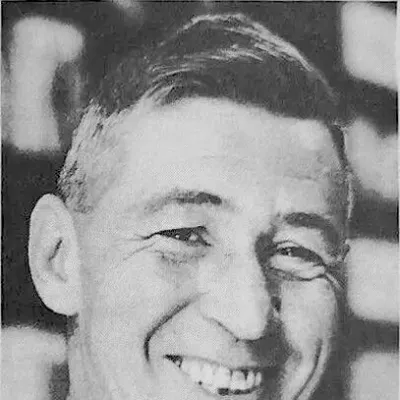
Photo: Wikimedia Commons
Karl Gustav Vollmöller
Human Design Chart
Biography
His uncle Karl Vollmöller (1848–1922) was a notable Romance philologist and Anglicist; his sister Mathilde Vollmöller (1876–1943) married the painter Hans Purrmann in 1912.
Karl Vollmöller died on 18 October 1948 at age 70 in Los Angeles, California.
The Human Design of Karl Gustav Vollmöller: Projector 4/6
Projector 4/6 — Design at a Glance
Karl Gustav Vollmöllers design points to a tendency towards focused and penetrating perception. As a projector, his aura was like an intense beam of light directed at weaknesses in his environment. He had the ability to immediately recognize systemic flaws or inefficient processes in others – similar to a flashlight revealing darkness. This direct confrontation with other people's shortcomings could be perceived as unpleasant or even aggressive when he openly addressed these flaws.
His optimal strategy involved not actively intervening but attracting others through his own harmonious existence. By keeping his life areas in order, he became an inspiring example that drew others in naturally. His energy was not consistently available; as a projector without a defined sacral center, he lacked intrinsic and constant vitality. Instead, he worked in phases of high intensity followed by necessary rest periods for regeneration. Ignoring this need for recovery or acting without the respectful invitation from his surroundings inevitably led to exhaustion and bitterness. His success depended on others seeking his advice rather than him imposing his insights.
Self-Projected Authority
Karl Gustav Vollmöllers design points towards extreme openness, coupled with the risk of being distracted by external motoric energies. As a projector with rare authority in self, his inner truth was anchored in his identity. This configuration required him not to lose himself in the pursuit of energy but to preserve his unique essence.
Decision-making occurred through two pathways: first, conversations – whether with others or as an internal dialogue – where listening was crucial. It was important to distinguish spontaneous expressions of true nature from reflective thought. What he spoke without deliberation revealed his identity and made it recognizable to others. Second, a physical sensation that guided him geographically or thematically in a specific direction.
By following this inner attraction faithfully, he could become a guide for others. This was his specific potential for success: not chasing energy but recognizing and following his own path. This mechanism emphasized the need to use his identity as a guiding star rather than losing himself in the open receptivity of the projector.
The 4/6 Profile — Opportunist / Role Model
Karl Gustav Vollmöllers design points towards an experimental approach during the first decades of life, marked by Line 3 in Profile 4/6. During this phase, he acted like a networker who learned through relationships and tried many things. After his first Saturn return, with the activation of Line 6, his focus shifted to becoming a role model. This shift revealed an internal conflict between his heart's desire for community (Line 4) and his head's drive for wise distance (Line 6).
This tension shaped his later development: he sought balance between cooperation and spiritual insight. The fourth line demanded discretion and single-minded focus, with timing being crucial to avoid conflicts through careless speech. Higher goals stood above the desire for recognition. Simultaneously, the sixth line brought unwavering hope for better relationships. It taught him to see every interaction as a necessary step towards greater unity and to replace pessimism with optimism. Karl Gustav Vollmöller had to learn to cautiously open his big heart to avoid being hurt by false people while also taking on the role of a wise exemplar who stood out through cooperation.
Single Definition — Defined & Open Centers
Karl Gustav Vollmöller's design inclines towards clear and reliable communication and a set inner direction. His defined Throat Center enables him to translate messages from various sources within his body into words or actions – not as arbitrary expressions, but as an expression of his specific energy configuration. Simultaneously, the defined G Center grants him stable self-awareness and a sense of personal mission; he intuitively knows where he belongs and who he can love without relying on others' validation.
At the same time, Karl Gustav Vollmöller is highly receptive to external influences due to numerous open centers. His open Head Center makes him vulnerable to mental pressure and confusion; he tends to be overwhelmed by other people's questions or seeks inspiration that isn't his own. The open Ajna Center amplifies this: He can take in many ideas but lacks a constant source for conceptual thinking, making him susceptible to false identification with foreign theories.
His open Heart Center also lacks consistent willpower; he is not designed to give promises or prove his worth through performance and risks getting caught up in spirals of self-doubt if he tries to do so. His open Sacral Center means no constant energy flow; he can easily become exhausted by strengthening the generative power of others and living off "borrowed" energy rather than his own. Additionally, his open Solar Plexus absorbs foreign emotions, which could lead to emotional instability if he does not recognize these as non-self. His open Spleen and Root Centers make him sensitive to fear and stress from the environment, often making spontaneous decisions or enduring pressure counterproductive.
Channels for inspiring, creative self-expression.
Karl Gustav Vollmöller revealed himself as someone who did not achieve his impact through words or explanations but by fully living out the unique nature of his identity. This attitude stemmed from Channel 1-8, which connected the G Center with the Throat Center. Through Gate 1, the individual entrance for mutative perspectives, and Gate 8, the Gate of Contribution, he was designed to gain public attention by serving as a role model. He said through his exemplary life to the goals of a group: "I know that I can make a creative contribution." This kind of leadership potentially changed the perspective of others and inspired them to creatively express their own uniqueness, much like a pianist encourages others to play the piano.
This expression required an inner, authentic authority, as Channel 1-8 did not have built-in social adaptability. It was necessary for him to develop skills for effective communication and cultivate patience to wait for the right timing. His success depended on being recognized for his individuality.
In the background, further energetic streams were at work: Gate 2 brought receptivity as the foundation for every reaction, while mutations defined new directions in evolution. Gate 13 promoted cooperation towards the cause of humanity through an awareness of progress and reflection within the context of time. Gate 7 projected patterns into the future and showed a need to lead, where hierarchies were considered an essential part of the design. Gate 25 enabled access to unconditional love through a mystical channel and tested innocence in the process of individualization. Gate 15 established flow in society through logical collective behavior and adaptation to natural rhythms. Finally, Gate 23 translated inner sound into language, where recognition of difference was essential to bring diverse mutations into the world and enable freedom.
Individual Circuitry — Circuit Signature
Karl Gustav Vollmöller's design inclined towards impulsive, inspired impulses. His knowledge circuit was activated by the Inspiration Channel, connecting the Throat Center with the Identity Center. This connection created a direct flow: an inner spark or sudden idea from the Identity Center found immediate expression through the voice in the Throat Center. It was acoustic, pulsating energy that worked in the "now" and was often tinged with melancholy or creativity. Since Karl Gustav Vollmöller was simply defined, these connected centers formed a continuous energetic stream. The circuit served to transform new insights and bring them directly into the world through this direct expression. His unique identity was reinforced by these mutations – deviations from the known. Karl Gustav Vollmöller emerged as someone who not only thought his individual thoughts but immediately manifested them verbally. This mechanism allowed him to initiate change by articulating his innate knowledge directly. The energy was not diffuse, but focused on expressing his own individuality through speech.
Right Angle Cross of the Sphinx 2
Karl Gustav Vollmöller's design carried the signature of the Right Cross of the Sphinx. This configuration shaped an attitude characterized by a deep connection to material life and a clear, often direct way of setting boundaries. It was an energy that did not strive for abstract ideals but focused on the here and now – on physical reality, health, and concrete results.
The Right Cross of the Sphinx connects in Human Design mechanics often the power of will with the ability to root into everyday life. For Karl Gustav Vollmöller, this meant inner stability that allowed him to maintain a firm stance despite external circumstances. He was someone who had his own rules and consistently enforced them without slipping into aggression. Instead, his presence often appeared calm but unshakable.
This structure promoted a lifestyle aimed at self-sufficiency and independence. Karl Gustav Vollmöller knew how to make the best use of given resources and not be swayed by external expectations. His energy was grounding and down-to-earth, which helped him maintain clarity in chaotic situations. It was a power that focused less on intellectual debates and more on actual ability to act in everyday life. Through this inner alignment, he could stand up against resistance and live his own truth without losing touch with reality.
Saturn Return · Uranus Opposition · Chiron Return · 2nd Saturn Return — Life Cycles
Karl Gustav Vollmöllers design shaped a life span structured by clear cycles of condensation and transformation. In 1906, at the age of 28, he completed the comedy "The German Count" and published his translation of "Antigone." This marked his first Saturn return, a phase in which years of internal preparation often culminate in a tangible external result. His design showed the ability to translate long-term stances into concrete works.
Another crucial chapter was his Chiron return around age 50. During this fulfillment cycle, one's incarnation cross unfolds increasingly in life; meaning and purpose become experiential if one follows their strategy. In 1928, based on a template by Vollmöller, the film "Dirty Money" emerged. This event underscores the typical dynamics of this phase: internal alignment often finds its visible bloom and public resonance at this age without necessarily implying healing of old wounds.
The second Saturn return around age 55 brought another turning point. In 1933, during the Nazi takeover, Vollmöller only stayed in Germany for a few days. This cycle often demands a realignment or farewell to old structures. His design responded to the external crisis with clear distancing, illustrating the mechanical necessity of repositioning oneself and letting go of outdated bonds as one ages.
Projector · Self-Projected Authority — Synthesis
Karl Gustav Vollmöller lived as a Projector, whose energy was aligned with recognizing the potential in others and bringing "light into darkness" for them (Design View). This ability to identify errors in the system (Design View) influenced his entire life – particularly in his creative engagement with existing structures. He sought ways to create new things and transform knowledge (Circuit: Knowledge Circuit), always emphasizing the expression of his own identity. The connection between G Center and Throat Center through the Channel of Inspiration allowed him to express his own perspectives courageously and encourage others to do the same (Channels/Gates: Inspiration).
A central tension in his design lay in the conflict between a desire for belonging (Profile Role: Line 4) and the need for independent reflection (Profile Role: Line 6). This led to an inner turmoil that was evident during transitional phases of his life cycles (Cycles), especially noticeable during times of significant societal changes (Cycles). His authority lay in self-expression (Authority: In Self) – a process of listening and distinguishing between inner truth and external influences, which made him both open and vulnerable to distractions.
1 Defined Channel
Incarnation Cross - Right Angle Cross of the Sphinx 2
Solar Return
The Solar Return shows the moment when the sun returns to its exact birth position - your personal solar year.
Life Cycles
Discover the life cycles with a detailed triple view (birth chart, cycle chart, composite).
Human Design Profile
- Type
- Projector
- Strategy
- Wait for the respectful invitation
- Authority
- Self-Projected Authority
- Profile
- 4/6 - Opportunist / Role Model
- Definition
- Single Definition
- Incarnation Cross
- Right Angle Cross of the Sphinx 2
- Date of Birth
- 07.05.1878 03:00
- Place of Birth
- Stuttgart, GER
Frequently Asked Questions
What was Karl Gustav Vollmöller's Human Design type?
What Profiles did Karl Gustav Vollmöller have?
What Authority did Karl Gustav Vollmöller possess?
What incarnation cross did Karl Gustav Vollmöller carry?
When was Karl Gustav Vollmöller born?
Discover your own Human Design
Are you also a Projector? Find out in a personal reading how to unfold your leadership qualities and recognize the right invitations.
More Personalities
Back to overviewSissy Spacek
Alain-Fournier
Anémone
Ann-Margret

Bourvil
Hergé