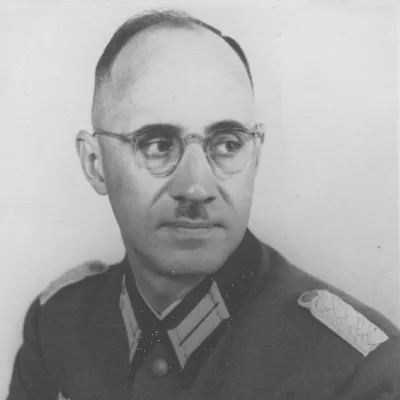
Karl Plagge
Human Design Chart
Biography
He died on 19 June 1957, aged 59, in Darmstadt.
Karl Plagge as a Generator 4/6 in Human Design
Generator 4/6 — Design at a Glance
Karl Plagge possessed immense, enduring strength inherent to his Generator nature. His design suggested that he operated like a strong workhorse: ready and capable of tackling large tasks as long as he had energy for his specific goals. This energy source came from his Sacral Center, but it was activated not through spontaneous initiation but rather through reactive action. His strategy involved waiting for signals from the outside world and then acting only when his inner self gave a clear "yes."
This mechanism protected him from two typical pitfalls: first, from squandering his strength on tasks without internal resonance, which often leads to exhaustion in Generators. Second, reacting served as protection against interruptions of his Heart Project by external constraints like "It's already late." When Plagge reacted from the gut rather than taking independent initiatives, he found access to a deep sense of satisfaction. Conversely, if he lived contrary to this principle and tried to initiate where he should have been reactive, frustration or energy deficiency would arise. His design therefore required a disciplined waiting period for the right impulse in order to effectively and fulfillingly deploy his immense endurance.
Sacral Authority
Karl Plagge was a Generator whose decision-making process was characterized by a simplified structure: His strategy and his inner authority aligned. This significantly reduced the internal conflict in orienting himself in life. The Sacral Authority acted as a central instance that responded to external stimuli with an immediate physical reaction. This "gut feeling" did not manifest in abstract thoughts but rather in physical signals like a surge of energy or vocal expressions – grunts, hums, or a confirming "mm-hm". Such reactions marked the moment when energy became available. When Karl Plagge felt this vitality and aliveness, he had an inexhaustible supply of power for his tasks. He could immerse himself completely in his actions, driven by enthusiasm and satisfaction, without needing an external purpose or benefit to be at the forefront.
Additionally, an active Spleen as a supporting authority contributed to the speed of his reactions. This connection allowed him to make spontaneous decisions based on instinctive perception and physical well-being. He relied reliably on this inner compass that gave him direct access to his instincts. The combination of sacral energy and spleen-supported intuition shaped his approach to life: quick-reacting, physically authentic, and energetically rich when the right impulses occurred.
The 4/6 Profile — Opportunist / Role Model
Karl Plagge showed a development line that was strongly marked by the alternation between social engagement and inner distance. In his first three decades of life, he appeared experimental, especially in the areas of relationships and friendships. This phase corresponded to the influence of Line 4, which conveys confidence and certainty during crises as well as emphasizing the cycle of experiences and reflection. Karl Plagge sought collective wellbeing here and learned that even embarrassing situations can contribute to personal maturity.
With the activation of Line 6, a tension field emerged: The desire to belong to a community conflicted with the need for spiritual elevation and contemplative distance. This created an inner conflict between heart and head. The sixth line demanded separation and division to overcome shocks and emphasized willpower as well as the ability to face challenges alone. Karl Plagge found himself in a phase of weighing his options: Should he confront the competitions or stay on the sidelines? He waited for clear spiritual signs to make these decisions.
In his later years, Karl Plagge developed into a role model. His life task was to work through cooperation with other people and give wise advice. In doing so, he protected his big heart from injuries caused by false bonds by carefully choosing who he opened up to. His design suggested that true leadership arises from the balance between social connectedness and personal integrity.
Split Definition — Defined & Open Centers
Karl Plagge revealed himself as someone who possessed a reliable inner direction and clear expression. His defined G Center gave him a firm sense of self; he knew where he belonged without imposing it on others. This identity flowed into his defined Throat Center, which served as the pivot point for his messages: He spoke and acted from his personal truth, enabling consistent and honest communication.
In contrast to this, with his Generator type and defined Sacral and Spleen Centers, he had a massive vital energy source. His strategy was not to initiate but to react to life. His Sacral Center provided the powerful 'yes' or 'no' response, while his defined Spleen Center offered spontaneous intuition and body awareness. He acted from the gut, trusted his instinct in the moment, and found satisfaction in tasks he responded to correctly.
In contrast, his Head, Ajna, and Heart Centers were open. The open Head and Ajna Centers meant that he did not have a consistent mental inspiration; he tended to take on others' mental pressure or deal with foreign questions instead of having his own conceptual answers. His open Heart Center lacked the energy for strong commitments; he was vulnerable to losing himself in competition for recognition, proving worth where there was no constancy. Furthermore, his open Solar Plexus absorbed the emotions of his environment, making him emotionally vulnerable, while his open Root Center amplified external stress. Plagge learned not to interpret these open fields as his own truth but rather to use them as a mirror for his environment without being overwhelmed by its pressure or emotionalism.
Channels for resource management and intuitive clarity.
Karl Plagge showed himself as someone who initiated deep directional shifts by skillfully using material resources. This inclination came from the Channel of Beat 14-2. He combined the ability to handle power (Gate 14) with higher knowledge about identity and direction (Gate 2). This gave him a powerful, generative life force that promoted innovation and the unusual. Plagge acted as a keyholder who paved new paths for others through trust in his sacral reaction without needing to know the exact outcome himself. His mere presence could help others find their own direction.
At the same time, he had the gift of articulating intuitive truths in the immediate now. The Channel of Brainwave 57-20 connected his deep-seated survival intuition (Gate 57) with the clear voice of the moment (Gate 20). This allowed him spontaneous, penetrating insights that came directly to expression. His verbal outbursts reached the core of a matter faster than reflective analysis. Through this now-grounded intuition, he overcame fear of the unknown and acted purely from instinct.
Additionally, his design featured a pioneering spirit that initiated new cycles of development (Gate 53), coupled with a drive for worldly success as a basis for spiritual insight (Gate 54). His strong willpower (Gate 51) responded flexibly to shocks and adaptation needs. In the background, processes of reflection (Gate 33) and mutative change towards creating new order (Gate 3) were at work. The energetic transmission of leadership (Gate 31), the genetic strategy of binding (Gate 59), the tribal hierarchy (Gate 45), as well as masterful change through experience (Gate 35) rounded off his complex profile, oriented towards deep transformation and authentic expression.
Individual Circuitry — Circuit Signature
Karl Plagge's design set a tendency for innovative, creative impulses paired with a driving rhythm. This configuration appeared as two separate but parallel forces. On one hand, the Knowledge Circuit connected the Throat Center to the Spleen Center through the Channel of Lightning Stroke (20-57). This promoted spontaneous, innovative ideas that directly came into expression – a pulsating energy of the moment. On the other hand, the same circuit linked the Identity Center with the Sacral Center via the Channel of Beat (2-14). Here, a consistent rhythmic life force drove actions from personal individuality.
Although both parts belonged to the same circuit, they were not directly connected in Karl Plagge. The Split Definition energetically separated these areas: The creative impulse (Head-Spleen-Throat) and the driving identity power (Sacral-Identity) existed side by side without a continuous flow. Karl Plagge used this structure to gain new knowledge and initiate changes. Emotions from the Solar Plexus – not directly active in the circuit but relevant as general human resources for expression – supported the formulation of this unique identity. His way of transforming the new was based on this duality: lightning creativity on one side, consistent rhythm on the other. This defined his own path without both aspects always acting synchronously. The mechanics thus described a person who was both inspired and action-oriented, with these qualities running in different energetic channels.
Right Angle Cross of Penetration 2
Karl Plagge's Human Design profile featured the right cross of penetration. This configuration shaped a fundamental stance where self-awareness was closely intertwined with service to others. For Karl Plagge, this meant that he did not see himself as an isolated individual but rather defined his identity through the support and protection provided by fellow human beings.
In Human Design terms, this cross describes a specific energy connection: The power of the Manifestor (Gate 2) flows directly into the empathic perception of the Generator (Gate 38). This created in Karl Plagge a deep, often unconscious need to stand up for others and protect them. His authority did not lie in controlling others but rather in his ability to intuitively sense their needs and respond accordingly.
This mechanism led Karl Plagge to actively seek out or accept situations where he could take on a protective role. He acted not from egoistic motives, but from an inner conviction that his value lay in helping others and safeguarding them from harm. The connection between the impulse to act and empathy for others' suffering was so strong in him that it significantly guided his life decisions. Karl Plagge lived this dynamic by placing himself at the service of others, often at the expense of his own needs, driven by a deep conviction that his existence only made sense within the context of helping.
Saturn Return · Uranus Opposition · Chiron Return · 2nd Saturn Return — Life Cycles
Karl Plagge's design showed a tendency towards structural anchoring and overcoming life crises through inner maturation. This configuration shapes a path where external changes are often accompanied by internal trials leading to clarity about one's purpose.
In 1938, at age 41, Plagge became the head of the factory. This career move fell into the phase of an Uranus opposition. In Human Design mechanics, this aspect often marks a turning point where old structures break down and new, unexpected paths are forced or enabled. Taking on leadership was not just a promotion but a moment of transition when life circumstances changed fundamentally.
Ten years later, in 1947 at age 50, Plagge faced denazification proceedings against him. This coincided with his Chiron return, a cycle of fulfillment and blooming. Here the mechanics do not show healing old wounds but rather as a phase where one's incarnation cross – if lived according to strategy and authority – increasingly becomes meaningful. The crisis of the proceeding was part of this profound engagement with one's essence and purpose.
The second Saturn return around age 60 rounds out this development. In 1957, Karl Plagge died of heart failure in Darmstadt. This cycle symbolizes the completion of a long journey of structuring and responsibility that ended with his physical demise.
Generator · Sacral Authority — Synthesis
Karl Plagge primarily lived from his sacral energy (Generator type) and responded to the world with an inner drive activated by external stimuli (sacral authority). This energetic core consistently shaped his actions – he was in his element when fully immersed in activities that vitalized him. His profile as a networker/role model suggests that throughout life, he experienced an internal conflict between the desire for community and the necessity of reflection. The connection between lines 4 and 6 created tension between the need for belonging and the drive towards independent thinking.
A central paradox in Karl Plagge's design lay in the interplay of his defined throat, which transformed messages from various centers, and the knowledge circuit that promoted innovation and individuality. He possessed the ability to receive and express knowledge while simultaneously feeling a pull to forge new paths and distance himself from conventions. This was evident during moments of professional advancement (1938), but also in times of crisis (1947) and culminated ultimately at his death (1957), when the energetic burden of his individual destiny caught up with him.
2 Defined Channels
Incarnation Cross - Right Angle Cross of Penetration 2
Solar Return
The Solar Return shows the moment when the sun returns to its exact birth position - your personal solar year.
Life Cycles
Discover the life cycles with a detailed triple view (birth chart, cycle chart, composite).
Human Design Profile
- Type
- Generator
- Strategy
- To respond - wait for something to respond to
- Authority
- Sacral Authority
- Profile
- 4/6 - Opportunist / Role Model
- Definition
- Split Definition
- Incarnation Cross
- Right Angle Cross of Penetration 2
- Date of Birth
- 10.07.1897 01:30
- Place of Birth
- Darmstadt, GER
Frequently Asked Questions
What was Karl Plagge's Human Design type?
Which Profile did Karl Plagge have?
What Authority did Karl Plagge have?
What incarnation cross was assigned to Karl Plagge?
When was Karl Plagge born?
Discover your own Human Design
Are you also a Generator? Find out in a personal reading how to use your sacral energy correctly and discover deep satisfaction.
More Personalities
Back to overviewAaliyah

Alexia

Angèle

Anne-Marie

Arcángel

Arno