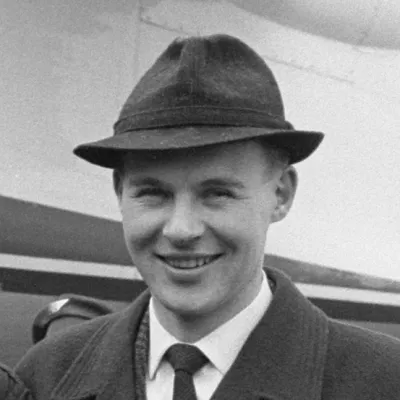
Knut Johannesen
Human Design Chart
Biography
What does Manifesting Generator 1/3 mean for Knut Johannesen?
Manifesting Generator 1/3 — Design at a Glance
Knut Johannesen's design shows a tendency towards hybrid work: the ability to move forward quickly and skip steps paired with a constant need for inner confirmation. As an Manifesting Generator, he had constant sacral energy, allowing him to draw things into his life rapidly. However, this speed was a double-edged sword. Without proper alignment, pursuing multiple impulses simultaneously or skipping necessary intermediate steps led quickly to frustration – his specific Non-Self theme.
Therefore, the mechanics of his design required conscious discipline: instead of initiating independently, he needed to respond to external life impulses. Only when his sacral center gave a clear 'yes' was it time to start. This strategy aimed to channel his natural drive into focused action rather than chaotic multitasking. When Knut Johannesen practiced this approach and regularly checked if his projects still had his inner approval, potential frustration turned into deep satisfaction. His design showed that he didn't need to proceed linearly; on the contrary, switching between different tasks and a playful handling of his creative power were essential for him. Only through this balance of quick execution and constant sacral verification could he use his full energy efficiently and satisfyingly without overburdening himself or neglecting important processes.
Sacral Authority
Knut Johannesen's design tends to make decisions not in the head but through direct physical resonance with the outside world. His inner authority is Sacral Authority, carried by a defined Sacral Center. As a Generator, his strategy of 'reacting' was identical to this authority; it fundamentally simplified his decision-making process as action and orientation stemmed from the same source.
This mechanism worked through physical signals: in response to an external stimulus, there would be a gut reaction, a grunting or humming sound, or a noticeable surge of energy. These sounds were his compass. When his sacral motor kicked in, he felt vital and alive with inexhaustible energy and great enthusiasm for the task at hand. He was born to take on tasks with joy without needing an external purpose.
Additionally, the Spleen Center supported this structure. As an active, instinctive instance, it allowed quick, spontaneous reactions and decisions. Knut Johannesen had direct access to his physical well-being and intuition through this center, which he could rely upon. The combination of Sacral and Spleen authority shaped a lifestyle based on immediate, energy-charged responsiveness rather than long-term planning or intellectual analysis.
The 1/3 Profile — Investigator / Martyr
Knut Johannesen's design shows a tendency towards a dual approach: he was geared to understand knowledge not only theoretically but also through direct practice and the conscious acceptance of mistakes. This Profile 1/3, the Researcher and Experimenter, defines the life task as a process of learning through trial and error. It combines the profound, fundamental knowledge of Line 1 with the necessary practical application and risk-taking of Line 3.
For Knut Johannesen, authenticity emerged only through the synthesis of these two aspects: A judgment was only trustworthy if it was both intellectually understood and practically tested on a gut level. The central tension in his design lay between the fear of insufficient knowledge – typical for Line 1, which often feels it doesn't know enough to act – and the strong urge to act and experiment from Line 3.
Self-discovered insights were the core theme. When Knut Johannesen evaluated something as right or good, he had previously examined it both theoretically and practically in depth. His judgment could be trusted absolutely because it was based on this dual foundation. His path was marked by the necessity to experiment to find out what works, with mistakes seen not as failures but as essential learning steps.
Single Definition — Defined & Open Centers
Knut Johannesen's design suggests a tendency towards reliable communication and a stable, intuitive orientation. His defined Throat acts as a constant pivot point for expression that does not depend on changing thoughts or emotions but rather speaks from his personal identity in the G Center and spontaneous intuition of the Spleen. This configuration allowed him to articulate his truth with clarity without being shaken by external opinions. The defined Spleen also provided strong body awareness and the ability to distinguish between healthy and unhealthy in the moment, shaping his well-being and values.
His energy foundation came from the defined Sacral Center, providing immense vital force. However, this energy was activated not through initiation but through reaction. Knut Johannesen responded to questions or offers with an internal "yes" or "no" to ensure that his energy was available for the task at hand. This protected him from exhaustion and frustration as he did not work against his own rhythm.
At the same time, his design revealed areas of situational receptivity. The open Heart Center made him vulnerable to pressure to prove his worth through promises or competition, though this is not his natural energy source. He tended to question whether he was doing enough to be recognized. The open Solar Plexus absorbed the emotions of the environment, making him vulnerable to others' moods; he could fluctuate between his own and absorbed feelings. Open Head and Ajna Centers led to mental inspiration and concepts that were not constant. He was open to new ideas but also vulnerable to confusion or pressure to find answers to questions that were not his own. The open Root Center amplified external stress, which could make him rush unnecessarily to escape this pressure rather than trusting his inner authority.
Channels for authentic leadership, intuition and powerful self-assertion.
Knut Johannesen's design inclines towards collective leadership that arises not through authority but through logical invitation and trust. This role is shaped by the Alpha Animal Channel 7-31: It connects the G Center with the Throat Center, where Gate 7 provides the logical structure and Gate 31 supplies the voice of the leader. Knut Johannesen had to demonstrate his competence to be chosen by the community; he was not a lone ruler but rather a leader who recognizes and represents patterns.
At the same time, his personality demanded absolute authenticity and self-love, carried by the Channel of Exploration 10-34. This connects the Sacral Center with the G Center: Gate 34 offers inner strength for individual convictions, while Gate 10 initiates behavior from deepest self-acceptance. Here lies the tension between the need for collective validation in his design and the impulse towards self-determined reaction in his personality. Success occurred when leadership was based on this secure self-love.
Additionally, the Channel of Perfected Form 57-10 acted as a juxtaposed energy linking intuitive insight (Gate 57) with behavior from self (Gate 10). This supported spontaneous, intuitive action in the present moment, free from future anxieties. The Channel of Power 34-57 reinforced this individual survival intelligence by connecting sacral reaction and spleen intuition. Thus, Knut Johannesen moved between serving collective patterns and unconditional loyalty to his own intuitively guided existence.
Individual Circuitry — Circuit Signature
Knut Johannesens design points to a tendency towards deep inner centering and individual confirmation. He was someone who drew his identity from within himself independently of external validation, characterized by firm convictions and a strong focus on self-worth. This attitude resulted from the Centering Circuit that directly connected his Sacral Center with his Identity Center (Channel 10-34). This channel pulsed in "the now" and fostered an individualistic basic stance: "I am who I am." Since this circuit did not connect to his Throat Center, this inner certainty often remained difficult to articulate verbally; the power was directed inward.
Parallel to this, the Understanding Circuit worked through Channel 31-7 ("The Alpha Animal"), which connected his Identity Center with his Throat Center. This allowed him to structure logical and rational insights strategically and share them free from conditioning – a process of focused future shaping through clear expression.
Additionally, he integrated power from reaction (Gate 34) with correct behavior (Gate 10) and intuitive knowledge (Gate 57) in the Integration Circuit. The channels "Perfect Form" (10-57) and "Power" (34-57) connected Identity, Sacral, and Spleen Centers. This helped him to gain power from reacting to life, guide it through intuition, and make it effective in the present moment. As a person with simple definition, these centers formed a coherent energetic unit that stabilized his existence through inner confirmation, strategic expression, and intuitive action capability.
Right Angle Cross of the Sphinx 4
Knut Johannesen's design carried the archetypal structure of the right Sphinx Cross 4. This configuration is characterized by a profound, often unspoken connection to mystical or spiritual dimensions, coupled with a strong impulse to bring hidden knowledge or secret truths into light.
The right Sphinx Cross 4 implies no superficial curiosity but rather a serious, almost fateful dedication to the invisible. It's about deciphering mysteries that go beyond everyday life. The energy of this cross often acts as an inner compass guiding the bearer towards deeper connections that must be understood—not for fame, but out of a fundamental necessity to recognize and make truth accessible.
For Knut Johannesen, this meant a way of living shaped by this archetypal force: seeking what lies behind the facades of the visible world. It's a design requiring patience and intuition to interpret subtle signals from the universe. The Sphinx 4 represents wisdom often hidden; its right aspect emphasizes the active role of an unveiler, someone ready to build bridges between the mysterious and the comprehensible. This inner orientation influenced how he engaged with topics beyond the obvious.
Saturn Return · Uranus Opposition · Chiron Return · 2nd Saturn Return — Life Cycles
In this phase of his life, Knut Johannesen was seen as someone who condensed his early development into a stable identity. The first Saturn Return cycle typically marks the period of serious self-confrontation and review of earlier decisions. For him, this consolidation peaked in 1960 at age 27 when he was named Athlete of the Year in Norway. This success is no coincidence but evidence of how years of groundwork within this astrological cycle often crystallizes into a solid result. The mechanics describe here the transition from experimental youth to adult responsibility and self-structuring. Knut Johannesen's design suggested that this period was a critical test where the foundations for his later work were laid. Through recognition as Athlete of the Year, it became visible how he translated his individual strengths into socially acknowledged achievements. The Saturn Return cycle demands stripping away illusions and focusing on essentials. In this case, this process led to confirmation of his abilities and created a basis for further developments. Being named Athlete of the Year thus exemplifies the condensation of potential into concrete performance as facilitated by this cycle.
Manifesting Generator · Sacral Authority — Synthesis
A central red thread in Knut Johannesen's design is the dynamic connection between inner drive and outer expression. The defined Sacral Center (Centers) provides a constant energy source, which through the Manifesting Generator configuration (Design View) not only reacts to stimuli but also quickly initiates actions. This combination of reactive and manifesting power is amplified by the Alpha Animal Channel (Channels/Tor), signaling a natural inclination towards leadership and collective influence—a pattern evident in recognized achievements (Cycles). The profile as Researcher/Experimentator (Profile Role) underscores this process of actively testing and validating insights.
At the same time, Knut Johannesen's chart reveals a paradox between the urge for rapid implementation and the need for thorough preparation. The Manifesting Generator Hybrid nature (Design View) carries the risk of skipping important steps while Profile 1/3 emphasizes the need for deep examination and verification. This tension field between impulsivity and analytical depth is further intensified by the defined Throat Center (Centers), which allows clear expression but also bears responsibility for decisions made—a dance between action and reflection.
4 Defined Channels
Incarnation Cross - Right Angle Cross of the Sphinx 4
Solar Return
The Solar Return shows the moment when the sun returns to its exact birth position - your personal solar year.
Life Cycles
Discover the life cycles with a detailed triple view (birth chart, cycle chart, composite).
Human Design Profile
- Strategy
- To respond - wait for something to respond to
- Authority
- Sacral Authority
- Profile
- 1/3 - Investigator / Martyr
- Definition
- Single Definition
- Incarnation Cross
- Right Angle Cross of the Sphinx 4
- Date of Birth
- 06.11.1933 20:15
- Place of Birth
- Oslo, Norway
Frequently Asked Questions
What is Knut Johannesen's Human Design type?
What are Knut Johannesen's Profiles?
Which authority determines his decisions?
What is Knut Johannesen's incarnation cross?
When was Knut Johannesen born?
Discover your own Human Design
Are you also a Manifesting Generator? Find out in a personal reading how to unfold your multi-talents and direct your energy wisely.
More Personalities
Back to overviewAldair

Alizée

Angeli

Arletty

Artus

Balthus