
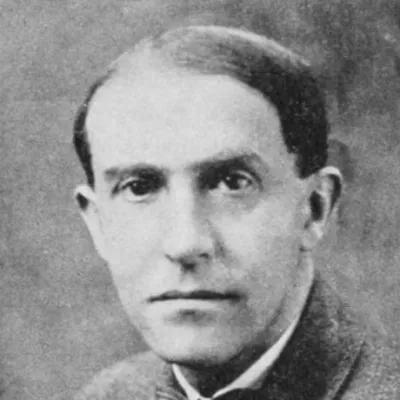
Kurt Koffka
Human Design Chart
Biography
From 1904-1907 Koffka was enrolled in the University of Berlin as a psychology student and earned his PhD there in 1909 as a student of Carl Stumpf.
In 1927, he accepted a position at the Smith College in Northampton, Massachusetts, which he retained until his death on 22 November 1941 from Coronary thrombosis.
Kurt Koffka as a Manifesting Generator 6/2 in Human Design
Manifesting Generator 6/2 — Design at a Glance
Kurt Koffka revealed himself as a person with a hybrid energy structure: He possessed the constant power of a Generator but also had the speed of a Manifestor. His design tended to quickly draw things into his life and skip important steps in the process. This ability for rapid implementation was, however, associated with specific risks. Often he acted too quickly, overlooked crucial intermediate steps, and later had to return to complete them—a process that could cause frustration as it touched on his non-self theme. Additionally, Koffka tended to pursue multiple projects simultaneously, driven by various impulses. Without the clear approval of his inner authority and sacral center, his creative enthusiasm rapidly turned into exhaustion. His path to satisfaction lay in not initiating things himself but responding to external life impulses. Only when his Inner Authority gave a clear "yes" after an internal testing process could he effectively use his energy. Under these conditions, he found deep fulfillment in his work. The pressure to complete one thing before starting another was at odds with his nature; rather, he thrived in a playful mode of variety as long as his inner resonance remained intact.
Emotional Authority
Kurt Koffka showed a decision-making stance that did not solidify in the moment of first enthusiasm or rejection. His design featured Emotional Authority, meaning his defined emotional center always took precedence over all other potential impulses – regardless of which additional centers were active in his graph. This configuration marked him with an inner wave of feelings that ebbed and flowed constantly. The world appeared to him always colored by the current mood: What fascinated him for a moment could appear negative in the next. For his design, however, this first impression was only a snapshot, not yet the deep truth. Quick, spontaneous judgments from such an emotional peak often proved misleading. Instead, his inner logic required patience and time. He had to let decisions mature, sleep on them multiple times, and give himself space. Only when intense feelings subsided and emotional distance was gained did clarity set in for him. This process of calm after the wave crest was crucial for long-term, life-defining choices. Kurt Koffka therefore did not live by the impulse of first impressions but waited for the calm after the storm to recognize his true direction.
The 6/2 Profile — Role Model / Hermit
Kurt Koffka's design laid a tendency for deep introspection that only fully unfolded after midlife. As a 6/2 Profile, he appeared in his youth like a 3-line: His path was marked by experimenting and the principle of trial and error. Mistakes served not as failure but as necessary corrections to experience justice without expectation. This phase served the collection of raw life experiences, far from any preconceived goals or conditioned patterns.
After turning thirty, with the activation of his sixth line, his approach fundamentally changed. Koffka metaphorically retreated into a "cave" to look back at past mistakes from great distance. This retreat was not an escape but an active process of healing and self-discovery. The second line of his profile supported this independence through conscious isolation from external influences and conditioning. In this phase, mental activity became fruitful as it was free from the constant need to adapt to the environment.
From this period of intense reflection, Koffka emerged as a wise person. The previously gathered experiences condensed into clear life wisdom. Others recognized this clarity and sought his advice to learn from his ability for deep introspection. Thus, his design described a path from an experimenting layperson to a reflective role model who preserved independence through withdrawal into seclusion and ultimately gained an unbiased perspective on the innocence of human action.
Split Definition — Defined & Open Centers
Kurt Koffka was someone who constantly felt mental pressure to ask questions and understand connections. His defined Head and Ajna centers created a firm style of conceptual thinking; he was perpetually in the process of conceptualizing, unable to stop or control this thought stream but had to learn to accept the confusion and doubt that came with it as natural phases. These inspirations could not be directly put into action since neither the Head nor Ajna are energy centers; trying to force them would only lead to frustration. Instead, he influenced others through his aura by conditioning the mental field of his surroundings and inspiring others to think.
His communication was reliable and structured, characterized by his defined Throat Center. He spoke from the mind what he had conceptualized, giving his words clarity and constancy. Yet this mental activity was accompanied by a deep emotional wave: His defined Solar Plexus was his inner authority. Kurt Koffka needed time to achieve emotional clarity; decisions made in the heat of the moment were often impulsive and later regretted. He learned to wait out the waves of his feelings before acting, as only at the end of this cycle did a deep truth become visible.
At the same time, his Heart Center was open. He lacked inner willpower in terms of assertiveness or competitiveness and tended to prove himself to demonstrate his worth. This often led into cycles of promises he could not keep, undermining his self-esteem. His Spleen Center was also open, making him vulnerable to fears and leading him to cling to uncertain situations just to simulate a sense of well-being. Spontaneous decisions were risky for him as he absorbed the vibrations of his environment rather than relying on his own intuitive knowledge. His open Root Center further allowed him to take in external stress which he often misinterpreted as his own drive towards productivity, leading to overloading. While his defined G and Sacral centers gave him a firm identity and vital energy, this power was only available when he did not initiate but waited for stimuli and responded – a strategy conflicting with his mental urge for immediate resolution.
Channels for intimacy, presence, emotional depth and mental clarity.
Kurt Koffka's inner compass was strongly determined by the emotional wave. This configuration shaped his entire being: He sought hidden connections and had the need to convey insights in such a way that others could absorb them. This did not happen impulsively but through patience and waiting until emotional clarity emerged.
Central for this was Channel of Union 59-6, connecting sacral energy with the Solar Plexus and creating a powerful foundation for intimacy. Kurt Koffka could thus quickly build trust and deepen relationships, yet only if he followed his inner reaction and did not act out of conditioning. His emotional wave determined the timing of these connections; it drew him in or pushed him away, helping him recognize whether a deep bond could form.
Parallel to this, Channel of Openness 22-12 worked. It connected Solar Plexus with Throat Center and allowed Kurt Koffka to express his feelings through voice and articulation. However, his social interaction heavily depended on his mood. If he felt like it, he could emotionally touch others and inspire change; if pushed into social situations against his rhythm, he appeared harsh or isolated.
On a mental level, Channel of Abstraction 64-47 shaped his thinking style. It filtered every experience through a kaleidoscope of images and seeking meaning. This process could be confusing but often led to inspiring new perspectives that he then shared. Crucial was that he did not use the mind as authority for his own life but patiently waited for clarity.
Channel of Awakening 10-20 rounded this picture off. It connected G Center with Throat Center and expressed wisdom in loving and accepting oneself. Through this attitude, Kurt Koffka often unconsciously inspired others to be themselves by simply living and speaking authentically.
Individual Circuitry — Circuit Signature
Kurt Koffka's design inclined towards emotional openness and abstract meaning-making. His split definition showed two parallel, not directly connected energy fields: a network of Solar Plexus, Sacral, Throat, and Identity Centers as well as a separate field of Head and Ajna Centers. This separation meant that his emotional life force and cognitive thinking existed side by side as independent streams without a continuous energetic flow.
The Knowledge Circuit in him linked Throat with Solar Plexus Center through Channel of Openness (Gates 12–22), shaping the ability to express inner emotional waves directly and authentically. Parallel, the Meaning-Making Circuit worked through Abstraction Channel (Gates 64–47) between Head and Ajna Centers. This was about visually grasping patterns and finding meaning in past experiences, separate from his expressive power.
The Archer Circuit connected Sacral with Solar Plexus Center via Union (Gates 59–6). This endowed a primal energy for preserving and protecting one's genetics and family. Finally, the Integration Circuit linked Throat with Identity Center through Awakening Channel (Gates 20–10), enabling intuitive impulses and right actions in the present moment to strengthen individuality. Together, these separate circuits formed a complex web of emotional authenticity, cognitive abstraction, and instinctive protective need that significantly shaped Kurt Koffka's behavioral patterns.
Left Angle Cross of the Plane 1
Kurt Koffka's design revealed a tendency towards a deeper, often unconscious search for the essential. He was someone who did not just observe the surface of things but sought to understand the core and hidden connections. This approach was not a conscious intellectual act but an inner drive that compelled him to look beyond the visible reality.
This configuration corresponds to what is known as the left cross on Level 1 in Human Design mechanics. It describes a specific energetic alignment: the urge to make the invisible visible and uncover deeper truths. This is not about superficial analysis, but rather an intuitive connection to the fundamental essence. Kurt Koffka lived with this inner compass that always directed him towards true meaning. His way of perceiving the world was marked by a need for authenticity and depth. He did not seek answers for others but followed his own deeply rooted logic of understanding. This mechanics shaped his entire life approach: a constant turning inward to truly understand the outer world. It was an attitude of quiet observation and deep penetration into matter, far from superficial impressions.
Saturn Return · Uranus Opposition · Chiron Return — Life Cycles
Kurt Koffka's design indicated a tendency towards structural condensation followed by later, deeper expansion. In 1911, at the age of 25, he earned his habilitation at the University of Giessen – a classic expression of the first Saturn return, during which long-term efforts often lead to a stable professional foundation. This cycle marks the transition from searching for one's place to establishing an established position.
Later, his chart showed the dynamics of the Uranus opposition, characterized by internal tension and a need for change. In 1927, at age 41, Koffka began his work at Smith College in Northampton, Massachusetts. This step aligned with the typical energy of this configuration: a necessary detachment from the familiar to embrace new horizons and perspective shifts.
The peak of his development occurred during the Chiron return, a fulfillment cycle between the ages of 49 and 51. During this period, one's incarnation cross unfolds increasingly if strategy and authority are respected; meaning and purpose become experiential. In 1935, at age 49, Koffka published his magnum opus "Principles of Gestalt Psychology." This was not a mere coincidence but the visible bloom of his life's mission: synthesizing years of work into a coherent whole that reflected his deeper intention.
Manifesting Generator · Emotional Authority — Synthesis
Kurt Koffka lived a process of continuous deepening and alignment with inner wisdom. The combination of manifesting generator energy that tended towards quick action (Design) and emotional authority (Authority) shaped a personality that could be impulsive in initiation but ultimately found calm and maturity by waiting for emotional clarity (Centers). The Profile as role model and natural talent (Profile Role) points to someone who learned from personal experience and later passed on this wisdom – a process reinforced through the phases of Saturn Returns (Cycles), especially marked by his habilitation early in adulthood. The defined Head Center, along with its associated need for understanding (Channels/Gates), contributed to a deep engagement with complex themes.
A central paradox in Kurt Koffka’s design lay between the urge to quickly initiate things (manifesting generator) and the necessity of letting decisions mature emotionally (emotional authority). This tension was evident in alternating phases of quick steps followed by periods of intense reflection. The Knowledge Circuit suggests an inner dynamic that aimed for innovation and transformation, while his left cross on Level 1 (Crossexit) indicated a life marked by constant adaptation and overcoming obstacles – a process fueled by sacral energy (Design).
4 Defined Channels
Incarnation Cross - Left Angle Cross of the Plane 1
Solar Return
The Solar Return shows the moment when the sun returns to its exact birth position - your personal solar year.
Life Cycles
Discover the life cycles with a detailed triple view (birth chart, cycle chart, composite).
Human Design Profile
- Strategy
- To respond - wait for something to respond to
- Authority
- Emotional Authority
- Profile
- 6/2 - Role Model / Hermit
- Definition
- Split Definition
- Incarnation Cross
- Left Angle Cross of the Plane 1
- Date of Birth
- 18.03.1886 12:45
- Place of Birth
- Berlin, Germany
Frequently Asked Questions
What was Kurt Koffka's Human Design type?
What profile did Kurt Koffka have in Human Design?
Which authority guided Kurt Koffka?
What incarnation cross did Kurt Koffka have?
When was Kurt Koffka born?
Discover your own Human Design
Are you also a Manifesting Generator? Find out in a personal reading how to unfold your multi-talents and direct your energy wisely.
More Personalities
Back to overviewAlain-Fournier

Aldair

Alizée

Angeli

Arletty

Artus
