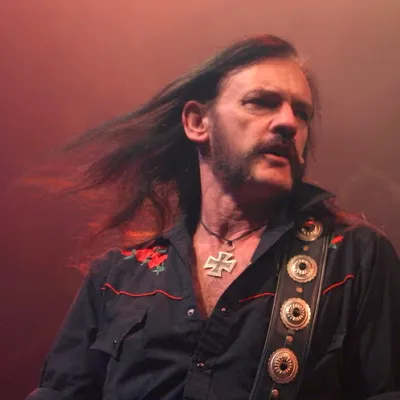
Lemmy
Human Design Chart
Biography
He had worked on and off as a roadie for Jimi Hendrix beginning October 1967 until his death. He even had hopes of joining his band just prior to Hendrix's death on 18 September 1970. Hendrix's bass guitarist was Noel Redding who was born one day after Lemmy.
In August 1971, Lemmy joined Hawkwind, a heavy experimental theatrical rock band, with whom he recorded three studio albums before having to leave the band suddenly when he was busted for drug possession at the Canadian border on 26 May 1975.
Motörhead played its first gig at London's Roundhouse on 20 July 1975. Still going strong, their definitive album, "Ace of Spades", was released in 1980.
He was hospitalized for the flu while on tour in Milan, Italy on 8 December 2000.
Lemmy was diagnosed with an aggressive form of cancer in December 2015 and died two days later at around 4pm on the 28th in Los Angeles.
Lemmy — Generator with Profile 5/1
Generator 5/1 — Design at a Glance
Lemmy's design showed a tendency towards immense endurance and strength, comparable to that of a workhorse. However, this physical and energetic robustness was not an unlimited resource that could be mobilized by sheer will alone but depended strictly on proper utilization. As a Generator, Lemmy had tremendous sacral energy which primarily unfolded when he responded to external impulses rather than initiating himself.
The central mechanics of his design required waiting for an inner signal – that gut feeling calling out, "Yes! Let's get started!". When Lemmy followed this call and acted accordingly, deep satisfaction ensued. Conversely, ignoring these signals or forcing tasks without internal desire led to frustration and energy loss. Particularly critical was the risk of burnout if he engaged in activities he didn't care about for prolonged periods or when prevented from his heart project despite still having power.
Thus, Lemmy's key strategy lay in "not initiating but responding". Only through this approach did he avoid typical pitfalls of his type: wasting energy on wrong targets or resisting his own rhythm. Living by this principle made him unstoppable; acting otherwise led to persistent frustration. His strength therefore didn't lie in initiative but in the powerful response to life as it came.
Sacral Authority
Lemmy's decision-making relied on an immediate, physical resonance rather than cognitive analysis. As a Generator, he possessed sacral authority, a mechanism unique to his type whose strategy was identical to inner authority. This simplified his process: He waited for external stimuli and then listened to his gut feeling. This manifested as a surge of energy or through sounds like grunts or hums signaling whether energy flowed.
When his sacral motor kicked in, Lemmy felt vital and alive. He had seemingly inexhaustible energy and tackled tasks with great enthusiasm. His design predisposed him to go through life joyfully and fully immersed in activities without the need for purposefulness.
Supporting this sacral authority was his Spleen Center. Given its activation and possible direct connection to the Sacral Center, it served as a supportive instance. This endowed Lemmy with the ability to react particularly quickly and spontaneously. He had immediate access to his physical well-being and an instinctive perception he could reliably follow. His authenticity manifested not in deliberate action but in the vital life energy that rose at the right stimuli.
The 5/1 Profile — Heretic / Investigator
Lemmy's design created a specific tension: the magnetic urge to solve problems for others paired with a deep need for private research. As a 5/1, the profile "Hero/Explorer", he used his internal knowledge base to offer solutions. Line 5 gave him almost an attractive quality; people actively sought answers from him regarding their issues. This aligned with the role of the Rebel (Line 5), who questioned norms in crisis times and provided mutated behaviors for survival. Yet, this attraction carried a risk: without clear boundaries, exhaustion threatened due to over-demanding expectations, similar to a scientist drained after hours-long conferences while new inquiries poured in.
Simultaneously, Line 1, represented by Gate 18, called for conservative principles and the building of stable foundations. Here it was about gradual changes to avoid upheavals and correct traditional structures while preserving fundamental patterns. Lemmy had to learn to say no to maintain balance between his public role as a problem solver (Line 5) and private space for knowledge accumulation (Line 1). Only through this demarcation could he optimally utilize his gifts without being overwhelmed by environmental expectations. His path lay in adapting the legacy of predecessors while simultaneously acting as a guardian of necessary behavioral changes – always navigating between the need for insight and responsibility towards others.
Split Definition — Defined & Open Centers
Lemmys design points to a tendency towards an extremely stable internal structure, paired with complete openness to external influences regarding identity and emotion. He was someone whose mind was his primary energy source: the defined Ajna Center (Gate 10) characterized him through a constant mental concept – interpreting answers as opinions. His thinking was unshakeable and specific; he processed data in the same way every time, making him an external authority for others. This mental firmness directly influenced his defined Throat Center, so that he spoke what he thought with a reliable yet limited voice.
This constant energy was fueled by his defined Sacral Center, which gave him immense vital force. Lemmy had an internal engine that could only be activated through reaction; his satisfaction depended on responding to requests rather than initiating actions himself. His defined Spleen Center provided spontaneous intuition and well-being in the present moment, while the defined Root Center supplied a constant pressure to master existential challenges. Together, these centers formed a "power plant" of thinking, communication, and vitality.
In stark contrast stood his open centers: G, Heart, Solar Plexus, and Head. Lemmy had no fixed internal identity or emotional foundation. His open G Center allowed him situational adaptation; he adopted the identities of his surroundings rather than possessing one of his own. The open Heart Center made him vulnerable to the pressure of proving his worth, even though he was not designed to compete with willpower. His open Solar Plexus absorbed foreign emotions like a sponge, making him emotionally vulnerable and dependent on the climate of his environment. Additionally, his open Head Center tended to engage with others' doubts and questions rather than generating his own inspiration. Thus, Lemmy lived as a constant engine in a variable shell: stable internally but constantly shaped by the energy of the outside world.
Channels for curious mind, focus and clear logic.
Lemmy's design inclined towards precise and corrective analysis, complemented by magical storytelling and logical structuring. This configuration constantly shaped his way of thinking and evaluating.
Channel 52-9 acted as a focus energy: It created a calm tension that kept Lemmy still to perfect details. Through the Gate of Non-Doing (52) and the Gate of Focusing (9), he remained in place until his focus was clear – an energy influencing other channels in his design.
Parallel to this, Channel 11-56 propelled abstract inspiration forward. Connecting the Gate of Ideas (11) with the Gate of Inspiration (56), Lemmy wove stories from few facts that taught or entertained listeners. Here, it was less about dry data and more about the magical connection between philosophical concepts and experience.
Logical order came through Channel 17-62. Between the Gate of Opinions (17) and the Gate of Details (62), Lemmy mentally organized information into language. He translated visual patterns into words to structure his worldview; anything that did not fit logically was initially incomprehensible to him.
Finally, Channel 58-18 provided an insatiable drive for correction. The Gate of Vitality (58) demanded "better and more," while the Gate of Correcting (18) checked what was in balance. Lemmy assessed patterns in the collective to determine if they worked or needed adjustment – a process that brought him joy when invited to find solutions.
Collective Circuitry — Circuit Signature
Lemmy's design tended towards a dual approach to gaining insight: on one hand, cool, strategic planning for the future, and on the other, emotional reflection of the past. This tension between reason and feeling shaped his way of interacting with the collective. As someone with Split Definition, Lemmy often needed external validation to gain inner clarity; he could not decide alone what was right, but sought exchange.
The Understanding Circuit connected two separate parts in him: The Ajna (Mind) with the Throat Center (Expression), allowing for clear articulation of logical strategies and visual concepts. Simultaneously, the Centers Sacral (Life Force Energy), Root (Pressure/Reaction), and Spleen (Intuition/Safety) merged. This created a direct connection between his energy source, his instinctive safety needs, and his ability to act under pressure – all free from emotional coloring.
The Meaning Circuit also connected Ajna with the Throat Center. Here, however, this channel served not cool logic but sharing felt insights. Through Channel "Curiosity" (Gates 11/56), Lemmy reflected on past experiences and emotions in waves. He sought meaning behind events and shared these emotional cycles with others to learn collectively from the past.
Both circuits used the same expression channel (Ajna-Throat), which meant that Lemmy could verbally communicate both rational future plans as well as emotional reflections of the past. However, his Split Definition forced him to validate these inner processes in dialogue with others before they became fully clear for him.
Left Angle Cross of Prevention 2
Lemmy's design showed a tendency towards strategic prevention. He appeared as someone who sought to avoid conflicts through early intervention. This attitude resulted from the influence of the left cross of Prevention 2 in his chart. This configuration focuses on the ability to anticipate problems and develop proactive solutions before they escalate. For Lemmy, it was about strategic thinking aimed at maintaining stability and harmony through foresight. Instead of reacting to crises, he sought ways to prevent them from arising in the first place. His approach was characterized by the intention to nip tensions in the bud by recognizing and addressing potential discord early on. This meant constant vigilance towards possible disruptions to balance in his environment or relationships. Through this proactive strategy, he aimed for a sustained calm that was not achieved through reactive repairs but rather through careful planning. The mechanics of this cross described a lifestyle where avoiding friction took precedence over impulsive action. Lemmy used this energy to create an environment where harmony was not left to chance but was the result of conscious, forward-thinking measures.
Saturn Return · Uranus Opposition · Chiron Return · 2nd Saturn Return — Life Cycles
Lemmy's design set a tendency for cyclical stress tests that dissolved old structures and inevitably forced new life phases. This mechanism became visible through two specific Saturn Returns, which acted as catalytic moments of structural reorganization.
In 1975, at the age of 30, Lemmy experienced his first Saturn Return. That year he was thrown out of Hawkwind. For his design, this expulsion marked a classic crisis point: The years-long work within the band structure collapsed, necessitating a painful but necessary maturation and detachment from old patterns.
This dynamic reappeared in 2000 when Lemmy was 55 years old. His second Saturn Return manifested as a serious illness: He was hospitalized in Milan with the flu. Again, this crisis served as a breaking point. The physical threat forced confrontation with personal limits and dissolved existing life plans to make way for a new phase.
Both events underscore that Lemmy's path did not follow a linear course but was marked by these cyclical breaks. The Saturn Return did not merely bring misfortune but acted as an architectural intervention, removing instability and laying the groundwork for a more stable foundation in the following period of life. This repetition of crisis points highlighted the deep embedding of this mechanism in his chart: Growth occurred through the forced reorganization after the collapse of the familiar.
Generator · Sacral Authority — Synthesis
Lemmy's life was marked by a deep inner drive to understand things and express these insights (Channel 17-62). This ability for logical analysis and breaking down complex issues, fueled by a defined Ajna Center and the Channel of Concentration (52-9), manifested in his musical work and his tireless search for new ideas. He was a collector of knowledge (Profile 5/1) whose energy was ignited by reacting to external impulses (sacral authority). This combination of intellectual curiosity and reactive energy led to a life full of creative activity, yet also a constant search for the next project, the next challenge.
Central to Lemmy's design was a paradox between his need for expression and his inner restlessness. While he possessed a clear voice and the ability to communicate (defined Throat Center), he lacked a stable emotional center (open Solar Plexus) and a defined G Center, making him vulnerable to external influences. Although he could intensely immerse himself in topics, the lack of an internal compass led to a constant search for validation and a feeling of restlessness – a life between the urge to create something and the challenge of finding a stable inner anchor.
4 Defined Channels
Incarnation Cross - Left Angle Cross of Prevention 2
Solar Return
The Solar Return shows the moment when the sun returns to its exact birth position - your personal solar year.
Life Cycles
Discover the life cycles with a detailed triple view (birth chart, cycle chart, composite).
Human Design Profile
- Type
- Generator
- Strategy
- To respond - wait for something to respond to
- Authority
- Sacral Authority
- Profile
- 5/1 - Heretic / Investigator
- Definition
- Split Definition
- Incarnation Cross
- Left Angle Cross of Prevention 2
- Date of Birth
- 24.12.1945 08:30
- Place of Birth
- Burslem, United Kingdom
Frequently Asked Questions
What was Lemmy's Human Design type?
What Profile did Lemmy have in Human Design?
Which Authority guided Lemmy's decisions?
Which incarnation cross defined Lemmys life?
When was Lemmy born?
Discover your own Human Design
Are you also a Generator? Find out in a personal reading how to use your sacral energy correctly and discover deep satisfaction.
More Personalities
Back to overviewAaliyah

Alexia

Alizée

Angèle

Anne-Marie

Arcángel