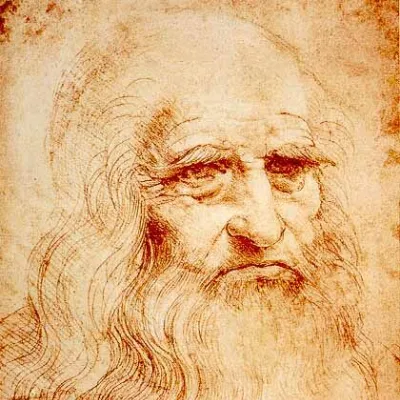
Leonardo Da Vinci
Human Design Chart
Biography
The son of a wealthy notary and a peasant mother, he was stigmatized by his illegitimate birth. As a teenager, he joined his dad in Florence but his status as a bastard barred him from joining guilds that would have led him into a conventional career. The Renaissance had begun, fueled by a new merchant class anxious to patronize the arts, as well as a desire to repair the damage from centuries of war and the decimation of the plague. Leonardo was apprenticed as a studio boy to the painter Verrocchio, who was a leading metal smith, painter and sculptor in Florence. There Leonardo became familiar with the production of religious and more secular paintings as well as sculpture. In 1472, he joined the painter’s guild of Florence, and by age 26 he had become an independent master. A homosexual, he was charged with sodomy on April 9, 1476 OS in Florence. The humiliation of this public denouncement was a factor in his decision to leave Florence, beginning his celebrated career shuttling back and forth between various eminent patrons.
Leonardo Da Vinci as a Generator 5/1 in Human Design
Generator 5/1 — Design at a Glance
Leonardo Da Vinci possessed immense endurance and the ability to physically realize projects if he responded to external impulses. His design as a Generator was marked by abundant sacral energy, making him strong and steady like a workhorse – provided his strength was used for tasks that resonated with him internally. The central dynamic of his character lay in the contrast between deep fulfillment through reactive action and the risk of burnout or frustration when he worked against his inner self.
His strategy did not involve initiating himself but rather waiting for signals from life. When Leonardo Da Vinci acted only after his Sacral Center responded with a clear “yes,” nothing could stop him, and he experienced profound satisfaction. Conversely, ignoring this internal compass or suppressing his heart project led to energy loss. Preserving his endurance depended on avoiding forced initiation; only in harmony with these reactive impulses could he fully realize his potential without falling into sustained frustration or exhaustion.
Sacral Authority
Leonardo Da Vinci did not react through cognitive analysis but based on physical signals. His design saw sacral authority as the primary decision-making instance, which for him as a Generator meant a simplified strategy: He waited for an external stimulus and listened to how his body responded. This reaction manifested in the form of gut feelings or bursts of energy – audible as grunts, hums, or a clear “Mhm” versus dismissive “Hmm.” When this inner motor engaged with something, he possessed vital energy and inexhaustible enthusiasm for the activity itself, free from purposefulness. This process was only possible because his Emotional Center was open. Additionally, his activated Spleen Center supported this sacral confirmation by enabling quick, spontaneous instinctual reactions and immediate access to his physical well-being. Leonardo Da Vinci reliably followed this instinctive perception that guided his decisions before the mind intervened. This configuration shaped a lifestyle in which he fully immersed himself in what vitalized him, driven by a deep, bodily resonance with his environment.
The 5/1 Profile — Heretic / Investigator
Leonardo Da Vinci exhibited a balance between the magnetic urge to offer solutions as a hero during crises and a profound need for withdrawal for research. His design dictated that others instinctively saw him as a source of problem-solving, often leading to overextension if he did not set clear boundaries.
This dynamic resulted from his Profile 5/1. Line 5 bestows almost magnetic qualities: Others desperately want to know what knowledge Leonardo Da Vinci has to offer. He was practically sought out in times of crisis to complete processes and demonstrate maturity. Yet, this external expectation clashed with Line 1, which formed the foundation of his character. This line emphasized accepting limitations and preserving inner harmony through withdrawal. Leonardo Da Vinci lived a process of learning and accumulating knowledge for himself, away from public stages.
The risk was that he ignored his personal boundaries because others saw his energy as inexhaustible. Similar to a scientist who is drained after hours of conferences while more questions await, Leonardo Da Vinci faced the threat of exhaustion through unconscious helping. His path led from unconsciously providing solutions to the necessity of saying “no.” Only by consciously setting limits could he maintain balance between self-realization as a researcher and service to others. Thus, his influence became sustainable rather than exhausting.
Split Definition — Defined & Open Centers
Leonardo Da Vinci had a highly consistent and autonomous energy and thought structure, characterized by four defined centers. His design allowed for a direct flow of concepts into implementation: thoughts were not only generated but immediately expressed or translated into action. This connection between mental consciousness (defined) and communication (defined) created a person with strong inner focus who consistently brought ideas to reality. The vital energy of his defined Sacral Center provided the necessary endurance for long-term projects, while the defined Root Center supplied the existential pressure needed to move forward and survive.
At the same time, Leonardo Da Vinci was open to external influences in five areas: Inspiration (Head), Identity (G), Willpower (Heart), Emotions (Solar Plexus), and Intuition (Spleen). These open centers meant that he did not have a fixed internal source for these topics. Instead, he absorbed the corresponding energies from his environment. He tended to be guided by the inspiration of others or adopt identities offered to him externally. This required vigilance against conditioning, as he could easily fall into the mental pressure or emotional waves of others. His strength lay not in constant inner knowledge about these areas but in the ability to reflect them situationally while simultaneously using his defined core areas – thinking, expressiveness, vitality, and survival drive – as a stable anchor.
Channel 9-52: Concentration — Channels & Gates
Leonardo Da Vinci showed himself to be marked by a permanent, logical structuring of reality. His design created a quiet pressure for silent, detailed focus on patterns and facts to perfect them. This trait came from the Channel of Concentration 52-9, which connected the Root Center with the Sacral Center. Through the Gate of Non-doing (52), he kept distractions at bay while the Gate of Focusing (9) directed his attention to details. This format energy allowed him to fulfill himself through concentrated attention and challenge, correct, and perfect any form or action.
Parallel to this, his mind organized these details mentally into a coherent system. The Channel of Accepting 17-62 connected the Ajna Center with the Throat Center. The Gate of Opinions (17) visualized patterns that were then translated verbally through the Gate of Details (62). Anything he could not logically integrate into his inner worldview was rejected as "not understood." This mechanism held groups or projects together through precise logic and promoted the translation of visual patterns into formulas or theories.
Additionally, other Gates influenced him: Gate 42 emphasized experience and completing processes, while Gate 32 sought continuity and material success. Gate 60 represented accepting limitations as a prerequisite for transcendence. Gate 56 enabled the abstraction of mental processes into pictorial representations. Gate 38 set boundaries to preserve individual integrity, and Gate 39 provided through provocation the fuel for mutations. Gate 4 developed formulas to clarify suspicious patterns. Gate 58 promoted experiments and perfectionism, Gate 19 sought resources and territory within the community, and Gate 31 transferred forces in a collective context. These configurations shaped his way of understanding and shaping the world.
Collective Circuitry — Circuit Signature
Leonardo Da Vinci showed himself as someone who wanted to share visual insights based on logical understanding in order to shape structured improvements for the future. His design was marked by a Split Definition, meaning two independent energetic blocks: One block connected the Ajna Center with the Throat Center, while the other linked the Sacral Center with the Root Center. These centers did not merge but rather worked alongside each other as separate forces.
The Understanding Circuit drove this dynamic. Through Channel "Acceptance" (17-62) between Ajna and Throat, he developed the ability to translate inner visual images into clear communication. This served to share rational insights free from emotional conditioning – pure reason. Simultaneously, Channel "Concentration" (9-52) between Sacral and Root ensured sustained strategic endurance. This connection linked deep life energy with a drive for immediate action and planning.
Together, these two separate strands formed Profile 17/62, aiming to penetrate complex relationships and convey them in a way that enabled societal progress. The energy did not flow as one single stream but rather as two distinct mechanisms: once in the Head-Throat area for precise formulation of future visions, and again in the Sacral-Root area for concentrated implementation of strategic goals. This created a foundation for clearly focused dissemination of knowledge to shape a better order.
Left Angle Cross of Limitation 1
Leonardo Da Vinci's Design inclined towards a clear yet restrictive structure. His inner self was marked by the "Left Cross of Definition," a pattern that determined the fundamental framework of his existence. This did not mean arbitrary limitation but rather the acceptance of boundaries as an essential component of his capacity for action.
In this Human-Design context, such a cross configuration defines the strategic orientation of the individual. It represents the architectural foundation within which all personal mechanisms and energies could unfold. For Leonardo Da Vinci, being conscious of these limits was not an obstacle but a constitutive element of his identity. It created the necessary stability to organize his complex internal processes.
Without this structural framework, his inner dynamics would have been chaotic. The limitations served to focus his energy and give it direction. They shaped how he engaged with the world: not through boundless expansion, but by understanding and utilizing his specific parameters. This inner architecture was the basis on which he could harness his potential, always operating within the design given to him.
Saturn Return · Uranus Opposition · Chiron Return · 2nd Saturn Return — Life Cycles
Leonardo Da Vinci moved through phases of intense transformation, testing, and structuring. In 1490, at the age of 38, he began to present his horse statue model for Ludovico Sforza. This Uranus aspect marked a moment of breaking with the familiar, opening new paths in his career.
A decade later, in 1499, Leonardo was expelled from Milan by King Louis XII. This fell during his Chiron Return (around 47–50 years old). During this cycle, one's incarnation cross unfolds increasingly; if one lives according to strategy and authority, meaning becomes experiential. The expulsion here was not an end but part of a deep reorientation toward the unfolding of one’s true nature.
In 1509, at age 57, Leonardo studied the position and blood supply of the fetus in the womb. This occurred during his second Saturn Return (around 58–60 years old). This cycle condenses years of preparatory work into solid results and demands structuring. His anatomical studies were expressions of this maturation, where his knowledge concretized and stabilized. The recurring cycles thus shaped his life as a sequence of new beginnings, testing, and the final consolidation of his work.
Generator · Sacral Authority — Synthesis
He was a Generator whose life was marked by deeply rooted sacral energy. This power source, combined with the focus on details through the Channel of Concentration (Gates 9 and 52), drove him to tireless creation – as long as the work aligned with his inner drive. The ability to develop concepts and deepen knowledge (defined Ajna Center) served not only his own problem-solving as a Hero/Researcher (Profile 5/1) but also the need to share this knowledge and make it available to others. His energy found expression in shaping ideas and their implementation, which was evident in verifiable events when he worked enthusiastically on projects.
At the same time, he lived a paradox within the tension field between deep engagement and the urge for freedom. The sacral authority challenged him to follow his impulses, while the defined mental structure (Ajna Center) brought with it a tendency towards concentration and elaboration of complex ideas. This combination led him to be able to initiate and push projects forward, yet also face challenges through his deep focus and need for perfection – a dance between letting go in flow and holding on to detail.
2 Defined Channels
Incarnation Cross - Left Angle Cross of Limitation 1
Solar Return
The Solar Return shows the moment when the sun returns to its exact birth position - your personal solar year.
Life Cycles
Discover the life cycles with a detailed triple view (birth chart, cycle chart, composite).
Human Design Profile
- Type
- Generator
- Strategy
- To respond - wait for something to respond to
- Authority
- Sacral Authority
- Profile
- 5/1 - Heretic / Investigator
- Definition
- Split Definition
- Incarnation Cross
- Left Angle Cross of Limitation 1
- Date of Birth
- 14.04.1452 21:40
- Place of Birth
- Vinci, Italy
Frequently Asked Questions
What was Leonardo Da Vinci's Human Design type?
Which Profile did Leonardo Da Vinci have?
What Authority guided Leonardo Da Vinci?
What incarnation cross did Leonardo da Vinci have?
When was Leonardo Da Vinci born?
Discover your own Human Design
Are you also a Generator? Find out in a personal reading how to use your sacral energy correctly and discover deep satisfaction.
More Personalities
Back to overviewAaliyah

Alexia
Angèle
Anne-Marie

Arcángel
Arno