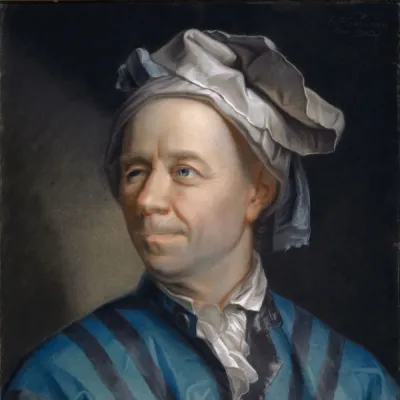
Leonhard Euler
Human Design Chart
Biography
Leonhard Euler — Generator with Profile 5/1
Generator 5/1 — Design at a Glance
Leonhard Euler's Design inclines towards great endurance, conditioned by his nature as a Generator with much sacral energy. He was someone who generated power not through self-initiation but rather through reacting to signals from life. The central mechanics of his design were the strategy: Not initiate, but wait until an impulse came and then act when his inner center gave a clear "yes."
This approach allowed him to use energy efficiently and sustainably implement things in reality. Living in harmony with this reaction to external stimuli rewarded him with deep satisfaction and a sense of fulfillment. Conversely, ignoring this principle—such as by constantly initiating without internal signals or compulsively performing tasks he disliked—led to frustration and energy depletion. Two specific pitfalls shaped his potential: burnout from activities that did not resonate internally, and the frustration when prevented from pursuing his heart project even though the strength to continue working was still present. His success thus directly depended on whether he reacted from the gut and supported his actions with genuine life impulses rather than swimming against the current of his own energy.
Sacral Authority
Leonhard Eulers Design inclines towards intuitive, body-based decision-making. As a Generator, he possessed Sacral Authority, meaning his strategy and inner guidance were identical: responding to external impulses rather than taking initiative. This mechanism greatly simplified his process of orienting himself in the world.
His responses to life situations did not primarily manifest in the Head Center but as physical signals in the abdominal area – an internal confirmation or rejection that was expressed through sounds like grunting or a soft humming. When his sacral motor responded to a stimulus, he felt an immediate surge of energy. In these moments, he was vital and alive, equipped with seemingly inexhaustible energy that allowed him to immerse himself fully in activities. He did not act out of compulsion or purposefulness but with great enthusiasm and inner satisfaction.
Additionally, an activated Spleen supported this sacral guidance. This configuration enabled him to react particularly quickly and spontaneously. His instinctive perception offered direct access to physical well-being, so he could reliably orient himself according to these deep impulses. Thus, Leonhard Euler lived in a constant interaction with his environment, guided by the clarity of the body, which showed him where his true strength and joy lay.
The 5/1 Profile — Heretic / Investigator
Leonhard Euler's Design created a tendency towards tension between the need for withdrawal and the magnetic attraction to others. As someone with Profile 5/1 (Hero/Inventor), he showed himself as someone who was sought out in times of crisis to offer practical solutions. Line 5 gave him almost magnetic qualities: Others instinctively sought after the nuggets of wisdom he had to offer. This led to him often being drawn into roles as a hero or expert author, answering questions and closing processes.
This mechanism described a cycle. After phases of intensive service and problem-solving for others, Leonhard Euler needed to withdraw to regenerate his energy. Line 1, the Investigator aspect of his design, required this withdrawal for knowledge accumulation and deepening. Without clear boundaries, there was a risk of burnout as constant demand for solutions could overload his capacities. Like an expert exhausted after long conferences, he had to learn to say no in order to maintain balance between research for himself and service to others. This ability to preserve inner harmony despite external constraints was central to his expression. Learning to set boundaries allowed him to maintain the beneficial balance of deep reflection and practical application without exhausting himself.
Split Definition — Defined & Open Centers
Leonhard Euler's design established a constant, reliable foundation for communication, identity, and vital endurance. His defined Throat Center ensured that he expressed his messages clearly and authentically without being swayed by transient impulses. The connection to the G Center gave him a deep sense of direction and identity; intuitively knowing where he belonged, he could give others this orientation without needing to force it upon them. This inner security was fueled by his defined Sacral Center, an inexhaustible source of vital energy. As a Generator, his strategy was not to initiate but to respond to life. Only when he felt a confirming response from the gut would he apply this power, which gave him persistence and satisfaction in his tasks. The defined Root Center provided the necessary pressure to move forward in daily life and process stress physically, enabling him to remain action-ready even under strain.
At the same time, Leonhard Euler was strongly dependent on several open centers from his environment. His open Head and Ajna Centers meant that he did not have a constant mental inspiration. He tended to engage with questions that were not his own or desperately sought answers to avoid confusion instead of trusting his inner knowledge. The open Heart Center made him vulnerable to the pressure of proving his worth through performance. He risked making promises he could not keep just to find recognition, leading into cycles of disappointment when failing. His open Solar Plexus absorbed others' emotions; he had to learn to distinguish between foreign moods and his own feelings to avoid emotional exhaustion. Finally, his open Spleen Center was marked by a fundamental survival anxiety. He tended to cling to people or situations that radiated a false sense of security rather than listening to his own intuition, making him vulnerable to unhealthy dependencies.
Channels for evolutionary change and reflective memory.
Leonhard Euler's design set a tendency towards evolutionary change through patient waiting for inner impulses. The Channel of Mutation 60-3 connected his Root Center with the Sacral Center, where Gate 60 required acceptance of limitation and Gate 3 demanded the ordering of new possibilities. This configuration generated pulsating energy between chaos and order, accompanied by melancholy as mechanical moodiness. Instead of arguing these moods, it required attention during phases when the pulse stood still. The change did not occur linearly but suddenly, like music in the gaps between notes, demanding surrender to the correct sacral reaction to bring innovations into the world.
This dynamic was complemented by the Juxta-Channel of the Lost Son 13-33, which connected his G Center with the Throat Center. Gate 13 gathered information and secrets as a listener while Gate 33 withdrew to reflect on these experiences. This channel promoted reflection and delayed revelation of deeper truths. Leonhard Euler emerged as someone who stored life stories and only shared them after fully reflecting upon them. The challenge lay in timing: not prematurely revealing secrets but waiting for the magic of completion. Through this patient observation, he gained wisdom that could be passed on as lessons from personal or collective history. Both channels together shaped a process where inner tension and withdrawal were necessary to ultimately generate stable and transformative insights.
Individual Circuitry — Circuit Signature
Leonhard Euler's design revealed two parallel, non-directly connected energy fields. On one side, the Knowledge Circuit drove him: The Channel of Mutation connected his Sacral with the Root Center. This connection generated pulsating power for innovation and the courage to deviate from the known. It was about creating new knowledge and its acoustic expression, filtered through emotional waves from the Solar Plexus – even though this center did not lie directly in the circuit here, the focus on individual identity and change was clear.
Simultaneously existed separately the Sense-making Circuit. Here, the Channel 'The Lost Son' connected his Throat with the Identity Center. This energy worked cyclically and looked into the past to gain insights from experienced emotions. The goal was sharing these felt truths with the collective to learn together.
As Leonhard Euler had a split definition, these two systems – the future-oriented creativity of the left side and the past-focused reflection of the right side – were energetically isolated from each other. They did not form a continuous bridge in his inner experience. Instead, they worked as parallel forces: One pushing for mutation and new expression, the other for cyclic sense-making and collective learning. The full unfolding of these energies required resonance with external situations or other people since the definition was not fully self-contained.
Left Angle Cross of Limitation 1
Leonhard Euler's design established a structural dynamics primarily focused on recognizing and setting boundaries. He emerged as someone whose self-definition was formed through demarcation: the consequent identification of what did not belong or where his own capacity ended, laid the fundamental groundwork for clear decisions. This pattern, known in Human Design as the 'left cross of limitation,' described an active process of definition by exclusion rather than passive restraint. For Leonhard Euler, it was essential to know precisely what he could not do or wanted to avoid doing, thereby creating space for what truly suited him. This mechanism acted as an inner compass; by systematically eliminating what was foreign or overwhelming, he created the necessary clarity for his actions. It wasn't a search for infinite possibilities but rather the precise delineation of the possible into the viable. His ability to use boundaries constructively shaped how he dealt with demands and his own resources. The strength lay in each rejected option simultaneously affirming his direction. Thus, negation – knowing what would be misplaced – became a positive, stable identity. Leonhard Euler lived this logic of limitation not as a restriction but as a tool for sharpening his focus and securing inner integrity in a complex world.
Saturn Return · Uranus Opposition · Chiron Return · 2nd Saturn Return — Life Cycles
Leonhard Euler's design established a tendency towards recurring cycles of structural maturation and stepwise assumption of authority. This rhythmic development was evident in three critical life phases, each corresponding to planetary returns. In 1735, at the age of 28 during his first Saturn return, he presented a solution for the Königsberg bridge problem. This cycle often marked the transition from theoretical preparation to practical, public effectiveness and anchored his professional position.
The Chiron return around 1753 (age 46) served as an achievement cycle in which his incarnation purpose increasingly unfolded in everyday life. In this year, Maupertuis took leave, after which Euler effectively assumed leadership of the Academy. This was not merely a career step but the concrete result of long-term alignment with his strategy and authority: the clarity of his design became external responsibility.
The second Saturn return in 1766 (age 59) confirmed this structural consolidation. Euler returned to Saint Petersburg and was elected as an honorary member of the Royal Swedish Academy of Sciences. These events illustrate how his design, through cyclic condensation of experience, led to recognized authority without external validation being paramount. The mechanism here works as a rhythmic process: each phase condensed prior work into new, stable structures of leadership and recognition.
Generator · Sacral Authority — Synthesis
He was a Generator whose life was marked by deep, sacral energy (Generator type). This power source fueled his ability to generate knowledge and bring it continuously into the world through persistent effort (sacral authority, Channel of Mutation). The Profile as Hero/Researcher reinforced this drive by motivating him to gain profound understanding and make it available to others (5/1 Profile). Repeated career events marked by Saturn and Chiron returns showed a tendency to take responsibility for knowledge domains and actively further develop them – a pattern driven by the inner necessity to invest his energy in meaningful projects.
Simultaneously, he lived within a tension field between an unceasing drive to solve problems and the potential depletion through his own creative force (Generator pitfalls). While awareness of limitations (Gate 60) seemed part of his design, the need to explore new possibilities (Gate 3) continually pushed him to the limits of his energy. This dynamic between the pulse of mutation and the necessity to set boundaries shaped his work style and revealed an inner conflict between creative activity and self-protection.
2 Defined Channels
Incarnation Cross - Left Angle Cross of Limitation 1
Solar Return
The Solar Return shows the moment when the sun returns to its exact birth position - your personal solar year.
Life Cycles
Discover the life cycles with a detailed triple view (birth chart, cycle chart, composite).
Human Design Profile
- Type
- Generator
- Strategy
- To respond - wait for something to respond to
- Authority
- Sacral Authority
- Profile
- 5/1 - Heretic / Investigator
- Definition
- Split Definition
- Incarnation Cross
- Left Angle Cross of Limitation 1
- Date of Birth
- 15.04.1707 21:13
- Place of Birth
- Basel, Switzerland
Frequently Asked Questions
What was Leonhard Euler's Human Design type?
Which Profile did Leonhard Euler have?
What Authority did Leonhard Euler have?
What incarnation cross was assigned to Leonhard Euler?
When was Leonhard Euler born?
Discover your own Human Design
Are you also a Generator? Find out in a personal reading how to use your sacral energy correctly and discover deep satisfaction.
More Personalities
Back to overviewAaliyah

Alexia

Angèle

Anne-Marie

Arcángel

Arno