Leopold Anoul
Human Design Chart
Biography
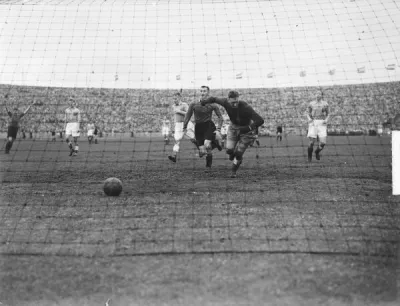
From 1947 to 1954, he earned 48 caps and scored 20 goals for the Belgium national football team, including 3 goals in the 1954 FIFA World Cup.
Léopold "Pol" Anoul died on 11 February 1990 at age 67 in Liege.
Leopold Anoul — Generator with Profile 2/4
Generator 2/4 — Design at a Glance
Leopold Anoul possessed remarkable endurance and a high degree of sacral energy. His design suggested that he acted as a Generator: a configuration comparable to a workhorse – extremely strong and durable, provided the necessary energy was available for the task at hand. However, this strength did not always come readily; it depended on his strategy of responding.
Unlike initiating, which is common among other types, Leopold Anoul's effective approach lay in waiting for internal signals. His success principle involved reacting to impulses from the environment and only acting when his Sacral Center gave a clear confirmation – an inner 'Yes! Let's get started!' Only through this response could he fully release and utilize his energy.
Living in harmony with this principle, by doing only what he felt internally drawn to, led to deep satisfaction and a sense of fulfillment. Conversely, ignoring this principle – such as constantly initiating without internal signals or working on things without joy – resulted in frustration, energy depletion, and an increased risk of burnout. His endurance was thus not an unlimited reservoir but depended on whether he listened to his inner feedback and acted accordingly.
Emotional Authority
Leopold Anoul exhibited a decision-making structure that did not rely on immediate clarity but rather on navigating an internal wave movement. His design indicated that his defined Solar Plexus Center functioned as an inner authority – a mechanism that always took precedence over all other defined centers. This meant that his feelings constantly fluctuated in a rhythm of ups and downs; what appeared as absolute enthusiasm at one moment could turn into deep disappointment the next. However, this emotional wave was not an ultimate truth but merely a temporary coloring of his perception. Spontaneous reactions to these initial impulses often would have led him astray, as the first emotion had yet to mature. Instead, his system required patience and temporal distance. Leopold Anoul needed to reconsider decisions multiple times to let the noise of immediate mood subside. Only when these intense feelings subsided and emotional distance was gained did true calmness set in. This process of waiting was not a sign of hesitation but a necessary filtering to ensure that the choice rested on a stable inner truth, not a transient affect. Through this conscious delay, he could achieve clarity essential for long-term life decisions.
The 2/4 Profile — Hermit / Opportunist
Leopold Anoul revealed a constant interplay between his deep need for withdrawal and his desire for social connection. His design as Profile 2/4, combining the natural talent of solitude with networking skills, laid out an inherent tension: Line 2 demanded time in the 'cave' for reflection and processing, while Line 4 sought exchange within a familiar network. This polarity required him to clearly communicate his current needs – whether for company or quiet – to establish a secure framework. Only then could he effectively transform knowledge from his surroundings into new insights during solitude. Line 2 gave him selectivity and persistence, which often only became effective when prompted. Simultaneously, Line 4 helped him gain respect in the network and make individual contributions. Leopold Anoul learned that his potential could be fully realized by integrating these two aspects: The network provided input; alone time was necessary for condensation. Through this rhythmic back-and-forth between isolation and community, he created a space where experience ripened into wisdom and he could offer his unique contribution without being overwhelmed by external expectations.
Split Definition — Defined & Open Centers
Leopold Anoul was a person of strong internal structure and high energy capacity due to four defined centers – G, Heart, Sacral, and Solar Plexus. His defined G Center gave him a firm identity and a clear sense of direction in life; he knew where he belonged but had to learn not to direct others unless invited to lead. The constant willpower of his defined Heart Center allowed him to keep promises and use resources autonomously while seeking recognition and being careful not to overburden anyone. His defined Sacral Center acted as the motor: an enormous source of vital energy that was only correctly released in response to external stimuli. His strategy involved waiting and reacting to avoid frustration.
This inner urgency was in tension with his emotional authority in the defined Solar Plexus Center, where truth reveals itself over time. Leopold Anoul had to wait for the emotional wave to pass before making decisions; this gave him depth and seductive power but required patience to avoid impulsive actions.
His open centers created areas of situational openness. His open Head and Ajna Centers made him vulnerable to mental pressure and confusion if he did not listen to his inner authority; he tended to get entangled in other people's problems or seek answers that were not meant for him. His open Throat Center meant that communication worked best through invitations rather than initiatives; the urge to force attention was a trap of non-self. Additionally, his open Root Center absorbed environmental stress, making him vulnerable to unhealthy environments while his open Spleen Center made him sensitive to well-being and fears – a good mirror but one that had to learn to avoid spontaneous decisions and unhealthy attachments. This openness complemented his defined strength through adaptability.
Channels for inner endurance and communal connection.
Leopold Anoul's life path was characterized by a deep, persistent dedication to processes whose full significance often only became apparent later on. His design inclined him towards long-term discovery combined with the ability to create emotional clarity in communities and partnerships.
This attitude stemmed from Channel of Discovery 29-46, connecting the Sacral Center, source of endurance, with the G Center, which stands for being at the right place at the right time. Leopold Anoul had to let go of expectations and immerse himself fully in his experiences. By correctly reacting to his environment, he developed an unshakable persistence. Only after these often years-long cycles did he recognize the meaning of his paths and could share these insights, influencing how others perceived their surroundings. Control played no role; instead, he trusted that his life force was being used appropriately.
Parallel to this, Channel of Community 37-40 structured his social environment by connecting the Solar Plexus Center with emotions and the Will Center. For Leopold Anoul, this meant that relationships and agreements were not made spontaneously but had to be carefully aligned. He sought recognition and his place in the whole while being ready to work for the community if fair contracts with mutual respect existed. This mechanism promoted emotional balance and stable bonds as investments in relationships were based on group cohesion rather than material calculation.
Additionally, Gates like Gate 30 emphasized recognizing feelings and accepting limitations as fate, while Gate 8 encouraged individual contributions to the group. Gate 14 helped him handle power with grace and find direction. These configurations underscored his ability to take a clear yet sometimes reserved position in complex social dynamics based on deep inner conviction.
Collective Circuitry — Circuit Signature
Leopold Anoul exhibited a split definition that formed two independent energetic poles within his design. One pole connected his Identity Center with the Sacral Center through the Discovery Channel (46–29), creating a cyclical, wave-like flow of emotional insights from the past. Leopold Anoul reflected on events not logically but intuitively and emotionally to grasp their meaning. These processed experiences pushed him to share them with the collective so others could learn from them. His Sun energy in Gate 29 emphasized this dominant expression of emotional perception.
The second, separate pole connected his Heart Center with the Solar Plexus Center through the Community Channel (37–40). This was about cooperation and mutual giving within a group. Leopold Anoul sought support from others and offered it in return based on traditional resource-building understanding. Since this circuit did not connect to the Sacral Center, he lacked constant life force. Consequently, Leopold Anoul needed regular rest periods to generate new energy for his cooperative efforts. Both systems – emotional sense-making and practical cooperation – existed parallel without direct connection, shaping his life as alternating phases of inner reflection and outer collaboration.
Right Angle Cross of Contagion 3
Leopold Anoul revealed himself through an energy that arose less from his own will than from contact with others. His design was characterized by the ability to absorb and convey ideas or moods – a process often occurring subconsciously. This dynamic corresponded to the right infection cross 3, a configuration describing how inspiration or negative vibrations can be transmitted from a source to an individual.
For Leopold Anoul, this meant that he frequently acted as a channel for foreign energies. What drove him was not always a clear internal strategy but rather the spark ignited by encounters. This 'infection' could be positive, triggering creative impulses, or negative, when he unconsciously took on others' uncertainties. The mechanics of this cross suggested that his effectiveness depended strongly on the environment around him and the energies swirling in it. He relied on perceiving these external influences and transforming them into his own actions or thoughts without necessarily identifying the original source of inspiration clearly. This receptivity shaped how he interacted with his surroundings.
Saturn Return · Uranus Opposition · Chiron Return · 2nd Saturn Return — Life Cycles
Leopold Anouls design indicated a tendency towards structured life phases characterized by clear external conditions. This structuring served as scaffolding for his inner development and enabled him to translate internal processes into concrete results. The first Saturn return marked a crucial turning point: in 1951, at the age of 29, Leopold Anoul won his first Belgian master title with RFC Liège. This success crystallized years of groundwork and demonstrated how inner discipline could be transformed into external triumph – a typical moment for this cycle, which fosters stability and recognition.
Later came the Uranus opposition, often associated with sudden changes or breaks. In 1960, at age 38, Leopold Anoul ended his career with Standard Liège. This was not an accidental event but aligned with the mechanics of this cycle: a necessary end to make way for new developments. The structure of his life phases thus showed itself not only in successes but also in clear conclusions that allowed him to embark on new paths. His ability to channel inner development through external conditions shaped his entire life – from career to retirement.
Generator · Emotional Authority — Synthesis
Leopold Anoul lived a life deeply marked by the tension between internal reaction and external engagement. As a Generator with emotional authority, he needed the sacral response to find energy for tasks – an internal guideline modulated by the cyclical nature of his Solar Plexus Center. This process required time, waiting out the emotional wave to gain clarity before acting. Simultaneously, his profile as a natural talent/networker revealed a dynamic interplay between the need for withdrawal and the desire for connection, amplified by his defined centers for identity and willpower. He was someone who needed both internal processes to orient himself and lived from relationships and exchange – a person who drew energy from contact with others but also required space for reflection.
A central paradox in his design lay in the combination of strong inner reaction (sacral center) and emotional depth (Solar Plexus), enabling him to act spontaneously while requiring careful deliberation. This tension was evident in the interplay between a desire to connect with the community (Channel of Community) and a need for solitude for reflection (Line 2). He was thus someone who both shaped the collective and was shaped by it – an individual whose authentic response to the world contributed, but also felt the necessity to continually re-center and align himself.
2 Defined Channels
Incarnation Cross - Right Angle Cross of Contagion 3
Solar Return
The Solar Return shows the moment when the sun returns to its exact birth position - your personal solar year.
Life Cycles
Discover the life cycles with a detailed triple view (birth chart, cycle chart, composite).
Human Design Profile
- Type
- Generator
- Strategy
- To respond - wait for something to respond to
- Authority
- Emotional Authority
- Profile
- 2/4 - Hermit / Opportunist
- Definition
- Split Definition
- Incarnation Cross
- Right Angle Cross of Contagion 3
- Date of Birth
- 19.08.1922 20:30
- Place of Birth
- Saint-Nicolas, Belgium
Frequently Asked Questions
What is Leopold Anoul's Human Design type?
What Profile did Leopold Anoul have?
Which authority guided Leopold Anoul?
What incarnation cross did Leopold Anoul have?
When was Leopold Anoul born?
Discover your own Human Design
Are you also a Generator? Find out in a personal reading how to use your sacral energy correctly and discover deep satisfaction.
More Personalities
Back to overviewAaliyah

Aldair

Alexia

Angèle

Anne-Marie

Arcángel