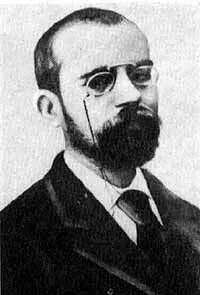
Leopoldo Alas
Human Design Chart
Biography
Alas spent his childhood living in León and Guadalajara, until he moved to Oviedo in 1865. There he studied Bachillerato (high school) and began his law studies. He lived in Madrid from 1871 to 1878, where he began his career as a journalist (adopting the pen-name "Clarín" in 1875) and he graduated with the thesis El Derecho y la Moralidad (Law and Morality) in 1878. He taught in Zaragoza from 1882 to 1883. In 1883 he returned to Oviedo to take up a position as professor of Roman law.
Above all, Clarín is the author of La Regenta, his masterpiece and one of the best novels of the 19th century. It is a long work, similar to Flaubert's Madame Bovary, one of its influences. Other influences included Naturalism and Krausism, a philosophical current which promoted the cultural and ethical regeneration of Spain.
La Regenta is special for its great wealth of characters and secondary stories, while the main character's description is left slightly unfocused and vague. On the other hand, the downfall of the provincial lady has place amidst two very diverse suitors: the most handsome man in the city and the cathedral's priest. The depiction of this priest is a key part of the book.
For the description of the provincial atmosphere and the city's collective life, Clarín used techniques such as the internal monologue or the free indirect style, which makes the story be narrated by the characters themselves and allows the reader to penetrate in their intimacy.
In 1890, he published a new novel, Su único hijo. Even though most critics consider it as a lesser novel in comparison with La Regenta, it is equal to the former in the skill with which the technical resources are used. Su único hijo was originally meant to be the introduction to a trilogy, but aside from an outline and a few fragments of the two sequels, Su único hijo was Clarín's last full-length novel.
The Human Design of Leopoldo Alas: Generator 4/1
Generator 4/1 — Design at a Glance
Leopoldo Alas possessed immense endurance and high inner power potential, comparable to that of a workhorse. As a Generator, his design dictated that this energy would not be released through self-initiated plans but exclusively in response to impulses from the environment. The motto 'react, do not initiate' defined his dynamic basic attitude.
His life force only unfolded effectively when he responded to signals that confirmed his sacral center with a clear inner 'yes'. In these moments, Leopoldo Alas experienced deep satisfaction and an unbridled ability to realize things in the material world. This differed fundamentally from other types; his strength was reactive, not proactive in the sense of taking the first step.
Ignoring this internal resonance led directly to energy loss. Whether through forced work on unwanted tasks or by blocking his heart projects – every deviation from reacting to the inner signal resulted in frustration and burnout risk. The central dynamic of his design thus lay in the tension between deep fulfillment when correctly using his energy and a feeling of persistent frustration when misused. Leopoldo Alas was most powerful when he acted from the gut and waited for what life offered him, rather than taking the initiative himself.
Sacral Authority
Leopoldo Alas made decisions not with his head but by waiting for a clear internal signal. His design established that sacral authority was his inner instance – a capability unique to Generators whose strategy is identical to this authority. This fundamentally simplified his decision-making process: he reacted to external stimuli through physical signals like grunting, humming or sudden bursts of energy. Instead of planning, he learned to use this 'gut feeling' as a reliable compass.
When his sacral motor kicked in, Leopoldo Alas felt vital and alive; an almost inexhaustible energy was at his disposal, enabling him to perform tasks with great enthusiasm. He was born to immerse himself fully in his work without the need for external purpose. His spleen supported this process as additional authority: it gave him the ability to react particularly quickly and spontaneously. Through direct access to his instinctive perception, he could reliably guide himself, which further accelerated his decisions and aligned them with his physical well-being.
The 4/1 Profile — Opportunist / Investigator
Leopoldo Alas showed through his Profile 4/1 a unique essence deeply rooted within him that barely deviated from his individual path. As the only fixed profile, it marked the transition from 'I' to 'You'. His 4-line gave him a big heart but cautiously protected against hurt. This led him to reject well-meaning impulses for change from outside. Since his nature could neither be changed nor wanted to be, he quickly excluded people from his heart who hinted at not fully accepting him.
This attitude was often misunderstood as stubbornness or inability to accept criticism and could lead to loss of trust. Others might have described him as a 'stubborn donkey' or someone who could not be changed. Such experiences may have led Leopoldo Alas to have little self-confidence, given that his life path presented a real challenge. The 4-line emphasized generosity and sharing within a network but required distinguishing the right people to avoid energy loss.
The 1-line underscored mutual dependence in resource finding and individuality. It was about successful approaches under acceptance of individual traits without identity loss. He learned to acknowledge differences and let people live differently as long as they contributed. One-sided dependencies were avoided, as these could lead to the loss of identity due to fear of rejection.
When Leopoldo Alas recognized himself and his life theme and rested stable in his character, he acted like a rock in the storm. This inner security allowed him to teach others magnificently and provide stability based on his unchanging nature and ability to clearly draw boundaries within the network.
Single Definition — Defined & Open Centers
Leopoldo Alas revealed himself as someone driven by a constant inner energy source. His defined Sacral Center generated a specific amount of vitality daily, often manifesting as restlessness or the urge to engage in active pursuits. However, this power was reliably available only when he responded rather than initiated actions. The strategy of waiting for an inquiry allowed him to use his sacral authority – a mechanical yes-or-no cooing – as a compass for decisions. Acting from this gut feeling brought deep satisfaction; ignoring it in favor of rational considerations led to frustration and exhaustion.
This process was supported by his defined Spleen Center, which enabled intuitive, momentary decision-making. This spleen authority provided a 'now' awareness, an instinct for health and well-being that worked independently of the mind. Together with the defined Root Center, which delivered a constant adrenaline-driven pressure towards forward movement and survival, this formed his stable energetic foundation.
In contrast, Head, Ajna, and Throat Centers were open. The open Head Center meant he lacked a steady mental focus and was vulnerable to the questions or inspiration of others. He tended to engage with thoughts that weren't his own, leading to confusion if he tried to resolve them mentally rather than trusting his inner authority. His open Ajna Center prevented firm conceptual thinking; he had to learn not to identify concepts and opinions as personal truth. The open Throat Center showed a tendency to force attention through speaking, which often seemed unpredictable. The healthiest approach was to wait for an external invitation to speak rather than forcing the issue himself. By trusting his sacral and spleen-based intelligence, he could use these open areas as mirrors without getting lost in them.
Channels for life's meaning in struggle and natural maturation.
Leopoldo Alas exhibited a personality marked by a genetic quality of care. His Sun in Gate 27 endowed his activities with altruistic warmth, serving self-preservation and species preservation – often described as 'magical' energy that protected the tribe. This fundamental attitude was in tension with his stubborn determination in the Life Struggle Channel 38-28. This channel connected Root Center to Spleen and drove him to fight external forces to maintain individual integrity. He actively sought fights with personal meaning and resisted expectations when they contradicted his authenticity. For him, this struggle wasn't a conflict of reason but a means of individuation and finding life's purpose.
Parallel to this, Leopoldo Alas underwent the cyclical maturation process of the Maturity Channel 42-53. He immersed himself in experiences to complete them fully before reflecting on them. This channel connected Root Center with Sacral Center and transformed empirical experience into wisdom. For him, it was essential to carry a cycle through to its end before starting a new one; otherwise, he had to repeat it. Through reflection, he could share the lessons learned and build new experiences upon old insights.
Additional facets were evident in his Gate 19, which sought resources, territory, and spiritual community, as well as in Gate 33, which required calm and reflection to process memories. His personality's Gate 39 brought analytical provocation, while Gate 54 linked worldly success with mystical insight. Finally, his Gate 3 demanded mutations through overcoming confusion towards new order. All these elements worked together: care as a foundation, struggle as a path of differentiation, and experience as a source of depth.
Individual Circuitry — Circuit Signature
Leopoldo Alas showed an internal tension between the drive for individual reinvention and the need to emotionally process past experiences. His design contained two separate circuits that, however, touched each other through the Root Center, imprinting his energy with pulsating or cyclical patterns.
The Knowledge Circuit connected Spleen and Root Centers via Channel 28-38 ('Life Struggle'). This created a tendency towards mutation and deviation from the known to form a unique identity. The energy here was pulsating and acoustic, driven by the need to bring new knowledge into the world.
Parallel to this, the Purpose Circuit connected Sacral with Root Center (Channel 42-53 'Maturity'). This circuit focused on emotions and insights from the past. Here, the energy flowed in waves: a cycle began, reached a midpoint, and ended again to enable purpose-making. The goal was sharing this emotional maturation with the collective.
Although both circuits utilized the Root Center, they did not form a continuous connection between Spleen and Sacral. Instead, two parallel forces existed: on one side, the innovative, mutating force of identity creation; on the other, the reflective, cyclical force of emotional purpose-making. Leopoldo Alas lived in the dynamics of these two directions – creating the new and understanding the past – with the Root Center serving as a common driving force for both processes.
Juxtaposition Cross of Caring
Leopoldo Alas revealed himself through a fundamental disposition that was anchored in the tension between a deep need for care and simultaneous confrontation with opposing demands. His design suggested that care for him was not experienced as an isolated, harmonious feeling but always stood juxtaposed – directly next to or in contrast to other forces. This configuration of the Care Juxtaposition Cross described a life dynamic where caring for others was always also connected to dealing with opposites. It was not about simple giving and taking, but rather a complex interaction where the desire to help constantly met conflicting impulses or situations. Leopoldo Alas lived this mechanism by understanding care not as a static state but as an active process defined by contrast. The structure of his design indicated that his way of caring always also included confrontation with the Other, the Foreign, or the Contradictory. This shaped his experience of relationships and responsibility: for him, care was inseparable from the experience of difference. Without further specific mechanical details like Gates or Channels, the interpretation is limited to this central concept that marked Leopoldo Alas’ inner landscape as a place where tenderness and contrast constantly met.
Saturn Return · Uranus Opposition · Chiron Return — Life Cycles
Leopoldo Alas’ design was characterized by a clear sequence of three critical life cycles marking the transition from intellectual foundation through internal disintegration to physical end. The first Saturn Return stood for the consolidation of his moral-legal basis. This occurred in 1878 at age 26, when he completed a decisive step towards solidifying his fundamental worldview with the work “El Derecho y la Moralidad”.
The subsequent Uranus Opposition destabilized and triggered a deep spiritual crisis. In 1892, at age 40, Leopoldo Alas went through a personal crisis full of religious doubts. This cycle broke down previously established structures and forced confrontation with uncertainties that challenged the previous understanding.
The Chiron Return concluded this sequence as a fulfillment cycle ending in the death of Leopoldo Enrique García-Alas y Ureña (Clarín) in 1901 at age 49. This cycle represents final letting go and completion of the individual path. The sequence of these events underscores how his design structured the process of maturation through firm foundations, disruptive upheavals, and finally dissolution. Each step was an integral part of his development, with early achievements laying the groundwork for later internal conflicts that ultimately culminated in the end of his earthly existence.
Generator · Sacral Authority — Synthesis
Leopoldo Alas’ life was marked by a deep reaction to the impulses of the moment, fueled by his sacral authority and Generator type. This reactivity, combined with the fixity of his profile as a Networker/Researcher, points to a character deeply involved in relationships but always aligned with an inner compass. The connection between Root and Sacral Center through channels of Life Struggle and Maturity underscores an energy that draws strength from enduring and working through experiences – a cyclical process generating wisdom and connecting him to the world. Open design in important centers like Head, Ajna, Heart, and Solar Plexus indicates high sensitivity to external influences, which he could filter through his defined sacral basis.
A central paradox lay in the tension between his ability to form deep connections while maintaining a clear individual direction. The open G Center points towards adaptability and taking on identities of others, while his defined sacral authority always brought him back to the core of his own truth. This dynamic manifested in a life both shaped by relationships as well as an unceasing drive for self-discovery and finding meaning – a struggle fueled by Channel 38-28 energy and prompting deep reflection.
2 Defined Channels
Incarnation Cross - Juxtaposition Cross of Caring
Solar Return
The Solar Return shows the moment when the sun returns to its exact birth position - your personal solar year.
Life Cycles
Discover the life cycles with a detailed triple view (birth chart, cycle chart, composite).
Human Design Profile
- Type
- Generator
- Strategy
- To respond - wait for something to respond to
- Authority
- Sacral Authority
- Profile
- 4/1 - Opportunist / Investigator
- Definition
- Single Definition
- Incarnation Cross
- Juxtaposition Cross of Caring
- Date of Birth
- 25.04.1852 17:30
- Place of Birth
- Zamora, Spain
Frequently Asked Questions
What is Leopoldo Alas' Human Design type?
Which Profile did Leopoldo Alas have?
What Authority guided Leopoldo Alas?
What incarnation cross did Leopoldo Alas have?
When was Leopoldo Alas born?
Discover your own Human Design
Are you also a Generator? Find out in a personal reading how to use your sacral energy correctly and discover deep satisfaction.
More Personalities
Back to overviewAaliyah

Alain-Fournier

Alexia

Angèle

Angeli

Anne-Marie