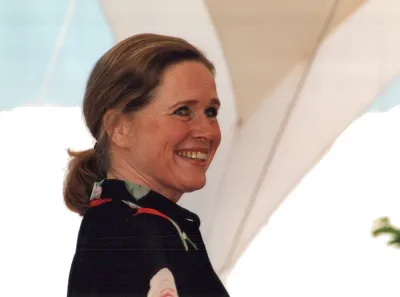
Liv Ullmann
Human Design Chart
Biography
Her childhood included frequent moves as her dad was a military engineer. After he was stationed in Tokyo, the Nazi occupation blocked their return to their home in Norway and they were forced to move to Canada . In 1943, sadly, her father walked into an aircraft prop; he died later. After the war, her mother moved her and her sister back to Norway.
In 1960 she married a psychologist, a marriage that lasted for five years. She met Ingemar Bergman, in 1964, a major influence in her life as her future lover and mentor,. They began a five-year love affair that never resulted in marriage, but they had a child, Linn, in 1966. The following year she made her film debut in "Persona."
Her autobiography, "Changing," was published in 1977. She made a second marriage in September 1985.
Liv Ullmann as a Projector 2/4 in Human Design
Projector 2/4 — Design at a Glance
Liv Ullmann's Human Design leans towards focused perception: She immediately saw where systems or relationships were rough. As a Projector, she did not have a constant, intrinsic energy source but acted like a bright flashlight, casting light into the darkness of her surroundings. This dense, focused aura could quickly be perceived as unpleasant by her environment if she addressed her observations directly – comparable to shining a light directly into someone's face.
The mechanics of her design showed that direct confrontation often triggered resistance. More elegant for her was to attract others through her own harmonious glow. If she followed her own path and did not immediately correct, she became interesting to others; people came to her on their own to seek advice. Her strategy was to wait for appreciative, honest invitations rather than taking the initiative herself.
Since her Sacral Center was undefined, she experienced phases of high productivity, followed by necessary rest periods to avoid burnout. Conventional work life often ignored this need. If Liv Ullmann lived by the principle of invitation and choice, she was rewarded with success. If she ignored this path and acted without the consent of her environment, this led sooner or later to her non-self theme: bitterness. Her design required patience to make her unique ability for system analysis effective.
Splenic Authority
Liv Ullmann's Human Design leans towards spontaneous, instinctive decision-making. Her inner authority lay in the Spleen, the center for health and survival intelligence. For this authority to function, her Emotional and Sacral Centers were open – a configuration only Projectors or Manifestors exhibit.
This system acted as a fine alarm mechanism. It did not provide long thought but an immediate, physical signal: An impulse indicated whether a situation, a person, or a place was healthy and right. This first, spontaneous impulse was the reliable indicator of her well-being. It served to rigorously distance herself from harmful influences and protect herself.
The challenge of this Spleen voice lay in its fleeting nature. The impulse came only once, at the exact moment of decision. Once it was gone, it could not be recovered. Therefore, it required high vigilance not to let this soft inner call be drowned out by external expectations or excessive analysis. A brief retreat could help to find the silence to hear the impulse.
Since the knowledge of the right thing was always only available in the moment, long-term, rigid plans were often counterproductive. Flexibility and free space were necessary, as the inner direction could change in the short term. Liv Ullmann's strategy was to not be overly committed and to trust the spontaneous flow rather than getting entangled in predictions.
The 2/4 Profile — Hermit / Opportunist
Liv Ullmann's Human Design leans towards a pendulum rhythm between deep withdrawal and the desire for connection. As a 2/4-Profile ("Natural Talent/Networker"), there was a constant swing between the need to be alone and the urge to spend time with chosen people. Important was clear communication: "Now I need company" or "Now I withdraw." In her solitary "Me-Time," she immersed herself in internal processes to gain clarity. Only after this need was satisfied did she emerge from her "cave" to tend to her network. This knowledge could then be reflected upon in the calm and processed into brilliant ideas.
This process was marked by specific energetic qualities. The inflexibility and strictness of the second line of Gate 11 required knowledge of her own process. Boredom set in when ideas were not brought to the outside; she overcame it by doing her "homework" and letting ideas mature. At the same time, the dominant emotional power of the fourth line in Gate 6 acted. This "emotional steamroller" wrote her strength out, which was reinforced and reflected back by others. With the urge to dominate and clean emotional fields, this configuration promoted goodness and wisdom once the inner process of line 2 was complete. Thus, a cycle emerged: withdrawal for idea formation, followed by dominant, emotional projection in the social context.
Split Definition — Defined & Open Centers
Liv Ullmann's Human Design profile established a tendency towards a constant mental structure and clear expression of will. Her defined Ajna Center ensured a trustworthy, specific mental function; she was always thinking and was difficult to influence externally in her concepts. This worked in conjunction with her defined Throat Center, which served as a pivot point to translate these thoughts as well as impulses from other centers into the world. She could speak what she thought, and her voice carried the quality of her inner processing.
Additionally, her defined Heart Center shaped her interaction with the material world. She had permanent willpower to keep promises and determine her own resources. It was healthy for her to express her ego and do what she said, thereby strengthening her self-esteem. Her defined Spleen Center also provided an intuitive, momentary authority. She could make spontaneous judgments and react to warning signals in the present, supporting her well-being and health as long as she trusted this body awareness.
At the same time, Liv Ullmann was vulnerable to external influences through several open centers. Her open Head Center had no constant source of inspiration; she could take on mental pressure that was not her own and tended to identify with other people's questions or seek answers she could not generate herself. Her open G Center meant she did not have a fixed identity or direction. She reflected the personality of her environment and was vulnerable in relationships, as she could take on "borrowed" identities. She had to learn to wait for external initiation to find the right place and direction.
Her open Sacral Center lacked a constant energy flow. She was sensitive to the generative energy of others and tended to overextend herself by using "borrowed" vitality, which could lead to exhaustion. She had to learn to set boundaries and rest rather than rely on sacral answers. Additionally, her open Solar Plexus absorbed the emotions of the environment. She could amplify and personalize the moods and feelings of others, leading to emotional confusion. Finally, her open Root Center took on stress and adrenalized pressure from the environment. She could not generate this pressure herself but reacted to external stimuli, making her vulnerable to overloading and burnout if she did not learn to recognize and let go of this foreign stress.
Channels for curiosity, clear structure and deep devotion.
Liv Ullmann's Human Design profile was marked by a profound ability to transform complex philosophical ideas into captivating stories. Channel 11-56, the Channel of Curiosity, connected her mental capacity with her expression, driving her not to seek dry facts but to explore perspectives that inspired her. She acted as a storyteller, presenting information in a way that engaged the imagination and emotions of her audience—not for self-reflection, but to educate or entertain others.
Parallel to this, she possessed the ability to structure innovative perspectives clearly and efficiently. Channel 43-23, the Channel of Structuring, allowed her to receive spontaneous insights as transformative impulses and translate them into understandable concepts. Her thinking often felt ahead of its time, but only through patient, clear explanation did her individual knowledge resonate and avoid being dismissed as alien.
A third imprint came from Channel 44-26, the Channel of Devotion, which gave her an instinctive sense of her "tribe's" needs. She could intuitively recognize which message or product would resonate with the market and use her willpower to convey these offerings persuasively. This was not mere salesmanship, but a form of care, where she supported the viability of her community through targeted, instinctive decisions.
Additionally, Gates like the Gate of Restraint (12) and the Gate of Crisis (36) enhanced her emotional depth and poetic expression, while Gates like the Gate of Continuity (32) and the Gate of Risk (28) shaped her actions through a balance of seeking stability and making bold decisions in the present moment.
Individual Circuitry — Circuit Signature
Liv Ullmann's Design inclined towards structured, emotional communication, which manifested in two separate, parallel existing energy fields. Due to the split definition, these areas were not directly connected to each other but existed as independent energetic poles.
In the Knowledge Circuit, Liv Ullmann linked the Ajna and Throat Centers through the Channel of Structuring. This allowed her to pour and express inner visions and creative impulses into clear, understandable forms. Simultaneously, in the Meaning Circuit, there was also a connection between Ajna and Throat Centers, this time through the Channel of Curiosity. Here, it was less about cool logic and more about reflecting on past experiences. Liv Ullmann emerged as someone who picked up emotional waves from the past, explored their meaning, and shared these insights with others to promote collective learning.
A third, independent area was the Ego Circuit, which connected the Heart and Spleen Centers. Through the Channel of Devotion (Marketing), this circuit featured the energy of cooperation and collective creation. Since there was no connection to the Sacral Center, there was a lack of constant life force; instead, this field required phases of rest and recovery to build resources for the collective and maintain a balance between giving and taking. These three circuits shaped Liv Ullmann's essence as someone who creatively structures, emotionally reflects, and cooperatively supports, with the areas always functioning as separate, parallel forces.
Right Angle Cross of Eden 4
Liv Ullmann's Human Design shows a tendency towards profound clarity, often painful, that is revealed not through logical reasoning but through immediate, emotional breakthroughs. She appeared as someone who, in moments of despair or loss, suddenly recognized an unshakable truth that dissolved all previous doubts. This stems from the mechanics of the right cross of Eden 4, a configuration that describes the path from deep sorrow to pure joy. This is not about superficial happiness but a fundamental transformation where pain serves as a catalyst to reach a higher, almost spiritual level of existence. The energy of this cross moves from the heaviness of the earth to a light, almost carefree presence, which is only possible through the complete acceptance and experiencing of the darkness. Liv Ullmann's chart showed her ability to gain clear, almost cheerful wisdom from the deepest valleys of experience, without denying the heaviness but by fully integrating it. This process was not a conscious act but a natural law of her inner structure, predisposing her to open up and receive a new, deeper truth during crisis moments, which profoundly shaped her actions and being.
Saturn Return · Uranus Opposition · Chiron Return · 2nd Saturn Return — Life Cycles
Liv Ullmann's Human Design shows a tendency towards profound life turning points structured by planetary cycles. Her film debut in 1966 with 'Persona' at the age of 28 marked her first Saturn return. This cycle condenses years of groundwork into a solid, public result and establishes professional identity.
Ten years later, in 1977, the Uranus opposition arrived. At 39, she published her autobiography 'Change'. This configuration often dissolves old structures to create new freedoms; the publication here was an expression of a necessary break with the past to redefine herself.
The Chiron return around 1985 (age 47) is a fulfillment cycle where one's incarnation cross unfolds, provided strategy and authority are observed. It is not about healing but about the blossoming of one's purpose. In this year, Liv Ullmann remarried. This relationship turning point is shown as part of the increasing experience of her life's meaning, which gains clarity and depth in this phase. The three events illustrate how external milestones reflect the inner Human Design cycles of establishment, dissolution, and fulfillment.
Projector · Splenic Authority — Synthesis
A central red thread in this design is the ability to recognize patterns and bring light into the dark (Projector Type, Gate 11). This happens through a defined mental center that consistently develops concepts and a pronounced curiosity (Channel of Curiosity) that drives the search for new perspectives. This ability to grasp the potential and weaknesses in systems is strengthened by the Spleen Authority, which provides an instinctive knowledge of well-being and the correctness of situations. The natural urge to share this knowledge is, however, modulated by the Profile as a Natural Talent/Networker, which emphasizes both the need for withdrawal and connection.
The central paradox lies in the tension between the Projector need to 'project' others and point out their flaws, and the natural withdrawal (Line 2) as well as the necessity to consider the needs of the social environment (Line 4). The Spleen Authority demands spontaneous decisions in harmony with one's well-being, while the Knowledge Circuit triggers the expression of creativity and transformation. This dynamic creates an inner tension between the desire for authentic expression and the adaptation to others' expectations, which manifests in life cycles as moments of professional unfolding and personal reflection.
3 Defined Channels
Incarnation Cross - Right Angle Cross of Eden 4
Solar Return
The Solar Return shows the moment when the sun returns to its exact birth position - your personal solar year.
Life Cycles
Discover the life cycles with a detailed triple view (birth chart, cycle chart, composite).
Human Design Profile
- Type
- Projector
- Strategy
- Wait for the respectful invitation
- Authority
- Splenic Authority
- Profile
- 2/4 - Hermit / Opportunist
- Definition
- Split Definition
- Incarnation Cross
- Right Angle Cross of Eden 4
- Date of Birth
- 16.12.1938 19:20
- Place of Birth
- Tokyo, Japan
Frequently Asked Questions
What is Liv Ullmann's Human Design type?
What Profile does Liv Ullmann have in Human Design?
What Authority determines Liv Ullmann's decisions?
What incarnation cross shapes Liv Ullmann's life?
When was Liv Ullmann born?
Discover your own Human Design
Are you also a Projector? Find out in a personal reading how to unfold your leadership qualities and recognize the right invitations.
More Personalities
Back to overviewSissy Spacek
Alain-Fournier

Anémone

Ann-Margret

Arletty

Arno