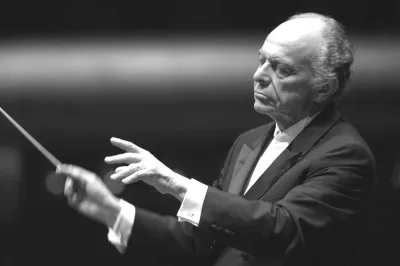
Lorin Maazel
Human Design Chart
Biography
Born in France to American parents, Maazel grew up in Los Angeles and Pittsburgh, PA. At age four it was discovered that he had perfect pitch and a photographic memory. A child prodigy as a violinist and pianist, he made his conducting debut at age seven with the NBC Symphony at the invitation of Toscanini. At 12 he conducted the New York Philharmonic. Known for his exacting musicianship and intense interpretations of classical music, he made his Cleveland Orchestra debut on 4 March 1943 playing violin. Attending the University of Pittsburgh at age 16, he studied languages, mathematics and philosophy and then continued his training in Europe. In 1951 he studied baroque music in Italy on a Fulbright Fellowship.
In 1960 he became the first American and youngest conductor at Bayreuth, Germany. He began his tenure as Music Director of the Cleveland Orchestra at the beginning of the 1972-73 season. Maazel conducted at the Sydney Opera House in Australia during the opening week of 20 October 1973. He was General Manager and Artistic Director of the Vienna State Opera from September 1982 to 6 April 1984 at which time he tendered his resignation. The drastic changes that he made, some anti-Semitic, were disliked by many and he felt he could no longer do his job with the control he needed. His last performance there was on 29 June 1984.
In 1988 he became the conductor for the Pittsburgh Symphony and retired in early 1996.
What does Generator 4/6 mean for Lorin Maazel?
Generator 4/6 — Design at a Glance
Lorin Maazel revealed himself as someone with immense endurance and an almost inexhaustible inner source of strength. His Human-Design identified him as a Generator, a type that possesses a very large sacral energy. One can understand this configuration like a strong workhorse: extremely durable and capable, so long as the task fits their nature. This enormous capacity was, however, coupled with a specific condition. The energy did not release through sheer will or initiative but reacted to signals from the environment.
The motto for his design was clear: Not initiate, but react. Lorin Maazel received his strength when he waited for impulses from his surroundings and then acted as soon as his sacral center signaled a clear "yes". This process of reacting from the gut was the key to his effectiveness. If he tried to go against this mechanism – such as doing things that did not resonate internally, or being prevented from pursuing his heart projects – frustration and a lack of energy threatened him. However, if he lived in harmony with this strategy of waiting and reacting, he was rewarded with a deep sense of fulfillment. His strength lay not in pushing forward against resistance but in the powerful response to what truly spoke to him.
Sacral Authority
Lorin Maazel lived as a Generator, whose Strategy and Inner Authority were identical: the sacral response. This congruence fundamentally simplified his decision-making process. Since his Emotional Center was open, he could not rely on fluctuating emotions but had to listen to an immediate physical impulse. His authority manifested in a "gut feeling" – a physical signal like grunting or a surge of energy as a reaction to external stimuli.
When his sacral motor engaged, he felt vital and energized. He accomplished his work with great enthusiasm and immersed himself fully in his tasks without needing strict purposefulness. This configuration allowed him to move through life with joy and satisfaction. Additionally, his active Spleen Center served as a supportive force. It gave him the ability to react particularly quickly and spontaneously and make decisions. Through this connection, Lorin Maazel had direct access to his physical well-being and instinctive perception. He followed this reliable inner guidance, which made his actions authentic and direct.
The 4/6 Profile — Opportunist / Role Model
Lorin Maazel revealed himself in his early life phase as someone who learned through diverse experiments. His Profile 4/6 acted similarly to a 3-aspect during the first thirty years: he actively sought confirmation from his environment and tried out various roles, especially in interpersonal relationships. This period was marked by Line 4 at Gate 63, which fostered a strong memory for details and comparisons. Lorin Maazel asked precise questions to eliminate uncertainties, with Mercury as the planet of intelligence playing a role here. He externalized his doubts to receive answers from outside and gathered background knowledge for a secure future.
With Saturn's return, this dynamic fundamentally changed. Line 6 became active, confronting Lorin Maazel with an inner conflict: the desire for belonging (Line 4) versus the urge for contemplative distance and wisdom (Line 6). This tension between heart and head shaped his further life. He had to learn to accept unforeseen events, symbolized by Neptune as universal flow. Instead of seeking guaranteed productivity, he recognized that unexpected turns strengthened his development. In his later years, it was expected of him to be a wise role model. His cooperation with others took precedence, yet his heart remained cautious to avoid opening up to the wrong people and getting hurt. The sixth line also taught him the importance of ego as well as contentment through possession and inner peace.
Split Definition — Defined & Open Centers
Lorin Maazel was someone with a fixed, reliable self-identity and a clear sense of direction. His defined G Center gave him the ability to love others and be loved without becoming dependent; he could comfort people by helping them understand the evolution of the species. This inner security contrasted with the risk of wanting to direct others uninvited or succumbing to their expectations, which could lead to deep loss if his internal authority was neglected.
His vital energy came from his defined Sacral Center. As a Generator, he had a constant energy reserve that required invitations for reactions. Only through affirmative responses ("Yes") could he fully unleash his power and endure stagnation phases; mental initiatives without sacral confirmation led to frustration and exhaustion. His defined Spleen Center provided spontaneous intuition and well-being in the present, while his defined Root Center supplied the necessary pressure to remain existentially vigilant and rise materially.
At the same time, Lorin Maazel was marked by several open centers. His open Head and Ajna Centers made him vulnerable to mental confusion and doubt when he tried to impose answers or concepts as his own truth instead of using them merely as reflections of others' ideas. His open Throat Center tended to seek attention through uncontrolled speaking rather than waiting for natural invitations to express himself. His open Heart Center led to the temptation to prove his worth through promises and competition, which ended in spirals of failure due to a lack of consistent willpower. Finally, his open Solar Plexus absorbed foreign emotions, making him vulnerable to others' emotional waves; he had to learn not to personalize these moods to maintain his own peace.
Channels for life's meaning in struggle and authentic self-expression.
Lorin Maazel's design inclined towards radical self-determination paired with stubborn determination to follow his own path. This attitude resulted from the interplay of two central energy flows in his system.
The Channel of Exploration 34-10 connected his Sacral Center with his G Center. Gate 34 provided inner strength to hold onto personal convictions, while Gate 10 initiated behavior from the deepest inner self to accept and honor oneself. This configuration served to perfect individual behavior within society. Lorin Maazel was designed to demonstrate the benefits of complete self-love through authentic reactions from his sacral authority. This often drew attention; whether positive or negative depended on how patiently he allowed reacting. Instead of imposing his energy, this channel focused creatively on staying centered in one's own truths.
Parallel to this, the Channel of Life Struggle 38-28 between Root and Spleen Centers operated. Here it was about finding meaning through active confrontation. Gate 38 exerted pressure to defend individual integrity against external distractions, while Gate 28 sharpened awareness of which struggles were worth engaging in and investing effort into. This adrenaline-fueled energy drove Lorin Maazel to stubbornly resist expectations and take risks for what mattered to him. His personal struggles served as an example to inspire others in their individuation process.
Additionally, Gates like 63 (Doubt) and 64 (Clarity through Past Experience) shaped his mental processes, while Gate 5 set the basic rhythm for energy build-up. Gate 27 brought genetic care into his activities, and Gate 44 promoted awareness in interactions. These elements collectively formed a profile oriented towards independent action, meaningful struggle, and demonstrating a unique, self-loved existence.
Individual Circuitry — Circuit Signature
Lorin Maazel was revealed through his design as someone who combined inner strength with an intense confrontation around survival and life energy. His Split Definition created two clearly separated energetic poles that did not flow directly into each other but existed parallel.
The Knowledge Circuit operated in him via the Channel 28-38 (Life Struggle). This connected the Spleen Center to the Root Center. It was a pulsating energy of individual intuition and acoustic present moment, primarily situated within the realm of instincts and stress reactions. Lorin Maazel used this connection to affirm his unique identity through direct life experiences without it automatically translating into an external expression.
Simultaneously, the Centering Circuit shaped his innermost self via the Channel 10-34 (Exploration). This channel directly linked the Sacral Center with the Identity Center. This connection created a deep internal stability and strong self-worth based on his life force. It was a very individualistic configuration: Lorin Maazel had firm convictions about his essence, fueled by his sacral energy. However, lacking a connection to the Throat Center, these profound certainties often remained unspoken or internally processed. The two circuits – one for life struggle and intuition, the other for inner centering and identity – thus formed two separate but equally important pillars of his personality, each maintaining its own dynamics.
Right Angle Cross of Consciousness 1
Lorin Maazel demonstrated a fundamental disposition marked by profound internal authority. His Human Design profile featured the right cross of consciousness, an arrangement indicative of a strong connection to one's own truth and spiritual or existential principles. This did not necessarily imply traditional religious orientation but rather an unwavering trust in what was felt as fundamentally correct and authentic.
This structure promoted clarity and resolve. Lorin Maazel tended to make decisions not just based on pragmatic considerations, but by measuring them against a higher standard of integrity and purposefulness. The right cross of consciousness often grants the ability to reduce complex situations to their essence while maintaining one's own compass. It was an inner stability that helped him maintain a firm stance even in uncertain times.
This characteristic profoundly shaped his work: he sought solutions not only functional but also aligned with his deepest convictions. The energy of this cross supported him in pursuing his visions with a certain unshakable determination, without being easily swayed by external opinions. It was an inner affirmation that helped him consistently follow his path while always maintaining the connection to his essence.
Saturn Return · Uranus Opposition · Chiron Return · 2nd Saturn Return — Life Cycles
Lorin Maazels design was characterized by immense dynamism and a drive for rapid international recognition. This energy reflected in his swift career progression. In 1960, at age 30, during his first Saturn return – a cycle often bringing initial major structural affirmations – he became the youngest American conductor appointed to the Bayreuth Festival. This marked the beginning of an intense phase of professionalization and global visibility.
Ten years later in 1970, at age 40, Uranus opposition occurred. This aspect often demands radical changes or new freedoms. Maazel became music director for the New Philharmonia Orchestra in London, underscoring his willingness to take over established structures and reshape them.
Around his 50th year, Chiron return is a fulfillment cycle where one's inner purpose increasingly manifests in outer life. In 1980, Maazel received his first invitation for the Vienna Philharmonic New Year’s Concert. This was no mere coincidence but the visible bloom of long-term work and reaching a peak in his artistic identity.
Finally, his second Saturn return in 1988 at age 58 confirmed his established position through appointment as conductor of the Pittsburgh Symphony. This cycle often solidifies achieved structures for the next life phase. Maazels path shows how his astrological cycles were closely intertwined with concrete career milestones, each step deepening his role within the musical establishment.
Generator · Sacral Authority — Synthesis
Lorin Maazel was a Generator whose life was marked by profound sacral energy and the need to bring it into action. The connection of his Sacral Center to the G Center (Channel 34-10) points to an inner strength that arises from exploring and refining one's behavior – a constant affirmation of individuality through action. This was evident in a career marked by early successes (Saturn return at age 30) and repeatedly appointed to leading positions, always stepping onto new paths and challenging established patterns. The focus on the 'here and now' of the knowledge circuit amplified this drive for innovation and creative expression.
A central paradox in his design lay in the interplay between inner destiny and the role assigned by others. The profile as a networker/role model indicates a desire to be part of a community while also representing a unique perspective – a conflict between Heart (Line 4) and Head (Line 6). This was reflected in the tension arising from the need to remain authentic while meeting expectations of a 'wise' leader. Repeated career boosts under Uranus opposition and Chiron return showed how he used these internal tensions to continually redefine himself.
2 Defined Channels
Incarnation Cross - Right Angle Cross of Consciousness 1
Solar Return
The Solar Return shows the moment when the sun returns to its exact birth position - your personal solar year.
Life Cycles
Discover the life cycles with a detailed triple view (birth chart, cycle chart, composite).
Human Design Profile
- Type
- Generator
- Strategy
- To respond - wait for something to respond to
- Authority
- Sacral Authority
- Profile
- 4/6 - Opportunist / Role Model
- Definition
- Split Definition
- Incarnation Cross
- Right Angle Cross of Consciousness 1
- Date of Birth
- 06.03.1930 06:35
- Place of Birth
- Neuilly sur Seine, France
Frequently Asked Questions
What was Lorin Maazel's Human Design type?
What Profiles did Lorin Maazel have?
What Authority did Lorin Maazel possess?
What incarnation cross did Lorin Maazel have?
When was Lorin Maazel born?
Discover your own Human Design
Are you also a Generator? Find out in a personal reading how to use your sacral energy correctly and discover deep satisfaction.
More Personalities
Back to overviewAaliyah

Alexia

Alizée

Angèle

Anne-Marie

Arcángel