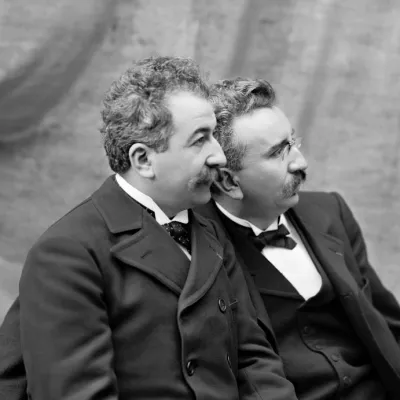
Louis Lumière
Human Design Chart
Biography
The brother were the son of a businessman, Antoine Lumière, who saw that his boys received a good education. The younger son, Louis, developed a dry-plate photo process, known as Etiquette bleue, which brought fame and financial success to the family business. To manufacture and commercialize the plates, Antoine bought a large tract of land in the Monplaisir quarter in the Lyon suburbs.
In the autumn of 1894, Antoine Lumière asked his sons to work on the problem of animated images, which had so far stumped such great inventors as Edison and others. This paternal push in the right direction resulted in the invention of the "Lumière Cinematograph."
The first film using the new invention was "Leaving the Lumière Factory." taking place in Lyon, France on 19 March 1895 in what is now known as the Rue du Premier Film. This first film opened the way for the development of cinema.
A program of short films directed and photographed by Louis was first unveiled to the general public on 28 December 1895: a date that many historians claim to be the birth date of the cinema as we know it. The showing of approximately ten short films lasting only twenty minutes in total was held in the basement lounge of the Grand Cafe on the Boulevard des Capucines in Paris, It was the very first public demonstration of their device they called the Cinematograph, which effectively functioned as camera, projector and printer all in one.
Louis Lumière as a Generator 3/5 in Human Design
Generator 3/5 — Design at a Glance
Louis Lumière revealed himself as someone who possessed immense, enduring strength, which was not driven by arbitrary pushing forward but rather through reactive action. His design as a Generator laid a foundational structure based on the presence of great sacral energy – comparable to the stability of a workhorse that only optimally employs its strength when used for a fitting task. Crucial for him was the strategy of reacting: instead of independently initiating actions, he waited for signals from his environment. Only when his sacral center responded with a clear inner "yes" did he set his energy in motion. This mechanism ensured him deep satisfaction and a sense of fulfillment when adhered to. Conversely, ignoring these inner signals or forcing activities without inner resonance led to frustration and energy loss. A particular danger lay in being prevented from his true work, even though his inner readiness to continue working was still present. Louis Lumière therefore did not live through constant planning and starting, but through intuitive responses to the life around him. Only in this rhythmic exchange between external stimuli and inner confirmation could he fully realize his potential without falling into burnout or constant dissatisfaction. His endurance was thus not merely a trait, but the result of precise, resonance-based energy management.
Sacral Authority
Louis Lumière was a Generator, whose design called for a direct physical response to external stimuli as the core of decision-making. His inner authority lay in the defined Sacral Center, meaning he did not act based on intellectual analysis but waited for an immediate, physical resonance. This "gut feeling" manifested as bursts of energy or characteristic sounds like grunts or hums, signaling whether a situation was energizing or not. With his Emotional Center open, this sacral reaction remained clear and unclouded by emotional waves.
This design simplified his process: he reacted rather than initiated. When his sacral motor kicked in, he possessed vital, inexhaustible energy and carried out his tasks with great enthusiasm and satisfaction, free from compulsive purposefulness. His nature was to fully immerse himself in the action, driven by the joy of doing itself. The connection to an activated Spleen Center supported this authority through quick, instinctive reactions and a reliable access to physical well-being. Louis Lumière thus lived in a rhythm of waiting for the right impulse, then acting with full force and spontaneous intuition, allowing him to move through life without going against his own flow.
The 3/5 Profile — Martyr / Heretic
Louis Lumière showed himself to be someone who learned through personal experimentation before helping others. His Profile 3/5, that of the experimenter and hero, set this attitude: He initially believed nothing prescribed, but gathered practical experiences. This Line 3 urged him to make mistakes and break ties to develop discernment. Often isolating himself, he gained the necessary depth. Later, he applied this self-acquired knowledge to solve others' problems – the role of Line 5. This hero position attracted people who wanted to learn from his experiences. Yet it also carried risks: failing in public could be painful.
His configuration also included Gate 48 (Line 3) and Gate 39 (Line 5). Gate 48 emphasized isolation from collective life as a protective mechanism for developing personal taste. Gate 39 gave him the ability to change rules in crisis times, not just overcoming obstacles but cleverly circumventing them. This allowed him to achieve success through innovative avoidance of barriers and to spread new approaches. Louis Lumière therefore did not live by rigid guidelines but navigated life as a cool storyteller, forging a treasure trove of practical knowledge from his own adventures and failures, which he then made accessible to others. His appeal arose from the authenticity of his experiences, not from theoretical knowledge.
Split Definition — Defined & Open Centers
Louis Lumière had a firm, reliable sense of self and a clear direction, shaped by his defined G Center. This gave him the ability to show others new paths without needing their approval. His actions were driven by an enormous daily vitality that came from his defined Sacral Center. However, this energy required him to wait for questions or invitations to respond correctly; only then could he fully unleash his power and avoid frustration. Additionally, he had a strong body awareness and intuitive perception of the "now," guided by his defined Spleen Center. This allowed him to make spontaneous, trustworthy judgments about what was necessary for his well-being and survival.
The constant pressure to move forward was provided by his defined Root Center, which supported him in dealing with material challenges.
At the same time, Louis Lumière was vulnerable to mental confusion and doubt, as his Head Center was open. He tended to engage with questions that weren't his own and sought inspiration to alleviate mental pressure. His open Ajna Center made him flexible in thinking but led him to adopt concepts and ideas from others without considering them as his own truth. This could lead to uncertainty when he tried to assert himself intellectually. His open Throat Center meant that he did not have a consistent way of expressing himself; he drew attention to himself by waiting for invitations to speak rather than actively forcing them. Furthermore, he lacked a consistent willpower, as his Heart Center was open. He was not suited to making promises or proving himself through competition but had to learn not to validate his worth through external achievements. Finally, his open Solar Plexus absorbed the emotions of his surroundings, causing him to amplify emotional waves of others rather than identifying them as his own.
Channels for resources, life purpose and the struggle.
Louis Lumière revealed himself as someone who not only conceived of new directions but also set them into the world with material force. His design featured the Channel of the Beat 14-2, connecting the Sacral Center with the G Center. Through Gate 14, he possessed the competence to use power and resources to advance mutations, while Gate 2 provided the higher knowledge that determined identity and direction. This connection allowed him to pour innovative impulses into concrete, material forms and give others a new orientation through his presence, simply by trusting the answers of his Sacral Center.
Parallel to this, the Channel of the Life Struggle 38-28 shaped his attitude. This channel connected the Root Center with the Spleen and brought the drive to find a deep meaning in life, even amidst resistance. Gate 38, the Gate of the Fighter, provided the pressure to maintain individual integrity against external distractions, while Gate 28, the Gate of the Player, sharpened the awareness of which struggles truly had value. Louis Lumière thus actively sought meaning in the challenges he faced and stubbornly resisted expectations that did not align with his inner compass.
Additionally, individual Gates influenced his perception: Gate 21 directed his interest towards control in material life and respect in the community. Gate 39 brought an analytical, provocative energy that drove mutation through re-evaluation. Gate 48 enabled the recognition of deeper patterns, though this could lead to frustration if no implementation occurred. Gate 44 promoted awareness and transformation through interaction. Gate 57 provided intuitive clarity in the here and now. Gate 1 supported his unique, creative mutation without restrictions, and Gate 3 helped create new orders from confusion. Gate 15 rounded this off with an understanding of collective rhythms and humility.
Individual Circuitry — Circuit Signature
Louis Lumière revealed himself through his design in two separate, parallel energetic strands. As a person with a split definition, he did not have a continuous, unified energy but rather two independent energy fields that did not communicate directly with each other. This shaped his experience as one of parallel, coexisting focal points.
The first strand, part of the Knowledge Circuit, connected his Identity Center with the Sacral Center. Here, Channel 2-14, "The Beat," was active. This channel gave him a pulsing, acoustic energy that worked in the here and now. It was a rhythmic power that supported his unique individuality and creativity. It helped him to walk his own path and bring new impulses into the world without necessarily being connected to his other energetic pole.
The second, completely separate strand of the Knowledge Circuit connected his Spleen Center with the Root Center. Here, Channel 28-38, "Life Struggle," was active. This channel brought a deep, instinctive power of survival security and resistance against external pressure. It was about the ability to protect inner values and defend against threats. This energy of the Spleen and Root did not directly exchange with the creative identity in the first strand. Louis Lumière thus carried two different aspects of the Knowledge Circuit: on the one hand, the pulsing, creative expression of his identity, and on the other hand, the instinctive struggle for his inner security and values. Both aspects shaped his life as separate, non-converging experiences.
Right Angle Cross of Tension 3
Louis Lumière was marked by the right cross of tension 3. This configuration pointed him towards a path defined by internal pressure and the necessity to push through obstacles. His design suggested that he did not passively wait for circumstances but actively intervened in situations that brought conflicts or tensions.
The mechanics of this cross describe a life task where the individual learns to deal with resistance and use it as a driving force. It is not about harmonious flow but about enduring friction to gain strength and clarity. Louis Lumière faced the challenge of establishing his own identity and will in an environment that often put him under pressure.
This internal state shaped his way of interacting with the world. He did not seek simple solutions but confronted reality to understand and shape it. The path was marked by constant adjustments and the struggle for assertiveness. Through this experience, he developed a robust stance that allowed him to stand firm even in difficult times and pursue his goals. The tension thus became the motor of his development and a central aspect of his personality.
Saturn Return · Uranus Opposition · Chiron Return · 2nd Saturn Return — Life Cycles
Louis Lumière showed a fundamental attitude of structural anchoring, paired with the urge to radically question established systems later in life. His design indicated a tendency to first create stable foundations before breaking away from them to give space to new horizons.
This dynamic became visible in 1895, at the age of 31, with the premiere of „Workers Leaving the Lumière Factory“. This cycle condensed years of groundwork into a solid result and reinforced his professional identity through a concrete public achievement. It was a moment of confirmation and structuring.
Ten years later, in 1905 at the age of 41, the Uranus opposition came into effect. This cycle often demands the dissolution of old bonds in favor of new freedoms. Louis Lumière sold the patent he had received in 1895 to Charles Pathé. This step corresponded to the mechanical necessity to break free from the self-created structure to make room for further development. The sale was not a defeat but the conscious release of resources and a shift from pure production to other interests. His design thus showed the classical path from foundation over stabilization to conscious detachment to meet the next phase of life.
Generator · Sacral Authority — Synthesis
Louis Lumière primarily lived through his sacral energy (Generator type) and responded to the world with an immediate, physical impulse (sacral authority). This reaction was not only a matter of energy but also of experimental joy (Profile 3/5) – he tried out, experienced, and learned through his own actions. The defined G Center pointed to a clear direction and identity, manifesting in the ability to take new paths and bring others along (Channel of the Beat). Through the right cross of tension 3, he was destined to learn through trial and error and pass this knowledge on, enriching his experiences and making him valuable to others.
A central paradox in his design lay in the connection between generative power and the need for constant mutation (Knowledge Circuit). On one hand, he needed sacral energy to tackle projects and work persistently, on the other hand, the search for new and unusual drove him. This led to a tension field between clinging to established methods and the desire to transcend boundaries, which was evident in the documented events – the start of a career through innovation, followed by the sale of the patent to explore new paths.
2 Defined Channels
Incarnation Cross - Right Angle Cross of Tension 3
Solar Return
The Solar Return shows the moment when the sun returns to its exact birth position - your personal solar year.
Life Cycles
Discover the life cycles with a detailed triple view (birth chart, cycle chart, composite).
Human Design Profile
- Type
- Generator
- Strategy
- To respond - wait for something to respond to
- Authority
- Sacral Authority
- Profile
- 3/5 - Martyr / Heretic
- Definition
- Split Definition
- Incarnation Cross
- Right Angle Cross of Tension 3
- Date of Birth
- 05.10.1864 01:00
- Place of Birth
- Besançon, France
Frequently Asked Questions
What was Louis Lumière's Human Design type?
What Profile did Louis Lumière have?
What Authority did Louis Lumière have?
What incarnation cross did Louis Lumière have?
When was Louis Lumière born?
Discover your own Human Design
Are you also a Generator? Find out in a personal reading how to use your sacral energy correctly and discover deep satisfaction.
More Personalities
Back to overviewAaliyah

Alexia

Angèle

Anne-Marie

Arcángel

Arno