
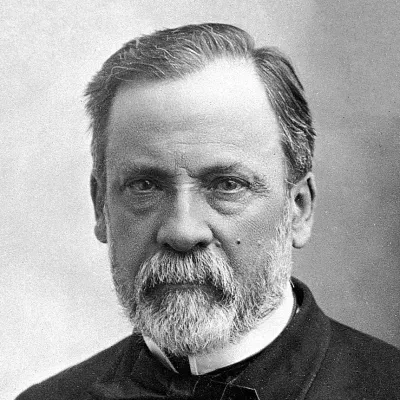
Louis Pasteur
Human Design Chart
Biography
Descended from generations of tanners, as a child, Pasteur’s main interest was drawing and he often did pastel portraits of his parents and friends. He attended primary and secondary school first in Arbois, and later in Besancon. He earned his bachelor of arts at the Royal College in Besancon in 1840, and followed this by achieving his bachelor of science in 1842. The following year, he entered the famous teachers’ college, École Normale Supérieure, in Paris, and received his master of science in 1845. After receiving an advanced degree in physical sciences, he got his doctor of philosophy in 1847.
On 22 May 1848, he presented a paper to the Paris Academy of Sciences; the discovery of which he spoke involved molecular asymmetry and formed the foundation for much of his later research. That same year, he became a professor of physics at the Dijon Lycée, but moved on to become a professor of chemistry at the University of Strasbourg. In 1854, he became dean of the science faculty of University of Lille where he put in place an exceedingly modern education concept by offering evening classes for the workmen of the city. It was here that he began his studies on the process of fermentation, an in 1857, he was named Director of Scientific Studies at École Normale Supérieure where he continued his research.
Pasteur was elected to the Academy of Sciences in 1862, and the following year, École des Beaux-Arts put him in charge of a new program of instruction in geology, physics and chemistry applied to the fine arts. His duties eventually interfered with his first love, that of research, and he resigned his post in 1867.
The Human Design of Louis Pasteur: Generator 2/4
Generator 2/4 — Design at a Glance
Louis Pasteur possessed enormous endurance and was known as an energetic "workhorse" whose power source lay in the sacral center. However, his design required a specific way of handling this energy: Instead of initiating independently, he had to respond to external impulses. This mechanism fundamentally shaped his daily life. Success and deep satisfaction only arose for him when he responded to signals from his environment and gave a clear "yes" internally. If he acted against this inner confirmation or tried to start projects without such impulses, it inevitably led to frustration and a noticeable energy shortage.
Two major stumbling blocks characterized his dynamics. On one hand, there was the risk of energy waste and burnout when he threw himself into tasks that did not offer him an internal resonance. On the other hand, he suffered when he was prevented from continuing heart projects, even though his inner self wanted to keep going with full power. The principle "not initiate but react" was thus no optional advice, but a condition for his effectiveness. By reacting to life and acting from the gut, he could unleash his materialization power. If he did not live by this principle, he encountered persistent frustration; if he followed it, he was rewarded with a sense of deep fulfillment.
Sacral Authority
Louis Pasteur showed himself as someone who did not seek orientation through intellectual analysis but trusted in an immediate, physical resonance. His design established sacral authority—a mechanism exclusive to the Generator type and whose strategy also served as his inner decision-making instance. This simplified his process: He waited for an external stimulus to respond with a somatic reaction. This "gut feeling" manifested as a surge of energy or loud grunting, humming, and groaning—clear signals from the body.
When this internal motor kicked in, he felt vital and alive. It seemed that he had inexhaustible energy at his disposal, enabling him to tackle tasks with great enthusiasm. Louis Pasteur was born to walk through life with joy and satisfaction. He immersed himself in his activities without them being strictly goal-oriented. The joy of the activity itself confirmed the right direction.
Moreover, his activated spleen center acted as a supportive instance for the sacral center. This gave him the ability to react particularly quickly and spontaneously. He had immediate access to his physical well-being and instinctive perception. This combination allowed him to be reliably guided by these inner impulses rather than falling into reflective cycles. His vitality was thus no coincidence but the direct result of this specific mechanical structure that brought him to action as soon as internal resonance was in agreement.
The 2/4 Profile — Hermit / Opportunist
Louis Pasteur's design laid a tendency towards tension between the need for solitude and the desire for community. He showed himself as someone who constantly oscillated between two poles: the urge to be alone to internally process, and the need to spend time with trusted people. For him, it was crucial to create a safe environment where he could clearly communicate when he needed company and when he wanted to withdraw undisturbed.
During his "me-time," Pasteur immersed himself in internal processes, found peace, and created clarity. Once this need was satisfied, he emerged from his retreat and sought contact with his favorite people. This configuration described a life task: reflecting on the network during alone time, evaluating it, and developing brilliant ideas from it.
Line 2 brought the readiness to promote unusual projects and the pressure to challenge authorities. It understood "perversion" as joy in the unconventional. At the same time, Line 4 with its focus on correction and dealing with inadequacies influenced his path. Here, it was about difficulties due to uncorrectable errors, coupled with a spiritual fixation on what cannot be repaired. This dynamic shaped his way by reflecting in silence and acting within the network.
Triple Split Definition — Defined & Open Centers
Louis Pasteur's design indicated a tendency towards strong internal structure: mental inspiration was directly translated into communication, supported by clear identity and vital endurance. His defined Head and Ajna centers generated constant mental pressure for concept formation; these thoughts flowed through the also defined Throat center as language and action into the world. The defined G Center provided stable direction while the Sacral Center served as a motor for vital energy that was released through reaction. The defined Spleen ensured spontaneous intuition in the present, and the Root Center generated necessary life pressure.
In contrast, Heart (Willpower) and Solar Plexus (Emotions) were open. The open Heart center meant that willpower was not constantly available; the mechanics set a trap to prove oneself through promises, often leading to frustration due to this missing energy. Louis Pasteur tended to question whether he possessed enough value if he did not exercise control – a typical non-self pattern of this center. The open Solar Plexus absorbed foreign emotions; it acted as a barometer function but could lead to contagion with environmental moods if not clearly distinguished which feelings truly belonged to him. This openness required vigilance to avoid emotional decision-making and to disengage from conditioned reactions. The high density of defined centers created a person with set patterns, while the open areas allowed space for learning through deconditioning.
Channel 31-7: The Alpha — Channels & Gates
Louis Pasteur was characterized by an insatiable drive for pattern correction that significantly shaped his actions. This tendency originated in Channel Judgment 58-18, connecting Root and Spleen Centers. Gate 58 drove the logical impulse to 'better and more,' while Gate 18 acted as a filter: it instinctively identified imbalances and dysfunctional structures. This mechanism functioned like a constant watchman checking whether existing processes promoted collective quality of life or needed correction. As long as no improvement was possible, this energy generated constant internal unrest.
Parallel to this, Channel Alpha Animal 7-31 between G Center and Throat Center gave Louis Pasteur the ability for logical, collective leadership with a view towards the future. Gate 7 provided the strategic role behind the scenes while Gate 31 represented the voice of the collective leader. This configuration required that his competence be recognized and invited by the majority before it could become effective; absolute authority was not in focus but shared leadership based on understood patterns.
The mental dimension formed through Channel Awareness 61-24 between Head and Ajna Centers. Here, inspiration from Gate 61 merged with rational processing of Gate 24. This enabled sudden insights – a Satori – when the thought process reached an opening. Louis Pasteur could not control his thinking but had to wait for knowledge to surface in its own time.
Additionally, individual gates contributed to shaping: Gate 52 demanded strong concentration and pause for pattern correction while Gate 17 implied logical teaching for the future as well as serving leadership. Gate 41 advanced evolutionary changes through specific experiences. The combination of these elements resulted in a profile dependent on perfectionism, waiting leadership, and spontaneous insight, always in service to restoring joy and order in the collective.
Collective Circuitry — Circuit Signature
Louis Pasteur's design showed complex interactions among three separate energetic systems. As a person with Triple Definition, his experience consisted of three parallel, non-directly connected power fields. The first field linked Head and Ajna Centers through Channel Awareness in the Knowledge Circuit. This generated impulsive access to new knowledge and creative transformation driven by individual identity.
A second independent system included two parts of the Understanding Circuit: Throat with Identity Center (Channel Alpha Animal) as well as Spleen with Root Center (Channel Judgment). Here, rational strategy and logical sharing of insights operated free from emotional coloring.
The third system linked Sacral and Spleen Centers through Channel Preservation in the Archer Circuit. This brought instinctive protection needs and concern for family survival.
The tension lay in the coexistence of these separate poles: emotional creativity and individual transformation on one hand, rational strategy on the other, underpinned by deep instinct to preserve. Since these groups were energetically isolated, Louis Pasteur had to integrate these different impulses – creating new things, structuring the future, and protecting what exists – as coexisting forces without a continuous flow between them.
Right Angle Cross of Service 4
Louis Pasteur's Human Design profile established a fundamental orientation towards serving others. His deeper motivation and life purpose did not stem from individual self-promotion, but rather from an energetic commitment to supporting his environment. This configuration formed the quiet foundation of his existence: living found its fulfillment in being useful and carrying others.
This attitude arose from the Right Service Authority 4. In Human Design mechanics, this element defines a person's fundamental intention. It is not about transient actions or conscious decisions in daily life, but rather a deep, often unconscious driving force. Those who carry this structure realize themselves through giving and helping. Their being is linked to the ability to serve others. This is not a question of negative sacrifice, but a natural resonance that arises when one proves oneself as support for others.
For Louis Pasteur, this was no abstract concept, but the defining energy of his character. His inner self sought ways in which he could be useful. This orientation created a constant inner peace and clarity so long as he served. The Right Service Authority 4 thus acted as a compass-like force guiding him to where his presence or actions benefited others. It was the quiet truth of his design: through serving another, his life was realized and fulfilled.
Saturn Return · Uranus Opposition · Chiron Return · 2nd Saturn Return — Life Cycles
Louis Pasteur's life followed a clear cyclical structure, marked by four decisive turning points. In 1849, at the age of 27, he married Marie Laurent. This first Saturn return signaled the beginning of a stable family commitment and laid the foundation for his personal stability.
Ten years later, in 1862, the Uranus opposition occurred. At the age of 40, Pasteur was elected to the Academy of Sciences. This configuration promoted a sudden breakthrough into scientific elite circles and established his public recognition beyond earlier structures.
In 1870, at the age of 48, the Chiron return began. During this phase of fulfillment, Pasteur retreated to his home in the Jura during the Franco-Prussian War to study brewing beer. This was not a retreat out of weakness but a practical realignment that connected his inner purpose with concrete application. The cycle fostered the flowering of his true life's work through focused action in isolation.
The second Saturn return in 1878, at the age of 56, crowned this development. Pasteur delivered a lecture on the "germ theory" and first recognized variations in virulence among sepsis pathogens. This moment solidified his theoretical authority sustainably. The structure shows how inner clarity was gradually anchored in life through external milestones—from marriage to academic advancement to scientific consolidation—and strengthened his specific contribution to the world.
Generator · Sacral Authority — Synthesis
He was a Generator whose sacral energy (sacral authority) tirelessly propelled him when he worked on something that truly inspired him. This deep physical reaction to external stimuli allowed him to fully immerse himself in his tasks – as long as they aligned with his inner life force. His Profile as a Natural Talent and Networker revealed an interplay between the need for withdrawal and the desire for exchange, leading him to alternate phases of intense self-reflection with times of connecting with others (Line 2/4). The definition in the Head Center indicated a constant mental pressure to ask questions and understand things, a perpetual search for inspiration and insight.
A central paradox in his design lay in the tension between the Knowledge Circuit and the Cross of Service. On one hand, he was geared through channels like Alpha Taurus to generate knowledge, transform it, and initiate changes – an expression of his unique individuality (Knowledge Circuit). On the other hand, the right cross pointed to a deep commitment to serve others and put his abilities at the service of the community. This combination of inquisitive independence and devoted service created a tension field that propelled him both innovatively forward and always mindful of the impact of his work on others.
4 Defined Channels
Incarnation Cross - Right Angle Cross of Service 4
Solar Return
The Solar Return shows the moment when the sun returns to its exact birth position - your personal solar year.
Life Cycles
Discover the life cycles with a detailed triple view (birth chart, cycle chart, composite).
Human Design Profile
- Type
- Generator
- Strategy
- To respond - wait for something to respond to
- Authority
- Sacral Authority
- Profile
- 2/4 - Hermit / Opportunist
- Definition
- Triple Split
- Incarnation Cross
- Right Angle Cross of Service 4
- Date of Birth
- 27.12.1822 02:00
- Place of Birth
- Dole, France
Frequently Asked Questions
What was Louis Pasteur's Human Design type?
What Profile did Louis Pasteur have?
What Authority did Louis Pasteur possess?
What incarnation cross did Louis Pasteur have?
When was Louis Pasteur born?
Discover your own Human Design
Are you also a Generator? Find out in a personal reading how to use your sacral energy correctly and discover deep satisfaction.
More Personalities
Back to overviewAaliyah

Alexia

Angèle

Anne-Marie

Arcángel

Arno
