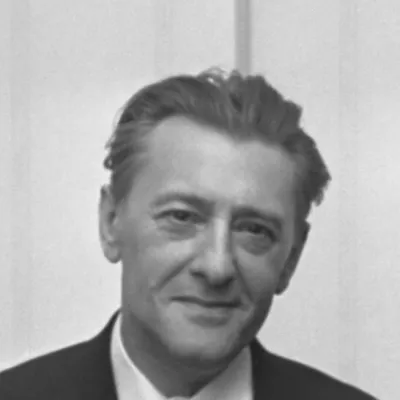
Louis Paul Boon
Human Design Chart
Biography
He died in Erembodegem, Belgium on 10 May 1979.
Louis Paul Boon — Generator with Profile 3/5
Generator 3/5 — Design at a Glance
Louis Paul Boon, as a Generator, possessed immense and enduring strength that could only be unleashed not through spontaneous initiatives but by responding to external impulses. His design suggested that his energy, comparable to that of a strong workhorse, flowed effectively without exhaustion only when he responded to life's signals. The central strategy was to wait for the inner 'sacral yes' rather than taking the first step himself.
When Louis Paul Boon acted in harmony with this response by pursuing activities driven by this internal impulse, it led to a profound sense of fulfillment and satisfaction. Conversely, two specific dangers loomed: either he squandered his energy on tasks lacking this inner approval, leading over time to frustration and burnout, or he was held back from his heart project despite having the energy available.
His high creative power thus materialized not through planned initiative but by consistently acting upon what internally spoke to him. Ignoring this strategy and instead initiating action from the mind led to a lack of energy and persistent dissatisfaction. The effectiveness of his design therefore depended crucially on whether he learned to listen for the signal and then respond with action, rather than fighting against the current of his own nature.
Emotional Authority
Louis Paul Boon exhibited an underlying emotional restraint in decision-making: He avoided acting impulsively because he knew that his immediate feelings were often fleeting waves. His design carried emotional authority, meaning that his defined Emotional Center was the source of his inner guidance—regardless of which other centers were also defined. This configuration generated a permanent rhythm of emotional highs and lows; his perception of the world was always colored by his current mood. What seemed absolutely right in one moment could appear completely wrong in the next. Thus, spontaneous reactions for him were misleading snapshots, not deep truths.
The mechanics of his authority required patience and time. To gain clarity, Louis Paul Boon had to 'sleep on' decisions. Only when initial emotional intensity subsided and a certain distance was established did calmness arise. This process of waiting was no sign of hesitation but a necessary strategy to ensure that his choice stemmed from a stable inner truth rather than a fleeting mood. Especially in long-term life decisions shaping his path sustainably, this ability to let emotional waves subside was crucial for his internal integrity.
The 3/5 Profile — Martyr / Heretic
Louis Paul Boon's design inclined him towards pragmatic learning through personal experimentation, coupled with later application of these insights for others. He appeared as someone who first questioned everything himself and only found trust in his paths through direct trial and error. This attitude stemmed from Line 3, which fostered adaptability and rebuilding after crises; changes were not merely endured but seen as opportunities for new growth.
From these personal experiences, Boon developed knowledge he made accessible to others. His Line 5, the Hero Line, projected an environmental expectation: He was viewed as a competent rescuer or storyteller offering solutions to collective problems. This role was flattering and attractive to his self-image but also carried the risk of public failure if experiments faltered in front of others. His philanthropic ideas gained traction only when recognized as useful for the general public. Often, he withdrew to protect his thoughts, communicating through writing rather than direct contact. Thus, he transformed individual crisis experiences into universally understandable wisdom.
Split Definition — Defined & Open Centers
Louis Paul Boons Human-Design profile indicated a tendency towards constant internal activity driven by defined centers for mental concept formation (Ajna), communication (Throat), vital energy (Sacral), emotional wave motion (Solar Plexus), and existential pressure (Root). This architecture created an autonomous presence: He had consistent mental processes, the ability to express thoughts directly, as well as a motor drive based on reaction. His decisions were governed by the rhythm of his emotional wave while constant Root pressure propelled him forward.
This contrasted with his open centers for inspiration (Head), identity and direction (G), willpower (Heart), and spontaneous intuition (Spleen). In these areas, he was vulnerable to external influence. The open Head Center tended to engage with foreign questions or doubts rather than waiting for its own inspiration. The open G Center sought identity through adaptation to the environment and correct place instead of providing a firm inner direction. The open Heart Center was not designed for holding promises or competitive pressure; it tended to feel worthless if it did not prove what it could do. The open Spleen Center lacked spontaneous survival intuition; instead, it could absorb fears from the environment and lead to impulsive, risky decisions in pursuit of security.
The challenge lay in not wasting the massive energy of defined centers through mental overload or emotional impulsivity but channeling them with patience and reaction. Simultaneously, he needed to use the openness of other centers as a mirror for wisdom – by learning to observe foreign inspirations without identifying with them, waiting for the right place instead of forcing it, and refraining from spontaneous impulses to strengthen his own authority.
Channels for drive, transformation and logical clarity.
Louis Paul Boon lived in a constant tension between waiting for inner transformation and the urge for emotional intensity. His design featured Channel 60-3, Mutation: a connection between Root and Sacral centers through Gate 60 (Limitation) and Gate 3 (Order). This configuration generated a pulsing rhythm of tension and release, accompanied by melancholy when the change rested. Boon had to learn to accept limitation and patiently wait for his inner reaction rather than fighting the silence with arguments.
At the same time, his Juxta-Center organized information logically. Channel 17-62, Accepting, connected Ajna Center with Throat Center through Gate 17 (Opinions) and Gate 62 (Details). This gave him the ability to structure complex patterns mentally and translate them into precise language. He sought logical order in details before speaking, which helped maintain a consistent worldview.
However, his personality drove this process forward with Channel 41-30, Recognizing: connecting Root and Solar Plexus centers through Gate 41 (Limitation) and Gate 30 (Feeling). This created an intense drive for new experiences driven by longing and restlessness. This emotional hunger often clashed with the necessary patience of mutative energy in his design. Boon lived this dynamic out: the melancholic provisional nature of change contrasted with the need to grasp details logically while the soul sought deeper, emotional experience.
Collective Circuitry — Circuit Signature
Louis Paul Boons Human-Design profile presented two separate, unconnected blocks of energy. The first block connected Sacral and Root centers (Knowledge Circuit). Here Channel 3-60, Mutation: a pulsing power for deviation from the existing and creation of new paths through individual identity was at work. The second block linked Ajna and Throat Centers (Understanding Circuit). Channel 17-62, Accepting, provided focused, emotionless logic to structure future developments here. A third, separate flow occurred between Solar Plexus and Root centers (Sensing Circuit). Channel 30-41, Recognizing, ensured cyclical emotional reflection on past experiences.
This configuration generated an internal tension: The rational, forward-looking clarity of the mind stood against the emotional, wave-like sense-making. While mutation in the Sacral-Root block continuously generated new impulses, the Ajna-Throat complex served as a filter for logical order. Emotions from Solar Plexus remained energetically separate from this rational structuring; they followed their own cycles of up and down fluctuation. Louis Paul Boon thus lived in parallel with impulsive renewal energy, cool strategic distance, and deep emotional learning from the past – three independent streams that never formed a common flow but existed side by side.
Right Angle Cross of Eden 1
Louis Paul Boons Human-Design profile featured the right cross of Eden 1. This configuration established a specific energetic alignment, without further behavioral details being elaborated in the raw content. The right cross of Eden 1 is an archetypal pattern within Human Design mechanics. It represents a particular quality of being and perception, though this is not further specified here. As no additional character traits or behavior descriptions were provided, interpretation remains limited to this basic classification. Louis Paul Boon lived with this energetic imprint in the background. It acted as a constant factor in his design, independent of external circumstances or life phases. The cross itself points towards deeper spiritual or existential themes often associated with the origin and essence of human beings. Without further mechanical explanations, however, it cannot be determined how this manifested concretely in Louis Paul Boons daily life. Mentioning this cross marks merely a structural component of his chart. It offers an anchor point for the overall architecture of his energy, even though the specific expression of this energy is not detailed in the available data. Louis Paul Boon carried this structure as part of his individual configuration.
Saturn Return · Uranus Opposition · Chiron Return · 2nd Saturn Return — Life Cycles
Louis Paul Boons life journey followed a clear structural progression marked by three Saturn returns and a Uranus opposition. These cycles formed milestones for building up, identity formation, and consolidation of his work.
The first Saturn return around the age of 29 marks the process of building up and anchoring. This was concretely shown in 1941 with the publication of 'De voorstad groeit'. During this phase, years of groundwork condensed into a viable career-relevant result that laid the foundation for his further development.
The Uranus opposition around age 41 often brings a breakthrough and individual identity formation. For Boon, this moment occurred in 1953 with the publication of his most important work 'De Kapellekensbaan'. Here not only artistic maturity was manifested but also a clear differentiation of his voice from established contexts.
The second Saturn return around age 55 marks the phase of recognition and consolidation. This cycle peaked in 1967 when he received the Constantijn Huygensprijs for his entire body of work. The award confirmed previous efforts and anchored his status sustainably. Through this sequential sequence—from building up over individual breakthrough to public affirmation—Boons design unfolded coherently, cyclically steered, with each milestone building on the previous one.
Generator · Emotional Authority — Synthesis
The red thread running through the chart is a dynamic interaction between the need for authentic expression and the ability to perceive and respond to the energy of others. The sacral definition as a generator forms the core here: a constant source of power that only becomes activated by external impulses. This readiness to react is amplified by the open G Center, which shows high sensitivity towards the environment and its influences. The Channel of Mutation (60/3) points toward a cyclical nature of creativity and renewal, coupled with an inner melancholy, while the defined Throat Center reinforces the urge for communication and manifestation of these internal processes—though always in connection with the authentic sacral yes.
The central paradox lies in the tension between individual freedom and collective conditioning. The open Heart and Spleen Centers make Louis Paul Boon receptive to the energies of others, leading to a strong adaptability but also carrying the risk of losing oneself in expectations or fears. Simultaneously, the defined Root Center with the Channel of Mutation drives an unstoppable force towards change and individual expression. This counterplay creates a life marked by creative energy but also inner tension and constant striving for authenticity amidst a complex network of relationships and influences.
3 Defined Channels
Incarnation Cross - Right Angle Cross of Eden 1
Solar Return
The Solar Return shows the moment when the sun returns to its exact birth position - your personal solar year.
Life Cycles
Discover the life cycles with a detailed triple view (birth chart, cycle chart, composite).
Human Design Profile
- Type
- Generator
- Strategy
- To respond - wait for something to respond to
- Authority
- Emotional Authority
- Profile
- 3/5 - Martyr / Heretic
- Definition
- Split Definition
- Incarnation Cross
- Right Angle Cross of Eden 1
- Date of Birth
- 15.03.1912 14:00
- Place of Birth
- Aalst, Belgium
Frequently Asked Questions
What was Louis Paul Boon's Human Design type?
What Profile did Louis Paul Boon have in Human Design?
Which Authority guided Louis Paul Boon?
What incarnation cross did Louis Paul Boon have?
When was Louis Paul Boon born?
Discover your own Human Design
Are you also a Generator? Find out in a personal reading how to use your sacral energy correctly and discover deep satisfaction.
More Personalities
Back to overviewAaliyah

Alexia

Angèle

Anne-Marie

Arcángel
Arno