
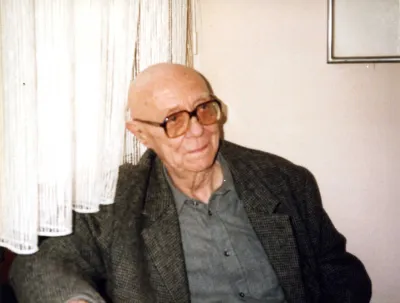
Louis Scutenaire
Human Design Chart
Biography
Scutenaire's published works include a series of books entitled Mes Inscriptions, collections of gnomic and mischievous aphorisms, as well as one of the earliest and most entertaining monographs on Magritte. He was awarded in 1985 the Grand Prix spécial de l'Humour noir in recognition of his achievements as a writer with a lifelong distrust of authority and institution.
He died on 15 August 1987, twenty years to the hour after his friend Magritte, just after watching a television programme on the painter.
Louis Scutenaire — Generator with Profile 4/6
Generator 4/6 — Design at a Glance
Louis Scutenaire was a Generator, a type characterized by abundant sacral energy and great endurance. His design inclined towards sustained power, comparable to a workhorse that could only be effective when it had energy for the task at hand. This configuration brought two specific pitfalls with it. The first occurred when he persistently did things he had no interest in. In such cases, he wasted his energy and tended to become exhausted. The second danger lay in being prevented from working on his heart project, even though he still wanted to continue working with full power.
The way his energy worked fundamentally differed from other types. His sacral center released energy primarily through reaction, not through initiation. His motto was: not to initiate, but to react. His most successful strategy involved waiting for signals from life and then acting only when his inner self gave a clear "yes". If he lived by this principle, his design rewarded him with deep satisfaction and a sense of fulfillment. If he, on the other hand, constantly initiated himself, he sooner or later encountered persistent frustration and a lack of energy. His path to effectiveness thus led through waiting for the inner signal and then acting from the gut.
Emotional Authority
Louis Scutenaire revealed himself as someone whose inner decision-making was marked by a pronounced emotional wave. His design featured Emotional Authority, meaning his defined Emotional Center always took precedence over all other defined Centers – a central rule that held regardless of further configurations. The world appeared to him always colored by his current mood; enthusiasm could quickly turn into negative evaluations. However, his immediate feeling formed only a snapshot, not necessarily the deeper truth. Spontaneous decisions that emerged directly from this emotional heat often proved problematic. Instead, his path required patience: he took time to let decisions mature, slept on them multiple times, and had others ask him multiple times. This process of layering allowed the intense feelings to subside. Only with gained emotional distance did the necessary clarity and calmness set in. This mechanism was particularly crucial for long-term, life-pragmatic steps. Through waiting, he gained the distance needed to recognize his true direction, rather than being led by passing emotions.
The 4/6 Profile — Opportunist / Role Model
Louis Scutenaire showed a development that clearly divided into two phases. In the first thirty years, before the return of Saturn, his sixth profile line still acted like a third line. This led to him experimenting frequently and extensively in his youth, particularly in the areas of relationships and friendships. Once line 6 became active, however, an inner conflict emerged: the desire to belong to a community (line 4) clashed with the urge to withdraw and contemplate the meaning of life (line 6). His life thus revolved around the tension between heart and head.
In his later years, he was expected to meet the high standards of a wise role model. This was mainly achieved through cooperation with others. The fourth line in Gate 52 provided self-discipline and a focus on concentration and silence. Although this line was socially active and maintained contacts, it had to remain focused. The big heart of a 4/6er is always cautious to avoid opening up to the wrong people and getting hurt.
The sixth line in Gate 17 represented complete succession and leadership. It resonated with the Buddhahood in Gate 18. The Bodhisattva aspect associated with this line resembled a spoiled child who would only express an opinion if explicitly asked. This line was a straight line without a cycle and marked the end of the learning process. Collective processes often ran into difficulties at this point, as mutations could change everything. However, doubts triggered by Jupiter could be beneficial to the collective if shared.
Split Definition — Defined & Open Centers
Louis Scutenaire revealed himself as someone with a clear, unwavering identity and a deep sense of his own direction. His defined G Center gave him an inner security that allowed him to lead others without being dependent on them. This firm self-love formed the foundation of his existence. This was complemented by his defined Heart Center, which gave him willpower and the ability to keep promises and determine his own resources. He was designed to actively shape his life and seek recognition for his contribution.
His defined Sacral Center functioned as a strong engine that provided him with a constant source of vitality and energy. However, this energy was only fully available to him when he waited for and responded to external stimuli rather than initiating on his own. His emotional depth and inner authority came from his defined Solar Plexus Center. Here lay the necessity of not making decisions in the moment of impulse but waiting for the emotional wave to clarify. This waiting was not hesitation for him, but an essential process of truth-seeking.
In contrast, his undefined centers revealed specific vulnerabilities. His open Head Center made him receptive to external inspirations, but could also lead him into mental confusion or the pressure to find answers to questions that were not his own. Similarly, his open Ajna Center allowed him to be flexible in responding to ideas, but sometimes left him unsure whether his own concepts were valid, as he lacked a constant mental structure. His open Throat Center led to a lack of controlled, consistent communication. Instead, he was dependent on waiting for invitations to speak, and could suffer under the pressure to attract attention if he did not receive these invitations. This openness meant that his expressions were spontaneous and context-dependent, not the result of a thought-out, long-term communication strategy.
Channels for emotional waves, rhythm, logic, intuition and community.
Louis Scutenaire revealed himself through a fundamental disposition that combined innovation with a deep, often melancholic emotionalism. His design included the channel of the Beat 14-2, linking the Sacral with the G Center. This connection conveyed the ability to guide new directions through skillful handling of material resources (Gate 14) and higher knowledge (Gate 2). He was capable of translating creative impulses into material reality, trusting his inner reaction rather than actively pursuing his fate. His presence could help others find their own direction by openly reacting to life.
Alongside this mutative power, the channel of Judgment 58-18, connecting the Root and Spleen Centers, was at work. Through the Gates of Vitality (58) and Correction (18), he possessed an insatiable drive to question and perfect patterns. This gave him a sharp sense of what was in balance and what needed correction to maintain the joy of life for the collective. He did not seek final perfection but functional solutions, which he only introduced when asked.
His emotional landscape was shaped by the channel of Recognition 41-30, connecting the Root and Solar Plexus Centers. The Gates of Limitation (41) and Feeling (30) generated a strong drive for new experiences, driven by restlessness and intense imagination. This led to a deep desire to feel life, but also required patience to give the emotional wave time to clarify.
In interpersonal relations, the channel of Community 40-37, connecting the Solar Plexus and Heart Centers, was at work. Through the Gates of Solitude (40) and Friendship (37), he sought his place in the whole and understood the need for fair agreements. He built bridges between individuals, valuing direct, personal invitations to find communities where everyone had a respected place. The channel of Releasing Feelings 55-39, connecting the Root and Solar Plexus Centers, added a swinging wave between joy and sadness. The Gates of Spirit (55) and Provocation (39) allowed him to touch the truth and spirit of others through authenticity and acceptance of his moods, without being overwhelmed by melancholy.
Individual Circuitry — Circuit Signature
Louis Scutenaire's design was marked by two separate, parallel operating energetic poles. One pole connected the Identity with the Sacral Center, as well as the Solar Plexus with the Root Center. Here, the Knowledge Circuit was at work: the channel 'The Beat' promoted the expression of individuality, while 'Releasing Feelings' channeled emotional waves into root energy. This generated a pulsating, acoustic creativity that sought new paths.
The second pole included Spleen, Root, Solar Plexus, and Heart Centers. In the Understanding Circuit, the channel 'Judgment' connected Spleen and Root. This gave a focused, visual perception that developed logical strategies for the future – free from emotions. Parallel to this, the Meaning Circuit channel 'Recognition' between Solar Plexus and Root reflected past experiences cyclically and visually to gain emotional insights. Finally, the Ego Circuit connected Heart and Solar Plexus through the channel 'Community'. This promoted cooperation and mutual giving and taking within a group, with traditional values and the sense of touch playing a role.
Since Louis Scutenaire had a split definition, these two groups did not exist as a continuous flow. The creative, identity-forming energy of the first pole stood independently from the strategic-emotional dynamics of the second pole. He moved between the search for unique transformation and the cooperation-oriented reflection of past and future, without these areas directly overlapping.
Right Angle Cross of Service 2
Louis Scutenaire carried the right Service Cross 2 in his design. This configuration shaped a fundamental disposition characterized by a deep, often silent dedication to others. In Human Design, this cross describes a specific energetic structure that focuses on support and care without dissolving one's own identity. It is an energy that does not seek recognition or visible leadership but finds fulfillment in direct, practical service.
For Louis Scutenaire, this meant that his essence was aligned with recognizing and addressing needs before they were articulated. The mechanics of this cross show a person who stabilizes through their presence and actions. It is not an energy of grand public gestures but of subtle, continuous support. Louis Scutenaire lived this dynamic by stepping into the background to give others space. His design suggested that he found strength in bearing burdens and creating relief without standing in the spotlight. This form of service was not a sacrifice but a natural expression of his inner structure, which sought and found harmony through selflessness.
Saturn Return · Uranus Opposition · Chiron Return · 2nd Saturn Return — Life Cycles
Louis Scutenaire published the first volume of 'Mes inscriptions' in 1945 at the age of 40. This success marked a turning point that emerged from the Uranus Opposition in his design. This configuration signaled a phase of sudden, often unpredictable changes that broke old structures to allow new expression.
The Uranus Opposition acts as a catalyst for innovation and liberation from established patterns. It fostered in Louis Scutenaire the ability to transcend conventional boundaries and find his own unmistakable voice. Instead of conforming to existing norms, he used this energetic dynamic to express his creative potential in a way that was radically different from previous approaches.
This cycle supported the unfolding of his individual identity through a break with the familiar. The publication was not an isolated event but the visible result of this inner transformation, which was sparked by the planetary configuration. It showed how his design enabled him to forge new paths in moments of uncertainty and communicate his artistic vision with a direct, unadorned power that touched his readers deeply.
Generator · Emotional Authority — Synthesis
Louis Scutenaire was a Generator whose life was marked by a deep, sacral energy. This energy, fueled by the Beat Channel (14/2), created a natural readiness to take new directions and advance innovation. His defined G Center gave him a firm self-identity and an inner compass that always guided him on his unique path – a path reinforced by the Knowledge Circuit and the right Service Cross 2. He drew strength from aligning with his direction and showed others new perspectives, always striving to create and transform something new. The Line 6 in his Profile pointed to a deep reflection and the desire to contemplate the meaning of life, while Line 4 reflected a need for community and connection.
A central paradox in his design lay in the tension between the pulsing, creative impulse of the Knowledge Circuit and the emotional wave of his authority. While he wanted to drive innovations through his energy and knowledge, his emotional authority required time and maturation to make decisions. This led to an internal conflict between the desire for rapid progress and the necessity of fully experiencing his feelings before stepping into the world. The publication of the first volume (1945) showed how he could translate these inner processes into creative work.
5 Defined Channels
Incarnation Cross - Right Angle Cross of Service 2
Solar Return
The Solar Return shows the moment when the sun returns to its exact birth position - your personal solar year.
Life Cycles
Discover the life cycles with a detailed triple view (birth chart, cycle chart, composite).
Human Design Profile
- Type
- Generator
- Strategy
- To respond - wait for something to respond to
- Authority
- Emotional Authority
- Profile
- 4/6 - Opportunist / Role Model
- Definition
- Split Definition
- Incarnation Cross
- Right Angle Cross of Service 2
- Date of Birth
- 29.06.1905 06:30
- Place of Birth
- Lessines, BEL
Frequently Asked Questions
What was Louis Scutenaire's Human Design type?
What profile did Louis Scutenaire have?
What authority did Louis Scutenaire have?
What incarnation cross did Louis Scutenaire have?
When was Louis Scutenaire born?
Discover your own Human Design
Are you also a Generator? Find out in a personal reading how to use your sacral energy correctly and discover deep satisfaction.
More Personalities
Back to overviewAaliyah

Alexia

Angèle

Anne-Marie

Arcángel
Arno
