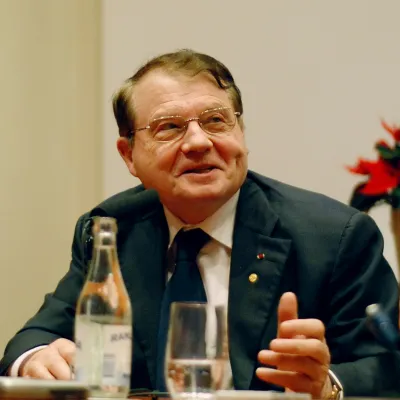
Luc Montagnier
Human Design Chart
Biography
He was the first person to discover the virus responsible for AIDS, though another claimed the same distinction, American Robert Gallo, at close to the same time. The clash arose as each called the virus by different initials but in 1986, three years after the discovery, the two mutually agreed on the designation HIV.
During the COVID-19 pandemic, Montagnier promoted the conspiracy theory that SARS-CoV-2, the causative virus, was deliberately created and escaped from a laboratory. Such a claim has been rejected by other virologists.
Luc Montagnier married Dorothea Ackerman in 1961, and they had three children. He died on 8 February 2022 at the age of 89 in Neuilly-sur-Seine, France.
What does Generator 1/3 mean for Luc Montagnier?
Generator 1/3 — Design at a Glance
Luc Montagnier was someone with immense endurance whose strength came not from his own initiative but rather from reacting to external impulses. As a Generator, he had a great sacral energy that made him strong and resilient like a workhorse – provided he acted in harmony with his inner compass. His design dictated that this energy would only be unleashed when he responded to signals from his environment. The motto was clear: not initiate but react. When his sacral center gave the internal 'yes', he could push forward his projects through consistent action and experience deep satisfaction.
However, if he lived against this principle, for example by forcing himself to do things he had no desire for or being hindered from continuing work on his heart project, frustration and energy loss were imminent. This configuration described his life task: waiting for the right impulse and then responding with full force. Only in this way could he avoid the typical pitfalls of a Generator – wasting energy in wrong directions or suppressing his creative drive. His strength lay in acting instinctively when life called him, which allowed him to effectively materialize his ideas and experience fulfillment.
Emotional Authority
Luc Montagnier exhibited a decision-making stance that was characterized not by spontaneous impulses but emotional maturity. His inner authority lay in the defined Solar Plexus Center – emotional authority. This configuration was subject to constant waves of emotional ups and downs; perception was always colored by current mood, with enthusiasm quickly shifting into skepticism. Since such an impression did not represent ultimate truth, quick emotional decisions carried the risk of negative consequences.
Therefore, for Luc Montagnier, a compelling rule applied: every defined emotional authority takes precedence over all other defined centers. This meant that patience and time were decisive factors. By letting decisions 'sleep' multiple times, intense initial emotions subsided. Only with this emotional distance did clarity and calmness emerge, which was considered the true inner truth. This process was particularly essential for long-term decision-making as it allowed access to deeper, more comprehensive insights hidden behind the first fleeting reaction.
The 1/3 Profile — Investigator / Martyr
Luc Montagnier appeared as a person whose life was marked by a deep drive to understand things not just theoretically but practically through personal action and failure. His Human Design Profile 1/3 defined him both as a researcher and experimenter: Line 1 brought with it the necessity of initially immersing oneself in subjects and accumulating knowledge, while Line 3 formed the necessary counterpoint – courage for trial and error. For Luc Montagnier, this process of learning through mistakes was not a weakness but the only path to reliable insights. When he made a decision or rendered judgment, it was based on double verification: theoretical foundation and practical experience.
The specific configuration of his lines deepened this dynamic. The first line in Gate 29 brought an energy of recruit, requiring endurance and commitment but also the risk of avoidance if knowledge was not yet deemed sufficient. Simultaneously, Line 3 in Gate 8 characterized by trial and error came into play. Here it was less about pure content than style of approach; Luc Montagnier had to learn not to hide his true nature but rely on disciplining his own uncertainties. His path was thus not straightforward progress but continuous experimentation, with each failure regarded as a necessary step towards truth.
Split Definition — Defined & Open Centers
Luc Montagnier was marked by a design characterized by constant mental pressure and profound emotional authority. His defined Head Center and Ajna Center created an ongoing internal tension of questioning and forming concepts. This mental process operated independently of his will; he was always on the verge of understanding connections. At the same time, he had a defined Sacral Center that provided him with a vital energy source, but this could only be correctly utilized through reaction – not initiation. His decisions were also subject to the emotional wave of the Solar Plexus; clarity emerged for him only after waiting out and riding these wave movements.
This interplay meant that his mind was constantly active, yet it lacked direct energy for implementation. Attempting to immediately convert mental ideas into action would have led to frustration. Instead, he acted as an inspirational source for others who provided the necessary impulse; then his Sacral Center responded with a yes or no reaction.
On the other hand, his vulnerability was revealed in undefined centers. His open Throat Center left him prone to seeking attention under pressure or speaking out of turn if not waiting for the correct invitation. His open G Center indicated a lack of stable identity; he tended to reflect himself in relationships and environments rather than setting a steady direction. The absence of consistent willpower in his open Heart Center made him susceptible to trying to prove his worth through promises – a path often leading nowhere. Finally, his open Spleen Center was marked by a fundamental survival anxiety; spontaneous decisions were risky for him as they lacked instinctive security and instead relied on conditioned fear of losing well-being.
Channels for clear logic, intimacy, impulse and maturation.
Luc Montagnier's design revealed a mind shaped by healthy skepticism. His configuration tended to filter patterns persistently and only acknowledge them as true if they were consistent and verifiable. This attitude stemmed from the Channel of Logic 63-4, which represents the doubting mind. Here, the Gate of Doubt combined with the Gate of Formulation; an answer was considered logical only if it practically functioned. Unfounded belief had no place in this setup – fear here did not manifest as panic but rather as necessary skepticism between question and proof.
Alongside this intellectual rigor, a deep emotional intensity was present. The Channel of Union 59-6 connected sacral sexuality with emotional friction. This created a need for intimacy that required patience. Luc Montagnier had to wait until the emotional wave provided clarity before true connection or fruitful collaboration could unfold. Spontaneity often led to confusion here; only through nurturing relationships over time did real potential emerge.
This dynamic was reinforced by the Channel of Recognition 30-41. The pressure from the Root Center to collect new experiences met with the emotional wave of the Solar Plexus, creating an intense desire to feel life deeply and fulfill desires. Yet patience was crucial here as well: only through waiting out the emotional cycles could he discern which experience was truly fulfilling and which offered merely transient excitement.
Finally, the Channel of Maturation 42-53 shaped his approach to processes. Each experience had to be brought to a satisfying conclusion before a new cycle began. Reflective consideration helped him draw wisdom from past events and make it useful for the collective. Expectations were hindering; the focus was on completing the entire cycle from start to finish, generating real depth and learning processes.
Collective Circuitry — Circuit Signature
Luc Montagnier's design inclined towards analytical clarity, manifesting in two separate energetic streams. Through the Understanding Circuit, he connected his Head Center and Ajna Center via the Channel of Logic. This marked him as someone who focused on taking in information strategically for future use – an emotionless ratio that created structures to share insights free from conditioning.
Parallel to this was a completely different current: The Meaning-Finding Circuit linked his Sacral, Root, and Solar Plexus Centers. Here, life force, instinct, and emotional waves converged. Through the Channels of Maturation and Recognition, he reflected on past experiences to gain collective learnable insights. This cyclical energy contrasted with cool logic; it was wave-like and emotionally charged.
A third aspect appeared in the Shielding Circuit, which connected his Sacral Center with his Solar Plexus Center. The Channel of Union brought primordial energies of care and preservation into play. It was about protecting genetics and nurturing the environment – a timeless force of support.
Given Luc Montagnier's split definition, these systems were not merged. Logical future orientation (Head/Ajna) stood isolated from emotional, past-oriented processes (Sacral/Root/Solar Plexus). He moved between these separate poles: sometimes strategically planning, other times intuitively reflecting, always with the subconscious aim of preserving what was essential.
Right Angle Cross of Contagion 3
Luc Montagnier's Human Design profile bore the imprint of the right infection cross. This specific configuration indicated a tendency towards controversial or polarizing developments often associated with themes of illness, healing, or profound transformation. In Human Design, this cross marks a life task where the individual challenges existing structures through their own experiences or work and frequently brings uncomfortable truths to light. It is not about conscious provocation but rather an energetic pressure to break through the status quo and force new perspectives, even if it meets resistance. For Luc Montagnier, this meant that his path was characterized by dynamics leading him into centers or debates where established views were questioned. The energy of this cross acts as a catalyst for changes initially perceived as disruptive but ultimately leading to necessary adaptations. Luc Montagnier lived out this mechanism by moving through areas that transcended traditional boundaries and often elicited polarized reactions. His design thus showed an inherent connection to processes of transformation through conflict or redefinition of health and scientific concepts.
Saturn Return · Uranus Opposition · Chiron Return · 2nd Saturn Return — Life Cycles
Luc Montagnier's life was marked by a clear structuring followed by the breaking of established barriers. His Human Design indicated a tendency towards stable anchoring, often leading to firm commitments around his first Saturn return (around 29 years). This was reflected in 1961 when he married Dorothea Ackerman – a moment of personal stabilization after years of building.
His chart configuration also described a tension between established structures and the urge for radical renewal, which became active during his Uranus return (around 40 years). This cycle often marks a break with old hierarchies in favor of new authority. In 1972, Luc Montagnier advanced to head of the virology department at the Pasteur Institute in Paris. This career advancement was no coincidence but rather the result of an inner maturation that enabled him to take on high-level responsibility and reshape established systems.
The peak of this development occurred during his Chiron return (around 49–51 years), a fulfillment cycle where one's life purpose increasingly unfolds. Here, the core essence of his design becomes visible. In 1983, at age 51, Luc Montagnier succeeded in isolating the HIV virus. This success was the concrete result of long-term alignment with his strategy and authority: years of work culminated in a groundbreaking achievement that made his life purpose tangible.
Generator · Emotional Authority — Synthesis
He was a Generator whose life was marked by a deeply rooted necessity to learn through action and gain insights. The sacral energy drove him to delve into topics capturing his attention – where the Research-Experimentor (Profile 1/3) ensured this wasn't based on mere theory but validated through practical application and repeated testing. This process was inseparable from a constant mental pressure (defined Head Center), compelling him to ask questions, challenge patterns, and seek consistency in his observations (Logic Channel). Emotional authority required time for decision maturation, deriving a grounded truth from initial feelings.
A central paradox lay in the tension between his need for independent research and the emotional wave that could temporarily color his judgments. While he sought insights through logic and experimentation (Understanding Circuit), he also had to confront the influence of his emotions to reach deeper truths. This led to an interplay between striving for objective analysis and subjective experience, prompting him to continually reassess and adapt his conclusions – a process evidenced by pivotal moments in life where both personal and professional turning points were reached.
4 Defined Channels
Incarnation Cross - Right Angle Cross of Contagion 3
Solar Return
The Solar Return shows the moment when the sun returns to its exact birth position - your personal solar year.
Life Cycles
Discover the life cycles with a detailed triple view (birth chart, cycle chart, composite).
Human Design Profile
- Type
- Generator
- Strategy
- To respond - wait for something to respond to
- Authority
- Emotional Authority
- Profile
- 1/3 - Investigator / Martyr
- Definition
- Split Definition
- Incarnation Cross
- Right Angle Cross of Contagion 3
- Date of Birth
- 18.08.1932 02:00
- Place of Birth
- Chabris, France
Frequently Asked Questions
What was Luc Montagnier's Human Design type?
What Profile did Luc Montagnier have in Human Design?
What Authority did Luc Montagnier possess?
What incarnation cross did Luc Montagnier have?
When was Luc Montagnier born?
Discover your own Human Design
Are you also a Generator? Find out in a personal reading how to use your sacral energy correctly and discover deep satisfaction.
More Personalities
Back to overviewAaliyah

Alexia

Angèle

Anne-Marie

Arcángel

Arno