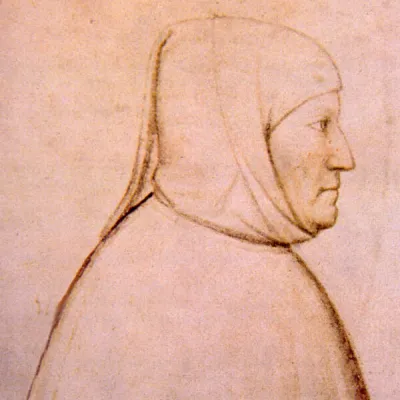
Petrarch
Human Design Chart
Biography
Petrarch's rediscovery of Cicero's letters is often credited with initiating the 14th-century Italian Renaissance and the founding of Renaissance humanism. In the 16th century, Pietro Bembo created the model for the modern Italian language based on Petrarch's works, as well as those of Giovanni Boccaccio, and, to a lesser extent, Dante Alighieri. Petrarch was later endorsed as a model for Italian style by the Accademia della Crusca.
Petrarch's sonnets were admired and imitated throughout Europe during the Renaissance and became a model for lyrical poetry. He is also known for being the first to develop the concept of the "Dark Ages".
Petrarch as a Manifestor 3/5 in Human Design
Manifestor 3/5 — Design at a Glance
Petrarch's design established him as a trailblazer and visionary. He was destined to lead the world into a new future, much like a Roman emperor: he had the grand vision of an empire but did not fight the necessary wars himself; instead, he delegated their execution to others. This structure brought with it a central challenge: Petrarch was often misunderstood and polarized his environment. Because he thought further ahead than many others, his vast vision inspired love and following in some, while others rejected or hated him.
To minimize this resistance and find the right followership, it was crucial for him to inform others about his plans at the right time and with precision. This strategy of information served to avoid misunderstandings and clear the path. If Petrarch followed this approach and lived according to his nature, he was rewarded with a sense of inner peace. However, if he deviated from this path and acted against his design, instead, a persistent deep anger would arise within him. This dynamic between delegating visions and the necessity for clear communication profoundly shaped his experiential world.
Emotional Authority
Petrarch's design established a tendency towards emotional wave movement: his inner truth did not show itself in the first impulse but only after the initial heat had subsided. The defined Solar Plexus Center carried his authority — a mechanism that always took precedence over all other defined centers. Petrarch saw the world colored by his current mood; what appeared inspiring at one moment could be perceived negatively the next. These fluctuations were not deception but the natural ebb and flow of his emotional landscape.
However, quick reactions to these feelings would have been misleading as they only represented snapshots. His design strategy required patience: decisions needed time to mature, ideally through multiple nights' reflection. By allowing himself to “flirt” with the moment and taking time, he gained emotional distance from the intense first impressions. Only when the wave had subsided did clarity and calm set in. This process was essential for long-term direction-setting in his life. Thus, Petrarch showed himself as someone who found his deepest intuition not in the storm of emotion but in the quiet aftercare once the emotional current had passed its peak. This ability to delay was his protection against impulsive misjudgments and the key to authentic action.
The 3/5 Profile — Martyr / Heretic
Petrarch's design established a tendency towards initial skepticism toward prefabricated truths, preferring to test everything through trial and error. This attitude of Line 3 at Gate 31 means that leadership competence does not come from dogma but from personal, often painful experience. Only after identifying the right influences with precision could he utilize these practical insights.
This process culminated in the role of the Hero (Line 5), as described at Gate 27. Here, the ability to effectively manage foreign resources and offer concrete solutions during crises is evident. Petrarch attracted others because he presented a rich trove of proven knowledge from which his environment could learn. However, this heroic problem-solving always rested on the preceding phase of experimentation, which came with the risk of public failure. The mechanism describes a clear cycle: skeptical experimenting lays the groundwork for later crisis management. Those who carry Line 5 risk power loss or reputation damage when they fail but gain strong trust through successful resource management and practical help offers. Petrarch's character trait was thus to make his own mistakes into resources for others by structuring complex situations with the quality of his self-tested leadership skills.
Single Definition — Defined & Open Centers
Petrarch's design inclines towards emotional depth and persistent internal pressure, paired with a reliable yet limited expression. His defined throat serves as a pivot for communication that speaks not from the mind but from other sources. This voice is stable, yet its content undergoes filtering through the Solar Plexus Center. As his inner authority, this configuration requires patience; decisions are only correct when made after emotional waves subside. Petrarch tends to express feelings immediately upon their arising, leading to impulsive reactions that he later regrets once emotional clarity sets in.
Parallel to this, his defined Root Center acts as a source of persistent adrenalin-driven pressure. This stress propels him forward, especially in dealing with emotional situations and relationships. Without channeling this energy through his authority, there is a risk of becoming obsessive or projecting this pressure onto others.
In contrast, Petrarch's identity reveals itself situational and adaptable. His open G Center means he does not have a fixed direction but takes it from the environment. He tends to lose himself in relationships or places that are not correct for him because he reflects their energy. Without consistent willpower (open heart), he is prone to making promises to prove worth, often ending in disappointment. His generative energy (open sacral) is unstable; he absorbs others' vitality and risks exhaustion as he does not know when enough is enough. Mental confusion (open head and Ajna centers) along with existential fears (open spleen) can distract him from his true path by making him seek answers or cling to uncertain structures rather than trusting emotional clarity.
Channel 55-39: Emoting — Channels & Gates
Petrarch's design inclines towards dynamic leadership that does not rely on static authority but instead provokes spirit and mood in others. This energy is filtered through the Recognizing Channel 41-30: The drive from Gate 41 creates restlessness, while the emotional wave from Gate 30 fuels a desire for new experiences to dispel uncertainty.
This restless search finds expression in the Transience Channel 36-35. Here, the need of Gate 35 to bring about change combines with the emotional crisis of Gate 36, which perceives unfamiliarity as inadequacy. This drives Petrarch to set things in motion and draw others into emotional adventures where wisdom is gained through lived experience.
The mechanics of this interaction are steered by the Emotions-Release Channel 39-55. The provocation from Gate 39 uses pulsating moodiness to tease and strengthen the mind out of Gate 55. Thus, Petrarch can change others' perceptions through his own emotional ups and downs between joy and melancholy. Leadership is shown in sharing intense, often fleeting emotional adventures where authenticity of one's mood is crucial for impact on the environment.
Collective Circuitry — Circuit Signature
Petrarch's design inclines towards cyclical, emotionally driven forms of expression. His energy pulses, focusing both on creating new identity and reflecting past experiences. For Petrarch, a simple definition exists: The Solar Plexus, Root, and Throat Centers are directly connected, forming a cohesive flow.
The Knowledge Circuit connects his Solar Plexus to the Root Center, fostering the ability to set new impulses through emotional waves and express individual aspects of identity. Parallel to this, the Meaning-Finding Circuit also encompasses the Throat, Solar Plexus, and Root Centers. Here it is about emotionally processing past events, giving them meaning, and sharing these insights with the collective. The energy of these circuits flows in waves: It has a beginning, middle, and end.
Petrarch emerges as someone who translates inner emotional states into external expression. Connecting all three centers allows him to articulate both innovative impulses (Knowledge Circuit) and profound meaning-finding through reflection on past experiences (Meaning-Finding Circuit) via the Throat Center. This configuration shapes his essence through a constant interaction between seeking new, unique identity and the need to formulate collective learning messages from past experiences. The energy is never static but follows a natural rhythm of ups and downs.
Right Angle Cross of the Unexpected 2
Petrarch's design inclined towards non-linear life paths, where growth rarely occurred through planned progression but rather through sudden insights or external circumstances. This configuration, the Unexpected Right Cross 2, describes a dynamic that consciously moves away from predictable patterns. Instead of following a straight path, his internal compass led him to turns that often came as surprises and abruptly changed his course.
The challenge of this design was not to fight against this unpredictability but to learn how to dance with it. Petrarch emerged as someone whose development was marked by such unexpected impulses. Life did not offer him a rigid structure he could simply fill; instead, he had to react to what came—whether it was a new idea, an unforeseen event, or sudden clarity about his path.
This mechanism does not mean chaos in the negative sense but rather a high adaptability to changing circumstances. Petrarch had to accept that control was often an illusion and that true strength lay in taking the curve when it appeared. His way was thus defined by this flexibility: continuously embracing what was unplanned yet necessary for his further development. This required patience and letting go of rigid expectations about the future.
Saturn Return · Uranus Opposition · Chiron Return · 2nd Saturn Return — Life Cycles
Petrarch's design set a tendency towards structural turning points, not as arbitrary events but as architectural phases of maturation. His life followed a clear mechanical sequence of four classical cycles, each presenting specific integration tasks. The first Saturn return marked the transition into a phase of consolidation, followed by the Uranus opposition, which triggered internal tensions and the urge for change. These mechanical processes served to question earlier patterns and integrate new perspectives.
The Chiron return appeared as a fulfillment cycle in which his incarnation cross unfolded increasingly. Provided Petrarch had lived according to his strategy and authority, this period became a blooming time when meaning and purpose were experienced—not as healing of old wounds but as confirmation of his path. The second Saturn return concluded this sequence by solidifying the previously gained insights into a stable structure. These cycles shaped Petrarch's development less through specific energies or character traits but through their function as temporal markers for change and integration. They formed the framework within which his life gained significance and structural density.
Manifestor · Emotional Authority — Synthesis
Petrarch's life seems to have been marked by a deep, internal tension between the urge for experience and the necessity of emotional clarity. The Channel of Recognition (30/41) points towards an insatiable search for new impressions fueled by the emotional wave of his Solar Plexus Center—a constant oscillation between enthusiasm and melancholy. This energy, amplified by the open Root Center, created a relentless drive but without the ability to fully anchor or be content long-term. He was driven by the search for the new, always on the hunt for the next experience to fill the void created by the impermanence of all things.
This striving manifested as a central paradox: Petrarch's capacity to feel and express intense emotions (Channel 35/36) clashed with an open heart and Spleen Center. He was susceptible to other people's energies, tended to make promises he could not keep, and sought validation from outside. This internal conflict between the desire for authentic expression and conditioning by external influences shaped his character and created a dynamic tension between individuality and adaptation.
3 Defined Channels
Incarnation Cross - Right Angle Cross of the Unexpected 2
Solar Return
The Solar Return shows the moment when the sun returns to its exact birth position - your personal solar year.
Life Cycles
Discover the life cycles with a detailed triple view (birth chart, cycle chart, composite).
Human Design Profile
- Type
- Manifestor
- Strategy
- To inform others before acting
- Authority
- Emotional Authority
- Profile
- 3/5 - Martyr / Heretic
- Definition
- Single Definition
- Incarnation Cross
- Right Angle Cross of the Unexpected 2
- Date of Birth
- 28.07.1304 04:33
- Place of Birth
- Arezzo, Italy
Frequently Asked Questions
What is Petrarch's Human Design type?
What Profile does Petrarch have in Human Design?
What Authority guides Petrarch's decisions?
What incarnation cross defines Petrarch's life purpose?
When was Petrarch born?
Discover your own Human Design
Are you also a Manifestor? Find out in a personal reading how to use your initiation power peacefully and dissolve resistance.
More Personalities
Back to overviewChristian-Jaque

Kesha

Lucebert
Masaccio

Papus
Pupo