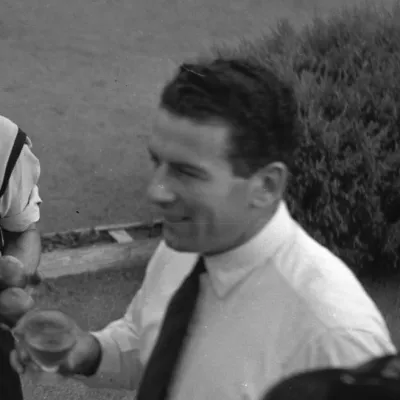
Lucien Teisseire
Human Design Chart
Biography
Lucien Teisseire as a Generator 2/4 in Human Design
Generator 2/4 — Design at a Glance
Lucien Teisseires design points to a tendency towards great endurance and inner drive, provided he pursues tasks that intrinsically motivate him. As a Generator, he possesses a lot of sacral energy, which makes him strong and resilient like a workhorse, but only if he has energy for his specific task. His design highlights two central pitfalls: Firstly, the risk of wasting energy on things that do not interest him, which could lead to burnout. Secondly, the frustration of being prevented from working on his heart project, even though he still has plenty of power to continue. Unlike other types, his approach does not work through initiative but through reaction. The energy of his sacral center is released when he responds to impulses from life. His most successful strategy was to wait for a signal and then act when his inner self gives a clear “yes”. If Lucien Teisseire lived in harmony with this strategy, he acted from his gut and reaped deep satisfaction and a sense of fulfillment. If he, however, constantly initiated things without waiting for inner confirmation, he would sooner or later encounter persistent frustration and a lack of energy. His design therefore required patience and trust in his own reactions to effectively and satisfyingly use his immense power.
Sacral Authority
Lucien Teisseires design points to a tendency towards direct, physically anchored decision-making. As a Generator, his strategy of reacting was identical to his inner authority, simplifying his process of orientation. This sacral authority did not manifest through intellectual analysis but as an immediate physical response to external stimuli. Lucien Teisseire had a kind of “gut feeling” that expressed itself in sounds like grunts or hums, as well as in palpable bursts of energy. When his sacral motor engaged with a topic, he felt vital and alive. Then he had seemingly inexhaustible energy at his disposal, enabling him to carry out his tasks with great enthusiasm and without compulsive purposefulness. His design promoted a way of life in which he engaged in his tasks with joy and satisfaction.
Additionally, his activated spleen center acted as a supportive instance. This connection gave him the ability to react particularly quickly and spontaneously. He had direct access to his physical well-being and his instinctive perception. These instincts were reliable and served him as additional orientation aids alongside the sacral response. The open emotional center was the necessary prerequisite for this sacral authority to function clearly, as it was not overlaid by emotional turbulence. Lucien Teisseire therefore lived in a system that asked him to trust the first impulse to use energy efficiently and satisfyingly.
The 2/4 Profile — Hermit / Opportunist
Lucien Teisseire was characterized by a constant interplay between a deep need for withdrawal and a drive towards community. His design as Profile 2/4, the “Natural Talent”, sets a tension: On one hand, he sought solitude to gain inner clarity, on the other hand, he missed the connection to his familiar network. This dynamic required him to communicate his boundaries clearly. Only when he used his time alone to learn from past experiences and reflect, could he later return to his social environment with energy.
Line 2, marked by themes like memory and reflection, urged him to withdraw to draw insights from painful or instructive moments of the past. Often, he learned through his own mistakes and developed a strong sense of self-strength. This process of inner condensation was essential. Only after this phase was completed, Line 4, which stands for brotherhood and influence in the network, was activated. Then he actively sought exchange with his “favorite people” to share and evaluate what he had gained in solitude.
Lucien Teisseire had to learn to carry these phases transparently to the outside: “Now I need peace” or “Now I want company”. Without this clear demarcation, confusion or the feeling of being overwhelmed, which Line 4 often knew when external support was lacking, threatened. His strength lay in processing the knowledge of his network in silence and developing brilliant ideas from it, which he then brought back into the community. This rhythm of isolation and connection shaped his way of dealing with others and with himself.
Split Definition — Defined & Open Centers
Lucien Teisseire's Design reveals a tendency towards constant mental pressure and a clear, unwavering sense of self-identity. He had defined Head and Ajna Centers, making him a source of specific inspiration and conceptual thinking. This permanent internal process of questioning and concept formation was his natural way of understanding the world, even if he lacked the energy to directly translate these thoughts into action. Simultaneously, his defined G Center indicated a firm direction and a deep sense of self-love, allowing him to guide others without being dependent on them.
As a Generator with a defined Sacral Center, Lucien Teisseire possessed a vast reservoir of vital energy. His life strategy involved waiting and responding rather than initiating. Only through a confirming sacral response could he deploy his energy for satisfying activities; mental decisions that anticipated this response led to frustration and exhaustion.
His open Throat Center meant he did not have a consistent communication drive. He tended to feel the pressure to attract attention or speak to avoid being overlooked, though his true wisdom lay in waiting for invitations. His open Heart Center lacked a consistent willpower; he was vulnerable to the urge to prove his worth through promises or competition, often ending in a cycle of self-doubt when he failed. Additionally, his open Solar Plexus absorbed the emotions of his surroundings, making him vulnerable to emotional conditioning and prone to personalizing others' feelings as his own. His open Spleen Center carried a fundamental survival fear, leading him to act impulsively or cling to unhealthy situations to gain a false sense of security. Finally, his open Root Center amplified external stress, leading to a feeling of pressure and restlessness that he did not generate himself but absorbed from the environment.
Channels for powerful resources and abstract comprehension.
Lucien Teisseire's Human Design profile revealed a tendency towards rhythmic innovation, paired with a mind constantly searching for hidden patterns. This configuration was highlighted by the Beat Channel 14-2, connecting the Sacral Center with the G Center. Gate 14, adept at handling power, focused on material resources for mutation, while Gate 2, the Gate of Higher Knowledge, directed movement through space and time. This tantric channel endowed him with the ability to open new directions by trusting the generative energy of his Sacral Center. He could encourage others through his aura without actively guiding them; his presence alone often sufficed to inspire a new orientation in others.
Parallel to this, the Abstraction Channel 64-47, linking the Head Center with the Ajna Center, was influential. Gate 64 of Confusion and Gate 47 of Understanding created a mental space that filtered every experience through a kaleidoscope of images. Lucien Teisseire was under the pressure to understand connections, even though the mind could never offer absolute certainty. This mental power served not to solve personal problems but to discover inspiring stories and perspectives that he could share later. The reward for his patience was the sudden flash of clarity, an "aha" moment, transforming complex experiences into a comprehensible sequence.
Additionally, defined Gates shaped his essence: Gate 26 in the Heart Center allowed him to anchor innovations within the conservative tribe, while Gate 45 represented hierarchy and willpower. Gate 22 promoted openness and calm listening, supporting mutation in social environments. Gate 34 in the Sacral Center represented a massive energy source that fostered leadership and integration, yet required clear guidance to avoid aimless action. Gate 59 carried the genetic strategy of bonding and pairing, independent of personal feelings. Finally, Gate 7 projected future patterns and leadership perspectives, tested through experiments. Together, these elements formed a complex tapestry of rhythmic creation, mental analysis, and social integration.
Individual Circuitry — Circuit Signature
Lucien Teisseire's Human Design profile featured a split structure that defined two independent energetic poles. This separation meant that his energies did not work as a continuous flow but rather as parallel, independent systems.
One pole was the Knowledge Circuit. Here, Channel 2-14, "The Beat," connected the Identity Center with the Sacral Center. This connection generated a pulsing, acoustic energy aimed at creativity and individual mutations. It drove Lucien Teisseire to follow his unique path and transform knowledge through his own, singular identity. The energy was grounded in the "now" and promoted the expression of individuality.
The second, completely separate pole was in the Meaning Circuit. Here, Channel 64-47, "Abstraction," connected the Head Center with the Ajna Center. This was a visual, cyclical system dealing with the past and finding meaning behind past events. Unlike the pulsing identity energy, this force worked in a wave-like and abstract manner. It was used to process felt insights and eventually share them with the collective to learn from the experience together.
Since these two circuits were not connected in Lucien Teisseire, they operated as separate units. The creative, identity-forming power of one pole did not directly exchange with the reflective, meaning-forming energy of the other. Instead, they existed side by side: once as the driving force for change and new creation, and the other as the ability to understand and abstractly process past patterns.
Right Angle Cross of Rulership 4
Lucien Teisseire's Human Design profile carried the signature of the right cross of Governance. This configuration combined a deep, often unconscious search for inner truth with a natural authority and the drive to structure and lead these insights in the outer world. It was not a superficial desire for power, but a complex dynamic where personal transformation and public responsibility intertwined.
In Human Design, this cross describes a specific life task: the integration of spiritual or psychological depth with practical leadership. Lucien Teisseire was predisposed to go through inner processes to develop a clear, sustainable vision that he could then model or guide others to follow. The energy of this cross demands authenticity; it only works when external leadership is based on honest inner work. There was no conflict between his private self and his role as a leader, but rather a necessary entanglement. His authority did not arise from mere will but from the credibility that emerged from this inner clarity. This mechanism shaped his way of interacting with his environment: he sought the essential, filtered out the irrelevant, and structured the rest into a form that was understandable and guiding for others. It was a path of constant alignment, where every external action served as a mirror of inner development.
Saturn Return · Uranus Opposition · Chiron Return · 2nd Saturn Return — Life Cycles
Lucien Teisseire's Human Design profile indicated a tendency towards structural anchoring and validation through concrete achievement. This was evident at the age of 27, when he became the runner-up at the Milan–Sanremo in 1946. For his design, this marked the first Saturn return, a cycle in which years of groundwork often condenses into a visible, sustainable result.
The first Saturn return is not just a milestone in age but a mechanical turning point in Human Design. It signals the transition from an experimental phase to the consolidation of one's identity. What previously existed as potential or search must now be cast into a stable form. His success at Milan–Sanremo was no coincidence but the result of this inner maturation: Lucien Teisseire had learned to focus his energy and assert himself in a competition that required structure and endurance.
This victory confirmed the rightness of his path. The Saturn return demands that one harvest the fruits of one's labor and use them as a foundation for the future. Lucien Teisseire used this confirmation to solidify his position. The mechanics of the Saturn return require responsibility and the ability to hold onto what has been achieved. Through this second-place finish in Milan–Sanremo, he demonstrated exactly this quality: the transformation of effort into recognized achievement. It was the moment when his potential became tangible reality, which he could further develop in the following years.
Generator · Sacral Authority — Synthesis
Lucien Teisseire lived deeply in the dynamics between inner drive and the need for withdrawal. As a Generator with sacral authority (Sacral Center), he responded immediately to external stimuli with an inner yes or no, an energy that set him into action as long as it aligned with his life force. This ability to generate and move energy was amplified by the Beat channel (Gate 14-2), which characterized innovation and the search for new paths. Simultaneously, his profile as a natural talent/networker (Line 2/4) demanded phases of isolation to gain clarity before rejoining the community – a give-and-take that fed his creativity but also caused inner tensions.
A central paradox in his design lay in the connection of defined mental activity (Head and Ajna Centers) and sacral authority. While sacral energy drew him into the flow of the present, mental pressure challenged him to question, understand, and seek inspiration. This combination led to a constant movement between the need to delve into creative processes (Knowledge Circuit) and the necessity to heed the immediate reaction of his body to avoid burnout. His success in the second race (1946) demonstrated how this inner tension could be channeled.
2 Defined Channels
Incarnation Cross - Right Angle Cross of Rulership 4
Solar Return
The Solar Return shows the moment when the sun returns to its exact birth position - your personal solar year.
Life Cycles
Discover the life cycles with a detailed triple view (birth chart, cycle chart, composite).
Human Design Profile
- Type
- Generator
- Strategy
- To respond - wait for something to respond to
- Authority
- Sacral Authority
- Profile
- 2/4 - Hermit / Opportunist
- Definition
- Split Definition
- Incarnation Cross
- Right Angle Cross of Rulership 4
- Date of Birth
- 11.12.1919 16:00
- Place of Birth
- St.Laurent du Var, France
Frequently Asked Questions
What was Lucien Teisseire's Human Design type?
What profile did Lucien Teisseire have?
What authority did Lucien Teisseire have?
What incarnation cross did Lucien Teisseire have?
When was Lucien Teisseire born?
Discover your own Human Design
Are you also a Generator? Find out in a personal reading how to use your sacral energy correctly and discover deep satisfaction.
More Personalities
Back to overviewAaliyah

Aldair

Alexia

Angèle

Anne-Marie

Arcángel