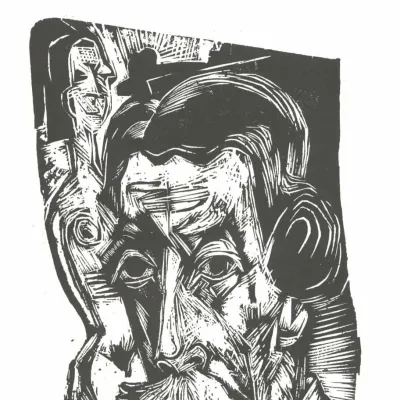
Ludwig Schames
Human Design Chart
Biography
Schames received training as a banker and spent many years alternately in Frankfurt and Paris, where he worked as a banker, and where he was fascinated by the local art scene. He made numerous contacts with artists and compiled an art collection.
In 1885, aged 36, Schames returned from Paris and took part in the family business in Frankfurt, which traded in bedsprings and horsehair. In 1895, together with his business partner Wilhelm S. Posen, he opened 10 "splendid little rooms (at the opera, 1st floor) at Opernplatz ..." This art shop belonged to a new type of gallery, which promoted modern artists, actively conveying their ideas and styles.
The art dealers Posen & Schames specialized in the paintings of French late Impressionism and the art of Fauvism. In 1900, Posen & Schames exhibited works by Jakob Nußbaum, for which the artist himself designed the invitation card.
From 1906 he continued the art shop Posen & Schames alone under the name "Kunstsalon Ludwig Schames". At the same time, his emphasis shifted to the German Expressionists, in particular from the circle of the Neue Künstlervereinigung München such as Wassily Kandinsky, Adolf Erbslöh, Alexei Jawlensky, Alexander Kanoldt and Karl Hofer.
Shames had two children with his wife Fanny. The painter Samson Schames was his nephew. He died on in Frankfurt am Main on 3 July 1922, aged 69.
Human Design Analysis: Ludwig Schames as Projector 1/3
Projector 1/3 — Design at a Glance
Ludwig Schames was someone who immediately recognized weaknesses in systems and relationships. His Projector design was characterized by a dense, focused aura, which he used like a bright flashlight to shine light into the dark for others. He quickly saw what wasn't working in his counterpart. However, this direct confrontation with flaws risked making his environment perceive him as unpleasant, comparable to a light beam directly in the face.
The more effective way to express his design was simply to shine pleasantly. By embodying harmony himself, he became attractive; others sought his advice voluntarily. His strategy was to wait for a respectful and honest invitation before taking on a leadership role.
Since his Sacral Center was undefined, he did not have a constant intrinsic energy source. Instead, he went through phases of high activity followed by necessary rest phases for regeneration. The conventional work environment often did not accommodate this need, increasing the risk of burnout. If Ludwig Schames lived according to this design, he was rewarded with success. If he ignored this structure and the necessity of the invitation, it led sooner or later to his Non-Self theme: bitterness. His path therefore lay in patiently waiting for recognition and sparingly using his focused energy.
Splenic Authority
Ludwig Schames listened to a subtle, spontaneous inner voice to determine if a situation or environment was healthy for him. This inner authority in the Spleen was based on his survival intelligence. Since his Emotional and Sacral Centers were open, only this specific Spleen authority could work in him, typical for Projectors or Manifestors.
His intuition and physical well-being served as reliable indicators of whether he was in the right place. Decisions therefore had to be made in the moment. The first, spontaneous impulse was the right one and immediately served his health. This allowed him to take good care of himself and rigorously distance himself from harmful influences.
This Spleen voice was, however, a very subtle impulse that only came once in the moment. It could easily be ignored or drowned out by other influences. Therefore, his decision-making required high vigilance. A retreat for clarification could be helpful. Since he could only know what was right in the moment, plans could change short-term. Long-term commitments were difficult. He needed a lot of space and flexibility rather than being tied down to fulfill his spontaneous nature.
The 1/3 Profile — Investigator / Martyr
Ludwig Schames was someone who not only gathered knowledge but actively tested it in the fire of practice. His design as a 1/3 Profile set a basic attitude that combined research and adventure: he was a scientist who also had the courage to venture into the unknown. For him, self-earned insights carried the highest seal of quality. When Ludwig Schames made a statement or gave a recommendation, he had previously thoroughly examined it both theoretically and practically. One could trust his judgment because it was based on this double validation.
This approach resulted from the dynamics of his lines. The first line drove him towards preparation and study to find the perfect timing. But the third line challenged him to put this plan into action, even if mistakes were inevitable. This tension between the fear of not knowing enough and the urge to simply try out shaped his path. He learned through trial and error. His individuality he showed boldly, even if this sometimes aroused suspicion in others. But his goal was not perfection in advance, but the reward through experience. He responded and acted only when the right moment came, which he had identified through his preparatory work. So every mistake became a lesson that strengthened his competence.
Split Definition — Defined & Open Centers
Ludwig Schames was characterized by a consistent, trustworthy mental functioning. His defined Ajna Center ensured that he always created concepts and theories in the same, specific way. He was not easily influenced by external factors in his thinking and used his mind to process data and mentally inspire others. This directly affected his communication: His defined Throat Center connected with the Ajna, allowing him to reliably express what he thought. His voice served as a focal point to transform mental content into the world.
At the same time, he possessed a deep, spontaneous body intelligence. His defined Spleen Center gave him a reliable instinct for health and well-being in the moment. He could make intuitive judgments without having to rationalize them. This existential focus was reinforced by his defined Root Center, which gave him a set way to deal with physical pressure and stress to secure material stability and survival.
In contrast, he was open to external influences in other areas. His open Head Center made him vulnerable to mental pressure and the questions of others, which he should not identify as his own. His open G Center also meant that he did not have a fixed identity or life direction but received these through the environment and the right places. His open Heart Center exposed him to the need to prove his worth, while his open Sacral Center made him sensitive to the energy of others, which could lead to exhaustion if he ignored boundaries. Additionally, his open Solar Plexus absorbed emotions from the environment, which he could perceive as a barometer but did not need to personalize.
Channels for logical analysis and spontaneous insight.
Ludwig Schames was someone who questioned patterns and sought out improvable structures. His design tended to control life energy through critical review. This happened through the Judgment Channel 58-18. It connected the vital stamina of the Vitality Gate with the corrective impulse of the Correcting Gate. This configuration drove him to recognize imbalances and logically resolve them to stabilize the collective. He sought the best answer by comparing what worked and what did not.
Parallel to this, he had the ability to develop and express innovative perspectives. The Conditioning Channel 23-43 connected his insights with assimilation. He received spontaneous breakthroughs and processed them to promote efficiency. His thinking was often ahead, but he had to learn to communicate his messages clearly so they would be accepted. Without the right timing, his unique knowledge could be perceived as foreign.
Additionally, other gates influenced him. The Formulating Gate (4) helped him develop formulas for future security and clarify suspicious patterns. The Overthrow Gate (49) challenged him to follow principles and distribute resources in emotional rhythms. The Freedom Gate (53) drove him as a pioneer to start new cycles, while the Inaction Gate (52) allowed him pauses for concentration and pattern correction. Finally, the Mental Mutation Gate (24) supported him in renewing knowledge and finding inner peace. Together, these elements shaped his path of analysis, correction, and innovative transmission.
Individual Circuitry — Circuit Signature
Ludwig Schames was shown through his design as someone who carried two separate, parallel operating energy focal points, characteristic of his split definition. This configuration meant that he did not have a single continuous energy flow but used different energy fields independently of each other.
A key aspect was the Knowledge Circuit. In Ludwig Schames, this circuit specifically connected the Ajna Center with the Throat Center through the Conditioning Channel. This connection allowed him to directly translate conceptual thoughts and visual images into structured expressions. It was less about spontaneous emotional inspiration and more about the ability to clearly and understandably formulate complex ideas so that they could be accepted by others.
At the same time, a second, completely independent stream from the Understanding Circuit was at work. Here, the Judgment Channel connected the Spleen Center with the Root Center. This connection gave him an intuitive ability to recognize dangers or usefulness in his environment instantly and respond with an appropriate energetic reaction. Since these two circuits were not connected in him, these abilities – clear expression of thoughts and intuitive response to the environment – acted as separate, coexisting competencies that he could call upon individually depending on the situation.
Right Angle Cross of Explanation 3
Ludwig Schames revealed himself through a design oriented towards clarity and the uncovering of connections. His chart contained the configuration of the right cross of explanation, a specific arrangement that conveyed a profound ability for analysis and understanding of complex structures. This mechanism fostered an attitude that was not satisfied with superficial explanations but sought the underlying logic that governs events and phenomena.
It was characteristic of Ludwig Schames to collect, organize, and present information in a comprehensible form. The right cross of explanation endows the individual with an inner compass for truth and precision. He aimed to reduce confusion and create orientation through clear, well-founded insights. This energy influenced how he perceived and reacted to his environment: with a sharp eye for details and a drive to separate the essential from the non-essential.
His way of looking at the world was marked by this need for explanation. He sought the reasons why things were the way they were and strove to formulate these insights in a way that was understandable to others. This was not merely an intellectual game, but a deeply rooted life task that significantly shaped his interactions and thinking. Through this configuration, he was called to shed light on dark corners and make complex matters accessible.
Saturn Return · Uranus Opposition · Chiron Return · 2nd Saturn Return — Life Cycles
Ludwig Schames revealed himself as someone who combined structural stability with the readiness for radical changes. His design indicated a tendency to question established forms and to chart new paths, especially when inner maturity and outer responsibility converged.
In 1895, at the age of 43, he opened a fine art shop with Wilhelm S. Posen. This fell during the Uranus opposition, a cycle often leading to fundamental life changes. Here, the inclination towards innovation crystallized into a concrete professional structure.
Around 1900, at the age of 48, the Chiron return occurred. This fulfillment cycle marked the flowering of his incarnation purpose. In this year, they exhibited works by Jakob Nußbaum. It was not about healing but the visible unfolding of his deepest purpose: the mediation of new artistic currents.
In 1906, at the age of 54, Schames continued the fine art shop alone and shifted the focus to German Expressionists. This happened during the second Saturn return. This cycle often demands the full assumption of responsibility and the consolidation of earlier achievements. Schames used this phase to solidify his vision and focus on a specific, avant-garde direction, which underscored his long-term orientation.
Projector · Splenic Authority — Synthesis
Ludwig Schames’ life was marked by a deeply rooted drive to recognize and correct patterns (Channel 58-18). As a projector with a defined mental center and authority in the Spleen, he possessed the ability to quickly grasp what was disharmonious and instinctively judge what was right for him. This combination of analytical sharpness and inner guidance led him to an investigative approach (Profile 1/3), where he arrived at self-discovered insights through repeated experimentation and verification. The recurring professional shifts, evidenced by the opening of the fine art shop (1895) and the successive alignment with the Expressionists (1906), testify to a continuous process of learning, adapting, and refining his judgment.
Simultaneously, his design revealed a fundamental paradox: the necessity to project his insights to bring 'light into the dark' for others stood in tension with the delicate, intuitive Spleen authority that required immediate, spontaneous action. He was destined to recognize errors in the system, yet a too direct approach could provoke resistance. This points to an internal tension between the desire to share his judgments and the need to protect himself and his health, which may have forced him to convey his insights indirectly or at the right moment.
2 Defined Channels
Incarnation Cross - Right Angle Cross of Explanation 3
Solar Return
The Solar Return shows the moment when the sun returns to its exact birth position - your personal solar year.
Life Cycles
Discover the life cycles with a detailed triple view (birth chart, cycle chart, composite).
Human Design Profile
- Type
- Projector
- Strategy
- Wait for the respectful invitation
- Authority
- Splenic Authority
- Profile
- 1/3 - Investigator / Martyr
- Definition
- Split Definition
- Incarnation Cross
- Right Angle Cross of Explanation 3
- Date of Birth
- 11.08.1852 18:30
- Place of Birth
- Frankfurt am Main, GER
Frequently Asked Questions
What was Ludwig Schames' Human Design type?
What Profile did Ludwig Schames have in Human Design?
What Authority did Ludwig Schames have?
What incarnation cross did Ludwig Schames have?
When was Ludwig Schames born?
Discover your own Human Design
Are you also a Projector? Find out in a personal reading how to unfold your leadership qualities and recognize the right invitations.
More Personalities
Back to overviewSissy Spacek

Alain-Fournier

Anémone

Ann-Margret

Bourvil
Christian-Jaque