
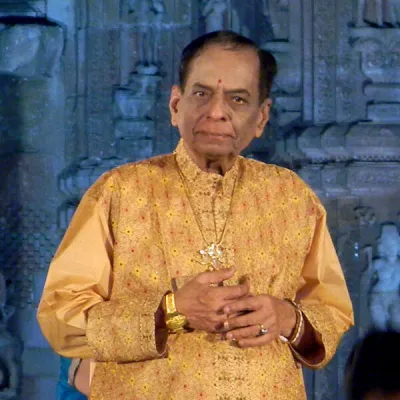
M. Balamuralikrishna
Human Design Chart
Biography
Balamuralikrishna started his career at the age of six. Up to the present time, he has given over 25,000 concerts worldwide. His concerts combine sophisticated vocal skills and rhythmic patterns of classical music with the popular demand for entertainment value.
Balamuralikrishna has composed over 400 compositions in various languages like Telugu, Sanskrit, Kannada and Tamil. His compositions range from Devotional to Varnams, Krithis, Javalis and Thillans, in all the fundamental 72 melakartha ragas to film music.
He made his acting debut with Bhakta Prahlada (1967) under AVM Productions as Narada, and has acted in various films.
What does Generator 5/1 mean for M. Balamuralikrishna?
Generator 5/1 — Design at a Glance
M. Balamuralikrishna revealed himself as someone whose strength did not lie in driving plans forward but rather in powerfully responding to what he encountered. His design as a Generator endowed him with immense endurance and much sacral energy – comparable to a strong workhorse that only brings its full performance when it feels inner resonance for the task at hand. The central dynamic of his essence was waiting for impulses from life and then acting only when his gut feeling signaled a clear “yes”. This reacting rather than initiating was the key to his effectiveness.
Living in harmony with this strategy, by waiting for signals and then responding through action, his design rewarded him with a deep sense of satisfaction and fulfillment. Conversely, ignoring this inner compass led to two significant stumbling blocks: either he wasted his energy on tasks that did not ignite internal enthusiasm – which could quickly lead to exhaustion – or he was held back from his true heart project even though there was still enough power available. In both cases, frustration and a noticeable lack of energy resulted. His ability to realize things in reality thus strictly depended on whether he followed this rhythmic pattern of stimulus and inner confirmation or tried to fight against the flow of his own nature.
Sacral Authority
M. Balamuralikrishna's decision-making was based on direct, physical resonance as a reaction to external stimuli. His inner authority was the Sacral Authority, a mechanism exclusive to the Generator type whose strategy of waiting aligned with this inner guidance. This simplified his process: he did not need intellectual analysis or emotional weighing but reacted to the immediate energetic impulse of his body.
This authenticity showed through a palpable surge of power and a feeling of vitality as soon as his sacral motor was engaged. M. Balamuralikrishna learned to listen to these physical signals – often manifesting as grunts or affirming “mmms”. When this inner motor was active, he had seemingly inexhaustible energy and tackled tasks with great enthusiasm. He lived to immerse himself fully in activities driven by joy and satisfaction without external compulsion.
Ignoring these sacral signals, however, led to frustration and a lack of energy. Since his Emotional Center was open, he could not replace this physical truth with fleeting emotional waves. Instead, he relied on the constancy of his gut feeling. This configuration allowed him to make spontaneous and quick decisions guided by an instinctive access to his own well-being. His life force flowed naturally as long as he waited for and then followed this inner response, which gave him a life in harmony with his natural disposition.
The 5/1 Profile — Heretic / Investigator
M. Balamuralikrishna revealed himself as someone who possessed a magnetic presence and could circumvent rules through creativity or provocation rather than conventional means. This aligned with his Human Design configuration: the Sun was in Gate 39, Line 5. This position endowed him with the ability to cleverly navigate obstacles and provocatively act when necessary during crises to bring about change.
This public “Hero” image stood in contrast to his private nature as an Explorer. As Profile 5/1 – Hero/Explorer – he used the depth of his knowledge (Line 1) to help others solve problems (Line 5). Others often sought him out for solutions, which carried the risk of overexertion, similar to an expert who burns out after days of consulting.
However, Line 1 required time and rest for personal development and shock absorption. It demanded willpower and experience to handle setbacks. M. Balamuralikrishna therefore had to learn to say no in order to preserve energy for his deep research. Only this way could he maintain the balance between his outwardly helpful role and the private necessity of a slower, experiential development process. His design was marked by this dynamic: public effectiveness through rule change paired with the private need for slow, experience-based growth.
Split Definition — Defined & Open Centers
M. Balamuralikrishna's Design clearly distinguished between mental inspiration and physical implementation. His defined Head and Ajna Centers generated a constant pressure to question, understand, and form concepts. However, this mental process lacked direct energy availability as these centers were not connected to the motors; attempting to immediately materialize thoughts often led to frustration. Instead, this continuous thought flow served to inspire or put others under pressure while M. Balamuralikrishna himself had to wait for the right timing.
The actual power source lay in his defined Sacral Center: a massive, constant vital energy that was only accessible through reaction and ensured persistence. These processes were supported by a defined Spleen Center with intuitive survival awareness as well as a defined Root Center providing a constant stress pressure for forward movement.
In contrast, his Throat, G, Heart, and Solar Plexus Centers were open. This meant that communication was situational and dependent on the environment; identity, direction, and love were initiated through interaction rather than self-generated. Willpower was not constantly provided but he absorbed others' egos. He took in emotions and amplified them but lacked independent emotional stability. The central mechanism involved accepting mental pressure without acting it out, waiting for life to react with Sacral energy, and protecting himself from conditioning in open areas through strategy.
Channels for wise doubt, care, meaning and maturation.
M. Balamuralikrishna's Design exhibited a tendency towards strong logical filtering that tested patterns for constancy. This was evident through the Channel of Logic 63-4, representing a doubting mind constantly seeking verifiable evidence instead of giving space to unfounded belief. Simultaneously, M. Balamuralikrishna bore deep responsibility for clan care. The Channel of Preservation 27-50 combined caregiving with traditional values, enabling him to act spontaneously and instinctively to protect and nourish communities often under great personal strain.
A stubborn fighting spirit also characterized his pursuit of individual integrity. The Channel of Life Struggle 38-28 drove him to fight against resistance to find a personal meaning; this process was experienced as mutative and necessary for individuation. Experiences could not be prematurely terminated. The Channel of Maturation 53-42 demanded the complete passage through each cycle to extract collective wisdom from it and allow new orders to emerge from confusion.
Additionally, specific Gates were at work: Gate 57 promoted intuitive clarity in the present moment while Gate 39 induced mutations through provocation and analysis. Gate 51 brought a strong will without social bonds, coupled with the ability to react to shocks. Gate 14 facilitated skillful power accumulation and direction finding. In the Root Center, Gate 58 supported experiments for perfecting life processes through pattern recognition. Finally, Gate 3 in the Sacral Center steered overcoming confusion towards new order while Gate 59 embodied a genetic strategy of binding and pairing independent of personal preferences. This configuration described a person who was logically skeptical but emotionally strong for others' well-being and their own truth.
Collective Circuitry — Circuit Signature
M. Balamuralikrishna's Design presented a divided structure showing two independent energetic poles: a cognitive focus on logical strategy and an instinctive impulse to preserve. This separation did not create a continuous flow between thinking and feeling but rather parallel existing force fields.
In the Understanding Circuit, the Channel of Logic connected the Head with Ajna Center enabling focused, visual information processing free from emotional wave motion. M. Balamuralikrishna used this energy to structure rational insights and share them futuristically driven by the need to logically improve things.
Simultaneously, the Archer Circuit worked through the Channel of Preservation linking Sacral with Spleen Center. Here lay timeless, primordial energy for preserving genetics and family. This connection supported instinctive caregiving and protective mechanisms independent of cognitive process.
Additionally, in the Knowledge Circuit, the Channel of Life Struggle between Spleen and Root Centers brought a pulsating energy of survival struggle strengthening individual identity through mutation and deviation. Parallel to this, in the Meaning Making Circuit, the Channel of Maturation connected Sacral and Root Centers providing cyclical emotional resonance from past experiences that did not blend with the cool logic of the mind.
The dynamics thus existed in the tension field between sober strategic analysis of the future and deep instinctive needs for sustenance and protection. M. Balamuralikrishna integrated these separate systems not as a stream but navigated between rational distance and emotional connection as two distinct, coexisting realities.
Left Angle Cross of Individualism 1
M. Balamuralikrishna's design inclined towards an independent identity that consciously distanced itself from collective norms. He was someone who had to walk his own path rather than blend into the crowd. This attitude stemmed from his configuration of the Individualism Cross 1.
This cross describes a profound drive for self-validation through individual expression forms. The energy of this structure pushed towards establishing one's personality as an independent entity. It wasn't about rebelling just to rebel, but about the necessity to be authentic and true to oneself. M. Balamuralikrishna lived with the inner urge to express his uniqueness while acting independently from external expectations.
The mechanics of this design promoted a clear distinction from the general norm. Those who carry this configuration often feel a strong resistance against what is considered standard or conformity. Instead, there arises a desire for a personal signature that clearly stands out from others. For M. Balamuralikrishna, this meant that his life and actions always bore the stamp of his individual vision. He did not seek validation through adaptation but found strength in consistently pursuing his own unmistakable path. This structure shaped him as someone who formed his identity through continuous self-determination and differentiation.
Saturn Return · Uranus Opposition · Chiron Return · 2nd Saturn Return — Life Cycles
M. Balamuralikrishna's design inclined towards sudden, disruptive changes often experienced as a liberation from established structures. This dynamics was steered by the Uranus Cycle in opposition to the Sun, typically occurring in mid-adulthood. During this phase, the inner need for autonomy and originality pushes against external expectations or earlier identities, which can lead to breaking away from the familiar.
This process became concrete in 1967 when M. Balamuralikrishna at age 37 made his debut as an actor in 'Bhakta Prahlada'. This career shift marked the peak of the Uranus opposition, a time when the design tends to shed old roles and take new, often unexpected paths. It was not a gradual development but a clear break that brought external manifestation of the inner necessity for differentiation. The Uranus Cycle promoted the ability to detach from conventional paths and find one's own expression forms, even if this came with uncertainty or resistance. For M. Balamuralikrishna, this moment showed how his design responded to pressure for change: through concrete action that initiated a new life phase and surpassed previous boundaries.
Generator · Sacral Authority — Synthesis
M. Balamuralikrishna lived a life deeply marked by the ability to act from inner reaction. As a Generator with sacral authority, he found energy and fulfillment in responding to external impulses – a process enhanced by the connection between Root and Sacral Centers. This responsiveness went hand in hand with an acute sense for pattern recognition and logical analysis (Channel 63-4), enabling him to gain new insights and share them. His profile as Hero/Researcher (5/1) suggests that he found joy in deepening knowledge and making it accessible to others, focusing on the individual process of maturation and transformation (Channel 42-53).
Simultaneously, M. Balamuralikrishna's design revealed a paradox between the need for inner clarity and openness to external influences. While the defined Head and Ajna Centers pointed towards logical thinking and inspiration, open Heart and Solar Plexus Centers made him vulnerable to others' emotions. This tension between striving for inner autonomy and the ability to empathize created a dynamic interplay that shaped his path – an ongoing navigation between personal truth and collective consciousness.
4 Defined Channels
Incarnation Cross - Left Angle Cross of Individualism 1
Solar Return
The Solar Return shows the moment when the sun returns to its exact birth position - your personal solar year.
Life Cycles
Discover the life cycles with a detailed triple view (birth chart, cycle chart, composite).
Human Design Profile
- Type
- Generator
- Strategy
- To respond - wait for something to respond to
- Authority
- Sacral Authority
- Profile
- 5/1 - Heretic / Investigator
- Definition
- Split Definition
- Incarnation Cross
- Left Angle Cross of Individualism 1
- Date of Birth
- 06.07.1930 18:40
- Place of Birth
- Sankaraguptam, India
Frequently Asked Questions
What is M. Balamuralikrishna's Human Design type?
What profile did M. Balamuralikrishna have?
Which authority guided M. Balamuralikrishna?
What incarnation cross did M. Balamuralikrishna have?
When was M. Balamuralikrishna born?
Discover your own Human Design
Are you also a Generator? Find out in a personal reading how to use your sacral energy correctly and discover deep satisfaction.
More Personalities
Back to overviewSissy Spacek

Aaliyah

Alexia

Anémone

Angèle

Ann-Margret
