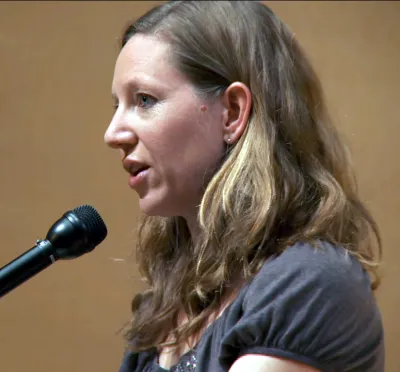
Maggie Nelson
Human Design Chart
Biography
In 2001-2002, 2004-2005, Margaret Nelson worked as a visiting lecturer in poetry at Wesleyan University, Middletown. In 2002-2005, she was a visiting faculty member at New School University. In 2003-2004, Nelson was a writing instructor at Pratt Institute and the curator at The Poetry Project. In 2005, she moved from New York City to join the faculty at California Institute of the Arts, where she has taught a wide variety of courses in art, literature, writing, theory, and cultural studies for 12 years. She also worked as a director of the creative writing program at California Institute of the Arts. She has been a professor of English at the University of Southern California since 2017.
Her most famous book is The Argonauts published in 2015. It mixes philosophical theory with memoir. The book discusses her romantic relationship with the transgender artist Harry Dodge leading to her pregnancy as well as topics ranging from the death of a parent, transgender embodiment, academia, familial relationships, and the limitations of language. Nelson also explores and criticizes ideas from several philosophers including Gilles Deleuze, Judith Butler and Eve Kosofsky Sedgwick. The title is a reference to Roland Barthes' idea that to love someone is similar to an Argonaut who constantly replaces parts of their ship without the ship changing names.
Human Design Analysis: Maggie Nelson as Manifesting Generator 6/2
Manifesting Generator 6/2 — Design at a Glance
Maggie Nelson's Design shows a tendency towards hybrid dynamics: She has the constant energy of a Generator paired with the ability to skip steps and quickly draw results into her life. This configuration as an Manifesting Generator describes someone who not only reacts to impulses but executes these reactions at a speed that bypasses traditional processes.
The mechanics reveal two central challenges. First, there is the risk of skipping important intermediate steps through excessive speed, which would require catching up later and could lead to frustration – a state corresponding to this type's lack of self. Second, her design tends to respond simultaneously to many different impulses and start multiple projects at once. Without strictly adhering to the strategy of waiting until the sacral center gives a clear "yes" before acting, this creative force quickly turns into overwhelm.
However, when inner authority is engaged, this structure transforms. Maggie Nelson's chart describes a source of deep satisfaction in creation, provided she regularly checks whether her projects still resonate with her. In this state, working on multiple things at once is not an obstacle but necessary for her well-being. The pressure to finish one thing before starting the next proves counterproductive. Instead, accessing the "play mode" and variety in the process leads her specific energy form to be effective: fast, versatile, and satisfying when applied correctly.
Emotional Authority
Maggie Nelson's design indicated a tendency towards emotional depth and delayed clarity. She was someone who did not make decisions on impulse but consciously embedded them in a process of maturation. This resulted from her inner authority: Emotional Authority.
In Human Design, the defined Solar Plexus Center carries this authority. A central rule of this mechanism states that Emotional Authority always takes precedence over all other defined centers, regardless of which additional strategies or authorities are present in the chart. Maggie Nelson thus followed a natural emotional wave, a permanent up and down of her feelings. The world appeared to her colored by her current mood; a moment of enthusiasm could quickly turn into a negative outlook.
Her design pointed to the fact that feeling in the moment was merely a snapshot, not yet the final truth. Quick, spontaneous decisions made from such an emotional state often proved detrimental. Instead, her system required patience and multiple reconsiderations of important questions. Over time, intense feelings subsided, allowing her to gain emotional distance. Only then did clarity and calmness set in for long-term life decisions. This process of waiting was not a hindrance but the essential mechanism for recognizing her inner truth.
The 6/2 Profile — Role Model / Hermit
Maggie Nelson's design indicates a tendency towards intensive inner work, particularly in the phase after turning thirty years old. Before this threshold, her Profile 3/2 manifested as an experimental approach: trial and error characterized her early years, followed by necessary withdrawals for processing. Around age 30, however, the 6-line of the Profile "Role Model / Natural Talent" activates. This marks a profound shift towards distance and reflection.
The mechanics describe this process as retreating into a metaphorical cave to view past experiments with great calmness. This period serves for healing and deeper self-knowledge. The 6-line represents maturity, metamorphosis, and the alignment of form and content; it brings forth nonconformist openness and creates a new societal foundation through mutation. Simultaneously, the 2-line with its themes of inflexibility and rigor comes into play. Here: boredom arises when ideas cannot be shared externally or if their maturation is neglected. Those who develop their ideas overcome this stagnation.
From this configuration, Maggie Nelson emerges as someone who gains wisdom through intensive introspection. Once the period of inner clarification is complete, she re-emerges to engage with others. People then seek her out for her life insights and to learn the ability for deep self-reflection. She becomes a role model not through external pressure but through the authentic integration of her own transformation experiences.
Split Definition — Defined & Open Centers
Maggie Nelson's design shows a tendency towards consistent but limited self-expression. Her defined Throat Center acted as a focal point for messages from the entire body, making her communication and actions reliably structured. This voice was fueled by her defined Sacral energy, an immense power source that she generated daily. For Maggie Nelson, it was essential to listen to this sacral response – a mechanical yes/no tone – to know if energy was available for a task. Initiating actions without such reactions led to resistance and frustration in her, while reactive activities were carried by her vital endurance.
Her inner authority lay in the defined Solar Plexus Center. Maggie Nelson showed herself as someone who did not make decisions in the 'now', but waited for an emotional wave. Emotional clarity arose for her only over time; impulsive reactions in highs or lows of her mood were signs of non-self. By waiting, she reached a deeper sensitivity and intelligence that colored her environment. Additionally, she had a defined Spleen Center, which gave her spontaneous, intuitive knowledge in the moment. This existential awareness warned her of dangers and ensured well-being based on a non-verbal recognition of what was healthy. The pressure of her defined Root Center drove her physically forward, supported by these structuring energies.
In contrast, her undefined centers revealed specific vulnerabilities. Her open Head and Ajna Centers did not mean constant mental processing; Maggie Nelson tended to engage with questions or concepts that were not her own topic, which could lead to confusion. She was open to external inspiration but had to learn not to seek answers where none existed. Her open G Center lacked a fixed identity; she adapted to the environment and often sought 'borrowed' direction or love. The danger lay in meeting the wrong people at the wrong place and concluding about herself from that. Finally, her Heart Center was open: Maggie Nelson had no consistent willpower in terms of ego-setting. She tended to want to prove her worth through promises or competitive thinking, which ended in a cycle of self-doubt if she failed. The solution lay in not needing to prove anything and trusting her sacral as well as emotional authority instead of succumbing to the pressure of non-self ego.
Channels for focus, emotional depth, ambition, change and maturation.
Maggie Nelson's design shows a tendency towards precise focus paired with emotional restlessness for new experiences. Channel Concentration 52-9 connects Root and Sacral Center through Gate Non-action (52) and Gate Focusing (9). This structuring energy created a calm pressure to hold still and keep distractions away, to logically assess details. It worked like a yoga pose: the body held steady so that the energy could be used precisely. Without this focus, she felt restlessness; with it, she perfected patterns into which she had entered.
At the same time, Channel Transience 35-36 drove her to seek emotional depth and new impressions. As a connection between Solar Plexus and Throat Center, it linked Gate Change (35) with Gate Crisis (36). This channel resisted restrictive patterns and actively sought adventures to expand the gene pool. The emotional wave determined timing: only when the mood was right could she share these experiences authentically and serve as an advisor to others.
Channel Openness 22-12 regulated her social interaction through caution (Gate 12) and passion (Gate 22). She used her voice to emotionally touch others, but only if she felt like it. Forced communication led to harshness; patience enabled transformative communication.
Channel Transformation 54-32 connected Ambition (Gate 54) with Continuity (Gate 32). It motivated her to improve her position through consistent effort and be supported by the tribe. This drive for recognition served the survival of the collective.
Channel Maturation 53-42 closed cycles. Through Gate Beginnings (53) and Gate Growth (42), she learned to fully go through experiences and derive wisdom from them for others.
Additionally, Gates like 47 (Purpose from Confusion), 11 (Visual Memory), 39 (Provocation towards Mutation), 41 (Evolutionary Feeling), 34 (Power in Sacral Center), 14 (Skillful Power Accumulation), 18 (Correction of the Corrupt) and 38 (Resistance for Integrity) influenced her life. This configuration characterized a life swinging between focused logic, emotional exploration, and striving for collective progress.
Collective Circuitry — Circuit Signature
Maggie Nelson's design is marked by two separate energetic poles: on one side, a strong connection between Throat and Solar Plexus Centers; on the other, an interplay of Sacral, Root, and Spleen Centers. This split structure means these areas do not communicate directly with each other but act as parallel existing energy fields.
In the Knowledge Circuit, Channel 'Openness' connected Throat with Solar Plexus Center. This shaped a tendency to translate emotional waves and individual impulses directly into expression without long delays. The energy was pulsing and acoustically driven by the need to articulate one's own feeling in the here and now.
The Understanding Circuit showed through Channel 'Concentration' between Sacral and Root Centers. Here, focused rational energy aimed at strategically carrying logical insights into the future. It was an emotionless ratio that sought structure and improvement independent of current emotional states.
In the Meaning-Finding Circuit were two separate segments active: again Throat and Solar Plexus Center as well as Sacral and Root Center. Channel 'Transience' emphasized the cyclical nature of emotional insights, while 'Maturation' aimed at learning from the past. Since these centers were not directly connected to the other pole, emotional reflection remained an independent process alongside rational strategy.
Finally, in the Ego Circuit, Channel 'Transformation' linked Spleen and Root Centers. This promoted intuitive security in resource acquisition and cooperation. Without direct connection to G Center or identity, this support was purely functional and aimed at collective creation, separate from individual self-worth questions.
Left Angle Cross of Informing 1
Maggie Nelson's design suggests a tendency towards a deep, almost instinctive urgency to carry inner truths outward. She is someone who does not just convey information but whose communication is driven by an inner necessity to make the invisible visible and understandable.
This attitude stems from what is known as the "left cross of sharing." In Human Design mechanics, this configuration describes a specific kind of expressive ability: it's not about superficial small talk or purely logical argumentation, but rather conveying meaning and significance. Those who carry this cross often have the ability to articulate complex feelings or abstract ideas in words that resonate directly with others. The energy lies in "sharing" itself – in the process of sharing, which creates a connection.
For Maggie Nelson, this meant that her way of expressing herself was less a choice than a natural flow. She had the potential to build bridges between what was happening inside her and the outside world. The challenge always lay in structuring this intense communication energy clearly so that the message not only reaches but also comes across precisely. Her design supported her in functioning as a channel for deeper insights, with the authenticity of expression taking precedence.
Saturn Return · Uranus Opposition · Chiron Return — Life Cycles
Maggie Nelson's design revealed a tendency towards radical and often unexpected innovation. She emerged as someone who questions established structures and replaces them with personal, unconventional perspectives. This attitude stemmed from her Uranus position: a planet that represents the individual, revolutionary, and breaking of conventions. While others seek adaptation, her chart tended to strive for unique expression – even if this brought about isolation or misunderstanding.
In 2015, at age 42, Maggie Nelson published "The Argonauts." This event marked a peak in her career and served as concrete evidence of the mechanics of her design. The Uranus phase promoted precisely such moments when inner truths must push outward, regardless of societal norms. The book was not a conventional product but an experimental form that blurred genre boundaries – typical for someone whose design is geared towards originality rather than reproduction.
Moreover, the opposition in her chart pointed to tensions: between the desire for freedom and the demands of the outside world. Maggie Nelson navigated this tension by maintaining her voice instead of conforming. Her work thus became a mirror reflecting an inner dynamic that is not silently accepted but actively challenged.
Manifesting Generator · Emotional Authority — Synthesis
A central red thread in this design is the dynamic interaction between inner perception and outer expression. The emotional authority (Sacral Center defined) demands a maturing, emotionally processing before acting, while the Manifesting Generator type (defined Throat) has the impulse to quickly initiate and transform things (Channel 52/9). This combination creates a process in which energy is present but only through emotional depth and reflection can it fully unfold its effect – a constant swing between inner maturation process and outer shaping power. The profile as role model (6/2) reinforces this cycle: intense personal experience followed by withdrawn reflection to ultimately share wisdom.
The central paradox lies in the tension between the need for inner stillness and the ability to initiate rapid changes. The defined Root Center (Channel) signals a deep drive to focus on details and format things, while the emotional wave requires a period of waiting and feeling. This apparent discrepancy between quick action and emotional maturation leads to an internal field of tension that both releases creative energy as well as necessitates phases of reflective withdrawal – a play between movement and stillness.
5 Defined Channels
Incarnation Cross - Left Angle Cross of Informing 1
Solar Return
The Solar Return shows the moment when the sun returns to its exact birth position - your personal solar year.
Life Cycles
Discover the life cycles with a detailed triple view (birth chart, cycle chart, composite).
Human Design Profile
- Strategy
- To respond - wait for something to respond to
- Authority
- Emotional Authority
- Profile
- 6/2 - Role Model / Hermit
- Definition
- Split Definition
- Incarnation Cross
- Left Angle Cross of Informing 1
- Date of Birth
- 12.03.1973 17:58
- Place of Birth
- San Francisco, CA, United States
Frequently Asked Questions
What is Maggie Nelson's Human Design type?
What profile does Maggie Nelson have in Human Design?
Which authority guides Maggie Nelson's decisions?
What incarnation cross is assigned to Maggie Nelson?
When was Maggie Nelson born?
Discover your own Human Design
Are you also a Manifesting Generator? Find out in a personal reading how to unfold your multi-talents and direct your energy wisely.
More Personalities
Back to overviewAldair

Alizée

Angeli

Arletty

Artus

Balthus