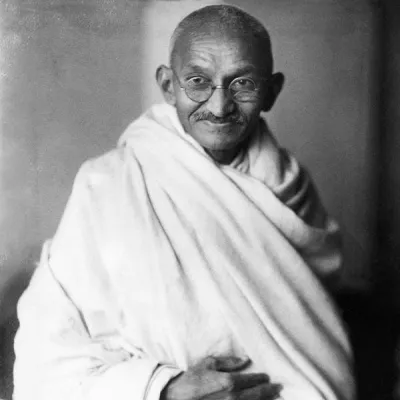
Mahatma Gandhi
Human Design Chart
Biography
What does Generator 6/2 mean for Mahatma Gandhi?
Generator 6/2 — Design at a Glance
Mahatma Gandhi was a Generator. His design endowed him with immense endurance and the ability to generate energy over long periods of time. He worked like a strong workhorse, whose strength flowed efficiently only when he responded to external impulses. The central mechanics of his type did not lie in initiating but rather in reacting. His sacral energy was primarily released when life called out to him and his inner self gave a clear 'yes'.
This dynamic created two specific challenges. First, there was the risk of wasting his strength by doing things that lacked internal desire. This tended towards frustration or exhaustion. Second, there was the risk of being prevented from pursuing his heart's project even though his energy level was still high and he wanted to continue working.
Therefore, successful use of his nature required a clear strategy: He had to wait for signals from the environment and then act upon them. When his gut feeling signaled that it was time to start, he could respond with full power. Living by this principle rewarded him with a deep sense of fulfillment. Ignoring this inner guidance or trying instead to initiate independently led sooner or later to persistent frustration and a lack of energy. His strength thus did not lie in pushing forward but rather in the powerful response to what was presented to him.
Sacral Authority
Mahatma Gandhi was a Generator whose internal authority lay in his defined Sacral Center. This configuration fundamentally determined his decision-making: He reacted to external stimuli instead of initiating. With his open Emotional Center, he could clearly perceive this sacral guidance. It manifested as a physical voice – a grunting, humming or clear 'mm-hm' when resonating and a negative signal in case of misalignment.
This mechanism gave him a specific vitality. When his sacral motor engaged with something, he had seemingly inexhaustible energy and completed tasks with great enthusiasm. Gandhi was born to immerse himself entirely in his duties without them needing an external purpose. His satisfaction arose from the act itself, not from an abstract goal.
This simplified his process significantly as strategy and authority were identical: Reacting. Through activation of his Spleen Center, which was connected with the Sacral Center, he received a supportive instance for quick, spontaneous judgments. This allowed him immediate access to his physical well-being and instinctive perception. He relied reliably on this inner compass that signaled when an engagement would give life energy and when it would cost energy. Thus, he lived in a state of natural alignment, driven by the direct physical confirmation of his actions.
The 6/2 Profile — Role Model / Hermit
Mahatma Gandhi followed a clear evolutionary arc prescribed by his Profile 6/2, the Role Model/Natural Talent. In his youth, before the age of thirty, the experimental energy of Line 3 – triggered by the still dormant 6-line – dominated. This phase was characterized by trial and error; Gandhi learned through personal action and withdrew after mistakes to process them. The 2-line contributed the natural talent for provocation, a necessary nudge to the environment to overcome obstacles or draw attention. Simultaneously, it ensured self-preservation through withdrawal in emotional discomfort.
After his thirtieth year, the 6-line fully activated. Gandhi metaphorically retreated into a cave on a mountain to look back at his earlier experiments with great distance. This period of intense reflection served for healing and deep self-awareness. The 6-energy brought the ability to correct – an enjoyable process for him – as well as the impulse to form public opinion. He strove towards perfection and Buddha-nature, ready to open new horizons. Finally, he emerged from this isolation as a wise person. Others sought him out to partake in his life wisdom and learn the art of deep introspection from him. His role became the propagation of a specific kind of correction, supported by his ability to see solutions for the next step in the Life Hexagram.
Triple Split Definition — Defined & Open Centers
Mahatma Gandhi's design established a tendency towards constant internal structure. His defined Ajna, G, and Sacral centers created a reliable foundation: clear mental concepts, firm identity, and available vital energy through reaction. This mechanical stability was complemented by the intuitive Spleen center and the specific stress management of the Root center.
At the same time, his openness to external influences manifested in Head, Heart, and Solar Plexus centers. The open Head center made him vulnerable to absorbed inspiration or confusion without his own constant mental processing. He tended to feel the pressure to answer others' questions, which could distract him from his own decision-making process.
The undefined Heart center lacked consistent willpower. Here, the typical trap of trying to prove worth through performance or promise emerged – a cycle that led to self-doubt in case of failure. His mechanics did not allow him to be competitive; instead, this center often reflected the ego demands of his environment.
The open Solar Plexus center acted as an emotional barometer. It absorbed and amplified foreign emotions, leading him to fluctuate between happiness and depression without always attributing these emotions to their own origins. The fear of confrontation often arose from a desire not to disturb the emotionally taken-in waves further.
This combination described a person with a strong inner compass (G center) and energy source (Sacral), who, however, situatively responded to mental, willful, and emotional atmospheres in his environment. His strength lay in reacting to life while his challenge was not getting caught up in the mental or emotional whirlpool of others.
Channel 15-5: The Rhythm — Channels & Gates
Mahatma Gandhi's design established a tendency towards authentic flow and stubborn integrity. His energy worked through the synthesis of inner rhythms, logical detail work, and an individual struggle for meaning.
The Rhythm Channel 5-15 connected his Sacral center with the G center. Gate 5 held fast to fixed habits while Gate 15 integrated the diversity of society into the life flow. This generated a biological magnetism and unique timing that unconsciously drew others into his energy flow and determined the course of a group.
Parallel to this, he organized information mentally through the Accepting Channel 17-62. Gate 17 visualized patterns in the Ajna center while Gate 62 translated these details into language. This allowed him to logically structure and communicate opinions and complex issues clearly if invited to speak.
The driving force came from the Life Struggle Channel 38-28 between Root and Spleen centers. Gate 38 pushed for the maintenance of individual integrity against external distractions, while Gate 28 recognized which struggles had value. This gave him a stubborn determination to fight for his life's meaning and serve as an example for others' individuation.
The prioritized gates underscored this mechanism: Gate 18 discriminated between necessary corrections in the collective process, often focusing on human rights. Gate 39 used provocation and analysis to trigger mutations. Gate 31 energetically transferred leadership forces to others to achieve impact. This configuration created an energy that propelled collective patterns through clear communication and authentic resistance.
Collective Circuitry — Circuit Signature
Mahatma Gandhi's design presented three separate, parallel acting energetic poles. One pole connected the Spleen with the Root center via the Life Struggle Channel (28-38). This created a pulsating, acoustic energy of creativity and individual reinforcement based on new knowledge and initiating transformation.
A second, unconnected pole linked the Ajna with the Throat center through the Accepting Channel (17-62). Here, focused visual energy operated to share logical insights free from conditioning. A third, also isolated pole connected the Identity with the Sacral center via the Rhythm Channel (15-5). This allowed an emotionless ratio for strategic societal improvement and leadership towards a better future.
This triple definition meant that these forces did not flow into each other but existed as separate systems: the creative emotional wave of the Knowledge Circuit stood alongside the structured rational logic of the Understanding Circuit. Gandhi was marked by this synthesis of creative pulse and focused ratio, where each area maintained its own dynamics without being directly fed by the others.
Left Angle Cross of Upheaval 2
Mahatma Gandhi's design carried the archetypal structure 'The left cross of revolution 2'. This configuration set a fundamental tendency towards profound changes, where old structures were not simply repaired but fundamentally broken through. The cross of revolution describes in Human Design an energetic focus on change itself – not as coincidence, but as a central life principle. It is about the ability to point out a new direction in moments of uncertainty or disintegration by breaking away from the known and letting something new emerge.
For Mahatma Gandhi, this meant that his path was marked by phases where existing orders were questioned and transformed. The energy of this cross often acts like a catalyst: it overcomes stagnation by awakening the courage to start anew. It is not a quiet development but a dynamic process that can sometimes generate discomfort because it dissolves security. Yet precisely therein lies the power of this structure – it allows one to break out of old patterns and open up for a more authentic existence form.
Without delving into specific gates or channels in detail, it remains clear that this archetypal form guided Mahatma Gandhi's actions towards revolution. His life was marked by the necessity to initiate changes and be part of these transformations.
Saturn Return · Uranus Opposition · Chiron Return · 2nd Saturn Return — Life Cycles
Mahatma Gandhi's life followed a clear cyclical structure, shaped by recurring astrological phases that structured his development. The first Saturn return marked 1896 at age 27 as a turning point: He returned to India for six months to bring his family back and publish writings on the situation of Indians in South Africa. This signaled the beginning of a phase of consolidation and public positioning.
Ten years later, in 1909 at forty, the Uranus opposition occurred. This cycle often promoted breaks or new perspectives; Gandhi traveled to London where he met radical Indian revolutionaries, expanding his strategic networks.
The Chiron return around age 48 was understood as a fulfillment cycle in which his inner purpose increasingly unfolded outwardly. In 1917 Jawaharlal Nehru became his secretary – a relationship that embodied this phase of spiritual transmission and growing influence.
The second Saturn return concluded this period. In 1927 at age 58, Gandhi published his first autobiography 'Autobiography: The Story of My Experiments with Truth'. This publication condensed years of experience into a coherent work and signaled the maturity of both his personal and political stance. The cycles did not act in isolation but together formed a red thread from early definition through radical exchange to long-term legacy building.
Generator · Sacral Authority — Synthesis
He was a Generator, whose life was marked by a deep rhythm (Channel of Rhythm) – a constant energy source activated by external stimuli that put him into a state of vibrant endurance. This sacral authority led him to activities he devoted himself to with enthusiasm as long as they were in harmony with his inner reaction. The profile as role model indicates that early years were characterized by an experimental spirit and the selection of one's life path, followed by a phase of intense reflection and wisdom that attracted others. The defined Ajna Center showed itself in consistent conceptual thinking that created concepts and inspired others.
A central paradox lay in the connection between deeply rooted habits (Gate 5) with the desire for change and innovation (Knowledge Circuit). While he lived a firm inner rhythm, he was simultaneously a catalyst for transformation by generating and spreading new knowledge. The cycles confirm this trait: career phases marked by creative expression and sharing his life wisdom alternated with periods of self-discovery and reflection – a steady movement between constancy and revolution.
3 Defined Channels
Incarnation Cross - Left Angle Cross of Upheaval 2
Solar Return
The Solar Return shows the moment when the sun returns to its exact birth position - your personal solar year.
Life Cycles
Discover the life cycles with a detailed triple view (birth chart, cycle chart, composite).
Human Design Profile
- Type
- Generator
- Strategy
- To respond - wait for something to respond to
- Authority
- Sacral Authority
- Profile
- 6/2 - Role Model / Hermit
- Definition
- Triple Split
- Incarnation Cross
- Left Angle Cross of Upheaval 2
- Date of Birth
- 02.10.1869 07:08
- Place of Birth
- Porbandar, India
Frequently Asked Questions
What was Mahatma Gandhi's Human Design type?
Which profile did Mahatma Gandhi have?
What authority did Mahatma Gandhi have?
What incarnation cross was assigned to Mahatma Gandhi?
When was Mahatma Gandhi born?
Discover your own Human Design
Are you also a Generator? Find out in a personal reading how to use your sacral energy correctly and discover deep satisfaction.
More Personalities
Back to overviewAaliyah

Aldair

Alexia

Angèle

Anne-Marie

Arcángel