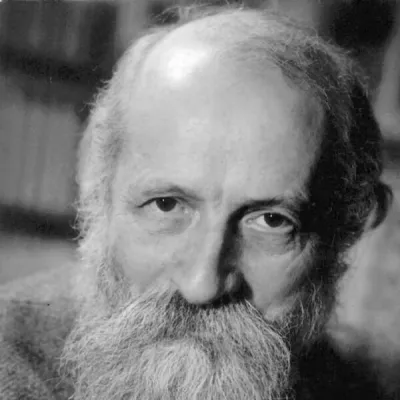
Martin Buber
Human Design Chart
Biography
He was nominated for the Nobel Prize in Literature ten times, and the Nobel Peace Prize seven times.
What does Projector 1/3 mean for Martin Buber?
Projector 1/3 — Design at a Glance
Martin Buber's design inclined towards focused perception. As a projector, he did not have an intrinsic energy source like the sacral center provides but rather worked through a dense aura that immediately revealed problems in others' surroundings. This ability was akin to a bright flashlight shining directly into dark corners and exposing flaws in another person's system.
However, this direct confrontation could be perceived as unpleasant, similar to light shining directly into someone's face. Therefore, his strategy did not involve actively correcting or instructing but rather waiting until others respectfully invited him to ask questions. Only then could he share his insights effectively without causing resistance.
His energy flow was rhythmically marked: phases of high activity alternated with necessary rest periods to prevent burnout. If he followed this invitation and waiting strategy, his work would be rewarded with success. Ignoring this mechanism and intervening uninvited led sooner or later to his non-self theme: bitterness over the inability of others to accept his leadership.
No Inner Authority
Martin Buber did not possess inner authority – an extremely rare configuration that set him apart from most people. He did not seek answers in a single, stable internal compass but rather in the living exchange with others. As a mental projector, he had no defined centers below the throat; his energetic system was largely open. This openness allowed him to activate dormant potentials through dialogue with various individuals and view issues from multiple perspectives. The interaction provided him with the necessary information to grasp a situation holistically.
However, this process of information gathering was complex and required time for digestion. Martin Buber withdrew to recognize the red thread in the chaos of impressions alone. He learned to filter out what is essential and structure it meaningfully – his specific intelligence developed precisely through this sorting ability. Crucial to this path was the quality of his environment: In a circle of trust with compatible people, he deepened his sense for what truly suited him. He used the resonance capability of his open centers to gain clarity in exchange rather than listening to a rigid internal voice. His success depended on not blindly following external impulses but bringing them into personal order through calm and distance.
The 1/3 Profile — Investigator / Martyr
Martin Buber's design inclined towards profound research paired with an unrelenting drive for practical experimentation. As someone with Profile 1/3 – the Researcher and Experimenter – he collected knowledge not just theoretically, but tested it rigorously in practice. His Line 1 pushed him to understand necessary fundamentals, while Line 3 challenged him to actively test these insights and learn from mistakes. This process of trial and error was central for him: Only through personal experience could he judge if an idea was truly viable. When Martin Buber recognized something as valuable, he had validated it both intellectually and practically; his judgment thus rested on tested viability. The mechanics of his design required adaptability and the willingness to form connections regardless of external criticism. This is reflected in the dynamics that he stood between knowing his insights and tolerating critique to further this wisdom. His path was marked by revolutionizing old structures with new, viable principles that he only supported once proven superior through experimentation.
Single Definition — Defined & Open Centers
Martin Buber's design created a tendency towards constant mental pressure to ask questions and seek answers. This configuration between the Head Center and Ajna Center generated a permanent inner drive to understand connections. Since there was no direct energy available for implementing these thoughts, his focus was on inspiring others to think deeply rather than manifesting solutions himself. His defined Throat served as a reliable channel to translate these conceptual processes into clear communication.
At the same time, Martin Buber showed high receptivity to external influences due to several open centers. His open G Center meant he did not carry a fixed identity but was shaped by the right environments and encounters; he tended to seek the right place rather than follow a predetermined direction. The open Heart Center made him vulnerable to the pressure of proving his worth, often ending in cycles of promises and disappointment if he didn't trust his inner authority. Additionally, his open Solar Plexus absorbed the emotions of his surroundings, putting him at risk of personalizing foreign moods and feeling emotionally overwhelmed. His open Sacral Center led to taking energy from the environment, which could result in exhaustion without a steady internal life force. These opennesses challenged him to practice patience and wait for the environment to offer the correct initiation rather than actively seeking identity or validation.
Channels for logical doubt and structured expression.
Martin Buber's design established a fundamental disposition characterized by critical scrutiny and a need for clear structuring. His mind did not seek blind faith but verifiable patterns. This was most evident in the Logic Channel 63-4, connecting the Head Center with the Ajna Center. Through the Gate of Doubt (63) and the Gate of Formulation (4), his mind continuously filtered patterns to see if they were consistent. Inconsistency triggered pressure that eventually led to a question demanding an answer. For Martin Buber, skepticism was essential; an answer was only considered logical if it proved itself in a consistent, practical pattern.
This analytical sharpness was complemented by the Channel of Structuring 23-43, connecting Ajna with Throat Center. Here, the Gate of Insight (43) and the Gate of Assimilation (23) were at work. Spontaneous breakthroughs were not only thought but poured into an original perspective and expressed. This connection allowed him to formulate innovative thinking in a way that changed how others saw and thought. It was a mutative process, promoting efficiency by clearly explaining complex connections.
Additionally, individual gates influenced his disposition. Gate 49 in the Solar Plexus brought an emotional wave that shaped discernment regarding principles and sacrifice. Gate 61 stood for inner truth and the struggle for silence, while Gate 8 fostered a need for individual contribution and leadership in group contexts. Martin Buber's design thus combined logical verification with the ability to linguistically structure new insights and make them accessible to the collective.
Individual Circuitry — Circuit Signature
Martin Buber's design showed a clear orientation towards mental clarity and structured communication. Through the simple definition in Head, Ajna, and Throat Centers, there was a continuous energetic flow linking logical thinking directly to expression. This marked him as someone who did not keep inner insights to himself but articulated them purposefully.
The Understanding Circuit worked through the Logic Channel (63-4), connecting the Head Center with the Ajna Center. This connection promoted the ability to filter intuitive impulses from the head through rational structuring in Ajna and transform them into clear strategies. It was about 'emotionless ratio': sharing logical insights for future improvement, free of conditioned patterns.
Parallel to this, the Knowledge Circuit worked through the Structuring Channel (43-23), connecting Ajna and Throat Centers. This channel enabled expressing thoughts structured in Ajna through the Throat Center. While this circuit generally also encompasses creativity and emotional waves, for Martin Buber primarily the ability to formulate precisely was active. The connection from Ajna to throat ensured that understood knowledge was put into words that could reach others.
Both circuits utilized the Ajna Center as an interface: one provided logical foundations from the head, the other external expression. Since all three centers belonged to a group, this resulted in a continuous process of impulse through processing to articulation without energetic breaks or separate segments.
Right Angle Cross of Explanation 1
Martin Buber's design inclined towards a clear and explanatory approach. He was someone who felt the need to not only experience connections but also to explain them in a way that others could understand. This orientation stems from the right cross of explanation 1, a configuration associated with the ability to translate complex inner processes or spiritual insights into logical, comprehensible language.
While others might have acted intuitively or emotionally, Martin Buber's approach was characterized by the necessity to structure and communicate experienced content. It wasn't just about presenting personal truth but formulating it in such a way that it resonates with others and can be understood. This mechanism fostered a type of thinking that bridges experiencing and understanding. He didn't use his intuition solely for himself but transformed it into explanatory impulses aimed at creating clarity. By doing so, he had a strong drive to make the invisible visible and the hidden accessible by organizing and explaining it linguistically. His impact thus relied on the connection between inner perception and external communication, where explanation itself became the central means of conveying depth and involving others in a process of understanding.
Saturn Return · Uranus Opposition · Chiron Return · 2nd Saturn Return — Life Cycles
Martin Buber's design shaped a life path where internal attitudes condensed into concrete, sustainable structures. This tendency was evident during his first Saturn return in 1907 at age 29: His marriage to Paula Winkler after her conversion marked the transition from personal search to binding commitment – a typical moment when long-term commitments find their place.
The Uranus opposition around 1916 (age 38) promoted the need for collective voice and innovation. This was realized through the founding of the magazine 'Der Jude' together with Salman Schocken, an initiative that translated individual impulses into public format.
His Chiron return around 1925 (age 47) ushered in a phase of bloom and fulfillment of his incarnation purpose. Here he began translating the Hebrew Bible into German – a task not seen as healing but as the completion of his deepest life mission: to convey the essential in understandable language.
The second Saturn return in 1938 (age 60) brought another consolidation and demarcation. His escape from the NS state to Jerusalem was not merely an act of flight, but a strategic safeguarding of his existence foundation and functioning in a new environment. Buber's path demonstrates how cyclical phases of condensation (Saturn) and expansion (Uranus/Chiron) structured his life: from partnership over public voice to linguistic mediation and finally the protection of one’s own space.
Projector · No Inner Authority — Synthesis
Martin Buber was a mental projector whose life was marked by a constant drive towards understanding and communicating this understanding. The lack of inner authority (no center definition below Throat Center) required interaction with others to gain clarity – a resonance capability amplified by his open center system. This process of cross-checking and filtering information (Channel 63-4) led to profound insights that he then passed on. Repeated turning points in his career, marked by events like founding magazines or translating the Bible, reflect the profile of researcher/experimenter (1/3): a continuous testing and verifying of knowledge through personal experience.
Central to Buber's design was however a paradox between the need for deep analysis and the resulting mental concern (defined Head-Ajna Center). On one hand, he incessantly sought logical patterns and answers; on the other, this process through the logic channel intensified doubts and questions. This led to an internal tension between the desire for certainty and acceptance of uncertainty – a field of tension that manifested in his life cycles (Saturn returns, Uranus oppositions), as he both embarked on new paths and faced the consequences of his decisions.
2 Defined Channels
Incarnation Cross - Right Angle Cross of Explanation 1
Solar Return
The Solar Return shows the moment when the sun returns to its exact birth position - your personal solar year.
Life Cycles
Discover the life cycles with a detailed triple view (birth chart, cycle chart, composite).
Human Design Profile
- Type
- Projector
- Strategy
- Wait for the respectful invitation
- Authority
- No inner authority - learn more
- Profile
- 1/3 - Investigator / Martyr
- Definition
- Single Definition
- Incarnation Cross
- Right Angle Cross of Explanation 1
- Date of Birth
- 08.02.1878 06:58
- Place of Birth
- Vienna, Austria
Frequently Asked Questions
What was Martin Buber's Human Design type?
Which Profile did Martin Buber have in Human Design?
What Authority guided Martin Buber?
What incarnation cross did Martin Buber have?
When was Martin Buber born?
Discover your own Human Design
Are you also a Projector? Find out in a personal reading how to unfold your leadership qualities and recognize the right invitations.
More Personalities
Back to overviewSissy Spacek

Alain-Fournier

Anémone

Ann-Margret

Bourvil
Hergé