
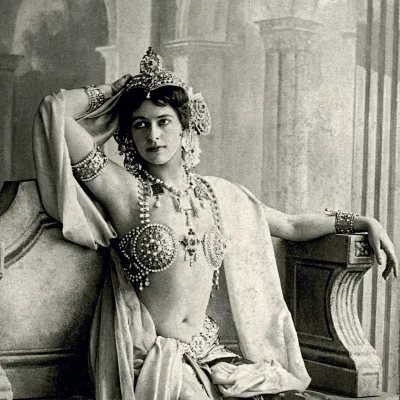
Mata Hari
Human Design Chart
Biography
She also attended German espionage school, but was arrested as a double agent when she delivered a message on German submarine activity to the French embassy. She was arrested on 13 February 1917 and placed on trial on 25 August 1917 for treason. Convicted, she was executed by firing squad on 15 October 1917, 5:00 AM*, Vincennes, France. On the morning of her execution, she put on her stockings, dressed in a pearl-gray frock, slung a coat over her shoulders, buttoned her boots, put on a dark tricorned hat with a veil and glove. "This lady knows how to die," said the sergeant major who helped her. "After the shots were fired, she crumpled in a heap of petticoats."
The famed figure returned to the news 84 years after her death when historian Leon Schirmann, who has spent a decade researching the case, put out his second book about Mata Hari in late October 2001. He finds that documents show French falsification of the records and that instead of a major spy for the Germans, Gertrude Zelle was an elegant but naive adventuress, essentially the first strip-tease dancer. At the outbreak of WW I, she was offered cash up-front for a German mission but turned out to be neither a very good dancer or spy. With the codename of H21 she returned to Paris, spent the money and did precious little else, Schirmann writes.
Mata Hari as a Manifesting Generator 3/5 in Human Design
Manifesting Generator 3/5 — Design at a Glance
Mata Hari revealed herself as someone who could quickly draw things into her life. As an Manifesting Generator, she possessed constant sacral energy that allowed her to utilize impulses and skip steps in the process. This hybrid nature combined the endurance of a Generator with the initiating power of a Manifestor.
Her design tended towards doing multiple things simultaneously since she responded to many different impulses. However, this could quickly turn into frustration if strategy and inner authority were not aligned. The danger was moving too fast and skipping important steps, which inevitably led her back to fill in what was missed.
For Mata Hari, it was crucial to react to life and only proceed when her sacral center gave a clear “yes.” Regular checks on whether ongoing projects still had her approval were essential. With the correct application of this strategy, she received her creative power through variety and playful mode. Then, working simultaneously on different projects did not bother her; in fact, the compulsion to finish one thing before starting another would have been a major problem for her. Thus, she could draw deep satisfaction from her work, provided she adhered to her inner resonance.
Sacral Authority
Mata Hari lived as a Generator, a type whose strategy and inner authority are identical. This alignment fundamentally simplified her decision-making process: She did not need to switch between external advice and internal impulses but could rely directly on her physical reaction. The prerequisite for this clarity was her open emotional center; since emotions can fluctuate here, sacral authority served as a stable anchor in the abdominal region.
Her decisions arose not from the head but as a direct response to external stimuli. Mata Hari revealed herself through an “inner voice” – perceptible surges of energy or internal confirmations like a faint hum or grunt. When her sacral motor kicked in, she felt vital and energized. This state allowed her to engage enthusiastically in activities. She did not act out of duty but from pure zest for life.
Furthermore, her Spleen acted as a supportive instance. Since the Spleen center was activated and possibly remained directly connected to the Sacral Center, Mata Hari reacted particularly quickly and spontaneously. She had an immediate access to her instinctive perception and physical well-being. This combination allowed her to reliably be guided by these deep, bodily signals without much thought or weighing options. Her energy flowed where her inner authority gave a clear “yes”.
The 3/5 Profile — Martyr / Heretic
Mata Hari revealed herself as someone who learned through personal experimentation and failure in order to lead others later on. Her design tended towards rejecting institutional orders – a characteristic of Line 7.3, which over time becomes skeptical of any given leadership. She initially believed nothing and had to experience everything firsthand, typical for the experimenter aspect of Profile 3/5. This profile corresponds to the image of a heroic adventurer: The Line 3 gathers practical experiences through trial and error, while Line 5 presents these insights as a “hero” who solves others’ problems. Mata Hari thus appeared attractive in her environment where people wanted to learn from her experiences. Yet this role carried risks; if she publicly failed at her experiments, it was painful. Moreover, her configuration contained an unconscious projection: Others often saw her as a guide, which could feed her ego. The challenge lay in intelligently using resources to achieve personal goals – an aspect of Line 5 that requires strategic thinking. Mata Hari therefore lived not only for herself but also became a projection surface for others seeking guidance while she constantly renegotiated her role.
Single Definition — Defined & Open Centers
Mata Hari was characterized by constant mental activity and a firm inner direction. Her defined Ajna Center ensured continuous conceptual thinking; she processed data continuously and could create concepts or encourage others to think. This worked in conjunction with her defined Throat Center, which served as a pivot point to translate these mental contents, as well as impulses from other centers, into communication and action. Therefore, her voice was not just an echo of her thoughts but a reliable expression of her inner mechanics.
At the same time, she possessed a defined sense of self through her G Center. This gave her a sense of direction and the ability to feel secure in her love for herself without relying on others. She could show others new directions based on this deep connection with her center.
As a Generator, Mata Hari had a defined Sacral Center, an immense source of vital energy and fertility. Her strategy was not to initiate but to wait for questions or invitations before reacting from the gut with a yes or no answer. Only upon receiving a positive response would the full sacral power be available to persistently carry out tasks and find satisfaction. Initiating actions without this reaction often led to frustration and exhaustion.
Her open centers made her vulnerable to conditioning. Her open Head Center allowed her to absorb mental pressure and confusion from the environment, leading her to engage with questions that were not hers. Her open Heart Center lacked consistent willpower; she easily fell into a cycle of wanting to prove her worth through promises rather than trusting her inner authority. Additionally, her open Solar Plexus absorbed foreign emotions, which could lead to emotional instability if she did not recognize them as non-own. The open Spleen Center brought fundamental survival anxiety and the tendency to cling to unhealthy situations for a false sense of security. Finally, her open Root Center amplified external stress, potentially leading to cycles of stress-seeking and burnout if she did not recognize this as foreign.
Channels for inspiration, rhythmic energy and structured insight.
Mata Hari was someone who attracted attention simply by being herself and living in a certain way. Her design tended towards not acting through words or explanations but rather by showcasing her unique identity. This happened via the Channel of Inspiration 1-8, connecting her G Center with her Throat Center. Gate 1 offered the mutative perspective of creative self-expression, while Gate 8 carried this as a contribution to the world. She was designed to live as an individual and draw public attention by demonstrating her unique direction. Her impact relied on showing others through her exemplary life how to live their uniqueness, potentially changing their perspectives.
At the same time, Mata Hari had the Channel of Beats 14-2, connecting her Sacral Center with her G Center. This tantric channel combined Gate 14, competence in handling material resources and power, with Gate 2, higher knowledge for new directions. This configuration gave her access to essential resources to transform mutative impulses into a material direction. She could bring innovative, strengthening new directions simply by trusting the reaction from her Sacral. This pulse as a deep response to life often happened spontaneously: one moment the new direction was there, the next it wasn't.
Furthermore, the Channel of Structuring 23-43 shaped her expressive behavior. It connected her Ajna Center with her Throat Center through Gate 43, spontaneous insight, and Gate 23, assimilation and processing. Her thinking often felt light-years ahead. Her challenge was to let go of control and allow her mind to process its knowledge at its own pace. When her insights came at the right time and were clearly explained, they opened the way for her individual knowledge to mutate the collective. Otherwise, she felt rejected or alienated as her innovative thinking needed time to be understood.
Individual Circuitry — Circuit Signature
Mata Hari's design inclined towards pulsating, acoustic creativity. She was someone who shaped her unique identity through the expression of new insights. This configuration came from the Knowledge Circuit, which was simply defined in her and thus guaranteed a coherent energy flow.
This circuit connected Mata Hari's Ajna Center (intellectual understanding), Throat Center (expression), Identity Center (self-worth), and Sacral Center (life force). The connection of these centers allowed her to translate innovative flashes of insight into concrete actions.
Three specific channels shaped this flow: the Channel of Inspiration (Gates 1-8) provided spontaneous ideas from the subconscious. The Channel of Beats (Gates 2-14) gave these ideas a rhythmic, emotional pulse. Finally, the Channel of Structuring (Gates 23-43) ensured that these creative impulses were carried out in a stable form.
Through this mechanism, Mata Hari could not only gain new knowledge but transform it and express it through her Throat Center with the right emotions from the Solar Plexus – here energetically rooted in the Sacral Center. This served to establish her individual identity in the world, driven by pulsating energy that was always focused on the present moment.
Right Angle Cross of the Sphinx 3
Mata Hari demonstrated a fundamental stance rooted in a deep connection to hidden truths. Her design suggested that she did not merely collect superficial impressions but sought to uncover the essence behind facades and share this knowledge with others. This orientation aligns with the mechanics of the right cross of the Sphinx 3: It describes a life task focused on revealing hidden connections and conveying them in a way that others can truly absorb. Mata Hari lived out this dynamic by understanding herself as a bridge between the unseen and visible worlds. Her energy was directed at not keeping insights to herself but bringing them into the world, always seeking what lay beneath the surface. This configuration shaped her approach to handling information: She filtered out the essence and made it accessible. For her design, this was not an optional behavior but a central driving force. Mata Hari used this ability to decipher complex issues and make them understandable for others. Throughout, she remained in search of deeper truths often hidden away. Her role was to bring these truths to light and share them with others, which significantly shaped her interactions.
Saturn Return · Uranus Opposition — Life Cycles
Margaretha showed an orientation towards adapting to external flows, coupled with a deep need for inner confirmation before acting. As a Generator, her energy was designed to respond to life impulses rather than take the initiative herself. This marked her path: She sought environments that allowed her natural radiance and sense of human dynamics without swimming against the current.
In 1903, at age 27, she traveled to Paris to begin a career as a mannequin. This step fell during her first Saturn Return, a time when years of internal maturation often crystallize into a clear life decision. For a Generator design, this marked the beginning of a phase where she learned to channel her energy by responding to the demands of her new environment rather than sending it out aimlessly.
Later, in 1916 at age 40, Mata Hari returned to The Hague in March and brought extensive moving possessions from Neuilly. This coincided with her Uranus Opposition, a phase of breaking free from old patterns and creating new structures. The move was not an impulsive act but the result of long-term development that now required physical anchoring in a new context. Her lifestyle always responded to the opportunities her path offered, using her inner authority to decide when a step felt right and when it did not.
Manifesting Generator · Sacral Authority — Synthesis
She was a Manifesting Generator whose life was marked by a steady flow of sacral energy (sacral center). This energy pushed her towards quick action and skipping steps—a tendency amplified by her defined Throat Center. Her profile as an experimenter and hero (3/5) reinforced this drive for direct experience; she had to try things herself to gain knowledge and then make it accessible to others. The defined Mental Center enabled her to develop concepts and convey them with conviction, underscoring her ability to inspire others through her perspectives (Channel Inspiration).
Her design contained a central paradox: the combination of sacral authority—the need to respond to inner impulses—and the manifesting component that led to initiation. This resulted in a tension between waiting for the right response (sacral center) and skipping steps in the eagerness of action. Repeated experiences with professional new beginnings (documented event 1903, 1916) showed how she sought her path through both quick decisions and experimenting with new paths.
3 Defined Channels
Incarnation Cross - Right Angle Cross of the Sphinx 3
Solar Return
The Solar Return shows the moment when the sun returns to its exact birth position - your personal solar year.
Life Cycles
Discover the life cycles with a detailed triple view (birth chart, cycle chart, composite).
Human Design Profile
- Strategy
- To respond - wait for something to respond to
- Authority
- Sacral Authority
- Profile
- 3/5 - Martyr / Heretic
- Definition
- Single Definition
- Incarnation Cross
- Right Angle Cross of the Sphinx 3
- Date of Birth
- 07.08.1876 13:00
- Place of Birth
- Leeuwarden, Netherlands
Frequently Asked Questions
What was Mata Hari's Human Design type?
What Profile did Mata Hari have in Human Design?
What authority did Mata Hari possess?
What incarnation cross did Mata Hari have?
When was Mata Hari born?
Discover your own Human Design
Are you also a Manifesting Generator? Find out in a personal reading how to unfold your multi-talents and direct your energy wisely.
More Personalities
Back to overviewAaliyah

Aldair

Alexia

Alizée

Angèle

Angeli
