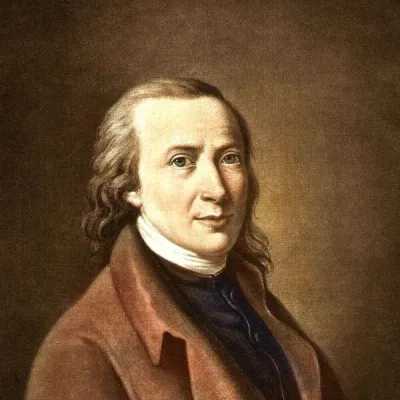
Matthias Claudius
Human Design Chart
Biography
He died 21 January 1815, Hamburg, Germany.
What does Projector 5/1 mean for Matthias Claudius?
Projector 5/1 — Design at a Glance
Matthias Claudius revealed himself as someone with a dense, focused aura that directly addressed his surroundings. His design tended to quickly recognize where other systems had flaws or things were not functioning properly – similar to a bright flashlight shining into dark corners. However, this ability to 'shed light on the darkness' was only effective when he used it gently. Pointing out problems head-on risked making others feel attacked and defensive. Instead, Claudius appeared most attractive when he radiated harmony himself; then others would come to him of their own accord to seek advice.
As a Projector, he did not have an undefined Sacral Center, meaning no constant intrinsic source for life energy. This led his energy to come in waves: phases of high productivity and clarity alternated with necessary rest periods to prevent burnout. His design strategy involved waiting for an honest and respectful invitation from others before offering his knowledge or leadership. Living by this principle rewarded him with success. Ignoring this dynamic and trying to fight against the current or lead without invitation eventually led to the bitterness theme of not being oneself. Therefore, his path was not one of constant action but rather targeted, invited illumination.
Splenic Authority
Matthias Claudius revealed himself as someone who did not find his orientation through logical deliberation or emotional waves, but through a fine physical impulse. His inner authority lay in the defined Spleen Center – an area that controls health and survival intelligence. With his open Emotional and Sacral Centers, he belonged to Projectors or Manifestors who could use this specific form of leadership.
This design gave him a spontaneous inner voice signaling whether a situation, environment, or society was right for him in the moment. His instinct and physical well-being served as reliable indicators. Decisions had to be made immediately; the first impulse was always correct and directly served his protection from harmful influences. However, this Spleen voice was a very subtle whisper that only came once and could easily be drowned out by other voices. This required him to maintain high vigilance and sometimes take short retreats to hear the impulse clearly.
Since his knowledge was only available in the present moment, his plans often changed frequently. Long-term commitments were difficult for him; instead, he needed a lot of freedom and flexibility to spontaneously embrace what proved healthy and right in each moment.
The 5/1 Profile — Heretic / Investigator
Matthias Claudius revealed himself as someone who used deeply rooted knowledge to help others solve their problems. His design as a Hero and Explorer (Profile 7/1) gave him almost magnetic appeal: Others actively sought the answers he seemed to have due to his intensive learning processes. However, this configuration created a tension field. While Line 1 urged him towards individual exploration and inner depth, Line 5 demanded that he publicly share these insights and take responsibility for others' understanding.
This mechanism worked like an enticement: Claudius was compelled to give energy to push the logical process in his listeners' heads forward. Without this external interaction, his own insight often remained incomplete or unproven. The risk lay in exhaustion; similar to an expert who answers questions for hours and ends up drained, Claudius faced overexertion through endless requests for solutions. His path involved setting clear boundaries. Only by learning to say no could he maintain the balance between necessary retreats for his own research (Line 1) and shared understanding in the community (Line 5). Honesty was crucial: His contribution only worked when he honestly shared his knowledge and found acceptance without self-destruction.
Single Definition — Defined & Open Centers
Matthias Claudius was characterized by a defined Spleen Center, which endowed him with an intuitive, immediate perception. He had the instinct to act in the present moment and trust spontaneous warning signals without having to rationalize them. This went hand in hand with a defined Root Center, providing a constant adrenalized pressure to ensure existential security and material survival. This combination fostered robust physical intelligence: Claudius reacted not out of thought but from a deep biological necessity that anchored him in the world.
At the same time, his design revealed several sensitive areas through undefined centers. His open Head Center made him vulnerable to mental stress and confusion; he tended to engage with questions that were not his own or sought inspiration externally rather than relying on inner clarity. Similarly, his open Ajna Center meant conceptual thinking was unstable – he could take in and reflect ideas but lacked a firm personal opinion or theory to defend.
Especially defining were his open G and Heart Centers. The open G Center lacked a fixed identity; Claudius did not actively seek direction or love but waited for the environment to initiate him. He depended on the right setting to feel at ease, as wrong environments promoted his misfortune. His open Heart Center lacked consistent willpower; he was not designed to make promises or prove his worth through competition. Instead, he was programmed to perceive others' egos without getting caught in cycles of self-proving and disappointment. These opennesses challenged him to not resist the inner pressure from Spleen and Root but trust the flow of external initiations.
Channel 28-38: Struggle — Channels & Gates
Matthias Claudius found his life's meaning not through passive acceptance, but in active resistance against external forces. His design laid a stubborn determination to maintain individual integrity even if it meant losing security. This stance rooted in the Life Struggle Channel 38-28. This channel connected the Root Center with the Spleen Center and drove him to endure struggles while finding deep meaning within them. Gate 38 generated the pressure to resist distractions from his own truth, while Gate 28 endowed intuitive ability to precisely identify which battles were truly worth fighting. For Matthias Claudius, this struggle was no accident but a driving force for individuation; he risked conflicts to remain authentic and thus became an example for others seeking their own path.
Alongside this central drive, other energies influenced him. Gate 4 allowed him to develop logical formulas despite uncertainties, clarifying suspicious patterns and avoiding retaliation. Gate 8 challenged him to gain attention through individual contribution to the group and live out his uniqueness. Simultaneously, Gate 14 brought the ability to handle power and resources with grace and self-control, supporting clear direction-finding. Emotionally, Gate 49 determined sensitive reactions to principles within the tribe or family, where emotional waves decided when sacrifices were necessary.
In his inner development, Gate 53 played the role of a pioneer beginning new cycles and leaving old patterns behind; however, the lack of a clear conclusion sometimes led to depression. This contrasted with Gate 52, which required self-imposed pauses for concentration and pattern correction; without a clear goal, this energy could be stressful. Gate 54 connected worldly success with mystical insight, where a partner or buddy promoted spiritual development. Finally, Gate 39 prepared the ground for mutations through provocative analysis and adrenaline, challenging the spirit to renew itself.
Individual Circuitry — Circuit Signature
Matthias Claudius was marked by direct physical engagement with life. His design linked the Spleen Center – responsible for intuition and recognizing what is truly important – directly with the Root Center, the source of endurance and survival energy. This connection formed the Life Struggle Channel (Gates 28-38).
This circuit endowed him with the ability to not only passively experience his deep inner perceptions but to immediately transform them into reality through pulsating energy. What he intuitively recognized as right or necessary became the driving force of his actions. It was not abstract philosophy, but concrete, often arduous work on his path. The energy flowed directly from intuition to endurance: an internal signal triggered immediate and consistent action.
As Matthias Claudius had a simple definition, these connected centers formed a closed, independent circuit within his system. Other areas remained energetically separate. His strength lay in this specific unit of perception and willpower. He used his intuition as a compass for his life struggle, where the emotional wave of Solar Plexus or creative flashes from other parts of the Knowledge Circuit were not active. His focus was clearly on implementing what he felt with his Spleen to be essential, supported by the unwavering energy of his Root Center.
Left Angle Cross of Revolution 2
Matthias Claudius showed a fundamental disposition marked by a deep urge to question outdated structures and rigid hierarchies. His design bore the signature of the left cross of revolution, a configuration that did not seek superficial adjustments but rather fundamental changes in existing orders. This meant for him an inner commitment to denounce what he felt was unjust or unnatural and to point out new paths, even if this provoked resistance.
The mechanics of this cross described an impulse directed against mere traditions to make room for more authentic expressions. Matthias Claudius lived this dynamic by not settling with the status quo but actively seeking solutions that enabled more freedom and truth. This was not destructive chaos but a revolutionary force breaking up crusty systems so new things could emerge. His energy focused on breaking old patterns and making space for innovative perspectives, turning him into someone who drove change rather than passively observing it. This attitude shaped his entire work as someone always striving for deeper, more just order.
Saturn Return · Uranus Opposition · Chiron Return · 2nd Saturn Return — Life Cycles
Matthias Claudius revealed himself to be someone whose inner structure only gained its clear form through friction with the outside world. His design laid a tendency not to find personal authority and professional orientation in youth but rather to solidify them in early middle age. This happened concretely in 1771 when, at the age of 31, he moved to Wandsbeck and became editor of the „Wandsbecker Bothen“. This step marked his first Saturn Return, a cycle where Human Design mechanics heralds a phase of consolidation. Instead of spreading out further, his life mission now condensed onto a sustainable foundation. Taking on this editorial responsibility was no coincidence but rather the result of years of inner groundwork that came to fruition at this astrological knot point. The Saturn Return functioned here as a catalyst for structure and duty consciousness; it helped Matthias Claudius translate his natural gifts into a stable, socially effective role. Through this anchoring in professional life, his design found the durability it previously lacked. The mechanics of the Saturn Return often demand relinquishing illusions in favor of real responsibility – and precisely this happened with his new position in Wandsbeck.
Projector · Splenic Authority — Synthesis
Matthias Claudius’ life was marked by a deep need to recognize functionality in his environment (Projector) and transform this knowledge into constructive contributions. His defined Spleen Center enabled him an instinctive grasp of what promoted his well-being, coupled with an immediate reaction to threats or disharmonies. This ability, paired with the Profile of Hero/Researcher (5/1), led him repeatedly to address problem-solving and make his insights accessible to others – a process amplified by the Channel of Life Struggle (38/28) as he always strove to maintain his own integrity.
Central to his design was, however, the tension field between the need for demarcation and the natural tendency to engage in other people’s problems. As a Projector, he needed recognition and invitation to effectively deploy his projected energy while simultaneously the Line 5 in the Profile exerted a magnetic attraction on those seeking help. This led to an inner dynamic where maintaining personal boundaries (Spleen Center) clashed with the desire for knowledge exchange and problem-solving – a give-and-take that played out throughout his life.
1 Defined Channel
Incarnation Cross - Left Angle Cross of Revolution 2
Solar Return
The Solar Return shows the moment when the sun returns to its exact birth position - your personal solar year.
Life Cycles
Discover the life cycles with a detailed triple view (birth chart, cycle chart, composite).
Human Design Profile
- Type
- Projector
- Strategy
- Wait for the respectful invitation
- Authority
- Splenic Authority
- Profile
- 5/1 - Heretic / Investigator
- Definition
- Single Definition
- Incarnation Cross
- Left Angle Cross of Revolution 2
- Date of Birth
- 15.08.1740 22:30
- Place of Birth
- Reinfeld, Germany
Frequently Asked Questions
What was Matthias Claudius' Human Design type?
Which Profile did Matthias Claudius have?
What was Matthias Claudius' Authority?
Which incarnation cross was active for Matthias Claudius?
When was Matthias Claudius born?
Discover your own Human Design
Are you also a Projector? Find out in a personal reading how to unfold your leadership qualities and recognize the right invitations.
More Personalities
Back to overviewSissy Spacek

Alain-Fournier

Anémone

Angeli

Ann-Margret

Bourvil