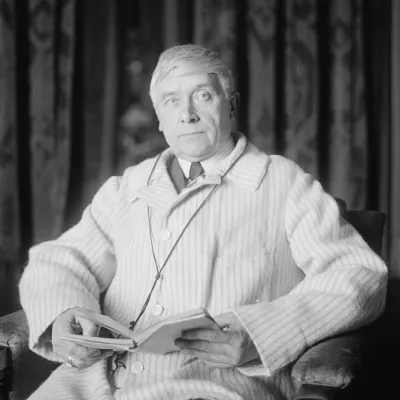
Maurice Maeterlinck
Human Design Chart
Biography
Associated with actress Georgette Leblanc, he broke his relationship with her to marry Renee Dahon.
He lived in the U.S. from 1940-1947 and died on 6 May 1949, Nice, France
Human Design Analysis: Maurice Maeterlinck as Generator 6/3
Generator 6/3 — Design at a Glance
Maurice Maeterlinck revealed himself as someone with immense inner endurance and the ability to generate energy over long periods of time. His design laid the foundation for a powerful presence, comparable to a workhorse that remains strong as long as it is fueled by its task. However, this energy was not released through self-initiative but rather in response to impulses from the environment. The strategy of his design involved waiting and then responding instinctively when his sacral center signaled a clear 'yes'.
This mechanism carried two significant risks. If he engaged in activities that did not resonate internally, he wasted his energy and was prone to exhaustion. Conversely, he suffered if external circumstances prevented him from continuing with heart projects despite being fully energized. The successful utilization of his potential depended on not initiating things himself but reacting to life signals. By following this rhythm, he was rewarded with a deep sense of fulfillment. Living against his design and constantly trying to initiate led to persistent frustration and a lack of energy. His strength therefore lay not in pushing forward but in powerfully responding to what came his way.
Emotional Authority
Maurice Maeterlinck exhibited an inner structure where emotional waves formed the decisive compass for his life. His design carried Emotional Authority, meaning that the Solar Plexus Center was defined and thus had precedence over all other defined centers – regardless of any other configurations in his chart. This mechanism generated a permanent rhythm of emotional ups and downs. The world appeared to him always colored by his current mood; enthusiasm could turn into deep skepticism in the next moment without the matter itself changing.
This state required patience as a central life strategy. Since an immediate emotional impulse was only a snapshot and not necessarily the deeper truth, spontaneous decisions made in the heat of emotion often had negative consequences. Clarity only set in when the initial intense reactions subsided and emotional distance was gained. For long-term decision-making, it was therefore essential to let decisions mature and reconsider them multiple times before taking a final stance. Only through this process of delay did Maurice Maeterlinck gain access to calm insight that lay beyond transient mood fluctuations. This necessity for differentiation between short-term emotion and lasting insight shaped his approach to important life questions.
The 6/3 Profile — Role Model / Martyr
Maurice Maeterlinck's design inclined towards continuous experimentation and the search for extraordinary forms of living. As a person with Profile 6/3, the role model and experimenter, he was strongly marked by the line of the Adventurer in the first thirty years. This meant numerous self-experiments as he did not seek ordinary perfection but rather aimed at a life far from standards. This inner restlessness and the feeling of always searching for the right thing were characteristic of this configuration.
After his first Saturn return, the dynamics changed. The early openness of Gate 59 on line 6 gave way to an understanding of the consequences of unions and long-term commitments. Venus influences allowed him to deepen relationships or find temporary connections acceptable. Simultaneously, Gate 16 on line 3 brought independence through self-generated talent. Here timing was crucial: he had to wait for energy to come before bringing in skills. The need for validation could lead to doubts if motoric drive was lacking despite existing talent.
With increasing age, Maurice Maeterlinck used his unusual experiences to become a wise and far-sighted role model. Responsibility became natural for him while the experimental line 3 never fully disappeared. His life task consisted in developing through this combination of adventurous spirit and later wisdom a humorous and profound attitude based on many personal experiences.
Triple Split Definition — Defined & Open Centers
Maurice Maeterlinck lived under a constant internal mental pressure. His defined Head and Ajna centers generated a continuous inspiration in the form of questions that had not yet been answered. This state was not a choice for him but a mechanical given: He thought constantly and could neither stop nor control this process. The challenge lay in accepting this confusion and doubt rather than trying to reduce it through hasty actions. Since Head and Ajna are not connected to energy motors, the attempt to implement ideas immediately only led to frustration. His task was to wait for the right moment to inspire others to reflect.
At the same time, he had a clear identity and willpower through his defined G and Heart centers. He knew his own worth and direction in life without being dependent on others. His defined Sacral energy provided the vital force for his expression, provided that he responded to life rather than initiating it. As a Generator with emotional authority (defined Solar Plexus center), however, he had to learn not to make decisions impulsively. The truth only revealed itself at the end of the emotional wave; patience was essential to gain clarity and avoid chaos.
In contrast, he was vulnerable to external conditioning through open centers. His open Throat center tended towards fear of invisibility, which could put him under pressure to seek attention rather than waiting for a natural invitation to speak. The open Spleen center brought a fundamental survival anxiety with it; he was at risk of clinging to unhealthy relationships just to simulate feelings of security and well-being. Spontaneous decisions were risky here as they often stemmed from this fear. Additionally, his open Root center absorbed the stress of his environment. This external adrenaline surge could drive him into a cycle of hyperactivity if he tried to get rid of this foreign pressure through overwork rather than recognizing that it was not his own.
Channels for intimacy, spiritual ambition and mental clarity.
Maurice Maeterlinck's design established a fundamental disposition based on deep fusion and the urge towards individuation. The Channel of Union 59-6 connected sacral sexuality with the emotional wave of the Solar Plexus. This created a need for intimacy, which clarity was achieved through patience and waiting for one's own mood waves. Relationships often only developed once emotional resonance had been built over time; closeness or touch could release pent-up feelings.
Parallel to this, the Channel of Initiation 51-25 connected the competitive ego of the Heart center with spiritual consciousness. This configuration promoted natural competitiveness that led to personal expansion only if it was not forced. Initiation occurred as a mystical process that separated the individual from the collective while simultaneously reinforcing them.
Mentally, he was shaped by the Channel of Abstraction 64-47 and specific Gates. The channel 64-47 connected Head and Ajna centers, leading to a mind that filtered experiences through mental images to find meaning. This could create temporary confusion until an inspiring story or perspective became clear. Gate 55 in Solar Plexus emphasized the importance of emotional awareness and genetic mutation, while Gate 16 encouraged experimentation with new forms. Gate 9 in Sacral center allowed for precise focusing and perfecting through repetition. In Heart center, Gate 26 supported introducing innovations into conservative structures. Gate 46 highlighted dedication to the process and nurturing the body as a temple. Additional influences came from Gate 11 (visual memory), Gate 15 (adaptation to natural rhythms), Gate 42 (completion of processes), Gate 37 (organic community) and Gate 24 (mental renewal). Together, these elements formed a life oscillating between intense emotional connection, competition-free individuation and the search for hidden connections.
Tribal Circuitry — Circuit Signature
Maurice Maeterlinck's design established a tendency towards solidified individuality paired with a deep, often inexpressible conviction. The Projector circuit connected his Identity and Heart centers directly through the Channel of Initiation. This connection strengthened self-worth and inner stability but created a gap in external communication: His firm principles often remained trapped internally as there was no direct bridge to Throat center. He appeared as someone who defined their identity not through words, but through mere presence and the radiance of their self-worth.
Parallel to this, a separate cyclical energy emerged in the Meaning circuit. Here, the Channel of Abstraction connected Head with Ajna centers. This generated a wave-like flow of thoughts and emotional reflections from the past. Maurice Maeterlinck sought the hidden meaning behind experienced events, a process that relied less on cool logic than intuitive perception. However, this energetic group did not engage in direct exchange with his identity or heart; it formed an independent sphere of contemplation and reminiscence.
A third, independent stream operated in the Sentinel circuit. The Channel of Union connected Sacral with Solar Plexus centers. This endowed him with primal instinctive energies for preservation and care. It was about protecting the near and emotional nourishment. Since this connection also acted independently from the other two circuits, Maurice Maeterlinck existed in three parallel power fields: the silent inner strength, the cyclical meaning-seeking process in his head, and the instinctual need for protection and attachment in his body – each functioning independently without merging into a single cohesive flow.
Left Angle Cross of Spirit 2
Maurice Maeterlinck's Human Design configuration suggests a tendency towards profound inner transformations that are often set in motion by seemingly small, everyday triggers. This setup describes a process of spiritual maturation where consciousness gradually disentangles from external constraints to meet higher intuitive truths. It was not about sudden moments of enlightenment but rather a slow, often unnoticed shift in perception.
The left cross of Spirit 2 acts as a catalyst for this inner transformation. It connects the search for meaning with the necessity to let go of old identities and fixed beliefs. For Maurice Maeterlinck, this meant that his development depended on relying on subtle signals from within rather than rational analysis or external validation. This mechanism fostered an attitude of humility and listening to life itself.
The energy of this cross supported him in moments of uncertainty or transition by not grasping for immediate answers but keeping the space open for new insights. It was about distinguishing between what is essential and what is not, focusing on what truly mattered. Through this inner work, Maurice Maeterlinck could establish a deep connection to his own essence, which helped him maintain clarity and calm even in complex situations. His path was characterized by this constant, gentle movement towards inner truth.
Saturn Return · Uranus Opposition · Chiron Return · 2nd Saturn Return — Life Cycles
Maurice Maeterlinck's Human Design suggests a tendency toward profound, often sudden transformation processes that intensified with age. This structure created phases where internal upheavals pushed outward and demanded new forms of expression. In 1901, at the age of 39, this mechanism became active: The publication of “The Life of the Bee” and its German edition marked a clear career boost. This time coincided with an Uranus opposition, an astrologically specific indicator for disruptive changes breaking old patterns in favor of new perspectives.
A decade later, in 1911 at age 49, his life reached another peak with the awarding of the Nobel Prize for Literature. This event corresponded exactly to his Chiron Return. In Human Design mechanics, this cycle is not a process of wound healing but an achievement cycle – a bloom period where one's incarnation cross unfolds and the purpose of life becomes tangible. If Maeterlinck had lived according to his strategy and authority up until then, here was the condensation of meaning in his path. The Nobel Prize was thus more than just external recognition; it was visible confirmation of an inner completion made possible by long-term alignment with his authentic nature. Both events illustrate how cosmic cycles shaped concrete life stations.
Generator · Emotional Authority — Synthesis
Maurice Maeterlinck was a Generator whose life was marked by deep, sacral energy. This power fueled his ability to engage intensively with topics over extended periods as long as they resonated internally (Sacral Center). The connection between Sacral and Solar Plexus Centers through the Pairing Channel indicated profound emotional intensity in relationships that only led to clarity after a phase of waiting and emotional resolution (emotional authority). His Profile as Role Model/Experimentator was evident in his constant search for new paths – an ongoing quest for extraordinary life designs beyond conventional norms.
A central paradox in his design lay in the interplay between inner restlessness and the need for deep emotional maturity. The Line 3 of his profile pointed to a permanent urge towards experimentation, while emotional authority compelled him to take time for thorough engagement with his feelings before making decisions. This led to tension between the desire for adventure and the necessity to digest things emotionally before bringing them into the world – an interplay that, for example, manifested in success after a longer process.
3 Defined Channels
Incarnation Cross - Left Angle Cross of Spirit 2
Solar Return
The Solar Return shows the moment when the sun returns to its exact birth position - your personal solar year.
Life Cycles
Discover the life cycles with a detailed triple view (birth chart, cycle chart, composite).
Human Design Profile
- Type
- Generator
- Strategy
- To respond - wait for something to respond to
- Authority
- Emotional Authority
- Profile
- 6/3 - Role Model / Martyr
- Definition
- Triple Split
- Incarnation Cross
- Left Angle Cross of Spirit 2
- Date of Birth
- 29.08.1862 08:30
- Place of Birth
- Ghent, Belgium
Frequently Asked Questions
What was Maurice Maeterlinck's Human Design type?
What Profile did Maurice Maeterlinck have?
Which Authority guided Maurice Maeterlinck?
What incarnation cross did Maurice Maeterlinck have?
When was Maurice Maeterlinck born?
Discover your own Human Design
Are you also a Generator? Find out in a personal reading how to use your sacral energy correctly and discover deep satisfaction.
More Personalities
Back to overviewAaliyah

Alain-Fournier

Alexia

Angèle

Angeli

Anne-Marie