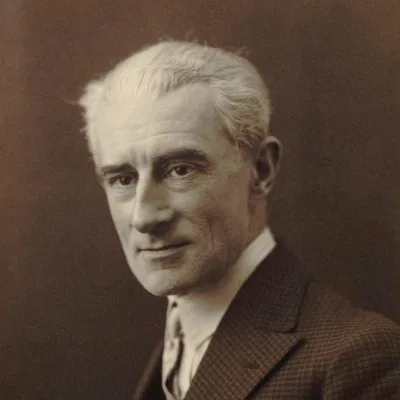
Photo: Wikimedia Commons
Maurice Ravel
Human Design Chart
Biography
Ravel studied music at the Paris Conservatoire under French composer Gabriel Faure.
It was suspected that Ravel may have had Alzheimer's. After a minor traffic accident on 10 October 1932 he began to show signs of senility though only 57 years old. The accident was not connected with the following years of aphasia and ataxia, but he never fully recovered. Aside from some music already in the works, he composed no more. In 1933, he tried to conduct a concert in Paris, but it was to be his last. He eventually lost his ability to produce or comprehend musical sounds, remember names, or even to recognize his own music.
On 18 December 1937, he entered a hospital in Paris and died 28 December 1937 after brain surgery.
The Human Design of Maurice Ravel: Generator 6/3
Generator 6/3 — Design at a Glance
Maurice Ravel possessed immense and enduring power that was unleashed not through arbitrary initiation but by reacting to external impulses. As a Generator, he had abundant sacral energy, comparable to that of a workhorse: extremely strong and durable as long as this energy was available for the task at hand. His life logic rested on not taking the first step himself but waiting until a signal from life came, which his gut feeling responded to with a clear "yes."
This reacting was the key to his materialization power. When he followed this inner resonance and acted upon it, he experienced deep fulfillment and could successfully realize projects. The danger lay in two specific errors: either he gave away his energy to tasks that did not bring him inner joy, leading to burnout, or he was held back from his true passion despite still being full of energy.
If Maurice Ravel initiated purely out of will without this sacral confirmation, he encountered frustration and a lack of energy. His design called on him to leave the initiative to others and instead put his enormous endurance where there was a genuine inner response. Only in this harmony between external impulse and internal "yes" could no one stop him.
Emotional Authority
Maurice Ravel's design showed a tendency towards careful consideration: He was someone who did not make decisions immediately but consciously allowed time to pass. This resulted from his emotional authority, which was carried by the defined Solar Plexus Center. In Human Design mechanics, this means that this center always takes precedence over all other defined centers, regardless of further configurations in the chart.
Maurice Ravel was subject to a constant emotional wave, manifesting as an ongoing up and down of his feelings. The world appeared to him colored by his current mood; the same thing could inspire him at one moment and seem negative the next. However, his feeling in the moment was only a snapshot, a first impression that did not necessarily represent his truth. Quick, spontaneous decisions based on such emotions would have had very negative consequences.
To gain clarity and calmness, his process required patience. Maurice Ravel took time to let decisions mature, often meaning sleeping on them multiple times. He hesitated properly and asked himself repeatedly. Over time, the intense feelings subsided, he gained emotional distance, and only then did the necessary clarity emerge. This mechanism protected him from the negative effects of impulsive judgments and ensured that long-term decisions were based on a deeper, more comprehensive understanding after the emotional cooling process was complete.
The 6/3 Profile — Role Model / Martyr
Maurice Ravel's design laid out a life dynamic that divided into two distinct phases. In the first thirty years, he lived as an experimenter, marked by Line 3. This was a time of intense self-experimentation and adventure-seeking. He did not seek the ordinary but aimed for an extraordinary life far from all standards. This phase was characterized by trial and error; rejection had to be endured in order to overcome vulnerability and gain influence.
After his Saturn return around age thirty, this energy transformed. Experimenting did not end but slowed down and served now as a means of integration. The accumulated experiences became the source for wisdom and humor. As an advocate of Line 6, he developed a visionary leadership personality. Nostalgia played no passive role; it helped him overcome old doubts and ask new questions. The goal was to mutate in his individual circuit through valuable reflection.
The duality between early restless searching and later stable identity shaped his essence. He used his unusual experiences to become a role model. Responsibility and wisdom became self-evident for him after age thirty. Instead of ending, the eternal search for perfection deepened, thereby creating a connection between past and future. His inner restlessness transformed into a powerful, humorous stance based on real experience.
Single Definition — Defined & Open Centers
Maurice Ravel's Human Design profile indicated a tendency towards deep endurance and emotional reflection. He had a defined Sacral Center, which provided him with a constant vital energy source; his strategy was to wait for questions or invitations before responding from the gut with a clear yes or no rather than taking initiative himself. This energy foundation was strengthened by his also defined Root Center, which generated a structured life force and propelled him forward. His inner authority lay in the Solar Plexus Center: He needed time to ride emotional waves before making decisions because clarity only emerged at the end of the cycle. The defined Spleen Center gave him an intuitive momentary security for health and well-being.
In contrast, Maurice Ravel was marked by five open centers. His open Head and Ajna Centers meant that he did not have constant thought processes but rather flexibly absorbed inspiration from his environment; he tended to question whether he had the right answers instead of having firm concepts of his own. The open G Center lacked a fixed identity or direction; it reflected its surroundings instead, seeking initiation by others rather than actively searching for a life path. His open Heart Center implied a lack of constant willpower: He tended towards overpromising to prove his worth rather than trusting natural commitments. Finally, the open Throat Center indicated that his expression was situational and spontaneous; he did not seek attention but waited for an external invitation to speak. This architecture formed him as a sensitive reactor who drew strength from his energy base but remained open in thinking, identity, and will to the influence of his environment.
Channels & Gates
Maurice Ravel's Human Design profile indicated a tendency towards inner tension that navigated between the drive for evolutionary change and the necessity of tribal loyalty. This configuration created an individual whose behavior was marked by melancholic moodiness – not a disorder but a precursor to new mutations, which had to be endured patiently.
The Channel of Mutation 60-3 connected the Root Center with the Sacral Center. It brought pulsating on/off energy and melancholy as a mechanical reaction to inner unpredictability. The key was not to rationalize these moods but to accept limitations and wait for the right moment for innovation.
Parallel to this, the Channel of Synthesis 19-49 between Root and Solar Plexus Centers determined acceptance or rejection within the tribe through emotional waves. Loyalty, protection of resources and territory, as well as a need for belonging shaped his social actions; he sought balance between feasibility and fairness among trusted companions.
As a protective mechanism, Channel of Power 34-57 connected Spleen with Sacral Center, giving intuitive survival intelligence: spontaneous, quick reactions to danger based on individual vitality and alertness. This energy kept him independent and physically fit but reacted purely for his own well-being without considering others' needs.
Additionally, Gates like 63 (Doubt) and 64 (Past Experiences) contributed to a mental process seeking security through understanding. Gate 26 allowed anchoring innovations within the tribe while Gate 50 protected traditional values. The sacral power of Gate 42 demanded closing processes to avoid blockages. Ravel's design thus showed as a complex interplay of mutative pressure, emotional bonding, and intuitive self-defense.
Circuit Signature
Maurice Ravel's Human Design profile displayed a structure where individual transformation, tribe-oriented cooperation, and survival-integrating mechanisms acted as separate parallel forces. Although all centers belonged to the same group, there were no direct connections between circuits. The Knowledge Circuit in him connected Sacral with Root Center (Channel 3-60). This promoted an expression form of unique identity through mutation and deviation from the known. Energies pulsing in the present drove new knowledge expressed emotionally.
Parallel to this, the Ego Circuit worked via Channel 49-19 between Solar Plexus and Root Centers (Synthesis). Here it was not about individuality but tribal cooperation and resources. As there was no connection to the Sacral Center, this dynamics required necessary pauses for regenerating life force for collective creation. The emotional wave here rather rumbled and conserved.
The third aspect was integration via Channel 34-57 (Power), connecting Sacral and Spleen Centers. This secured personal survival through power from reacting to life. Intuitive knowledge and correct behavior were merged in the present to maintain highest individuality. These three circuits did not form a cohesive unit but existed as separate segments: individual transformation, tribe-oriented support, and reactive self-assertion. Maurice Ravel navigated these different demands not as a flow but as parallel task fields each following their own energetic logic.
Left Angle Cross of Dominion 1
Maurice Ravel's Human Design chart established a specific orientation in dealing with authority and hierarchy. His chart contained the so-called left cross of sovereignty, a configuration that did not describe general power but rather implied a precise, often subtle dynamic concerning influence areas and power structures.
This mechanism did not work through loud assertion of will but through a deep structural anchoring within existing systems. The left cross of sovereignty signaled the ability to experience authority not as an external display but as an internal compass for one's territory. Maurice Ravel was thus marked by a need for clearly defined boundaries and responsibilities, within which he could maintain his integrity. It was a subtle force that aimed less at controlling others than at protecting his own space from intrusion or caprice.
The dynamics of this cross emphasized the importance of respect for established orders as long as they served individual truth. Maurice Ravel navigated hierarchies throughout his life with a certain restraint, which arose not from weakness but from strategic clarity. He intuitively understood where his legitimate authority ended and began. This inner map allowed him to remain stable in complex social or professional frameworks without sacrificing himself. The mechanism fostered a stance of disciplined self-determination within given conditions, which significantly shaped Maurice Ravel's interaction with his environment and defined how he dealt with questions of power.
Saturn Return · Uranus Opposition · Chiron Return · 2nd Saturn Return — Life Cycles
Maurice Ravel's Human Design chart indicated a tendency towards structuring and testing through cyclical crisis points. His life trajectories were marked by Saturn returns and Uranus oppositions, serving as tests for inner stability. The first Saturn return in 1905 marked a turning point: Ravel's withdrawal from the Prix de Rome competition due to numerous violations of compositional rules sparked public debate. This crisis challenged him to assert his own artistic integrity against established norms.
Ten years later, the Uranus opposition arrived in 1915. Ravel's conscription as a driver in the medical corps of the 13th Artillery Regiment during World War I represented an abrupt interruption requiring adaptability under extreme pressure. This cycle tested his resilience during a period of collective upheaval.
The second Saturn return appeared in 1932 at age 57, presenting physical and mental challenges. A traffic accident coincided with early signs of senility, confronting Ravel's design with the impermanence of the body and the need to find stability despite waning strength. These events illustrate how Ravel's chart defined structural stability not as a static state but as a dynamic process of testing in recurring life phases.
Generator · Emotional Authority — Synthesis
Maurice Ravel lived a path deeply influenced by his generative energy (Sacral Center). This power source seemed to propel him towards constant creation, yet his emotional authority required time for decision-making – an internal process contrasting with the impulsive drive toward activity. The profile as role model and experimenter amplified this trait further, as he was constantly seeking new forms of expression while the age of 30 initiated a phase of intense self-discovery and potential inner unrest. The Channel of Mutation (3-60) suggests an aptitude for evolutionary change, coupled with a melancholic energy accompanying the creative process.
A central paradox in Ravel's design lay in the interplay between vital creative drive and the need for emotional clarity. He was a Generator who found his energy through activity, yet the emotional wave required patience and weighing of different perspectives. Crisis moments (Saturn return, Uranus opposition) appeared as phases of transformation where new paths had to be found – an expression of the Knowing Circuit and its ability to generate knowledge through experiments and mutation.
3 Defined Channels
Incarnation Cross - Left Angle Cross of Dominion 1
Solar Return
The Solar Return shows the moment when the sun returns to its exact birth position - your personal solar year.
Life Cycles
Discover the life cycles with a detailed triple view (birth chart, cycle chart, composite).
Human Design Profile
- Type
- Generator
- Strategy
- To respond - wait for something to respond to
- Authority
- Emotional Authority
- Profile
- 6/3 - Role Model / Martyr
- Definition
- Single Definition
- Incarnation Cross
- Left Angle Cross of Dominion 1
- Date of Birth
- 07.03.1875 22:00
- Place of Birth
- Ciboure, France
Frequently Asked Questions
What was Maurice Ravel's Human Design type?
What Profile did Maurice Ravel have in Human Design?
Which Authority guided Maurice Ravel's decisions?
Which incarnation cross was active for Maurice Ravel?
When was Maurice Ravel born?
Discover your own Human Design
Are you also a Generator? Find out in a personal reading how to use your sacral energy correctly and discover deep satisfaction.
More Personalities
Back to overviewAaliyah

Alexia

Alizée

Angèle

Anne-Marie

Arcángel