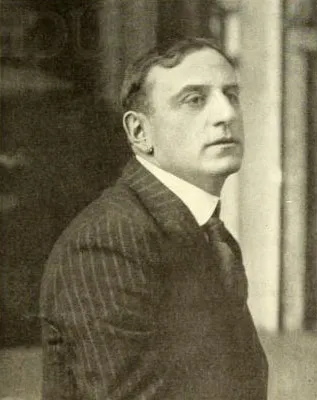
Maurice Tourneur
Human Design Chart
Biography
As a young man, he first trained as a graphic designer and a magazine illustrator but was soon drawn to the theater. In 1904, he married the actress, Fernande Petit. They had a son, Jacques (1904–1977), who would follow his father into the film industry.
Using the stage name Maurice Tourneur, he began his show business career performing in secondary roles on stage and eventually toured England and South America as part of the theater company for the great star Gabrielle Réjane. Drawn to the new art of filmmaking, in 1911 he began working as an assistant director for the Éclair company. A quick learner and an innovator, within a short time he was directing films on his own using major French stars of the day such as Polaire.
In 1914, with the expansion of the giant French film companies into the United States market, Tourneur moved to New York City to direct silent films for Éclair's American branch studio in Fort Lee, New Jersey before moving to William A. Brady's World Film Corporation, where he directed important early American feature-length films.
As the feature film evolved in the mid 1910s, he and his team (comprising screenwriter Charles Maigne, art director Ben Carré, and cameramen John van den Broek and Lucien Andriot) coupled exceptional technological skill with unique pictorial and architectural sensibilities in their productions, giving their films a visual distinctiveness that met with critical acclaim.
After directing several innovative films for Adolph Zukor's Artcraft Pictures Corporation (which released through Paramount) in 1917 and 1918, Tourneur launched his own production company with the film Sporting Life. In 1921 he became a naturalized citizen of the United States. By 1922 he believed that the future of the film industry lay in Hollywood and the following year he was hired by Samuel Goldwyn to go to the West Coast and make a film version of the Hall Caine novel The Christian.
What does Generator 1/3 mean for Maurice Tourneur?
Generator 1/3 — Design at a Glance
Maurice Tourneur possessed immense, enduring strength that allowed him to push projects forward over long periods of time. As a Generator, he had a great deal of sacral energy, making him an extremely powerful 'workhorse' as long as he had energy for his task. His design dictated that he would not act through initiatives but rather through reactions to signals from life. The motto was clear: do not initiate, but react.
When his sacral center sent the signal 'Yes! Let's get started!', he responded with action. This process of reacting from the gut was the key to his effectiveness. Living in harmony with this strategy rewarded him with a deep sense of fulfillment and satisfaction. No one could stop him when he followed this inner confirmation.
However, his design contained two specific pitfalls. One danger was doing things indefinitely that he had no interest in, which led to a waste of his energy and ultimately burnout. The other danger was holding back from his heart project, even though he still wanted to keep working with full power. If he initiated against his design or ignored the inner signals, he would eventually encounter a feeling of persistent frustration and a lack of energy. His strength did not lie in pushing forward against resistance, but in clearly listening to the inner confirmation and acting on it accordingly.
Emotional Authority
Maurice Tourneur showed himself to be someone whose inner decision-making was inseparably linked to his emotional rhythm. His design carried emotional authority, meaning that the Solar Plexus Center was defined, and thus the sole source of his truth. Independent of other defined centers in his chart, he was subject to a constant wave of emotional ups and downs. The world appeared to him always colored by his current mood: in one moment full of enthusiasm, in the next deeply skeptical.
This mechanism required of him a specific patience. His immediate feeling was merely a snapshot, a first impression that did not yet represent his final truth. Quick, spontaneous decisions that emerged directly from this emotional heat often proved problematic or negative. Instead, he had to take time to let decisions mature. This process demanded multiple nights of sleeping on questions and the willingness to hesitate.
Only through this temporal distance did the intense feelings subside. Maurice Tourneur gained emotional distance, allowing clarity and calm to set in. Only then was the inner process complete and a well-founded decision possible. This necessity of delay was especially true for long-term decisions that would significantly influence his life course. His inner authority thus dictated not impulsivity, but a strategic waiting period until the emotional flood subsided and the true essence of a situation became visible.
The 1/3 Profile — Investigator / Martyr
Maurice Tourneur's design established a basic attitude that combined research and practical experimentation inseparably. As a person with Profile 1/3, the Researcher and Experimenter, he showed himself to be someone who always had to test theoretical knowledge through his own experience. This profile describes a life task where learning and action are in tension: Line 1 strives for thorough understanding and can hesitate before implementation if the feeling prevails that not enough is known. At the same time, Line 3 drives the urge to experiment to learn through trial and error.
This dynamic shaped Maurice Tourneur as someone who uncovered secrets and took in stories from various sources, supported by the empathetic foundation of Gate 13. He had the ability to engage with and listen to others without discrimination, which helped him to grasp motives and backgrounds. But only the practical application, the adaptability, and the authentic self-expression of the third line transformed these insights into tested knowledge. When Maurice Tourneur made a judgment, it was based on this double test: both theoretically and practically tested on the heart and gut. His design challenged him to overcome the fear of incomplete knowledge to follow the natural impulse to experiment. Thus, he became a person whose judgments were based on self-earned and tested truth, providing others with a trustworthy foundation.
Triple Split Definition — Defined & Open Centers
Maurice Tourneur revealed himself as someone who was constantly under internal pressure to ask questions and understand connections. His defined Head and Ajna Centers created a permanent mental activity that pushed him to pursue inspirations even if they were not yet fully understood. This process was a source of both deep insight and potential concern for him, as he had to learn to accept the mental pressure without prematurely turning it into hasty actions.
At the same time, he possessed a reliable self-identity and a clear sense of direction, carried by his defined G Center. This gave him the ability to show others new paths without being dependent on their expectations. His energy source came from his defined Sacral Center, which gave him enormous vital energy. He was dependent on reacting to life rather than initiating it to use this energy efficiently and satisfyingly.
His defined Solar Plexus Center functioned as an inner authority. He had to learn to wait out the waves of his emotions to reach clarity, rather than making impulsive decisions based on the highs or lows of his mood. His defined Root Center provided the necessary pressure to move forward in the world and cope with stress.
In contrast, his Throat, Heart, and Spleen Centers were open. This made him vulnerable to the pressure to force attention or prove his worth through promises he could not keep. He tended to feel insecure if he was not immediately noticed or to cling to things that did not serve him out of fear of losing security. These open centers challenged him to forego spontaneous decisions and instead trust his inner authority and strategy to avoid conditioning from the environment.
Channels for rhythm, skeptical logic and mystical synthesis.
Maurice Tourneur was someone who examined patterns through healthy skepticism and logical analysis before accepting them. This attitude came from the Logic Channel 63-4, which represented the doubting mind. Gate 63 in the Head Center asked questions, while Gate 4 in the Ajna Center sought formulable answers. This mechanism filtered continuously to see if structures were stable; unfounded belief had no place here, as only verifiable, functioning patterns were considered logical.
At the same time, Maurice Tourneur had the ability to translate innovative, mutative impulses into material reality. The Beat Channel 14-2 connected the Sacral Center with the G Center. Gate 14 focused on the availability of resources to drive mutation, while Gate 2 as the driver directed movement through space and time. This configuration allowed him to strengthen new directions through trust in his generative energy, without needing to know the exact path in advance. He served as a key custodian for essential resources that channeled creative life force into a fruitful, innovative direction.
His design also included a deep sensitivity to tribal dynamics and emotional connections. The Synthesis Channel 19-4 connected the Root Center with the Solar Plexus Center. Gate 19 pushed for the manifestation of belonging, while Gate 49 established principles that led to the rejection of incompatibility. This created the emotional glue for loyalty and protection within the tribe based on the exchange of needs and values.
Additionally, individual Gates like Gate 13, which promoted collective memory and continuity through reflection, and Gate 7, which projected leadership perspectives and hierarchies, were at work. Gate 1 emphasized uniqueness and creativity in the here and now. On the personality level, Gate 25 with its mystical innocence, Gate 46 with its dedication to the physical process, and Gate 24 with its mental renewal contributed to the inner structure. Gate 30 steered the recognition of feelings and desires, while Gate 17 supported logical teaching and human rights. Gate 37 promoted organic community structures, and Gate 3 in the Sacral Center drove necessary mutations for survival.
Individual Circuitry — Circuit Signature
Maurice Tourneur was marked by three separate, parallel functioning energetic blocks that did not flow into each other. His design consisted of a Triple Definition, meaning these areas existed as independent forces side by side without a continuous connection.
In the Knowledge Circuit, the channel 'The Beat' connected his Identity with the Sacral Center. This created a pulsing, acoustic energy aimed at expressing his unique identity through new, transformative paths. It was about the authentic path and creative innovation, supported by the constant life force of the Sacral Center.
Completely independent of this, the Understanding Circuit was at work. Here, the channel 'Logic' connected the Head with the Ajna Center. This connection promoted focused, visual and rational thinking. It was 'emotionless ratio' aimed at structuring logical insights and steering society through strategy and intellect towards a better future.
The third, also isolated block was the Ego Circuit. Here, the channel 'Synthesis' connected the Solar Plexus with the Root Center. This generated a tangible, traditional energy aimed at cooperation and the joint creation of resources. As there was no connection to the Sacral Center, this area was dependent on rest periods to maintain the necessary support and balance between giving and taking within the tribe. Maurice Tourneur thus lived with these three distinct, non-connected energetic focuses.
Right Angle Cross of the Sphinx 1
Maurice Tourneur had the right Sphinx Cross 1 in Human Design. This configuration establishes a specific energetic alignment characterized by a deep connection to the material world and physical reality. The right Sphinx Cross 1 is one of the four Sphinx Cross configurations, which arise from the interaction of Gate 1 in the Root Center and Gate 40 in the Solar Plexus Center. Gate 1 represents the ground state, the impulse to create, and the foundation, while Gate 40 stands for intuition, trust in one's inner compass, and the ability to grasp the essence of things.
In Maurice Tourneur's design, this combination acted as a strong drive to translate abstract intuitions into concrete, tangible forms. It was not mere daydreaming but a process in which intuitive insights were brought into the physical world through the will and perseverance of the Root Center. This mechanism fostered an approach that was both visionary and pragmatic. Maurice Tourneur was marked by his tendency to not only keep his inner perceptions to himself but to transform them into structures, works, or actions that were visible and experiential to others. The right Sphinx Cross 1 underscored the necessity of trusting one's intuitions and pursuing them with a certain persistence to bring them to fruition. It was a design that linked creativity with a strong grounding in reality.
Saturn Return · Uranus Opposition · Chiron Return · 2nd Saturn Return — Life Cycles
Maurice Tourneur's design indicated a tendency towards deep, cyclical transformation processes that often manifested in seemingly contradictory life designs. This dynamic became evident in 1917, at the age of 41, when he directed "The Poor Little Rich Girl" and achieved significant success. This moment coincided with the Uranus opposition, an astrological transit traditionally associated with breaks, liberation from old structures, and questioning established patterns. For his design, this marked a point where internal tensions came to the surface and new, often unexpected paths were forced.
Five years later, in 1922, at the age of 46, he reached his Chiron return. In Human Design logic, this is not a healing process in a clinical sense, but a fulfillment cycle in which one's incarnation cross unfolds and the deeper meaning of existence becomes experiential. It was precisely during this phase that Maurice Tourneur moved to Hollywood, but later returned to France. This movement—from established home to new territory and back again—illustrates the mechanics of the Chiron return: it was not about correction, but about integrating and living out one's unique life purpose. The move and the return were not mistakes, but necessary steps to anchor and affirm one's identity and personal purpose in reality.
Generator · Emotional Authority — Synthesis
Maurice Tourneur was a Generator whose life was marked by a deep drive for practical action and the exploration of new paths. The sacral energy that propelled him (defined Sacral Center) constantly sought tasks that truly fulfilled him, while at the same time, his emotional authority compelled him not to rush into decisions. This interplay of swift, available energy and the necessity to let emotions mature formed a red thread in his development. He was a researcher and experimenter (Profile 1/3), who did not just work out knowledge theoretically but also tested it thoroughly through practical experience – a process fuelled by the constant inspiration of his defined Head Center.
A central paradox in his design lay in the tension between the need to be guided by the energy of the Sacral Center and the mental pressure to constantly question and understand (defined Head Center). This led to an internal conflict between the desire for immediate implementation and the necessity to think things through thoroughly. The creative energy of the Knowledge Circuit, particularly through the Beat Channel, seemed to push him in new directions, while he simultaneously felt the melancholy and the need for individuality associated with this channel. A documented event of professional success (1917) and a career change (1922) showed how he found his path through experimenting and gaining experience.
3 Defined Channels
Incarnation Cross - Right Angle Cross of the Sphinx 1
Solar Return
The Solar Return shows the moment when the sun returns to its exact birth position - your personal solar year.
Life Cycles
Discover the life cycles with a detailed triple view (birth chart, cycle chart, composite).
Human Design Profile
- Type
- Generator
- Strategy
- To respond - wait for something to respond to
- Authority
- Emotional Authority
- Profile
- 1/3 - Investigator / Martyr
- Definition
- Triple Split
- Incarnation Cross
- Right Angle Cross of the Sphinx 1
- Date of Birth
- 02.02.1876 23:30
- Place of Birth
- Paris Arrondissement 17, France
Frequently Asked Questions
What is Maurice Tourneur's Human Design type?
What Profile did Maurice Tourneur have in Human Design?
What Authority did Maurice Tourneur have?
What incarnation cross did Maurice Tourneur have?
When was Maurice Tourneur born?
Discover your own Human Design
Are you also a Generator? Find out in a personal reading how to use your sacral energy correctly and discover deep satisfaction.
More Personalities
Back to overviewAaliyah

Alexia

Angèle

Anne-Marie

Arcángel

Arno