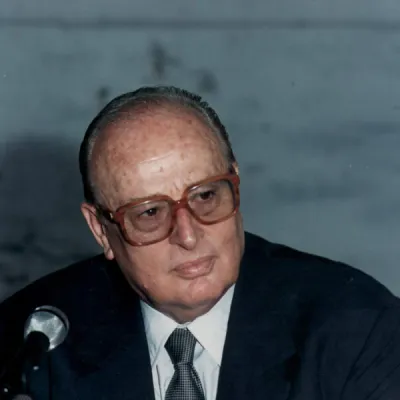
Mauro Bolognini
Human Design Chart
Biography
He died in Rome, Italy on 14 May 2001 at age 78.
What does Projector 3/5 mean for Mauro Bolognini?
Projector 3/5 — Design at a Glance
Mauro Bolognini revealed himself as someone with the ability to immediately recognize systemic flaws in his environment. His Human Design type was Projector, which made him appear like a focused flashlight: He shone his light directly onto areas in his surroundings that were still in darkness or not functioning properly. However, this dense aura could be perceived as unpleasant when he addressed these deficiencies directly, similar to a bright beam shining into someone's face.
Mauro's optimal strategy was not to instruct but to attract through his own harmony. By serving as an example and bringing 'light into the dark' without exercising direct criticism, he became attractive to others. People would then come to him voluntarily seeking advice. Crucial here was patience: Mauro had to wait strictly for a sincere, appreciative invitation before sharing his knowledge. This prevented bitterness, which is the non-self theme of Projectors that arises when this strategy is ignored.
Since Projectors do not have a defined Sacral Center, they lack a constant source of life energy. Mauro therefore experienced cyclical phases: periods of high energy and rapid work alternated with necessary rest phases to prevent burnout. The traditional school system and many workplace structures often did not take this need for recovery into account. When Mauro lived according to this design – by waiting for the invitation and respecting his energy cycles – he was rewarded with success. Deviations from it, however, led to frustration and a feeling of bitterness.
Splenic Authority
Mauro Bolognini showed a basic attitude based on immediate, intuitive reaction. His design determined that decisions were not made through prolonged deliberation but in the exact moment of the first impulse. This mechanism came from his inner authority in the Spleen Center. Since both his Emotional and Sacral Centers were open, only this specific configuration – typical for Projectors or Manifestors – could be effective.
The defined Spleen Center functioned as his health and alarm system. It provided a spontaneous survival intelligence that immediately signaled whether a situation or person was beneficial to him. His physical well-being and intuition served as reliable indicators of the right path. However, this impulse was subtle and occurred only once; it could easily be drowned out by other influences. Therefore, his way required high vigilance not to miss this fine signal tone. A temporary retreat supported him in rigorously separating from harmful influences and protecting his own health.
Since Mauro Bolognini knew what was right only at the moment, his plans often changed short-term. Long-term commitments stood against the situational nature of his authority. His design therefore required a lot of space and flexibility. He did not act according to rigid guidelines but let himself be guided by current intuition, which enabled him to take very good care of himself and leave harmful environments consistently.
The 3/5 Profile — Martyr / Heretic
Mauro Bolognini lived as an experimenter and hero whose authority was based on a rich treasure trove of practical experiences. His design shaped him through the learning process of Line 3 (Gate 52), which required trial and error. He had to try things out himself to understand; external inactivity or pressure helped him focus and learn from mistakes. This path was often painful, especially when attempts failed in front of others, but exactly these experiences formed the foundation of his knowledge.
This practical wisdom flowed into his role as Line 5 (Gate 17). Here, his need to operate within hierarchies and help others became apparent. Gate 17 emphasized mutual dependence and order; Mauro Bolognini sought synthesis and recognized each individual's place in the whole. His attractiveness to others arose from solving problems he knew through experience himself. As a hero and rescuer, he shared this knowledge to promote social harmony. Those who ignored his position in the hierarchy risked disorder; Mauro Bolognini, however, used his mistakes as a bridge to give orientation to others. So his mechanism connected personal experimentation with service to the community through orderly support.
Single Definition — Defined & Open Centers
Mauro Bolognini revealed himself as someone whose inner authority was based on existential intuition and constant survival pressure. His defined Spleen Center conveyed spontaneous, non-rationalizable instincts in the 'now' for health and well-being; he had to trust this body awareness to stay protected. Simultaneously, his defined Root Center provided a steady, adrenalized pressure towards material existence and correction. These two centers formed his consistent inner structure.
In stark contrast, all other centers in Mauro Bolognini were open: Head, Ajna, G, Heart, Sacral, and Solar Plexus. This meant that mental inspiration (open Head and Ajna Centers), identity and direction (open G Center), willpower (open Heart Center), vital energy (open Sacral Center) as well as emotions (open Solar Plexus) did not represent constant inner sources. Instead, he took this information situationally from the environment, amplified or reflected it.
Thus, Mauro Bolognini tended to be overwhelmed by doubts and confusion that actually belonged to others rather than having his own mental answers. His open G Center led him to lack a fixed identity and blend with the environment; he did not actively seek direction but waited to be initiated. The open Heart Center made him vulnerable to the pressure of proving his worth through promises, although he lacked the constant energy for it. His open Sacral Center allowed him to absorb foreign vital energies, which could lead to exhaustion if he did not listen to his inner authority. Finally, his open Solar Plexus absorbed the emotions of the environment, putting him at risk of personalizing other people's moods and making emotional decisions that he later regretted. Therefore, his mechanism required strict trust in Spleen and Root to avoid being swept away by the information from the environment.
Channels for analytical judgment and precise pattern recognition.
Mauro Bolognini revealed himself as someone who radiated a constant logical presence driven by a deep need to optimize patterns and correct errors. This attitude resulted from Channel of Judgment 58-18, which connected the Root Center with the Spleen Center. Gate 58 provided an insatiable impulse for 'better and more', while Gate 18 acted as a sentry checking what was healthy or needed correction. This combination generated a penetrating energy aimed at perfecting societal structures to regain joy and love.
Additionally, other gates influenced his design. Gate 52 demanded self-imposed pauses for concentration and pattern correction; without clear goals, this could lead to stress but offered deep understanding when focused. Gate 17 stood for logical teaching and organizing the future rooted in human rights and the principle of serving leadership, where doubt was considered a healthy part of this process. Gate 48 enabled recognizing deeper connections through its ability to recognize patterns, yet often led to frustration as it provided understanding but did not allow direct implementation into solutions.
The challenge for Mauro Bolognini lay in applying this critical logic only when requested. When his judgment uninvitedly took over, it appeared as an endless stream of data about the wrong things that others did not want to hear. Instead, he found his true effectiveness when asked: 'Is something wrong here?'. In such moments, he could offer solutions applicable for the collective and avoid conflicts by carefully choosing which battles to fight. His mechanism marked him as someone who wanted to contribute to societal harmony through targeted corrections, provided his gifts were wisely used upon invitation.
Collective Circuitry — Circuit Signature
Mauro Bolognini stood out with a clear strategic approach based on logical analysis and structured dissemination of insights. His design connected the Spleen Center with the Root Center via Channel of Judgment. This connection created a direct flow between the ability for visual perception and detail recognition as well as the energetic foundation for strategic action and survival intuition.
This mechanism allowed Mauro Bolognini to intuitively grasp complex connections and translate them into clear, understandable structures. The energy of the Spleen Center provided visual precision and an instinct for what is essential, while the Root Center transformed these insights into tangible strategies. It was not about emotional evaluation – the Solar Plexus Center was not involved here – but pure rational logic. Mauro Bolognini shared this knowledge with the aim to improve societal processes and positively shape the future through smart planning.
The left side of his chart emphasized this forward-looking focus. He acted as someone who filtered, formatted information, and then strategically applied it to achieve better results. This configuration shaped his way of solving problems: not through impulsive actions or emotional reactions but with a cool, calculating intelligence aimed at bringing order out of chaos and offering rational solutions for collective challenges. His strength lay in making the invisible visible and shaping it into a form that others could understand and use to actively shape their own future.
Right Angle Cross of Service 2
Mauro Bolognini was marked by the right cross of Service, a configuration that determined his deepest motivation and life direction. His design suggested that service for him was not just an external action or superficial duty but rather acted as a fundamental archetypal force that permeated and shaped his entire existence. This structure described a way of being in which giving and supporting others was experienced not as sacrifice, but as the central expression of one's identity.
In Human Design, this cross marks a specific energetic alignment where the essence of service is at the forefront. It represented an unconscious yet driving force that profoundly influenced his decisions and behavior. Mauro Bolognini thus emerged as someone whose inner compass was directed towards the well-being of others, with this orientation arising less from conscious moral choice than from a deeply rooted structural necessity. The right cross of Service 2 underscored the dimension of support and enabling for other people. It shaped his way of being by conveying to him that his worth and fulfillment lay in the act of giving. This mechanism worked as an enduring backdrop to his life, significantly steering his interactions with the world and providing him a clear, often unconscious, direction. His design revealed a person whose core identity was inseparably linked to the need to serve others and promote their own process.
Saturn Return · Uranus Opposition · Chiron Return · 2nd Saturn Return — Life Cycles
Mauro Bologninis Design structured his life through clear turning points where initiated phases became concrete reality. In 1953, at the age of 31, he staged his debut film "Ci troviamo in galleria". This marked his first Saturn return, a cycle that often serves to bring years of inner preparation and structuring into external manifestation, laying a solid foundation for further career development.
Two decades later, in 1972 at the age of 50, he began staging operas. This step fell during his Chiron return, an fulfillment cycle between the ages of 49 and 51. During this phase, one's incarnation cross increasingly unfolds in everyday life; if the person has followed their strategy and authority, the deeper meaning and purpose of the design becomes experiential and profoundly shapes subsequent life stages. Bologninis transition to opera staging illustrates this blooming period when essential life tasks condense and become visible.
Projector · Splenic Authority — Synthesis
Mauro Bologninis design reveals a central thread of precise perception and correction. His defined Spleen Center, coupled with the Channel of Judgment (Gate 58-18), gave him a natural ability to recognize errors and correct patterns—not just in his immediate surroundings but also in complex systems. This manifested in his involvement in staging, where he apparently recognized subtle nuances and highlighted them through his work (documented event 1953). The connection between Root and Spleen Centers indicates an inner strength that allowed him to turn this perception into concrete actions.
At the same time, a central paradox emerged between this ability for precise analysis and an open Solar Plexus Center. Bolognini was thus receptive to the emotions of others while simultaneously feeling compelled to correct or organize them. This tension may have led to his being perceived in his environment as someone who quickly uncovers errors (design perspective), but also as emotionally confused and hesitant to share his judgments unsolicited. The ability to recognize patterns coexisted, therefore, with a sensitivity that prompted him to handle the expression of his perceptions carefully.
1 Defined Channel
Incarnation Cross - Right Angle Cross of Service 2
Solar Return
The Solar Return shows the moment when the sun returns to its exact birth position - your personal solar year.
Life Cycles
Discover the life cycles with a detailed triple view (birth chart, cycle chart, composite).
Human Design Profile
- Type
- Projector
- Strategy
- Wait for the respectful invitation
- Authority
- Splenic Authority
- Profile
- 3/5 - Martyr / Heretic
- Definition
- Single Definition
- Incarnation Cross
- Right Angle Cross of Service 2
- Date of Birth
- 28.06.1922 11:00
- Place of Birth
- Pistoia, Italy
Frequently Asked Questions
What was Mauro Bolognini's Human Design type?
What profile did Mauro Bolognini have?
Which authority guided Mauro Bolognini?
What incarnation cross did Mauro Bolognini have?
When was Mauro Bolognini born?
Discover your own Human Design
Are you also a Projector? Find out in a personal reading how to unfold your leadership qualities and recognize the right invitations.
More Personalities
Back to overviewSissy Spacek

Alain-Fournier

Anémone

Ann-Margret

Bourvil
Christian-Jaque