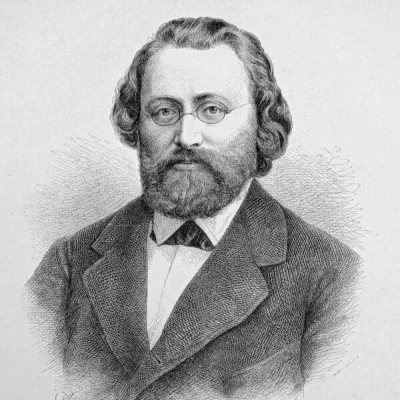
Max Bruch
Human Design Chart
Biography
Max Bruch died on 2 October 1920 at age 82 in Friedenau, Germany.
Max Bruch as a Generator 1/3 in Human Design
Generator 1/3 — Design at a Glance
Max Bruch had an enormous inner endurance and a high degree of life force. As a Generator, he possessed much sacral energy that made him strong and resilient, similar to a workhorse – provided this power was used for tasks that truly mattered to his heart. His design pointed to two central risks: First, the danger of burnout if he engaged with things over the long term without intrinsic motivation, wasting his energy. Second, frustration when prevented from working on projects close to his heart, despite still feeling full of drive.
The key strategy for him was not active initiation but responding to signals from his environment. His energy unleashed itself primarily when his Sacral Center responded with a clear 'Yes' to an impulse. Instead of taking the first step himself, he waited for an invitation or challenge and reacted to it with full action. If Max Bruch lived in harmony with this principle – reacting instinctively to what spoke to him from the gut – his design rewarded him with deep feelings of fulfillment. Initiating constantly without such internal confirmation led sooner or later to persistent frustration and energy loss. His strength lay in the ability to effectively deploy his enormous resources through consistent reactions to what was truly important.
Sacral Authority
Max Bruch was a Generator whose decision-making was shaped by Sacral Authority. This inner guidance did not manifest as intellectual deliberation but as an immediate physical reaction to external stimuli. His design required waiting for these impulses: a gut feeling, a grunt or a powerful surge signaling that his sacral motor had started up. In these moments, he felt vital and alive, equipped with seemingly inexhaustible energy that allowed him to immerse himself in activities – without the compulsion of purposefulness but out of pure enthusiasm.
A central mechanism of his chart was the openness of the Emotional Center. This prerequisite isolated Sacral Authority from a flood of transient emotional waves, ensuring clarity in his physical signals. Additionally, his activated Spleen Center acted as a supportive instance. Through its connection to the Sacral Center, it gave him quick, spontaneous reaction capability and reliable access to instinctive perception and bodily well-being. Max Bruch could use these intuitive impulses to make rapid decisions. His life task was to listen to these inner noises and use them as compass-like guidance through life, allowing him to walk his existence with joy and satisfaction.
The 1/3 Profile — Investigator / Martyr
Max Bruch showed himself to be someone who not only collected knowledge theoretically but also tested it through personal experience. As a Researcher and Experimenter, his design tended towards always wanting to learn more before moving into practical application. This profile combines the drive for thorough preparation with the need to try things out and learn from mistakes.
His Line 1 connected him to the theme of hidden alliances and influence through secret relationships. This energy allowed him to understand power structures that were not on the surface. At the same time, his Line 3 shaped the process of trial and error for adapting to life. It helped him sharpen intuition through concrete experiences.
For Max Bruch, it was characteristic that he only trusted a judgment if he had tested something both theoretically and practically in depth. If he considered something good, this was based on this double-checking. Sometimes the energy of Line 1 took control, leading to hesitation about moving into implementation because he felt he did not know enough yet. This conflicted with Line 3's desire to actively try things out. Self-earned insights were therefore central for him as they bridged abstract knowledge and lived reality.
Split Definition — Defined & Open Centers
Max Bruch's design inclined towards clear communication that stems from his own identity. His defined G Center provided him with a reliable self-image and a sense of direction in life; he did not speak out of whim but rather from the awareness of who he was. This inner security flowed into his also defined Throat Center, which served as a focal point to convey these messages to the world. Thus, his voice was not a random product of the moment but an expression of a constant inner truth.
This expressive ability was supported by his generative power: The defined Sacral Center ensured a steady source of vital energy. Max Bruch had the physical capacity to engage in tasks that appealed to him and could show persistence as long as he responded rather than initiated them. This stability was further supported by his defined Spleen Center, which allowed him spontaneous intuitive perception in the present moment. He possessed an instinct to distinguish between what is healthy and harmful and often acted from a deep bodily intuition without needing to rationalize it.
At the same time, Max Bruch was vulnerable to mental irritations due to his open Head and Ajna Centers. Without a firm structure for processing inspirations, he tended to engage with questions or concepts that did not originate within him. He could easily fall into a mental monologue seeking answers where none were necessary or take on the confusion of others as his own task. Additionally, lacking consistent energy in his open Heart Center for willpower and competition, he sometimes felt pressured to prove his worth through performance or make commitments that exceeded his actual capacity. His open Solar Plexus further amplified this sensitivity by absorbing emotional moods from the environment and experiencing them as his own mood swings, which led him to avoid conflicts to maintain peace.
Channels for inspiration, ambition and mature growth.
Max Bruch revealed himself as someone who inspired others simply through his presence and authentic expression. This effect stems from the Channel of Inspiration 1-8, which connects the G Center with the Throat Center. Here, unique individual identity is demonstrated not through lengthy explanations but through a exemplary life. Max Bruch was designed to attract attention by living his creative truth; this could in turn inspire new directions in others, much like how a pianist's performance might motivate listeners to take piano lessons themselves. However, the prerequisite for this inspiring power was an inner, authentic authority, as this channel does not bring automatic social adaptability and requires the right timing and recognition from others.
Parallel to this, the Channel of Transformation 54-32, which links the Root Center with the Spleen Center, also played a role. This mechanism drove ambition based on constant effort and motivated by the desire to be seen in order to improve one's position in life. Driven by fear of failure or falling behind the "tribe," Max Bruch sought ways to rise through talent and competence. The Spleen instinctively recognized when support was available to secure this prosperity; the transformation had lasting value only if it was supported by the community and acknowledged as mutual benefit.
A third aspect of his energy was the Channel of Maturation 42-53 between Root and Sacral Centers. This process required completing new cycles or experiences fully before reflecting on them to gain wisdom. Max Bruch needed to bring each experience to a satisfying conclusion before starting a new cycle; otherwise, frustration loomed. Through this cyclical movement, he accumulated depth that he could then translate as information for others.
Additionally, individual Gates contributed to his profile: Gate 51 brought strong willpower and the ability to respond to shocks with insight, while Gate 57 fostered intuitive clarity in the present moment. Gate 60 in Personality stood for accepting limitations as a prerequisite for transcendence, where melancholy could be overcome through creativity. In his design, Gate 18 focused on correction and discrimination between life-critical and less important matters, always with the attitude of not taking the collective process personally.
Individual Circuitry — Circuit Signature
Max Bruch's design inclined towards impulsive and inspired expressiveness. His Knowledge Circuit connected the Throat Center with the Identity Center through the Channel of Inspiration (Gates 8–1), fostering spontaneous insights that directly translated into expression – pulsating creativity without prolonged deliberation. Simultaneously, there was a separate energetic structure: The groups "Throat/Identity" and "Sacral/Root/Spleen" were not connected to each other, leading to parallel but independent energy fields.
In the second area, the Meaning Circuit worked through the Channel of Maturity (Gates 42–53), linking the Sacral Center with the Root Center. This created a cyclical flow from past experience and emotional processing into physical action patterns – wave-like learning from history.
A third, also separate stream emerged in the Ego Circuit via the Transformation Channel (Gates 32–54), connecting the Spleen and Root Centers. Here it was about intuitive recognition of resources and their transformation into concrete security or survival strategies, marked by a timeless and conservative imprint.
Since Max Bruch had a Split Definition, these three systems – inspired expression, emotional maturity, and intuitive transformation – existed side by side without direct energetic exchange between them. Each of these spheres operated autonomously: Inspiration did not automatically translate into action capability, nor did the emotional past directly flow into intuitive perception. This required conscious integration of different life areas, as no single continuous energy pathway connected all centers.
Right Angle Cross of Penetration 4
Max Bruck's design revealed a tendency towards a deep, often painful confrontation with his own identity. He was someone who carried the seemingly incompatible poles of individual steadfastness and universal connectedness within himself. This configuration, the right cross of Channel 4, described a life task: to not perceive one’s existence as an isolated phenomenon but to merge it with the whole through experiences of loss and rebirth.
For him, this integration was not a theoretical concept but an existential process. The design challenged him to relinquish the illusion of separate independence in order to recognize a deeper truth about the nature of being. This did not happen through superficial adaptation but through a radical commitment to his own path, even when it came with internal conflicts. The mechanics of this cross indicated that Max Bruck found his greatest strength in holding and ultimately transcending the tension between the individual and the collective. His life was marked by penetrating this dualistic viewpoint and finding unity that encompassed both personal integrity and global responsibility.
Saturn Return · Uranus Opposition · Chiron Return · 2nd Saturn Return — Life Cycles
Max Bruch's design indicated a tendency towards structural anchoring and institutional responsibility. His life path was marked by phases where external recognition met inner maturity. In 1865, at the age of 27, he received the position of Director of the Royal Music Institute in Koblenz under Queen Augusta of Prussia. This marked his first Saturn Return: a cycle that often brings years of groundwork to fruition in a public office. Taking on this role highlighted his ability to accept responsibility within established structures.
Later, in 1880 at the age of 42, he became engaged to Clara Tuczek. This fell during his Uranus Opposition, a phase of detachment and reorientation that often leads to fundamental relationship decisions breaking through the status quo. In 1887, at the age of 49, his second son Hans was born. This timing corresponded with his Chiron Return, an achievement cycle in which one's incarnation cross unfolds and meaning becomes experiential – here visible in the growth of his family as a personal fulfillment.
In 1892, Max Bruch at the age of 54 took up the directorship of the Master School for Composition at the Royal Academy of Arts in Berlin. This was his second Saturn Return, a phase of deepened authority and teaching responsibility. The career progression from Koblenz to Berlin illustrated the mechanics of his chart configurations: structural affirmation through Saturn, transformative relationship decisions through Uranus, and the realization of life purpose in the Chiron cycle.
Generator · Sacral Authority — Synthesis
Max Bruch lived a life path characterized by a deep drive for creative exploration and the urge to express insights. As a Generator with sacral authority (and open emotional center), he found energy in work itself – as long as it aligned with his inner "yes". The Profile of Researcher/Experimentor (Line 1/3) reinforced this process: He needed to experience things firsthand through experimentation to validate knowledge and ultimately pass it on with conviction. The Channel of Inspiration (Gate 1-8) indicates that he was destined to inspire others through his individual expression and take on a role as an example – a process that found its natural unfolding in the Knowledge Circuit.
Central to Max Bruch was the tension between the need for deep personal research and public expectations regarding his creative contribution. The recurring Saturn Returns tied to career events (1865, 1892) and the Uranus opposition in the realm of relationships (1880) show that he had to redefine himself repeatedly – both professionally and personally. These cycles seem to mirror an internal conflict between a desire for freedom and innovation and demands for stability and conformity, which constantly occupied him.
3 Defined Channels
Incarnation Cross - Right Angle Cross of Penetration 4
Solar Return
The Solar Return shows the moment when the sun returns to its exact birth position - your personal solar year.
Life Cycles
Discover the life cycles with a detailed triple view (birth chart, cycle chart, composite).
Human Design Profile
- Type
- Generator
- Strategy
- To respond - wait for something to respond to
- Authority
- Sacral Authority
- Profile
- 1/3 - Investigator / Martyr
- Definition
- Split Definition
- Incarnation Cross
- Right Angle Cross of Penetration 4
- Date of Birth
- 06.01.1838 15:30
- Place of Birth
- Cologne, Germany
Frequently Asked Questions
What was Max Bruch's Human Design type?
What Profile did Max Bruch have in Human Design?
Which Authority guided Max Bruch?
Which incarnation cross characterized Max Bruch?
When was Max Bruch born?
Discover your own Human Design
Are you also a Generator? Find out in a personal reading how to use your sacral energy correctly and discover deep satisfaction.
More Personalities
Back to overviewAaliyah

Alexia

Alizée

Angèle

Anne-Marie

Arcángel