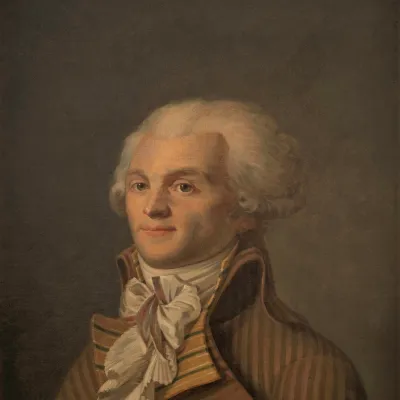
Maximilien Robespierre
Human Design Chart
Biography
Robespierre’s mother died when he was young. His father, a lawyer, left Maximilien, his brother Augustin and his sisters to be raised by their maternal grandparents. Small in stature, he was pale and sincere. In 1765, he attended the college of the Oratorians at Arras. He was awarded a scholarship to the famous college of Louis-le-Grand in Paris, in 1769, where he studied philosophy and law. In 1781, he received his law degree, began working as a lawyer and made a comfortable home with his sister Charlotte. Soon distinguished in his field, he was appointed judge at the Salle Episcopale. In 1783, he was admitted to the Arras Academy for the advancement of the arts and sciences, later becoming its chancellor and then its president. He socialized with the young people in the area as well as with the local notables, and spent his time entering academic competitions. His "Mémoire sur les peines infamantes" ("Report on Degrading Punishments") won first prize at the Academy of Metz, and by 1788, he was noted for his altruism.
In March 1789, at the age of 30, he embarked upon a political career, after the citizens of Arras chose him to be one of their representatives. Always careful in his dress and personal grooming and a man of simple manners, he quickly gained attention, but kept his frugal lifestyle. His first speech, of the more than 500 total he gave throughout his lifetime, was given before the National Assembly on approximately 18 May 1789, and despite a voice which had weak carrying power, his message spread, his popularity grew, and as well, he engendered great opposition. In April 1790, he presided over the Jacobins, a political club that promoted the ideas of the French Revolution.
Human Design Analysis: Maximilien Robespierre as Generator 3/5
Generator 3/5 — Design at a Glance
Maximilien Robespierre possessed the immense endurance of a Generator. His design provided an enormous capacity for long-term engagement, comparable to a workhorse that generates and expends energy. However, this energy was only fully available to him when he responded to impulses from his environment rather than initiating on his own. The strategy of his design involved waiting until his sacral center – the inner compass for passion and affirmation – signaled a clear "yes." Only then did he act with full force.
This mechanism created two specific risks: If Robespierre had to perform tasks that did not require internal approval, he would waste his reserves senselessly and was prone to exhaustion. Conversely, it led to frustration when external forces prevented him from continuing projects for which he still had energy. Living in harmony with this reactive strategy rewarded him with a deep feeling of fulfillment and made him nearly unstoppable in his effectiveness. If he initiated independently or ignored the lack of internal affirmation, this quickly resulted in persistent frustration and a noticeable lack of life force. His strength therefore did not lie in pushing plans forward without feedback but in powerfully responding to life when it called upon him.
Sacral Authority
Maximilien Robespierre demonstrated decision-making based on a direct physical reaction. As a Generator, his strategy was also his inner authority: Sacral Authority. This mechanism required an open emotional center, meaning he wasn’t guided by passing moods or emotional chaos but waited for a deeper, instinctive truth in the body. His responses came as gut feelings or noticeable surges of energy triggered by external stimuli. These signals often manifested as short sounds like grunts, hums, or affirming "mm-hmms". When his sacral motor engaged with something, he felt vital and alive; then, almost inexhaustible energy was at his disposal. He tackled his tasks with great enthusiasm and immersed himself in his activities without questioning an external purpose. The joy of the work itself was his motivation. Additionally, an activated Spleen Center acted as a supportive force. This gave him the ability to react particularly quickly and spontaneously. He had immediate access to his physical well-being and instinctive perception. This combination allowed him to make decisions rapidly and reliably follow these inner signals, thereby simplifying his process of orientation in life.
The 3/5 Profile — Martyr / Heretic
Maximilien Robespierre revealed himself as someone who initially had to try everything out for himself before offering solutions to others. His design indicated a tendency towards experimental learning through trial and error. He did not simply accept received doctrines but sought the truth in practical experience. This third-line process required patience while waiting for mutations and adapting to mistakes. Uranus stood for revolutionary changes without this patience, creating a lifelong openness to new paths.
At the same time, he carried the burden of the fifth line: Society projected onto him the hope that he would listen and help as a savior. He was expected to solve others' problems with his self-acquired knowledge. This role of hero and rescuer made him attractive to those who wanted to learn from his experiences. Yet precisely this expectation could be painful when, in full view of all, he had to try things out and fail. Jupiter on the case meant capable administration with a focus on expansion. Neptune represented charismatic genius and spiritual guidance. Robespierre lived in the tension between the need to test everything himself and the pressure to act as a saving force for the community. His path was marked by this dual nature: The experimenter who learns through mistakes, and the hero expected to apply these lessons to heal others.
Split Definition — Defined & Open Centers
Maximilien Robespierre revealed himself as someone with a fixed, reliable self-identity and a clear sense of direction. His defined G Center gave him the ability to show others new paths without being dependent on their approval. This inner security was supported by his defined Sacral Center, which provided an enormous source of vital energy. His strategy involved not initiating but responding to questions or invitations from the environment; only then could he fully apply his strength to tasks that fulfilled him and in which he persistently remained until mastery.
His communication was characterized by a defined Throat Center serving as a pivot point to translate messages from the rest of his design into clear actions. This did not happen impulsively but rather based on the reliable source of his energy and identity. Another defining feature was his defined Root Center, which provided a steady inner pressure to move forward and master existential challenges. This stress served not for panic but as a driving force for material prosperity and correction.
In contrast, Head, Ajna, and Heart Centers were open. Robespierre tended to take mental pressure from outside and get caught in doubts or confusion that were not his own. He often sought inspiration or answers to quiet this inner noise rather than trusting his inner authority. The open Heart Center led him to want to prove his worth through promises and performance, which could lead into a cycle of self-doubt if expectations weren't met. Also, the Solar Plexus and Spleen Centers were open, making him absorb emotional moods from his environment and vulnerable to spontaneous, fearful decisions that often went against his long-term well-being.
Channels for change, logical leadership and quiet reflection.
Maximilien Robespierre was a carrier of pulsating, mutative energy setting evolutionary change. The Mutant Channel 60-3 connected the Root Center with the Sacral: Gate 60 accepted limitation while Gate 3 created order from confusion. This frequency generated inner tension and melancholy in phases of silent development until a new impulse suddenly broke through. Robespierre had to learn to trust this rhythmic moodiness rather than rationalize it; change came unexpectedly like music between the notes.
Simultaneously, he possessed the mechanics of collective leadership. The Alpha Channel 7-31 connected his G Center with his Throat Center. Gate 7 provided the logical role to lead society – often as a "power behind the throne" – while Gate 31 was the voice of the collective leader. This configuration required invitation by the majority; Robespierre could only effectively lead when he gained the trust of the community and understood existing patterns. Absolute authority was not possible here, but rather a shared influence based on tested logic.
A third level formed the reflective depth of the Lost Son Channel 13-33. Gate 13 listened and gathered secrets while Gate 33 withdrew to transform these experiences into deeper truths. This fostered an attitude of patient observation: Robespierre learned from the past, sorted memories, and shared insights only after careful consideration.
Additionally, individual gates worked together: Gate 1 emphasized unique creativity in the here-and-now; Gate 2 allowed receptivity for new directions. In his design, Gates 5 (Rhythm), 41 (evolutionary feeling), and 54 (connection of success and spirituality) supported him. Gate 20 promoted authentic action in the present while Gate 25 brought mystical innocence. Gate 56 enabled the figurative narration of mental processes. This combination shaped a person who set evolutionary change, logically led, and learned from experience.
Collective Circuitry — Circuit Signature
Maximilien Robespierre's design tended towards isolated, parallel functioning energetic blocks. Through shared definition, two independent streams existed: one in the lower body, the other in the upper. In the Knowledge Circuit, Channel 3-60 (Mutation) connected the Sacral Center with the Root Center. This generated pulsating energy for his unique path and new identity, separate from other fields. Above, two circuits linked Throat and Identity Centers: The Understanding Circuit used Channel 31-7 (The Alpha), structuring logical, future-oriented strategies free of conditioning. Parallel to this, in the Meaning Circuit, Channel 33-13 (The Lost Son) cyclically drew emotional insights from the past to share with the collective and learn from them. Both upper channels flowed into the same centers but did not form a continuous connection to the lower body. Maximilien Robespierre thus appeared as someone whose rational future planning and emotional reflection on the past worked in his head and neck area, while the driving force for individual mutation remained isolated below. This separation meant that logical structuring and emotional meaning-making shaped expression together but did not directly merge with fundamental life energy or survival instinct. The mechanics described separate, coexisting forces without direct energetic flow between groups.
Right Angle Cross of the Sphinx 2
Maximilien Robespierre carried the right cross of the Sphinx, a configuration characterized by a defined emotional center and undefined motoric as well as logical centers. This design laid out a specific inner architecture: His emotions were his safe harbor while energy and rational analysis were influenced from outside. He was someone who did not act impulsively or coldly logically but rather from a deep, often unconscious emotional truth.
The mechanics of this cross describe a path where the person learns to use their feelings as a compass without being swayed by their waves. With an undefined motoric center, Maximilien Robespierre could not generate his own constant energy source for long-term projects; instead, he reacted to external impulses. His logical center was also open, meaning that his arguments and understanding of truth were strongly shaped by context and the people around him.
This structure created a tension between the need for emotional integrity and dependence on external validation. He sought an inner stability found not through rational evidence but through emotional resonance. The right cross of the Sphinx challenged him to acknowledge this emotional depth without forcing it into rigid ideologies, as his logic and drive remained variable. His design was thus marked by a search for authenticity in a constantly changing outer field.
Saturn Return — Life Cycles
Maximilien Robespierre was elected president of the Academy of Arras in 1786 at the age of 28. For his chart, this marked the first Saturn return, a cycle where years of groundwork often condense into a viable result. This positioning showed his ability to take structural responsibility and gain recognition within established systems. The first Saturn return serves as a milestone for one's life direction; it demands consistency and integration of earlier experiences into a more stable identity. Robespierre's election as president highlighted how his chart responded to such milestones: by solidifying status and taking on a leading role within an institution. It was not a sudden break but the logical consequence of a development line now finding recognition. This moment shaped his further career, providing him with a platform where he could practice his principles in a formal framework. The mechanics of the Saturn return always emphasize maturity and responsibility for one's fate within societal structures. Robespierre used this phase to strengthen his authority, which is typical for condensing potential at this age.
Generator · Sacral Authority — Synthesis
He was a Generator whose life was marked by deep sacral energy (Generator Type, Sacral Authority). This power source, combined with the Channel of Mutation (3-60), indicated an ability to initiate evolutionary change through experimentation and crossing boundaries. His profile as an Explorer/Hero and Saver (3/5) underscored this drive to collect personal experiences and make this knowledge accessible to others – a process often accompanied by melancholy (Knowledge Circuit). The repeated activation of the Sacral Center in response to external stimuli confirmed his deep connection with his inner driving force and a natural inclination to immerse himself in activities that invigorated him.
A central paradox lay in the combination of his generative potential and the impulsive nature of the Knowledge Circuit. He lived the constant search for new insights and possibilities (Channel 3-60), which went hand in hand with an inner necessity to implement and transform these insights. At the same time, the line 5 in his profile suggests that he found validation through solving others' problems while the line 3 pushed him to independently chart new paths – a tension between the need for recognition and independence.
3 Defined Channels
Incarnation Cross - Right Angle Cross of the Sphinx 2
Solar Return
The Solar Return shows the moment when the sun returns to its exact birth position - your personal solar year.
Life Cycles
Discover the life cycles with a detailed triple view (birth chart, cycle chart, composite).
Human Design Profile
- Type
- Generator
- Strategy
- To respond - wait for something to respond to
- Authority
- Sacral Authority
- Profile
- 3/5 - Martyr / Heretic
- Definition
- Split Definition
- Incarnation Cross
- Right Angle Cross of the Sphinx 2
- Date of Birth
- 06.05.1758 02:00
- Place of Birth
- Arras, France
Frequently Asked Questions
What was Maximilien Robespierre's Human Design type?
What Profiles did Maximilien Robespierre have?
Which Authority guided Maximilien Robespierre?
What incarnation cross was assigned to Maximilien Robespierre?
When was Maximilien Robespierre born?
Discover your own Human Design
Are you also a Generator? Find out in a personal reading how to use your sacral energy correctly and discover deep satisfaction.
More Personalities
Back to overviewAaliyah

Alexia

Angèle

Anne-Marie

Arcángel

Arno