
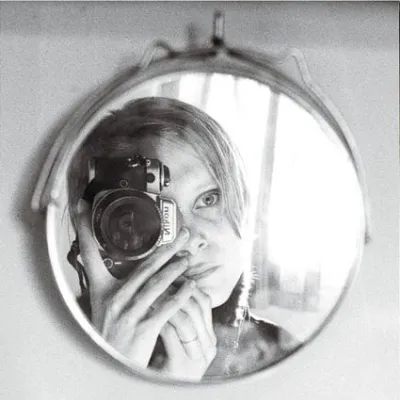
Photo: Wikimedia Commons
May-Irene Aasen
Human Design Chart
Biography
She has also worked as a freelance photographer, and illustrator of posters, record covers and magazines, as well as making two videos for the Museum of Cultural History, Oslo.
Aasen has additionally made a name for herself as a musician. She helped form the group Jokke & Valentinerne in 1982 and was the band's drummer until the very last concert on 23 December 1998.
The Human Design of May-Irene Aasen: Projector 3/5
Projector 3/5 — Design at a Glance
May-Irene Aasen revealed herself through a focusing aura that immediately recognizes system errors. Her design tends to act like a bright flashlight, bringing light into the darkness and guiding others. This mechanism explains her ability to identify weaknesses in her environment instantly.
However, the strategy of her projector design was not to address these flaws directly, as this would provoke resistance. Instead, she worked through her own harmony, attracting others unconsciously by setting an example. The key mechanism involved waiting for a respectful and sincerely meant invitation before sharing her knowledge.
Since May-Irene Aasen, as a projector, does not have a constant intrinsic energy source, her activity followed a cyclical pattern. Phases of high efficiency required subsequent resting phases for regeneration to avoid burnout. Managing her limited energy in this way was essential for her well-being.
Living by this design—through patient shining and respectful energy management—she was rewarded with success. Deviations from this strategy, such as uncontrolled intervention without invitation or ignoring the need for rest, led to experiencing her non-self theme: bitterness. Her chart thus described a path of efficient leadership through patience and targeted radiance rather than constant effort.
Emotional Authority
May-Irene Aasen showed a basic stance where spontaneous judgments were recognized as misleading; her decisions required emotional distance and time. This resulted from her emotional authority, which is carried by the defined Solar Plexus Center. In this center, there is a constant up-and-down of feelings: The world appears enthusiastic and positive at one moment, strongly negative in another, depending on current mood. However, since this immediate feeling impression is only a snapshot and does not necessarily reflect the truth, quick decisions based on emotion can have negative consequences.
The mechanics of her inner authority dictate that this emotional wave always takes precedence – regardless of which other centers are defined in her design. May-Irene Aasen therefore had to take time to let decisions mature. This process required patience and repeatedly "sleeping on" important questions. Only as the intense feelings subsided over time did she gain the necessary emotional distance. Then clarity and calm set in, marking the completion of the decision-making process. This strategy was particularly crucial for long-term life decisions, as it allowed access to a deeper, more comprehensive understanding rather than being led by an initial, still unclear impression.
The 3/5 Profile — Martyr / Heretic
May-Irene Aasen was marked by a fundamental attitude of radical experimentation: She initially believed nothing and had to experience everything herself, learning from her mistakes. This Line 3 of her Profile pushed her to take risks and often publicly fail – a process that was essential for her design to build real knowledge. From these practical experiences, she developed into a problem solver for others. As Profile 3/5, the experimenter and hero, she transformed her personal falls into attractive life wisdoms that she offered to others. Her charisma arose precisely from this authenticity: She had already lived through the problems herself.
This work brought with it a specific tension, however. While her failure in public could be painful, it was the price for the authority she later radiated. Other people were drawn to her story and sought her guidance during crises. May-Irene Aasen had to learn to respect timing. The dynamics of her fifth Line required restraint; she must not offer solutions prematurely before reflection was complete. Premature sharing of her inner processes would only have caused confusion. Only when the right moment came could she effectively use her secret insights and thus take on the role of the saviour without endangering her own ego or projections. Her strength lay in teaching not theoretically, but from her own, often painful actions.
Split Definition — Defined & Open Centers
May-Irene Aasen revealed herself through a firm internal foundation consisting of clear identity and consistent communication skills. Her defined G Center gave her a reliable sense of direction and self-love; she knew who she was without needing external confirmation. This inner security manifested in her defined Throat Center, ensuring a constant way of expression. Her voice served as a stable anchor point, carrying messages from her identity into the world, always honest and clear so long as she trusted her inner truth.
This firm internal structure contrasted with her emotional processing. Her defined Solar Plexus acted as an emotional authority: May-Irene Aasen needed time to navigate through the ups and downs of her feelings before clarity emerged. She tended to make decisions only after experiencing the full range of emotions, which endowed her with a deep sensitivity to nuances but required patience. This was complemented by her defined Root Center, providing constant pressure to move forward in the world and handle stress—not as chaos, but as steady progress.
At the same time, May-Irene Aasen was highly receptive to her environment. Her open centers—Head, Ajna, Heart, Sacral, and Spleen—functioned like mirrors. In Head and Ajna Centers, she absorbed inspirations and concepts from the environment without identifying them as her own truth; she could easily get lost in mental monologues if she did not rely on her inner authority. Her open Heart Center made her vulnerable to pressure to prove her worth or make promises despite lacking consistent willpower. Her open Sacral Center meant that her energy levels fluctuated; she absorbed the vitality of others and had to learn to set boundaries to avoid exhaustion. Finally, her open Spleen Center reflected fears and health conditions from the environment, leading to spontaneous decisions out of uncertainty rather than relying on long-term intuition. The challenge lay in not losing her firm self through the energies absorbed by her open centers.
Channel 33-13: The Prodigal — Channels & Gates
May-Irene Aasen revealed herself through a deeply rooted ability to patiently collect experiences and transform them into collective wisdom. Her design suggested that she did not process information immediately but first listened, stored it, then withdrew to recognize underlying patterns. This reflective process served to create continuity and stability for her environment by deriving lessons from personal or historical experiences that could guide others.
This approach was shaped by the Channel of the Lost Son 13-33, connecting Gate of Listener with Gate of Withdrawal, allowing secrets and memories to be securely kept. May-Irene Aasen used this energy to wait behind the surface until the truth of a situation revealed itself. Her challenge lay in timing: she had to wait for her insights to mature before sharing them without speaking prematurely or not at all.
Parallel to this was a strong drive towards emotional security and tribal belonging. May-Irene Aasen sought connections based on mutual loyalty and protection of shared resources. She clearly distinguished between those who belonged to the
Collective Circuitry — Circuit Signature
May-Irene Aasen revealed herself through an energy structure that featured two parallel, non-directly connected power fields. One field linked Throat with Identity Center (Channel 33-13). This was about processing past emotions and finding meaning. The energy flowed in waves: feelings had to run their natural cycle before they could be clearly articulated and shared. It wasn't cold logic but visual, felt insights from experience that became clear after the emotional wave.
The second field linked Solar Plexus with Root Center (Channel 49-19). This area concerned cooperation and resource management within a tribal context. Without connection to Sacral Center, there was no constant life force for continuous action. Instead, a rhythm of activity and necessary rest pauses was required to conserve energy and effectively shape mutual support. It was about the balance of giving and taking as well as accumulating material foundations through collaboration.
Both circuits existed side by side without direct energetic flow between them. May-Irene Aasen therefore had to learn to integrate these different demands—on one hand, intense, cyclical emotional reflection on the past; on the other, pragmatic, rest-need cooperation with resources—as separate life domains rather than viewing them as a single continuous step in her experience.
Right Angle Cross of the Four Ways 3
May-Irene Aasen's design provided a profound orientation: navigating through different perspectives to find one's own rhythm in a complex world. This fundamental approach was shaped by the Right Cross of the Four Paths 3, which defines an essential life direction. It outlines often unconscious motivation and ultimate purpose beyond individual gates or channels.
The mechanics of this cross represent a path of transformation through direct experience and intuition. May-Irene Aasen demonstrated a commitment to integrating knowledge not just theoretically but through life itself. The four paths symbolize the necessity to explore and unify various viewpoints, requiring patience and trust in the intuitive process as true meaning becomes visible only through action and experience.
For May-Irene Aasen, this meant a lifelong task based on navigating this diversity. It was not about linear progression but finding an inner harmony between different world demands. Thus, knowledge integration primarily occurred through personal experience. This archetypal framework provided her with a structure to remember her inner truth despite external complexity and gradually let it influence her actions.
Saturn Return · Uranus Opposition · Chiron Return · 2nd Saturn Return — Life Cycles
May-Irene Aasen's life journey was marked by clear cyclical phases of maturation and structuring. Her design followed a natural sequence of milestones that combined internal development with external alignment. The first Saturn return signified the transition into a phase of sustained responsibility, where earlier experiments became solid foundations. This laid the groundwork for the subsequent Uranus opposition, a time of profound upheavals and breaking free from old patterns to make space for new freedoms.
This dynamic culminated in the Chiron return. During this life stage, typically between ages 49 and 51, a period of flourishing began. If May-Irene Aasen had followed her inner strategy up until then, her deepest meaning and purpose unfolded increasingly in everyday life; it was not about healing wounds but completing her incarnation purpose and experiencing true fulfillment. The second Saturn return crowned this process with deeper wisdom and stability, transforming previously gained insights into a mature, enduring way of living. This sequence underscores a path of gradual integration: from foundation through change to meaningful realization and finally wise affirmation of the lived journey.
Projector · Emotional Authority — Synthesis
May-Irene Aasen's design reveals a central thread of mediation and deeper understanding. As a Projector with emotional authority, paired with defined centers for identity and communication, she is destined to view the world through a unique lens – identifying system errors (Gate 44) and gathering knowledge from experiences (Channel 13-33). Her profile as an experimenter/hero (3/5) emphasizes her ability to learn independently and make this knowledge accessible to others, yet always waiting for the right invitation. The connection between G Center and Throat Center suggests that her own direction and truth want to be expressed through communication, while the Root-Solar Plexus pair hints at deep emotional intelligence and an understanding of tribal dynamics.
A central paradox in May-Irene Aasen's design lies in the interplay of emotional depth and open Spleen center. The emotional wave requires time for clarification, whereas the open Spleen center signals a constant vulnerability to others' fears and well-being. This combination creates a tension between the need for inner reflection and the tendency to strongly perceive external influences – an interplay that forces her to consciously disengage from conditioning and trust her inner authority to act authentically.
2 Defined Channels
Incarnation Cross - Right Angle Cross of the Four Ways 3
Solar Return
The Solar Return shows the moment when the sun returns to its exact birth position - your personal solar year.
Life Cycles
Discover the life cycles with a detailed triple view (birth chart, cycle chart, composite).
Human Design Profile
- Type
- Projector
- Strategy
- Wait for the respectful invitation
- Authority
- Emotional Authority
- Profile
- 3/5 - Martyr / Heretic
- Definition
- Split Definition
- Incarnation Cross
- Right Angle Cross of the Four Ways 3
- Date of Birth
- 03.11.1963 06:30
- Place of Birth
- Oslo, Norway
Frequently Asked Questions
What is the Human Design type of May-Irene Aasen?
What is May-Irene Aasen's Profile?
What authority does May-Irene Aasen have in her chart?
Which incarnation cross is active for May-Irene Aasen?
When was May-Irene Aasen born?
Discover your own Human Design
Are you also a Projector? Find out in a personal reading how to unfold your leadership qualities and recognize the right invitations.
More Personalities
Back to overviewSissy Spacek

Aaliyah

Alain-Fournier

Alexia

Alizée

Anémone
